Arthur Lionel Rawlings#
This article was translated from Japanese using AI. Read the Japanese original
Why does a pendulum clock’s rate change with the amplitude of its swing? Arthur Lionel Rawlings, a British-born engineer, used physics to explain questions like this for clockmakers. He worked on gyrocompasses for determining a ship’s heading and was active in the US watch and clock industry and professional associations. His The Science of Clocks and Watches, published in 1944, continued to be used in precision clockmaking and education after his death. 1 2 3 4
An instrument for determining a ship’s heading#
According to the New York University Archives, Rawlings was born in Britain and received his university education in Birmingham and London. The watchmaker and reviewer Henry B. Fried identifies his doctorate as being in the physical sciences. A 1919 US patent application lists Rawlings and his co-inventor Geoffrey Brancker Harrison at the Admiralty Compass Observatory in Slough, England. They assigned the patent to the Sperry Gyroscope Company of New York. 1 2 5
A gyrocompass uses a rotor and the Earth’s rotation to find true north. On a ship, the heading indicator must remain stable as the vessel’s motion rocks the instrument. In the US patent granted to Rawlings and Harrison in 1920, tilting of the axis causes liquid to flow between vessels to the north and south. The shift in weight applies a torque to the rotor. The specification uses this action to make the instrument seek the meridian and describes a coupling to damp oscillations. One implementation connects parts of the mechanism with thin strip springs like those used in clocks. 5
In 1929 Rawlings published The Theory of the Gyroscopic Compass and Its Deviations. The contents proceed from the theory of oscillations to the Anschütz gyrocompass, the Sperry–Harrison–Rawlings design and errors arising aboard ship. It covers the principles for determining direction and the reasons an instrument deviates in use. Nature reviewed the book in 1930. 6 7
Pendulum period and clock rate#
The first edition of The Science of Clocks and Watches appeared in 1944, and an expanded second edition in 1948. The US National Bureau of Standards listed the second edition under timekeeping in a guide to instrumentation literature. According to Fried’s 1994 review, Rawlings attended meetings and lectures for clockmakers and found that practitioners had little to consult on the science and theory behind their work. 2 3 8
One example is circular error, the change in period with amplitude. In an ordinary pendulum that describes a circular arc, the period increases with the amplitude. The escapement supplies energy to the pendulum and can also affect the period through where it applies that energy and how it makes contact. The rate of a pendulum clock, the gain or loss over a given interval, therefore depends on the period of the pendulum by itself and its period with the escapement. Rawlings noted the difficulty of keeping amplitude constant and explained the value of a pendulum whose period remains constant as the amplitude changes. Clockmaker Bernard Tekippe cites this discussion from p. 56 of the third edition in a 2010 paper. 4
Tekippe adjusted a prototype so that, as amplitude rose, a gain from the escapement offset the loss from circular error. In a trial that increased the driving weight from 12 to 24 pounds, the rate shifted towards a gain immediately after the weight was added. As amplitude gradually increased, the rate approached its initial value. Tekippe attributed the immediate change to the escapement and the gradual change to increasing circular error. The trial records the different timescales on which the two effects appeared in the same clock. 4
Another design for minimising interference with the pendulum is the Shortt–Synchronome free-pendulum clock. No. 16 at Greenwich Observatory, for example, paired a master pendulum in a low-pressure enclosure with a separate clock. The master pendulum received an impulse every 30 seconds. The observatory’s 1928 report says that No. 16 controlled clocks used for time signals to the Post Office and the BBC and the apparatus that broadcast signals from the Rugby wireless station. Giving the precision pendulum fewer tasks reduced the influence of the driven machinery. 9
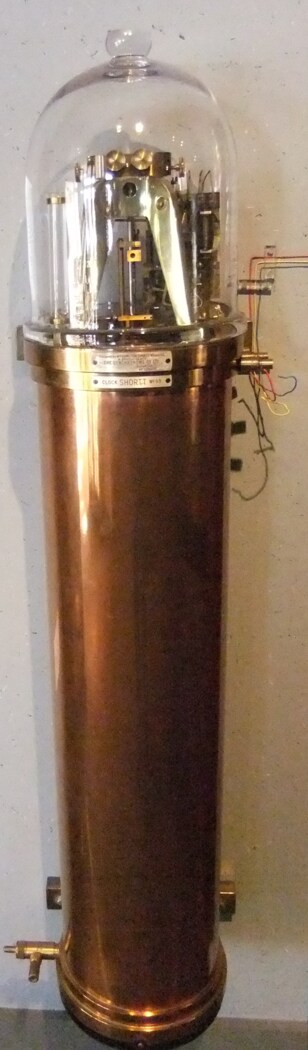
Shortt–Synchronome master pendulum enclosure, photographed at World Museum, Liverpool, by Rept0n1x. Wikimedia Commons file description, CC BY-SA 3.0. The image was resized and converted to JPEG under the same licence.

The US watch industry and training for craftspeople#
Fried recalled that Rawlings came to the United States during the Second World War on business for Sperry. The Sperry office was across from the horological school where Fried worked, and the two met through their interest in timepieces. 2
A US trade journal reported that Rawlings was elected vice-president of the New Jersey watchmakers’ association in January 1950 and named his employer as U.S. Time Corporation. In March he spoke at the Horological Society of New York, using working models and a blackboard and answering questions from craftspeople in attendance. In 1952 the same journal described him as heading Bulova’s gyro research and development and serving as president of the Horological Society of New York. 10 11 12
Writing as the society’s president in “The Watchmaker and the Public” in 1952, Rawlings proposed a nationwide effort to explain the skills and training needed for cleaning movements, repairing them and making adjustments. Customers who understood the work could make a more informed judgement about what a repair should cost. He proposed cooperation among professional associations and trade schools, with advertising capable of reaching a national audience. When the Horological Institute of America (HIA) honoured him with honorary membership in 1959, Rawlings said the hand skills he had acquired in learning watchmaking had supported his engineering work. 12 13
The New York University collection#
On 15 May 1953, Rawlings spoke at the James Arthur lecture at New York University on advances in timekeeping from 1650 to 1950, ranging from the hour to the microsecond. In 1956 the university combined three collections around the James Arthur collection and opened a horological museum in the Gould Memorial Library at University Heights. Rawlings served as curator from September 1956, with Brooks Palmer serving concurrently as associate curator. 1
According to the contemporary newspaper cited by the university’s finding aid, Rawlings died on 17 November 1959 at the age of 78. In 1993 the British Horological Institute published a third edition of his book with additions by specialists. Fried’s review connects that edition with plans for education in the science of timekeeping. The way Tekippe and others drew on the book for precision clocks of their own shows how theory helped them interpret the results of making and measuring mechanisms. 1 2 4
Timeline#
| Date | Event |
|---|---|
| August 1919 | Applies jointly with Harrison for a US gyrocompass patent. 5 |
| December 1920 | US patent US1362940A is granted. 5 |
| 1929 | Publishes his book on gyrocompasses and their deviations. 6 7 |
| 1944 and 1948 | Publishes the first and second editions of his book on the science of timekeeping. 2 3 |
| January and March 1950 | Elected vice-president of the New Jersey association. Speaks with working models at the Horological Society of New York. 10 11 |
| 1952 | Heads gyro research and development at Bulova. As president of the Horological Society of New York, proposes educating the public about repair work. 12 |
| May 1953 | Lectures at New York University on three centuries of developments in timekeeping. 1 |
| September 1956 | Takes up the post of curator of the university’s horological museum. 1 |
| June and November 1959 | The HIA journal reports his honorary membership. He dies on 17 November. 13 1 |
| 1993 | The British Horological Institute publishes the third edition of his book on the science of timekeeping. 2 3 |
| April 2010 | Tekippe cites Rawlings in a report on making and measuring a precision pendulum clock. 4 |
References#
- New York University Archives, Records of the James Arthur Collection of Clocks and Watches, RG.42.1. Biography, list of curators and lecture record.
2. Henry B. Fried, “The Science of Clocks and Watches”, Horological Times, May 1994, pp. 42–43. Review of the third edition.
3. A. L. Rawlings, The Science of Clocks and Watches. Pitman, first-edition bibliographic record, 1944. University library record for the second edition, 1948. Third-edition record, 1993.
4. Bernard Tekippe, “A Simple Regulator with an Isochronous Combination of Pendulum and Escapement”, NAWCC Watch & Clock Bulletin, April 2010, pp. 131–138, especially pp. 132 and 135–137 and table 1.
5. Geoffrey Brancker Harrison and Arthur Lionel Rawlings, “Gyroscopic Compass”, US1362940A, filed 9 August 1919, granted 21 December 1920. Specification, figs. 1–5 and claims 18–20.
6. A. L. Rawlings, The Theory of the Gyroscopic Compass and Its Deviations, Macmillan, 1929. Bibliographic record and public contents.
7. “The Theory of the Gyroscopic Compass and its Deviations”, Nature, vol. 125, 4 January 1930, pp. 11–12. Public opening of the review.
8. National Bureau of Standards, Guide to Instrumentation Literature, Circular 567, p. 66, no. 4107.
9. Royal Museums Greenwich, Shortt Free Pendulum System No. 16, ZAA0544. Collection entry. Astronomer Royal, “Time Service”, 1928 annual report, reproduced text.
10. Horological Institute of America, “New Jersey Horos Install Officers”, H.I.A. Journal, February 1950.
11. Horological Institute of America, “Arthur L. Rawlings Is New York Horo Speaker”, H.I.A. Journal, April 1950.
12. Horological Institute of America, convention report and A. L. Rawlings, “The Watchmaker and the Public”, H.I.A. Journal, June 1952, pp. 9–10 and 18.
13. Horological Institute of America, “H.I.A. Cites Rawlings for Contributions to Horology”, H.I.A. Journal, June 1959, p. 23.
Online sources accessed 21 November 2026.