This article was translated from Japanese using AI. Read the Japanese original
Charles Allix (1921–2015) was a horological historian, collector and antiquarian bookseller active in Britain. He wrote a history of carriage clocks designed to travel with their owners and used a craftsman’s working drawings to explain the mechanisms by which English mantel clocks sounded the time. He also directed the restoration of two Arnold astronomical clocks preserved at Dunsink Observatory near Dublin and supplied findings about their mechanisms to an astronomer. 1 2 3 4
Dealing in antiquarian horological books#
Allix took over the business of Malcolm Gardner (1896–1960), a dealer in antiquarian horological books. Gardner’s father Robert manufactured marine chronometers. The Antiquarian Horological Society (AHS) archive preserves business letters from father and son, and announcements of horological book catalogues that Allix issued under the Gardner name after taking over. The library catalogue of an Australian horological society lists nos. 17 (1973) and 19 (1978) of the series, which offered horological literature in English and other languages. 1 5
The same archival material documents dealings in both books and timepieces. The AHS file on George Graham, for example, contains a 1976 notice under the Gardner name offering 16 quarter-repeating pocket watches for sale, a list of Graham watches and correspondence about transactions. It also contains handwritten excerpts from a text Graham published in 1726 and copies of sales catalogues listing watches by him. The file brings together records of the maker’s writing and of individual timepieces that reached the market. 1
Returning the Dunsink astronomical clocks to working order#
In 1967 David S. Torrens, a Dublin University physiologist who studied clocks, died. Allix, based in Sevenoaks, Kent, handled the two Arnold astronomical clocks among the items Torrens left behind. P. A. Wayman of Dunsink Observatory writes that the restorations took place under Allix’s direction in 1968 and 1969, and that Allix supplied the details of the clocks. 2
The instrument Wayman called Clock A was almost in working order when restoration began. Its A-shaped escapement pallets contained sapphire, with cylindrical faces giving nearly line contact with the escape-wheel teeth. Clock B had been disassembled and lacked its pendulum, hands and other parts. Using A as a guide, Allix and his colleagues remade B’s pendulum and scale, the suspension support and guide piece, the crank, the escapement pallets and the hands. Wayman reported in 1972 that A had been returned to working order on solar time and B on sidereal time. 2
Studying carriage clocks#
Allix’s Carriage Clocks: Their History & Development was published in Woodbridge, England, in 1974. The CiNii Books record credits Peter Bonnert with the illustrations and notes the bibliography and index at the end. 3
A carriage clock is a compact clock made to travel. An oval portable clock on loan from the Mackelvie Trust to Auckland Museum, for example, displays the time, strikes the hours and quarters, and has an alarm. Four trains divide up these functions. A small bell below the dial sounds the quarters, and a bell inside the back cover sounds the hours and the alarm. The museum’s description explains the internal mechanism hidden by the pierced case. 6
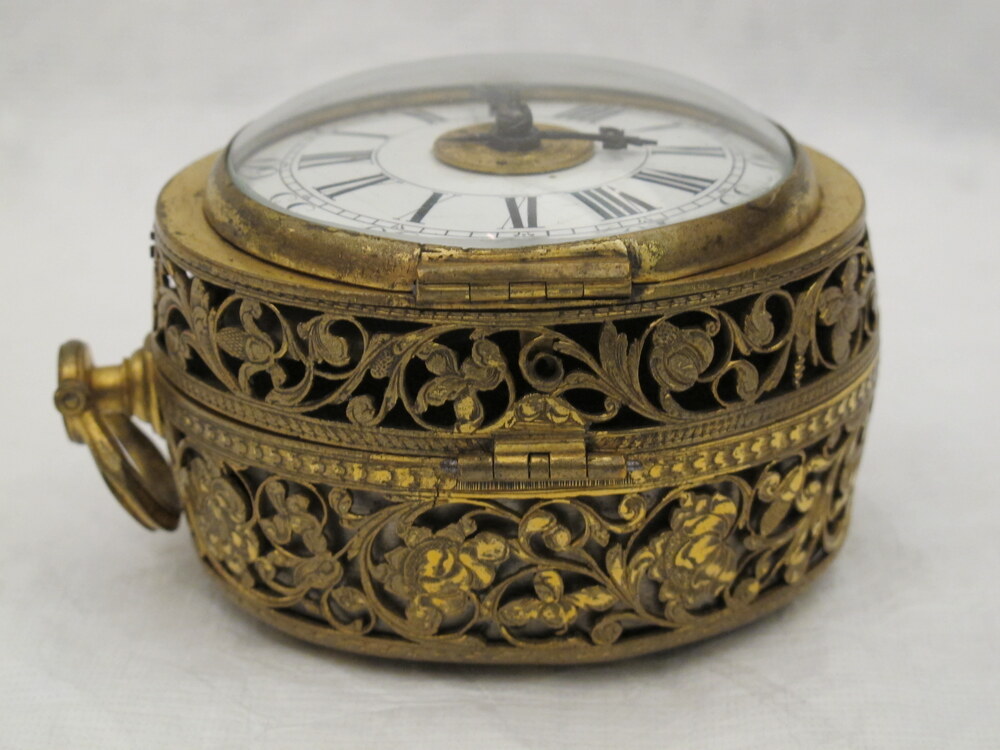
Portable clock held and described by Auckland Museum (identifier H110, Mackelvie Trust collection). Photograph by and courtesy of Auckland Museum. Source Wikimedia Commons file description. Licence CC BY 4.0. Resized only.

Allix’s book also informed research on decoration. In Antiquarian Horology in 2018, Larry L. Fabian cited Allix’s view that clocks with decorated panels were costly and were made in small numbers. Fabian compared the imagery on a Drocourt clock with prints after Fragonard paintings and argued that the dial and side panels tell a single story. 7
Allix had been rewriting the section on portable clocks associated with mail coaches for a revised edition. At the 2016 AHS annual general meeting, David Penney used information from the unpublished manuscript in a memorial lecture with Sally Allix’s permission. 8
Publishing a clockmaker’s working drawings#
A repeating clock sounds the time on demand when a cord is pulled or a similar control is operated. Some mantel clocks sound both the hour and the number of quarter-hours that have passed since it. The Metropolitan Museum of Art’s clock catalogue describes a mantel clock Thomas Tompion made around 1696 as an example of a pull repeater that sounds both hours and quarters. 4
Published in 1982, Hobson’s Choice contains sketches made by English clockmaker Charles Hobson over more than 70 years. Laurence Harvey and Allix took part alongside Hobson, and Allix contributed an account of the cord-operated repeating mechanisms of English mantel clocks. The essay appeared again in another book on horological history in 1993. The AHS records include Allix’s correspondence with Hobson, letters with Daniel Parkes about publication and reviews that appeared afterwards. 1 4
Recreating Harrison’s clocks#
Allix was also involved in recreating historical designs. A record of a talk by horological historian William J. H. Andrewes says that Len Salzer and Allix took part in making a replica of John Harrison’s H1 sea clock. According to Royal Museums Greenwich, Harrison designed H1 with two linked oscillators to reduce the effect of a ship’s motion. He tested it on a voyage to Lisbon in 1736. 9 10
Allix jointly commissioned another clock, a recreation by Andrew King of one of Harrison’s wooden pendulum clocks. According to King’s account in Bonhams’ 2018 catalogue, work began in 1977 and the finished clock was delivered to Allix in 1996. It has a train using oak and pinions incorporating lignum vitae rollers. King lent the clock to two screen productions about Harrison. 11
Timeline#
| Year | Event |
|---|---|
| 1921 | Allix is born. 1 |
| 1968–1969 | He directs the restoration of the two Arnold astronomical clocks at Dunsink. 2 |
| 1973 | He issues antiquarian horological book catalogue no. 17 under the Malcolm Gardner name. 1 5 |
| 1974 | Carriage Clocks: Their History & Development is published. 3 |
| 1976 | He publishes a notice offering quarter-repeating pocket watches for sale under Gardner’s name. 1 |
| 1982 | Hobson’s Choice, with Hobson’s working sketches, is published. 1 4 |
| 1993 | Allix’s essay on English pull repeaters is republished. 4 |
| 1996 | He receives Andrew King’s recreation of a wooden Harrison clock. 11 |
| 2015 | Allix dies. 1 |
| 2016 | David Penney uses information from Allix’s revision manuscript in an AHS memorial lecture. 8 |
| 2018 | Fabian draws on the 1974 book in his study of carriage clocks with decorated panels. 7 |
| November 2026 | The AHS public catalogue lists Allix’s letters, photographs and research notes among 28 files in four boxes. 1 |
References#
- Antiquarian Horological Society Archives, Allix, Charles (ALL). Biography on p. 3 of the public catalogue PDF, ALL/01/002 (Gardner), 004 (Graham) and 008 (Hobson). Accessed 20 November 2026.
2. P. A. Wayman, “Notes on the History of Dunsink Observatory III. The Arnold Clocks”, Irish Astronomical Journal, 10(8), December 1972, pp. 278–279. Accessed 20 November 2026.
3. CiNii Books, Carriage clocks: their history & development. Library record for the Antique Collectors’ Club edition, 1974, ISBN 0-902028-25-1. Accessed 20 November 2026.
4. Clare Vincent, Jan Hendrik Leopold and Elizabeth Sullivan, European Clocks and Watches in The Metropolitan Museum of Art, 2015. Object entry 32 and fig. 38 on p. 150, and bibliography entry “Allix 1993”. Accessed 20 November 2026.
5. Australian Antiquarian Horological Society, Library. “Horology and Allied Subjects”, nos. 17 and 19. Accessed 20 November 2026.
6. Auckland Museum, “Clock, carriage”. 1932.233, H110, museum description of the mechanism in the file for photograph 3. Accessed 20 November 2026.
7. Larry L. Fabian, “Drocourt’s porcelain tributes to Romantic Love and Royal Victory. Art-historical appreciation of rare carriage clocks”, Antiquarian Horology, December 2018, pp. 515–516 and 523–524. Accessed 20 November 2026.
8. Antiquarian Horological Society, 2016 Annual General Meeting report. “Mail Coach Watches” lecture. Accessed 20 November 2026.
9. Melody Benloss, “Meeting Recap: A Tapestry of Time — Horological Society of New York”, Horological Society of New York, 2020. Accessed 20 November 2026.
10. Royal Museums Greenwich, “Longitude found – the story of Harrison’s timekeepers”. H1’s design and 1736 sea trial. Accessed 20 November 2026.
11. Bonhams, Fine Clocks, 12 December 2018, lot 135 (printed p. 110). Description by Andrew King and provenance. Accessed 20 November 2026.