This article was translated from Japanese using AI. Read the Japanese original
Charles Bernaudat, also spelled Bernauda in contemporary records, worked on watches for Breguet’s Paris workshop in the early nineteenth century. He made and repeatedly refined the escapement in pocket watch No. 1135, the first example of the natural escapement devised by Abraham-Louis Breguet. He also carried out final finishing on other makers’ escapements for the same workshop. The workshop registers show where Bernaudat’s skills were needed to turn a design into a working watch.1 2 3
Completing the Duke’s watch#
Design notes and payment records#
In March 1802 the Spanish Duke of the Infantado ordered a watch from Breguet. Breguet’s design notes give dimensions and tooth counts for the barrel and gearing. Bérare delivered the ébauche, the unfinished base movement, in June, and Pierre Benjamin Tavernier supplied the gold case in August. Payments to other artisans are recorded for the striking mechanism and jewels. Bernaudat made the escapement that regulated the watch’s advance and finished the assembled movement.1 2
Bernaudat delivered the first escapement in March 1803. In the register excerpts published by Orford, Bernaudat received 1,440 francs for the escapement and repassage, the final finishing and adjustment of the assembled movement. The following year he appears in entries for small escapement jewels and casing, and the following year again for replacing the barrel and further changes to the escapement. The watch reached the Duke in January 1806 at a price of 4,200 francs.1 2 4
| Recorded work | Payment to Bernaudat |
|---|---|
| March 1803, escapement and final finishing | 1,440 francs |
| April 12, 1804, very small escapement jewels | 24 francs |
| July 24, 1804, casing | 150 francs |
| January 2, 1805, replacing the barrel | 48 francs |
| September 11, 1805, alteration to the escapement | 168 francs |
| December 1805, another alteration to the escapement | 300 francs |
The amounts and descriptions come from Orford’s table 1, transcribed from the workshop registers. His estimate of about 1,900 francs for escapement-related work principally combines the 1,440 francs when the first escapement was delivered and the two alterations in 1805. The initial payment also includes the repassage.1
Delivering impulse in both directions of swing#
The escapement releases the train in steps and replenishes the energy of the oscillating balance. The transfer of energy is called impulse. A detent escapement delivers it directly from the escape wheel to the balance once per complete oscillation. A portable watch with this arrangement could stop when disturbed by movement. Breguet aimed to deliver direct impulse with little sliding in both directions of swing.1 2 5
In No. 1135, the train drives a brass escape wheel, which drives a second steel escape wheel in the opposite direction. A jewel on the detent that rocks between the wheels catches the pins projecting from their rims in alternation. The unlocking jewel on the balance moves the detent and releases both wheels. A pin then gives impulse to the impulse jewel on the balance. On the next half-oscillation the other wheel gives impulse. Each direction of swing thus has its own path for transmitting energy.1 2
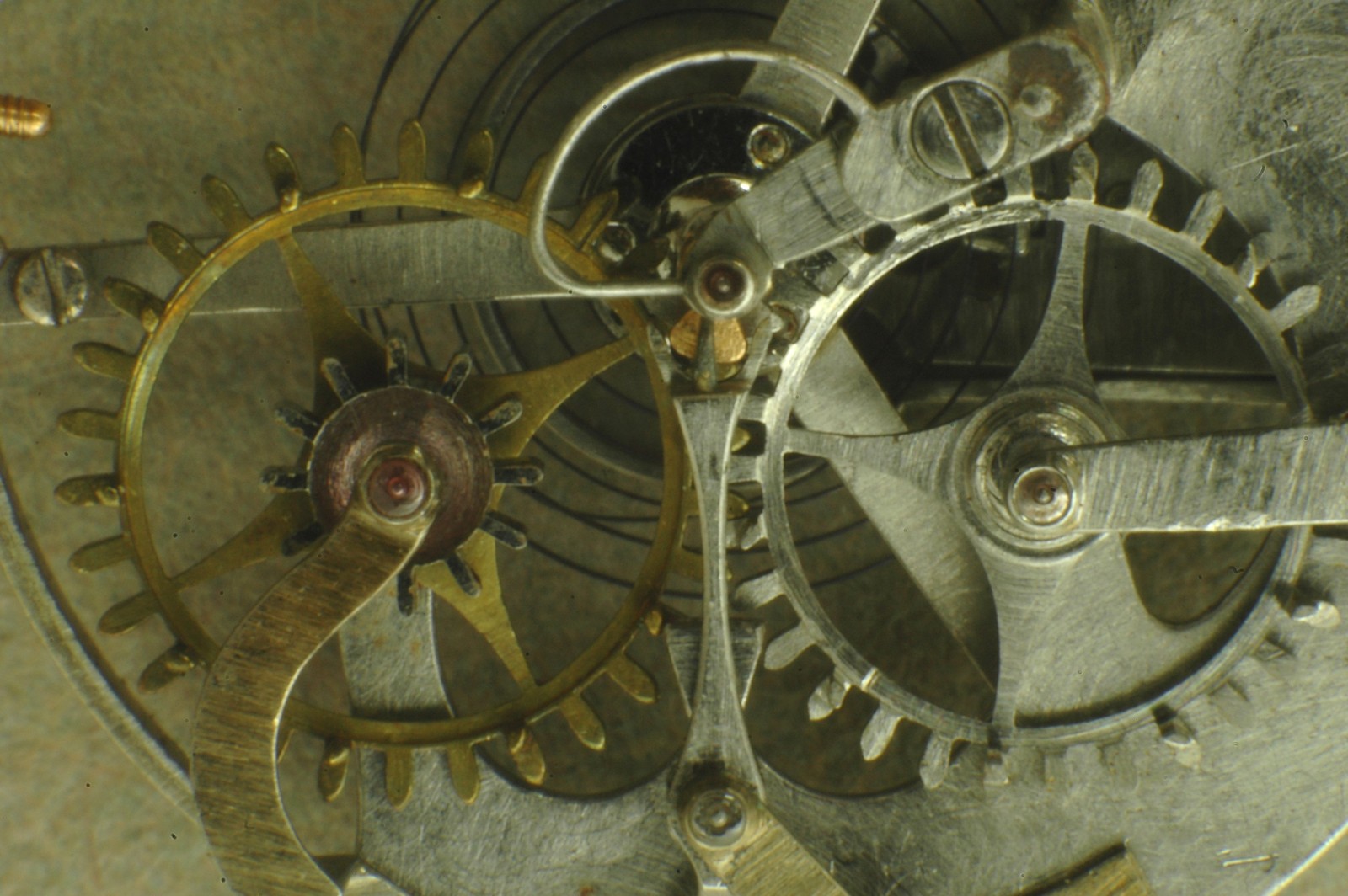
Figure 1. The escapement platform of No. 1135 viewed from below. Photograph by Kjorford. Source: Wikimedia Commons. Distributed under CC BY-SA 3.0. Resized and recompressed as JPEG from the original.

Twenty teeth in the notes and thirty in the surviving movement#
Orford found that the teeth linking the wheels and the spacing of the pins differed between the design notes and the surviving watch. The notes give 20 teeth per wheel with one pin every five teeth. The surviving wheels each have 30 teeth and one pin every three teeth. Since the pins on the wheels act alternately, each wheel would advance 45 degrees between unlocking and relocking in the design notes, and 18 degrees in the surviving watch. The pinions of the fourth wheel and first escape wheel have more leaves too. Orford interprets these changes as largely compensating for the ratio difference caused by the change in angle. He suggests the reconfiguration may have taken place during the work of 1805.1
Both escape wheels, the detent and the balance are mounted on a separate steel platform. Pivoting the platform slightly about its fixing screw alters the mesh between the fourth wheel and the first escape-wheel pinion. Orford confirmed on the watch that the depth of mesh changes the escapement’s action. Many adjusting screws in the three-arm compensation balance are platinum. Orford counts Bernaudat among the few artisans of the period able to work this difficult metal.1 2
Finishing No. 1711 and altering No. 1484#
No. 1711 is a montre à tact, in which the time can be read by feeling the position of a pointer outside the case. The workshop register records that Kehlhoff delivered the escapement on December 26, 1804, and Bernaudat completed the repassage on February 12 of the following year. The dial and hands were finished, and the watch went to Galakoff in September. The work overlapped with alterations to No. 1135. Even for the same escapement principle, different artisans could make and finish the mechanism. The driven escape wheel of No. 1711 is smaller than the driving one. Orford suggests that experience from the two prototypes may have informed both projects.1 3
The records for No. 1484 show a different course. Lapieur worked on a natural escapement in 1806, but the surviving movement described by Orford has a Robin escapement with two coaxial escape wheels. In November that year Bernaudat received 300 francs for work and inspection, and in October 1808 he received 60 francs for changing the escapement. Orford suggests the first payment may relate to fitting the Robin escapement. The descriptions in the registers are general, and the date of conversion is inferred from comparing the watch with the sequence of payments. It was sold to General Labadie in March 1810.1
What the early prototypes reveal#
Connecting the two wheels with gearing means that both have to accelerate for every impulse. Derek Pratt pointed to their inertia and to the possibility that clearance between the meshing teeth could change the driven wheel’s position. Daniels observed that in No. 1135, the detent could jam as the mainspring unwound and its torque fell. Later examples in the same family used a spring to support the detent. The early watches can be compared to see what needed adjustment in No. 1135 over the years spent making it and what changed in later movements.1 2 5
In 2010 Orford brought together photographs of No. 1135, drawings of its operation, workshop records and transcriptions of the design notes. Breguet added the watch to its historical collection in 2014. The completed watch bears Breguet’s name, while the registers name Bernaudat, Bérare, Tavernier and others. Together they document how a design with two escape wheels became a finished watch through prototyping, finishing, casing and readjustment.1 2 4 6
Timeline#
| Date | Watch and Bernaudat’s work |
|---|---|
| March 1802 | Breguet accepts the Duke of the Infantado’s order. Work starts on No. 1135.1 2 |
| March 1803 | Bernaudat supplies the first escapement for No. 1135 and receives 1,440 francs for it and the repassage.1 |
| April and July 1804 | Receives payments for escapement jewels and casing No. 1135.1 |
| December 1804 | Kehlhoff supplies No. 1711’s escapement.1 3 |
| January and February 1805 | Bernaudat replaces the barrel of No. 1135 and completes the repassage of No. 1711 on February 12.1 3 |
| September and December 1805 | Alters No. 1135’s escapement twice. No. 1711 goes to Galakoff in September.1 3 |
| January and November 1806 | No. 1135 reaches the Duke. Bernaudat receives payment in November for work and inspection of No. 1484.1 2 |
| October 1808 | Receives payment for altering No. 1484’s escapement.1 |
| March 1810 | No. 1484 goes to General Labadie.1 |
| March 2010 | Orford’s study appears in Antiquarian Horology.1 6 |
| November 2014 | Breguet adds No. 1135 to its historical collection.4 |
References#
- Keith Orford, “A Watch With Breguet’s Échappement Naturel”, Antiquarian Horology, vol. 32, no. 1, March 2010, pp. 52–70. Tables 1–2, figs. 6–8, sections on Nos. 1135, 1711 and 1484, and the transcription of design notes in the appendix. Public copy of the text consulted November 21, 2026.
2. Christie’s, “Breguet No. 1135”, Geneva, November 10, 2014, lot 393. Specifications, provenance and workshop records. Accessed November 21, 2026.
3. Christie’s, “Breguet, No. 1’711, Montre à Tact”, Geneva, May 13, 2024. Specifications of No. 1711 and work done by individual artisans. Accessed November 21, 2026.
4. Swatch Group, “Vente aux enchères Christie’s: Breguet enrichit sa collection historique”, November 12, 2014. Announcement of the acquisition of No. 1135. Accessed November 21, 2026.
5. Derek Pratt, “In Breguet’s Footsteps…”, Horological Journal, March 2009, p. 106 onward. Design aims of the two-wheel escapement, inertia and gear clearance. Accessed November 21, 2026.
6. Antiquarian Horological Society, “List of articles published in Antiquarian Horology”, vol. 32/1. Issue and opening page. Accessed November 21, 2026.