Charles-Édouard Guillaume#
This article was translated from Japanese using AI. Read the Japanese original
Charles-Édouard Guillaume (15 February 1861–13 June 1938) was a Swiss physicist who spent his research career at the International Bureau of Weights and Measures (BIPM) in Sèvres, France. He received the 1920 Nobel Prize in Physics for making use of anomalous properties of nickel steels in precision measurement. His main achievements included Invar, whose length changes little with temperature, and Elinvar, in which the elastic modulus varies little with temperature. The physicist Édouard Guillaume (1881–1959) was a different person. 1 2 3
Guillaume’s contribution to timekeeping was a way of choosing materials for pendulums, balances and balance springs. Controlling alloy composition and processing reduced the source of the rate error itself, alongside work with existing compensation mechanisms. It took sustained collaboration connecting a French steelworks with Swiss watchmakers and component manufacturers as well as the laboratory. 4
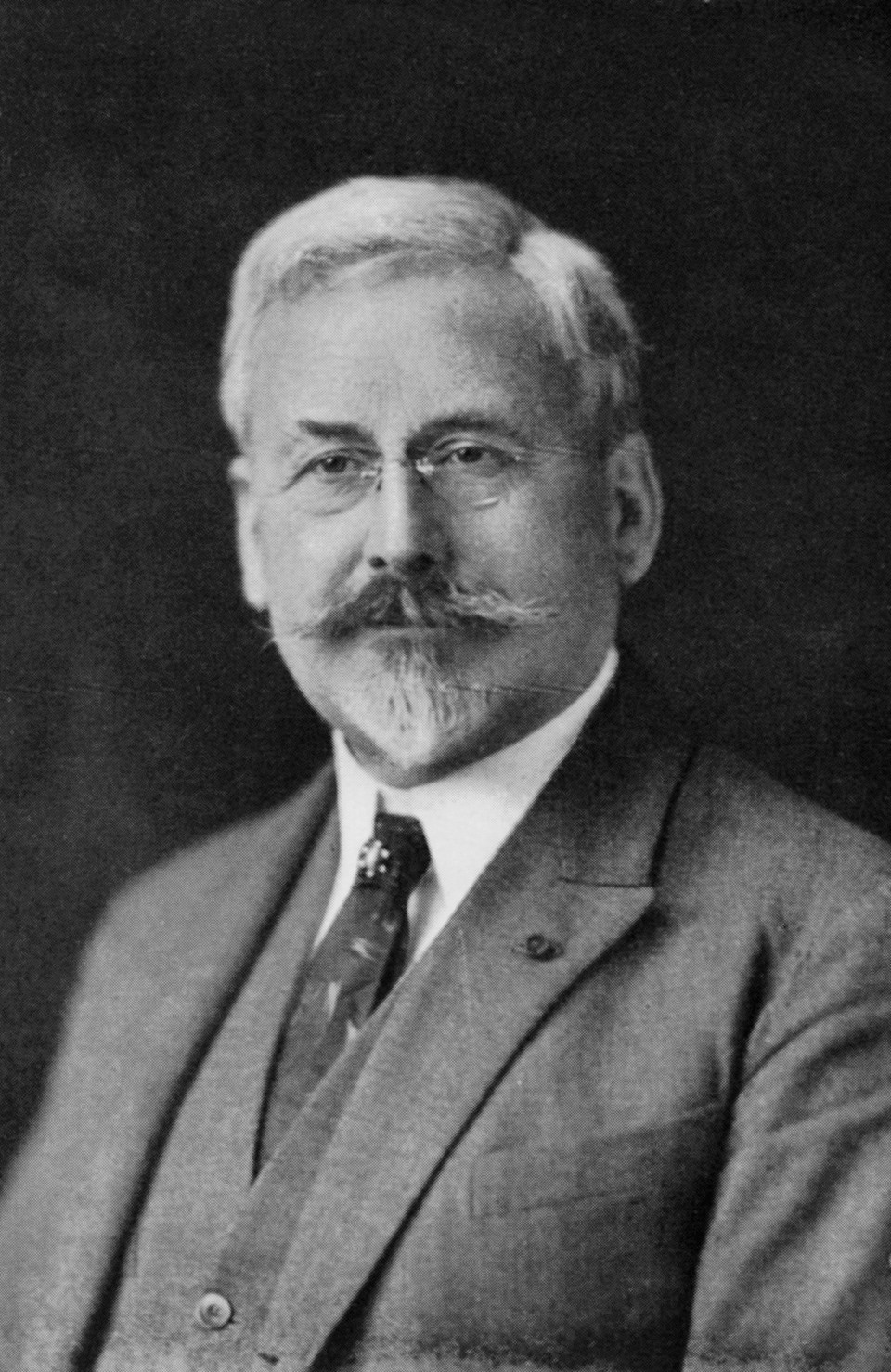
Figure. Charles-Édouard Guillaume, around 1920. Photographer unknown. ETH Library collection, Portr 08563. Wikimedia Commons, E-Pics. CC BY-SA 4.0, including the converted image. Resized and converted to JPEG without cropping or changing the colours.
From a watchmaking family to the BIPM#
Fleurier and education in Zurich#
Guillaume was born in Fleurier in the Neuchâtel region. His father and grandfather both worked in horology, and the family’s business also had links with London. He studied in Neuchâtel and attended its academy from 1877 to 1878. In the winter of 1878 he entered the Federal Polytechnic Institute in Zurich, forerunner to ETH Zurich. The ETH Library’s account, based on the university archives, records his diploma qualifying him to teach mathematics on 4 August 1882. 1
In 1883 he earned a doctorate under Heinrich Friedrich Weber. It was awarded by the University of Zurich. After a short period as an artillery officer, he joined the BIPM as an assistant the same year. 1 5
In 1888 he married Emilie Marie Anne Taufflieb. They had three children. In 1901 his alma mater offered him a physics chair, but he stayed in Sèvres. The physicist from a watchmaking family built his career in international measurement standards, which shaped the nature of his inventions. 1
Thermometers and measurement standards#
Early work included correcting and calibrating mercury thermometers. An inaccurate temperature reading prevents an accurate correction for the expansion of a length standard. Guillaume gained experience in an institution where measuring length involved measuring temperature as well. 5
In 1889 platinum–iridium standards were distributed to the countries participating in the Metre Convention. The expensive material was difficult to use widely in everyday measurement instruments. In his 1920 lecture Guillaume recalled that he began looking for a less expensive metal stable enough for measurement in 1891. He first considered pure nickel. The difficulty of producing sound long bars led him to study other alloys. 4
At the BIPM he became an adjunct in 1889, deputy director in 1902 and director in 1915. He held the directorship until 1936, then became honorary director. The adjunct appointment of 1889 and the deputy directorship of 1902 were distinct positions. 1 6
Where the discovery of Invar began#
Anomalously large and small expansion#
The first observations came before a deliberate effort to make steel with negligible expansion. In March 1895 J. R. Benoît of the BIPM noticed that a nickel steel standard for an artillery application expanded more than expected. The 1897 report estimated the sample at 22–23% nickel and 2–3% chromium and noted that the exact composition was unknown. 7
In May 1896 Guillaume measured another nickel steel bar, this one without chromium, and found that it expanded less than platinum. Increasing the nickel content did not simply move the properties smoothly between those of the two metals. He asked the maker, Société de Commentry-Fourchambault’s steelworks at Imphy, to supply samples and made systematic measurements at different nickel contents. 7
The method compared the bar in a water bath at different temperatures with a platinum–iridium reference bar, using microscopes. The 1897 report’s table shows a low expansion coefficient near 36% nickel from measurements between 0 and about 38 °C. For samples with specified additions and processing, the 1920 lecture places the minimum near 35.6% nickel and gives a linear expansion coefficient of about 1.2 × 10⁻⁶ per °C. A one-metre bar would expand by about 1.2 µm per degree Celsius. 4 7
The figure varies across alloys called Invar. Trace elements, heat treatment and cold working change the value and shift the composition at which the minimum occurs. Invar is an iron–nickel alloy designed for very low expansion over a target temperature range. 4
Why the works and the laboratory both mattered#
It was necessary to reproduce compositions, make bars or fine wire, avoid inclusions and uneven regions and achieve consistent properties in the finished material. In his 1920 lecture Guillaume thanked the company, under Henri Fayol, for supplying more than 600 alloys over the course of the research. 4
After cooling, Invar continued to change dimension over long periods. Guillaume investigated the effect of heat treatment and of traces of carbon and other additions. He distinguished low thermal expansion from long-term stability and said treatment and periodic comparisons were essential in using the material for precision standards. 4
Three applications in timekeeping#
| Application | Principal effect | Design consideration |
|---|---|---|
| Invar pendulum | Reduces temperature-related changes in effective pendulum length | Compensation accounts for the bob and support position as well as the rod |
| Guillaume balance | Reduces the middle-temperature error remaining in a conventional compensation balance | Uses curvature of the expansion curve of a nickel steel replacing ordinary steel |
| Elinvar balance spring | Reduces changes in the elastic modulus of the spring with temperature | Paired with a monometallic balance with a suitable expansion coefficient |
The applications address changes in dimensions, changes in elasticity or the nonlinear relation between the two. They use materials suited to each problem. 4
Simplifying pendulum compensation#
A longer effective pendulum length means slower swings. A clock loses time as an ordinary metal rod expands in warmth. Earlier compensation pendulums used mercury or different expansion rates of several metals. Guillaume described reducing the expansion of the rod itself and compensating the remaining amount by effects such as upward expansion of the bob. 4
Mercury pendulums can also be affected by temperature differences from top to bottom inside the case. Invar simplified the construction compared with liquid and more complicated compensation arrangements. Long-term rod stability, the support and the clock’s surroundings remained relevant. The construction is covered in Invar pendulums. 4
Paul Perret and experiments with balance springs#
With rising temperature, the elastic modulus of an ordinary steel spring falls, reducing its restoring force at the same deflection. Guillaume took advantage of the fact that the temperature coefficient of the elastic modulus, like thermal expansion, depends on the alloy, and can be positive or negative. 4
Paul Perret, a watchmaker in La Chaux-de-Fonds, took an interest in the early Invar research and tested samples as balance springs. The engineer Marc Thury also participated. Philippe Richard of METAS says compensation springs were made by the summer of 1897 from alloys with about 28% or 45% nickel. The alloy with the smallest dimensional change, near 36%, need not be the best spring material. 8
With early alloy springs, small compositional changes could produce large changes in elasticity with temperature. Rate could also differ between the middle and ends of the temperature range. In 1920 Guillaume gave an example of an early compensation spring with a monometallic balance. Even with the rates matched at 0 and 30 °C, an error of 20–25 seconds per day remained near 15 °C. Industrial adoption in ordinary watches and meeting chronometer requirements called for different levels of performance. 4
The Guillaume balance and middle-temperature error#
A conventional compensation balance uses arcs of steel and brass. In warmth the arcs bend inwards and bring the weights towards the staff, reducing inertia. This counteracts the slowing caused by loss of stiffness in the steel spring. Even when the rate is matched at two temperatures, the watch can gain at intermediate temperatures. This is middle-temperature error. 4
Guillaume replaced the steel side of the balance with a particular nickel steel and used the quadratic term in its expansion curve to match the nonlinear changes in the spring. His 1920 lecture dates the design calculations to 1899 and gives an alloy containing 45% nickel. Low-expansion Invar at around 36% nickel has a different composition. 4
Guillaume says that in 1900 P. D. Nardin and Paul Ditisheim obtained temperature compensation results using the balance. Richard likewise mentions their tests and presentation at Neuchâtel Observatory. Guillaume supplied the material properties and calculations. The watchmakers incorporated the balance into watches and verified the results. 4 8
The “complete compensation” in the lecture is Guillaume’s own assessment of how this temperature error was addressed.
Elinvar and industrial production#
Making the elastic modulus more stable#
Elinvar takes its name from élasticité invariable, elasticity that changes little. Invar refers to low expansion. Guillaume explains that the zero-temperature-coefficient composition in binary iron–nickel was sensitive to even small changes in composition and operated over a narrow temperature range. He explored additions such as chromium to make the variation more gradual. 4
He recalled conceiving the idea around 1912 and experimenting the next year with series containing 5% and 10% chromium. The research included Pierre Chevenard’s torsion tests and study of additions to improve hardness and workability. The dates refer to different stages, with the idea around 1912, patenting and development for use in 1918–1919 and a report of the results in 1920. 4 8 9
A spring whose elastic modulus changes little allows a stable oscillator to use a monometallic balance in place of a bimetallic cut balance. Expansion of the balance still changes its inertia, so the two materials need to be chosen as a pair. 4
In 1920 Guillaume said a simple combination could approach a good result but allowed only limited fine compensation by the gradual interventions of an adjuster. The approach was already entering precision watches, but he remained cautious about its adoption for the most demanding chronometry. 4
Announcing an invention and making it in quantity#
Fabriques de Spiraux Réunies (FSR), an association of balance spring manufacturers, helped supply watch components. Technology historian Johann Boillat examines Guillaume’s 1901 agreement with FSR and quality issues in processing Imphy’s material for watchmaking. Complaints around 1905–1908 concern uneven material and cracking, showing process obstacles between a successful experiment and reliable products. 9
U.S. patents US1106206 and US1106207 were filed on 20 February 1912 and granted on 4 August 1914. They name Guillaume as inventor and FSR as assignee. The specifications address the low elastic limit and susceptibility to permanent deformation of earlier alloy springs. They describe adding elements including chromium, tungsten and vanadium to iron–nickel alloys containing 27–31% nickel. The material had to be homogeneous and consistent and able to be rolled and drawn thin. Low expansion alone was insufficient. The patents document proposed designs and give no production performance test results. 10 11
The cover of Swiss patent CH82081, reproduced by Boillat, names Guillaume and FSR as applicants for a compensation balance spring for chronometers and watches. It gives the filing date as 4 June 1918 and the publication date as 1 September 1919. Perret’s rights in early alloy springs and the later Elinvar-related patents reflect distinct contributions. 9
Elinvar springs still presented problems such as magnetism and corrosion. Later developments dealt with environmental factors other than temperature and with manufacturing issues. Guillaume helped establish a way of developing alloys by working between composition, heat treatment, processing, measurement and testing in a watch. 4 9
Award, later life and surviving records#
The 1920 Nobel Prize in Physics recognised Guillaume’s discovery of anomalies in nickel steels and their contribution to precision measurement. Measuring geodetic baselines with Invar wire, making length standards and regulating timekeepers were among the applications of that research. 3 4
He wrote on topics including thermometry, units and standards, and nickel alloys. Works include Traité de thermométrie (1889), Unités et Étalons (1894) and Les applications des aciers au nickel (1904). He shared findings through papers and books alongside his collaborations from steelworks to watch-component factories. 5
Guillaume retired as BIPM director in 1936 and died in Sèvres on 13 June 1938. The Nobel Foundation biography gives 13 May, while the Bibliothèque nationale de France authority record gives 13 June, the date used here. As with the institution that awarded his doctorate, the discrepancy shows why it helps to check short institutional biographies against other records. 1 2 5
The Musée international d’horlogerie (MIH) in La Chaux-de-Fonds holds his personal papers. The ETH university archives also hold student records and correspondence. On 17 October 2020 the BIPM marked the centenary of the Nobel Prize with a symposium revisiting Guillaume’s work across geodesy, horology and precision measurement. His lasting contribution was to distinguish small errors in measurement and trace them to materials and manufacturing processes. 1 6
Timeline#
| Date | Event |
|---|---|
| 15 February 1861 | Born in Fleurier. 1 2 |
| 1877–1878 | Studies at the academy in Neuchâtel. 1 |
| Winter 1878–1882 | Studies at the Federal Polytechnic Institute in Zurich and obtains his diploma on 4 August 1882. 1 |
| 1883 | Receives a doctorate from the University of Zurich and joins the BIPM. 1 |
| 1888 | Marries Taufflieb. 1 5 |
| 1891 | In his recollection, begins seeking material for inexpensive length standards. 4 |
| March 1895 | Benoît notes the large expansion of nickel–chromium steel. 7 |
| May 1896 | Measures the low expansion of a different nickel steel, leading to systematic research with the Imphy steelworks. 7 |
| 1897 | Measurements of composition and expansion appear in the BIPM records. Perret and others work on testing alloy springs. 7 8 |
| 1899–1900 | Designs the Guillaume balance, which Nardin and Ditisheim test. 4 |
| 1901–1902 | Signs agreement with FSR. Becomes deputy director of the BIPM in 1902. 1 9 |
| 1912–1913 | Conceives and experiments with ternary alloys that lead to Elinvar. 4 |
| 1915 | Becomes director of the BIPM. 1 6 |
| June 1918 to September 1919 | Applies with FSR for compensation spring patent CH82081. The patent is published. 9 |
| 11 December 1920 | Delivers the Nobel lecture “Invar and elinvar” after receiving the Nobel Prize in Physics. 4 |
| 1936 | Steps down as director and becomes honorary director. 1 6 |
| 13 June 1938 | Dies in Sèvres. 2 |
| 17 October 2020 | BIPM holds a symposium for the centenary of the prize. 6 |
Scope of the sources#
The 1920 lecture gives the discoverer’s account of the research, including his assessment of its results and adoption. It can be read alongside the measurements of 1897, university archives, public authority records and later technical histories that examine company records.
The article follows Guillaume’s main contributions through documented measurements and applications and identifies the work of makers, testers and material suppliers. A comprehensive inventory of serial numbers, first uses in individual timekeepers and the claims of all patents is outside its scope.
References#
1. ETH Library, “Charles Edouard Guillaume (1861–1938)”, including university student records, records of the 1901 appointment offer and collection information. ETH Library. Accessed 6 November 2026.
2. Bibliothèque nationale de France, “Guillaume, Charles-Édouard (1861-1938)”, FRBNF12924047. Dates of birth and death and distinction from another person with the same surname and given name. BnF authority record. Accessed 6 November 2026.
3. Nobel Foundation, “The Nobel Prize in Physics 1920”, award citation. Prize summary. Accessed 6 November 2026.
4. Charles-É. Guillaume, “Invar and elinvar”, Nobel Lecture, 11 December 1920, Nobel Lectures, Physics 1901–1921, pp. 444–473. Discovery and measurement on pp. 444–453, elasticity, processing and ageing on pp. 454–463, and timekeeping applications on pp. 468–472. Lecture PDF. Accessed 6 November 2026.
5. Nobel Foundation, “Charles Edouard Guillaume – Biographical”, Nobel Lectures, Physics 1901–1921, Elsevier, 1967 edition. Early research and writings. The degree-awarding institution and date of death were checked against sources 1 and 2. Biography. Accessed 6 November 2026.
6. BIPM, “Symposium to celebrate the centenary of the award of the Nobel Prize in Physics to Charles-Édouard Guillaume”, 2020. Event record. Accessed 6 November 2026.
7. Comité international des poids et mesures, Procès-verbaux des séances de 1897, director’s report pp. 78–80 and Guillaume’s “Étude sur les aciers au nickel” pp. 97–100. Original BIPM records (PDF). Accessed 6 November 2026.
8. Philippe Richard (METAS), “Charles-Édouard Guillaume et son héritage: Perspective suisse”, BIPM Nobel centenary symposium, 2020, slides 5–9. Institutional account (PDF). Accessed 6 November 2026.
9. Johann Boillat, “Des alliances pour des alliages III: le béryllium des spiraux”, Bulletin SSC, no. 88, December 2019, pp. 29–36, especially pp. 30–31 for the agreement, material quality and the CH82081 cover in fig. 3. Swiss Society for Chronometry PDF. Accessed 6 November 2026.
10. Charles Edouard Guillaume, Balance-spring having elasticity increasing with a rise in temperature, US1106206, filed 20 February 1912, granted 4 August 1914, 3 pp. Original U.S. patent (PDF). Accessed 6 November 2026.
11. Charles Edouard Guillaume, Balance-spring having elasticity increasing with rise in temperature, US1106207, filed 20 February 1912, granted 4 August 1914, 2 pp. Original U.S. patent (PDF). Accessed 6 November 2026.