Charles Frodsham#
This article was translated from Japanese using AI. Read the Japanese original
Charles Frodsham (reported born in 1810, died in 1871) was a nineteenth-century London watchmaker and maker of marine chronometers. Alongside making and supplying precision timekeepers for the Navy, he investigated the isochronism of balance springs and took part in judging and reporting at international exhibitions. His work brought together the craft of making precision parts, the theory of oscillation, regulation by observation and the business of running a workshop that supplied timepieces. 1 2
The business of the same name continued after his death. A dial bearing the name Charles Frodsham can appear on a timepiece made later or assembled by someone else. Its date, trading name, serial number and later alterations need to be checked individually. 3
From the family trade to an independent business#
His father, William James Frodsham, made chronometers and co-founded Parkinson & Frodsham. Charles became his father’s apprentice in 1824 and was running an independent business by the mid-1830s. The business history at London Metropolitan Archives dates the founding to around 1834 and gives the address in 1837 as 12 The Pavement, Finsbury. The Science Museum’s biographical record also lists the 1824 apprenticeship and early London addresses. 3 4
Sources differ on his birth year. The Science Museum and London Metropolitan Archives give 1810, while the Royal Astronomical Society’s obituary of 1871 gives 15 April 1811. Both dates are reported with their respective sources. 1 3 4
In 1843, after John Roger Arnold’s death, Frodsham took over his business and shop at 84 Strand. The business history records the name Arnold and Frodsham from 1843 to 1858 and Charles Frodsham thereafter. Inheriting Arnold’s existing business and name helps trace customers and timepieces, while attribution of individual parts calls for more evidence than a signature. 3
In 1854 he acquired the Vulliamy business and took charge of the royal clocks. Maintaining court timepieces thus joined his work with precision marine timekeepers. He presented a new chronometer at London’s Great Exhibition in 1851 and served as a judge and reporter in the horological section at the International Exhibition in London in 1862. The Royal Astronomical Society’s obituary records that he also twice served as Master of the Clockmakers’ Company. 1 2
The problem of sustaining oscillation#
A marine chronometer keeps reference time at sea so the difference from local time determined by observation can be used to find longitude. The balance and balance spring oscillate, while the escapement releases the gear train in increments. Keeping a stable rate despite changes in temperature, position, friction and driving force was a challenge of making and regulating the instruments.
Frodsham’s Isochronism of Balance-Springs considers how to keep the time of oscillation as nearly constant as possible as amplitude changes. He divides a half-oscillation into short intervals and uses drawings to show the balance accelerating as it approaches equilibrium and decelerating after it passes through. Alongside the properties of the spring, the escapement and friction also affect actual timekeeping. 5
The paper also discusses the practical work of adjusting the curve of the spring and comparing the gain on long and short swings. The discussion in the appendix distinguishes tests that reduce amplitude by weakening the mainspring’s drive from real use, in which changes in the oil increase resistance. This shows that adjusters at the time distinguished trial conditions from conditions in service. It gives no measure of an individual surviving timepiece’s accuracy. 5
According to the Royal Astronomical Society’s obituary, Frodsham received the Institution of Civil Engineers’ Telford Medal in 1847 for his paper on isochronism. The digitised copy held by the Library of Congress is from an edition dated to around 1862. 1 6
His work in surviving timepieces#
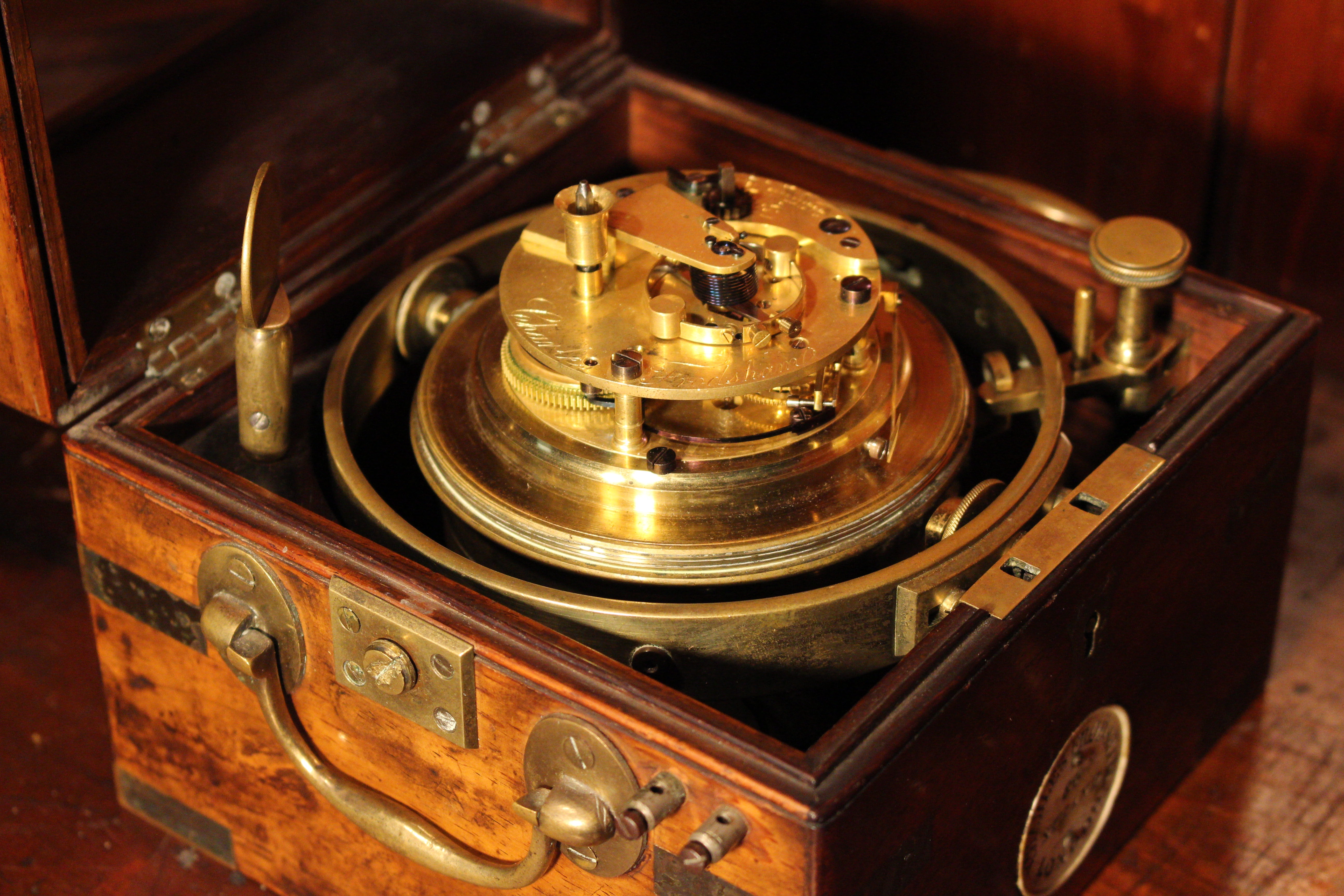
Figure 1. Movement of chronometer No. 2299 signed Frodsham, held by Ladd Observatory. A telegraph circuit was added later. By Ktr101. Source Wikimedia Commons file description. Licence CC BY-SA 4.0. Reproduced unchanged.

Royal Museums Greenwich dates marine chronometer “2025 / 1851” to about 1843 and attributes it to John Roger Arnold and Charles Frodsham. It is a one-day chronometer with a helical steel balance spring, an Earnshaw-type balance and a gimbal mounting. Its detent is now missing. The survivor documents the period when the workshop changed hands. Missing parts also make its present condition different from its construction when new. 7
The same museum dates pocket watch No. 3483 to about 1839 and records its full-plate movement, fusee and English lever escapement. The watch documents a trade in portable watches alongside boxed marine chronometers. A fusee uses a conical pulley and chain to even out the changing force of the mainspring. The lever escapement connects the balance’s oscillation to the advance of the gears. 8
Museo Galileo interprets “AD. FMSZ” on a three-quarter-plate watch shown at the 1851 exhibition as a code for 1850. The code assigns digits according to the sequence of letters in FRODSHAM and uses Z for zero. Inscriptions and codes help trace a watch, while its manufacturing history and ownership require other evidence. 9
Publications and succession#
According to the obituary, Frodsham wrote the horological report for the 1862 exhibition and published another work on timepiece manufacture that year. A manufacturer’s sharing of knowledge through objects, publications and judging shows the links between industry and science. 1
After his death in 1871 his son took over the business. It was incorporated in 1893. London Metropolitan Archives holds minutes from the successor business and manufacturing ledgers from 1876 onwards. 3
Timeline#
- 1810 — Reported year of birth in London. The 1871 obituary gives 1811. 1 4
- 1824 — He becomes an apprentice to his father, William James. 4
- Around 1834 — He starts an independent business. 3
- 1843 — He takes over J. R. Arnold’s business. 3
- 1847 — He receives the Telford Medal for his paper on balance-spring isochronism. 1
- 1851 — He presents a new chronometer at London’s Great Exhibition. 2
- 1854 — He acquires the Vulliamy business and takes charge of the royal clocks. 2
- 1862 — He judges and reports on the horological section at the London International Exhibition. 1
- 1871 — He dies, and his son takes over the business. 1 3
References#
1. Royal Astronomical Society, Obituary: Charles Frodsham, Monthly Notices, vol. 31, 1871, p. 101.
2. Antiquarian Horological Society, Marine, Pocket and Wristwatch Chronometers: The Story of Charles Frodsham, 2026 lecture record.
3. London Metropolitan Archives, Charles Frodsham and Company, archive catalogue.
4. Science Museum Group, Charles Frodsham, biographical record.
5. Charles Frodsham, Isochronism of Balance-Springs, pp. 10–12, 15–18, 24–26.
6. Library of Congress, Isochronism of balance-springs, bibliographic record.
7. Royal Museums Greenwich, 2025 / 1851, object ZAA0058.
8. Royal Museums Greenwich, Pocket watch No. 3483, object ZAA0415.
9. Museo Galileo, Charles Frodsham, biographical record.