This article was translated from Japanese using AI. Read the Japanese original
Charles-Pierre Claret de Fleurieu (1738–1810) was a French naval officer, hydrographer, geographer and naval administrator. His early writings used the name d’Éveux de Fleurieu. In the history of timekeeping, his contribution went beyond carrying Ferdinand Berthoud’s marine clocks on his ship. With the astronomer Alexandre-Gui Pingré, he devised procedures for observing, safeguarding and comparing the clocks and for calculating their performance. 1 2
From naval officer to timekeeper tester#
Fleurieu was born in Lyon on 2 July 1738. He had a grounding in mathematics, became a naval cadet in 1755 and served in the Seven Years’ War. Elected to the Lyon academy in 1761, he spoke about various branches of navigation in his inaugural address in 1762. From early in his career he combined the practical work of operating a ship with mathematics, astronomy and measurement. 1 3
The Lyon biographical sources say that he studied horology with Ferdinand Berthoud in 1765–1768 and undertook the construction of an astronomical clock. He approached horology as a technically informed user who understood the mechanisms and devised ways to test them at sea. 2 3
Berthoud’s aim was to carry the time of the place of departure to sea and compare it with local time determined by celestial observation to find longitude. Tests on land alone could not show how a precision clock would bear prolonged operation with the motion of a ship, changes of temperature, regular winding and calls at ports. Fleurieu’s work made it possible to measure performance under those conditions. 2
Sea trials aboard the Isis#
The voyage of 1768–1769 used two Berthoud clocks, No. 6 and No. 8. Fleurieu’s report distinguishes them clearly. No. 6 beats four times per second and has concentric hour, minute and seconds hands. No. 8 has a central seconds indication advancing in one-second steps, an off-centre minute indication and successive hours appearing in a window. Both were intended to be wound every 24 hours in normal use. Even if they could run longer, they were handled so that the daily observations took place under consistent conditions. 2
From Rochefort the ship headed south and west into the Atlantic, away from the English Channel. It called at or passed Cádiz, the Canaries, Gorée, Cape Verde, Martinique, Saint-Domingue, waters off Newfoundland and the Azores, among other places, before returning. The marine-clock log in Part I runs from the first inspection at Rochefort in November 1768 to the fourteenth and last inspection on the Île d’Aix in November 1769. Later summaries of 15 or 18 months count preparation and inspections differently, so the individual dates in the trial log provide the firmer basis. 2 3 4
Keys, witnesses and signatures#
The 1773 report begins with a formal record intended to authenticate all steps of the trial. The two clocks were placed at Rochefort on 8 November 1768, and their box was locked with two different keys. Fleurieu and Pingré each kept one. Separate keys to the observation room also prevented either man from accessing the clocks alone. After the clocks were brought aboard the Isis on 8 December, access to the room and boxes still required the presence of several people. 2
The arrangement guarded against theft and showed who had custody of the clocks and records in case questions arose about the hands having been reset or unfavourable observations altered afterwards. Fleurieu and Pingré designed procedures to test both the clocks’ accuracy and the reliability of the evidence supporting it. 2
Repeating comparisons and swapping observers#
The clocks were wound daily in the presence of the officer of the watch and their indications compared. One observer counted the seconds from No. 8 aloud. The moment the count reached 60, the other read the seconds and fractions on No. 6. The two observers then swapped places and repeated the comparison. The officer recorded the result and signed it with both observers. Mercury thermometer readings went into the same record. The combined record made it possible to look at differences between timekeepers as well as the effects of the observer and temperature. 2
They used similar procedures to compare against astronomical clocks on land. At ports, they obtained local time from solar altitude and used light signals to compare the shipboard clocks with a reference ashore. The formal record calls for a warning signal before each of five comparisons and estimates the delay between the person who sees the signal and the person who reads the time. A footnote describes allowing for a half-second difference in the calculation. The aim was to distinguish the clocks’ rates from human response time. 2
From clocks to longitude and nautical charts#
The conversion from a time difference to longitude rests on the Earth turning through 360 degrees in 24 hours. Comparing time of the same kind, one hour corresponds to 15 degrees. A local time ahead of the reference indicates a position east of it, and a local time behind it indicates a position west. The clock’s indication and the time found from a solar observation may require corrections for the clock’s known gain or loss and for the difference between apparent solar time and mean time. 2
The procedure called for determining rates before departure, checking them at ports, recording environment and differences between clocks, and documenting errors in the measurement method. The results were used to revise the positions of islands and headlands and the routes to ports. The 1773 work puts the clock and ship logs in Part I, and astronomical observations and an appendix on use and calculations in Part II. It is also a practical work linking clockmaking and nautical charting. 2 3
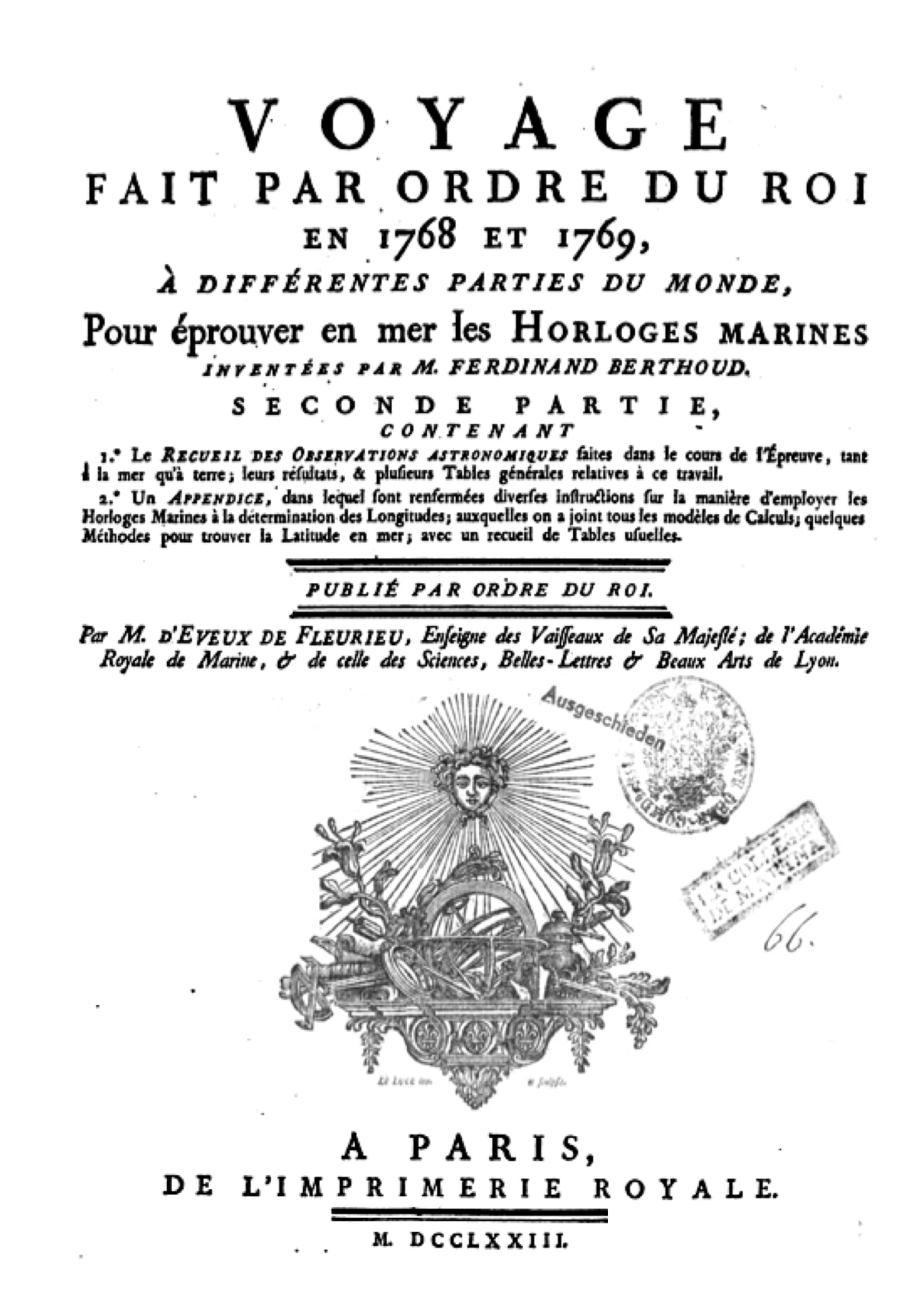
Figure 1. Title page of Part II of Voyage fait par ordre du roi…, Imprimerie royale, Paris, 1773. Author Charles-Pierre d’Éveux de Fleurieu. The image does not identify the maker of the decorative engraving. Source Wikimedia Commons file. Public domain as a faithful two-dimensional reproduction of an original published in 1773 whose author died in 1810. Rights notice, Public Domain Mark 1.0. Unmodified.


Assessment of the trial and disputes over priority#
The modern Ferdinand Berthoud company history states that No. 8 determined longitude to within half a degree and that the success led to Berthoud’s appointment as clockmaker to the navy in 1770 and an order for 20 clocks. It is a modern manufacturer’s account of an important step in the adoption of the clocks. 4
Fleurieu supported Berthoud’s work and wrote a criticism of Le Roy’s trials and construction in 1768. His report thus provides detailed observations from a participant in a French competition to develop marine clocks. Its successful results alone do not settle the question of priority between Berthoud and Pierre Le Roy. 2 3
Fleurieu’s title page credits Ferdinand Berthoud as the inventor of the clocks. Fleurieu contributed his knowledge of horology by directing the trial voyage, organising the observations and publishing them as a report that readers could verify. 2
Naval administration, the Revolution and later years#
Fleurieu became responsible for the administration of ports and dockyards in 1776–1777 and oversaw naval procurement and operations. He helped draw up the instructions for the La Pérouse expedition and supported its work of surveying the world with observational instruments that included clocks. He became Minister of the Navy and Colonies in 1790 and resigned in 1791. 1 3
He was imprisoned and released during the Revolution. In 1795 he joined the Bureau des longitudes and later the Institut national. He served in the Council of Ancients in 1797 and in the Council of State from 1799. His naval and geographical expertise remained in demand under Napoleon. He died in Paris in 1810 and was buried in the Panthéon. The Société linnéenne de Lyon gives the 17th as the day of death. Louis David’s Lyon academy biography identifies the death record and gives the 18th, the date used here. 1 3
Timeline#
| Date | Event |
|---|---|
| 1738-07-02 | Born in Lyon |
| 1755 | Becomes a naval cadet and serves at sea during the Seven Years’ War |
| 1761-11 | Elected to the Lyon academy |
| 1765–1768 | Studies horology with Berthoud and reportedly makes an astronomical clock |
| 1768-11 | Custody and comparison of No. 6 and No. 8 begin at Rochefort |
| 1768-12-08 | The two clocks are brought aboard the Isis |
| 1769-11 | Final inspection on the Île d’Aix |
| 1773 | The Imprimerie royale publishes the sea-trial report |
| 1776–1777 | Takes charge of port and dockyard administration |
| 1785 | La Pérouse’s expedition sails, with Fleurieu having helped plan it and draw up instructions |
| 1790–1791 | Minister of the Navy and Colonies |
| 1793–1794 | Arrested and detained during the Revolution |
| 1795 | Takes part in the Bureau des longitudes and Institut national |
| 1799 | Joins the Council of State |
| 1810-08-18 | Dies. Some sources give the 17th |
| Nineteenth to twenty-first centuries | Libraries preserve the voyage report and observational records and make them available digitally |
Sources 1–4. Sources differ on the exact dates of appointments, which are given here by year or date range.
Limits of the research#
Fleurieu’s published report documents the testing procedures. This account does not recalculate all measurements of No. 6 and No. 8. The whereabouts of the astronomical clock attributed to him and which parts he made are still unverified here, as are the full procurement records from his naval administration and all correspondence concerning the dispute with Le Roy. Broad titles such as naval clockmaker or inventor would leave those questions unanswered. As of 2026, the 1773 report, with procedures to safeguard the integrity of the observations, provides the most direct evidence of his role in the history of horology.
References#
- Louis David, “CLARET de FLEURIEU de La TOURRETTE Charles Pierre (1738–1810)”, Dictionnaire historique des académiciens de Lyon, revised edition, undated. Academy biography. Accessed 22 October 2026.
- Charles-Pierre d’Éveux de Fleurieu, Voyage fait par ordre du roi en 1768 et 1769… pour éprouver en mer les horloges marines inventées par M. Ferdinand Berthoud, Paris, Imprimerie royale, 1773, première partie, “Procès-verbal…”, pp. LXVII–LXXI and the structure of the clock log. ETH bibliographic record and original, PDF of the formal trial record. Accessed 22 October 2026.
- Société linnéenne de Lyon, “Claret de Fleurieu Charles-Pierre (1738–1810)”, Dictionnaire historique des membres, pp. 1–7. Biography and list of works. Accessed 22 October 2026. Day of death and some career dates differ from [1].
- Chronométrie Ferdinand Berthoud, Histoire, entries for 1768 and 1770. Official history. Accessed 22 October 2026. Modern brand history, distinct from Fleurieu’s trial log.