This article was translated from Japanese using AI. Read the Japanese original
Daniel Quare (c. 1648/1649–21 March 1724) was an English clockmaker and instrument maker known for devising a pocket-watch repeater that sounded the hours and quarters with one operation. 4 1 He developed and patented a portable mercury barometer. 4 1 He also made precision pendulum clocks and long-running clocks and was among the successful clockmakers of seventeenth-century London. 2
Life and career#
Quare is thought to have been born in Somerset in south-west England around 1648 or 1649. The identity of his teacher is unknown to the Metropolitan Museum of Art as well. 4 2
On 3 April 1671 the Clockmakers’ Company in the City of London admitted him as a brother. 4 A 1676 marriage register describes him as a clockmaker living at St Martin’s-le-Grand. The Met interprets “Great Clockmaker” at his admission as a trade designation for a maker of turret clocks. 3 2 A committed Quaker, he took part early on in meetings of the Society of Friends at Devonshire House in Bishopsgate, London. 4 He married Mary Stevens in London on 18 April 1676. 4 The Quaker ceremony was held at Devonshire House, and the record calls him a clockmaker of St Martin’s-le-Grand in the liberty of Westminster. 4
As religious dissenters, Quakers faced persecution in England. Quare refused on religious grounds to pay levies for the Church of England or government recruitment. In 1678 he was fined £2 12s. 6d. for refusing a levy for the parish clergy and had goods worth £5 seized. 4 In 1679, when he refused to contribute to militia recruitment, two clocks and two watches were confiscated. 4 He continued in Quaker activities. Radford records that in 1683 goods worth £195 17s. 6d. in all were seized from Quare and five others for attending a meeting at White Hart Court. 4 His professional reputation grew despite these penalties. In 1685 he moved to a shop at the sign of the King’s Arms in Exchange Alley, central London, among other clock and watch dealers. 4 James II took the throne that year. On 4 June 1686 Quare was summoned as a Quaker representative before a royal commission and was able to describe persecution alongside about 50 fellow believers. 4 Under William III, who succeeded after James’s exile, Quare gained the king’s favour and worked for relief from persecution. He was fined again in 1689. Radford records that his petition later secured release of two prisoners in Westmorland, and that on 2 May 1695 he arranged a private audience with William III for four people including George Whitehead and Gilbert Latey. 4 Quare and 19 other Quakers presented a petition to Parliament on 7 February 1695–6, using the original year notation, another contribution to wider toleration. 4
Quare’s professional reputation took shape in this period. By the early 1680s he was working on repeaters for pocket watches, and in 1686 a London Gazette advertisement reported a lost watch of his described as a “pendulum watch”. 4 As quoted, its dial carried numerals for six hours with small divisions between hours. One hand revolved in six hours to show both hours and minutes. 4 His surviving work includes single-hand watches and pieces with separate circles for hours and minutes, showing that several display layouts coexisted in his workshop. 4
In 1687 inventor and clergyman Edward Barlow, also called Edward Booth, applied for a patent for his repeating timepiece. The Clockmakers’ Company objected, citing an earlier pocket watch by Quare with a similar striking mechanism. 4 The designs were compared, reportedly with James II involved. Quare’s was judged superior because one operation sounded the hours and 15-minute quarters, whereas Barlow’s required separate operations. 4 James II favoured Quare’s invention and Barlow did not receive the patent. 4 5 The Company’s history transcribes the Privy Council order of 2 March 1687, which denied Barlow or anyone else a monopoly because several clockmakers were already making repeating watches. The decision left Quare without a patent for it. 6 The Ashmolean Museum’s WA1947.191.85 is an early Quare repeater and, according to the Met’s research, possibly among his earliest quarter repeaters or his first. 2
William III (r. 1689–1702), a Protestant, tolerated Quakers and directly patronised Quare, valuing his work. Quare made him a special long-running clock sometimes called a year clock. It reportedly ran a year on one winding of its weight, with no striking mechanism to disturb the king at night. 4 In Radford’s 1896 account, it stood in the royal bedchamber at Hampton Court Palace and showed sundial time, latitude, longitude and the Sun’s motion. 4 It stood over three metres high and had five gold-coloured figures at the top. 4 In 1836 Benjamin Lewis Vulliamy altered it during restoration, removing the equation-of-time mechanism and replacing the pendulum. The Met also identifies Royal Collection RCIN 1040 as a year-going example. 2 4 Quare made a double longcase clock with two pendulums for the Royal Hospital for Seamen at Greenwich in 1716. 7 Independent left and right dials show astronomical sidereal time and ordinary mean solar time at Greenwich, with date and equation of time above between them. 7 Royal Museums Greenwich records purchase in 1716 for the hospital’s Council Chamber and payment of £70 in 1718 after dissatisfaction with its initial performance. The account leaves the delivery date and details of the improvements open. 7 The museum records three known clocks of the kind, illustrating the rarity and sophistication of the work. 7
On 2 August 1695 Quare obtained a patent for a portable mercury barometer. 4 The patent description quoted by Radford aims to prevent loss of mercury or air entry when inverted in transit while letting atmospheric pressure act normally during measurement. 4 The Company’s resolutions of June and September 1695 show that other makers had an interest in the right to make and sell portable instruments. 6 Surviving examples include Science Museum 1948-227 Pt1, Sir John Soane’s Museum MP281 and Met 64.101.877. 8 9 10 11 In 1896 Radford mentioned a stationary example at Hampton Court. Some portable instruments can stand on a table or hang on a wall, and the collection records document both portability and indoor use. 4 9 His work thus extended to innovations in precision instruments beyond timekeeping.
In 1697 Quare was elected to the Company’s Court of Assistants, served as warden in 1705 and 1707, and became master on 29 September 1708. 4 Stephen Horseman progressed from apprentice to business partner. He gained the freedom of the Company in 1709. 2 According to the Met he became Quare’s partner around 1718 and the firm traded as Quare & Horseman. 2 Some of Quare’s late pieces carry their joint names. 2 By the 1710s Quare was among England’s wealthiest clock and watch makers and dealers, trusted by the court and upper-class clients at home and abroad. Diplomats representing Venice, Florence, Hanover, Portugal, Sweden, Prussia and Denmark attended his eldest daughter Anne’s wedding in 1705. 3 Sarah Churchill, Duchess of Marlborough, signed as a witness at his third daughter Elizabeth’s wedding in 1715. 4 3 Quare’s influence reached fashionable and international circles while he remained part of a religious minority.
Religion placed limits on his court connections. Drawing on Cedric Jagger’s research, the Met says that as a Quaker he refused to swear allegiance to the king and thus could not be formally appointed royal clockmaker. He nevertheless had direct access to English and Continental aristocratic circles. Working on royal clocks was possible without holding the public office that required the oath. 2
Radford dates his death at age 75 to 21 March 1724 at his house in Croydon, south of London. The original double year is 1723–4, reflecting the practice of starting the year on 25 March. 4 He was buried on 27 March at the Quaker burial ground in Chequer Alley, Bunhill Fields, outside the City walls. 4 The Daily Post of 26 March 1724 announced the death of Daniel Quare, clockmaker of Exchange Alley, famous at courts at home and abroad for his improvements to the art, and reported that his apprentice and partner Horseman was expected to carry on the shop and business. 4 Quare’s will, dated 3 May 1723, was proved by his son and executor Jeremiah on 26 March 1724. 4 He left his wife Mary £2,800, all the furnishings of the London and country houses, and two gold watches she habitually wore, one a repeater. 4 Radford names Jeremiah, a merchant, and Anna, Sarah and Elizabeth as the children who survived infancy. Anna married John Falconer, Sarah married Jacob Wyan and Elizabeth married apothecary Silvanus Bevan. Elizabeth’s marriage record has the signatures of Sarah Churchill and 72 others. 4 The cash, furnishings and personal gold watches in the bequest document both workshop success and family life. 4
Inventions and technical contributions#
The repeating pocket watch#
A pocket-watch repeater sounds the time when operated. Automatic striking begins instead at a scheduled hour. In Radford’s account of the dispute of 1687, Quare’s single press sounded both the hours and quarters while Barlow’s design needed two actions. 4
A quarter here means 15 minutes. Audible hours and elapsed quarters let a wearer tell the time to within a quarter-hour in the dark. A minute repeater gives the minutes as well. Quare’s contribution combined the hours and quarters in one operation. 2 4
The early quarter repeater WA1947.191.85 is at the Ashmolean Museum. The Met names it as possibly among Quare’s earliest examples or his first. It shows an early portable watch with one-action quarter repeating. 2
Quare put a visible dial and audible time on demand into one portable watch. A mechanism converted time information into strike counts and supplied power to the strikework. The Met’s Graham watch account distinguishes Barlow’s domestic clock of 1676, the pocket watch Tompion made for Barlow in 1685, and the comparison in 1687. Quare’s one-action method developed in the context of these earlier striking and repeating timepieces. 12
Two hands on a common axis#
Quare has also been credited with showing hours and minutes by long and short hands turning about the same centre. Radford cites the attribution and notes that p. 4 of Huygens’s 1673 Horologium Oscillatorium already illustrates concentric hands. She also records surviving Quare pieces with one hand or separate circles and hands for the hours and minutes. Several displays thus appear to have coexisted in his workshop, including the six-hour watch in the 1686 notice. 4
Two concentric hands allow the minute and hour scales to be read on one dial. The Met’s jointly signed longcase clock 64.101.870 combines central hours and minutes with subsidiary seconds and a calendar. Its layout makes quantities changing at different speeds legible in different places. 2
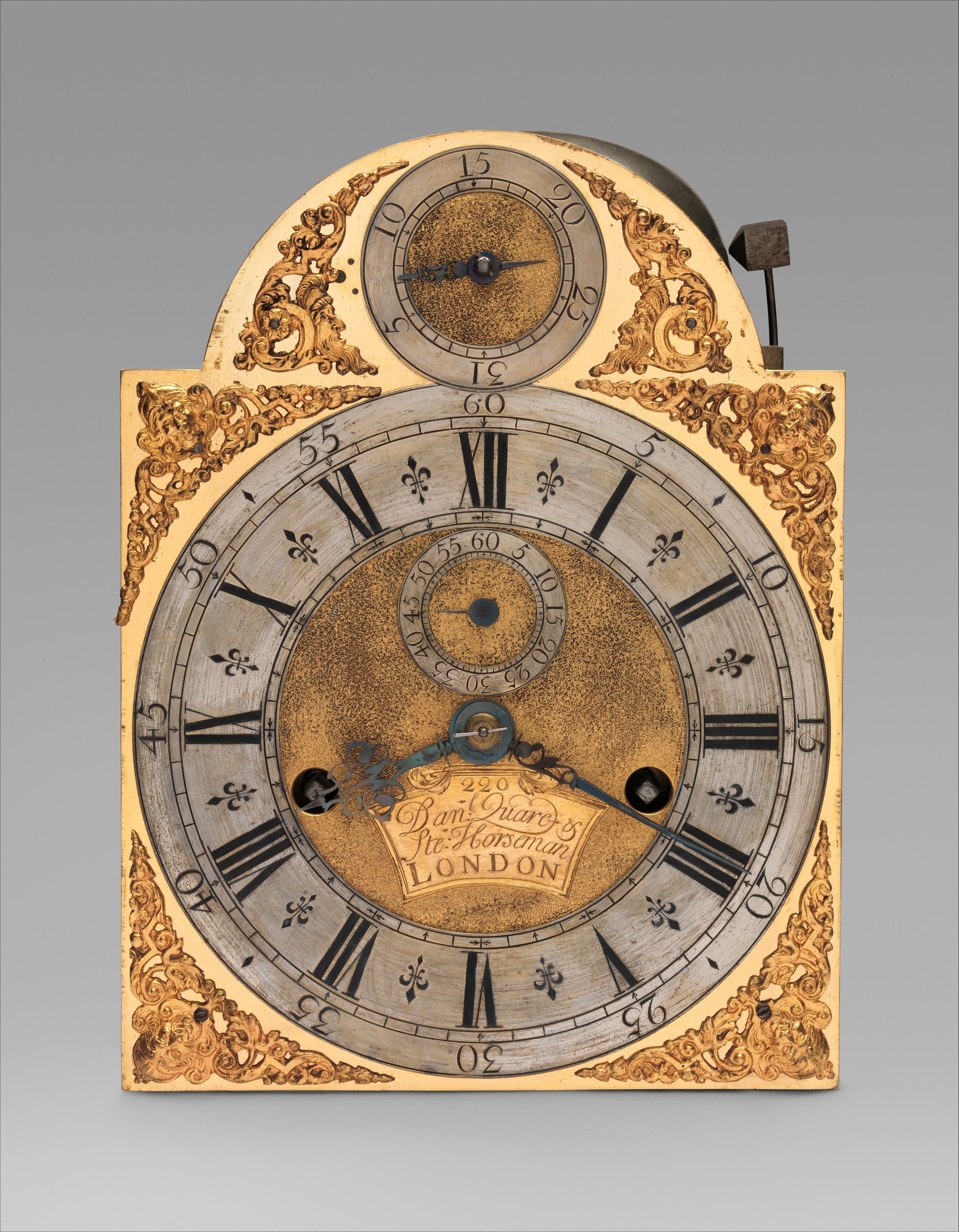
Figure 1. Dial of the Quare & Horseman longcase clock with calendar, c. 1720–25, Metropolitan Museum of Art 64.101.870. Makers Daniel Quare and Stephen Horseman. Image courtesy of The Metropolitan Museum of Art, photographer uncredited, Gift of Irwin Untermyer, 1964. Source collection record. Licence CC0 1.0 Universal. Unchanged.
The portable barometer#
A mercury barometer shows atmospheric pressure by the height of a mercury column. Quare’s portable instrument had to contain mercury and prevent air entry during transport while allowing pressure to act during measurement. Radford quotes the purpose of the patent dated 2 August 1695 as allowing the barometer to be transported upside down without loss of mercury or ingress of air. The original patent roll or complete transcription was not located for this article, and the account follows Radford’s quotation and museum research. 4 8 9 10 11
The Company opposed a monopoly on repeaters in 1687 and also opposed its own member Quare’s barometer patent in 1695. Its history quotes the 3 June resolution to stop the patent. The 30 September record reports it already granted and provides for the Company to defend any members, servants and John Patrick who might be sued. The interests of makers and of holders of exclusive sales rights could diverge from one case to the next. 6
Surviving barometers include the Met’s c. 1695 instrument 64.101.877, Science Museum 1948-227 Pt1 and the Soane Museum’s c. 1710 MP281. The last has folding legs, a scale of 28–31 inches divided into twentieths of an inch, and no signature. The museum attributes it to Quare. Nature in 1948 describes a piece lent to the Science Museum in which a screw presses against the leather bottom of the mercury cistern to fill the tube for transport. A constriction at the top lessens the impact of the mercury. The object documents protection of the measuring system in transit. Portable instruments could stand on a table on legs or hang by a loop on a wall. 8 9 10 11
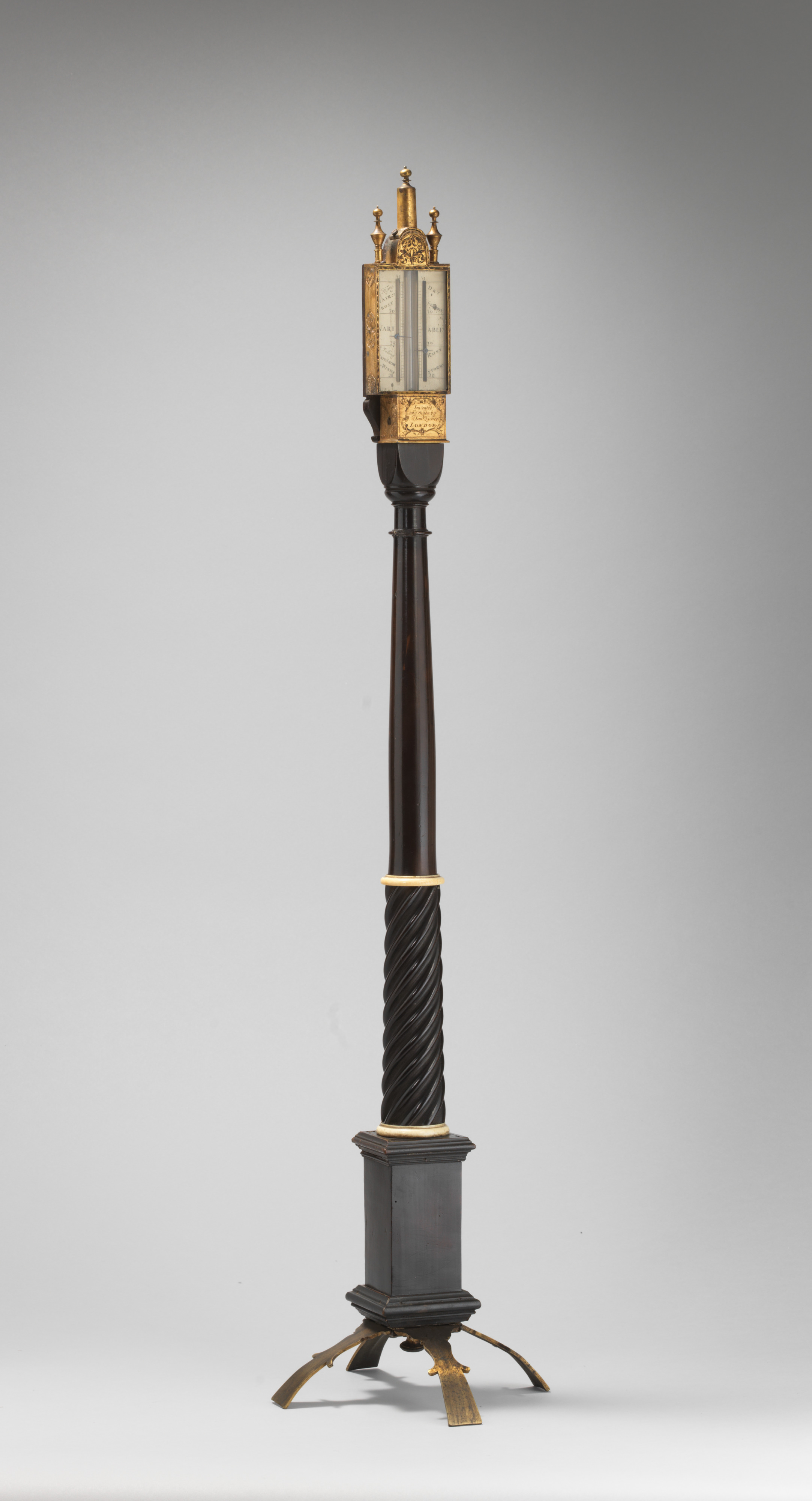
Figure 2. Portable barometer, c. 1695, Metropolitan Museum of Art 64.101.877. Maker Daniel Quare. Image courtesy of The Metropolitan Museum of Art, photographer uncredited, Gift of Irwin Untermyer, 1964. Source collection record. Licence CC0 1.0 Universal. Unchanged.
Other designs and surviving clocks#
Long running requires designing the train, friction, hand load and space for weight drop together with the supply of power. Radford quotes Britten’s account of a year clock running over 13 months with an 81-pound weight dropping 4 feet 6 inches. It mentions a light escape wheel, a counterbalanced minute hand, short arbors and fine pivots. She gives a weight of 72 pounds for the different year clock at Hampton Court. 4
The museum record for Clockmakers’ Company year clock No. 1264 (Science Museum L2015-4174) describes a six-wheel going train, anchor escapement and seconds pendulum. It has a Daniel Marot-style oak case veneered with walnut. The record dates it 1700–1710, or c. 1705 in the description, and says Thomas, first Earl Coningsby, ordered it for an anticipated visit by William III. The king died in 1702, and these details leave the exact sequence of commission and manufacture unclear. Richard Arkwright was a later owner. The clock documents demand for long-running clocks among nobles expecting royal visitors as well as at court. 13
The jointly signed miniature longcase clock 64.101.870, c. 1720–25, runs for 35 days. Its five-wheel going train uses an anchor escapement with a long pendulum. It strikes the hours by rack and snail. The going and striking trains are reversed from the usual layout of the period and both are wound counterclockwise. The interior of the trunk door is hollowed out for weight clearance, helping reduce the case size. The present escapement, pendulum suspension and hour hand are replacements. 2
Mean solar time progresses in uniform hours, while apparent solar time follows the apparent motion of the Sun. In a letter to the Royal Society published in 1719, Joseph Williamson claims to have made clocks for Quare showing these kinds of time. He describes a 400-day clock in the room of Charles II of Spain, made by him for Quare and sold by Quare to the king, with fixed and moving scales. Another type used an oval roller turning once a year and a brass slot through which the pendulum spring passed, changing the effective length of the pendulum to follow the apparent Sun. Williamson also reports a clock sold to William III and installed at Hampton Court during his lifetime. 14
The letter is a claim to priority by one participant, and it documents relations among the workshop, maker, seller and customer. Quare also brought skilled makers and clients together. Williamson discusses the effect of temperature on pendulum length and says he completed a table in 1711 based on several years of observing the Sun’s meridian transit. 14
The double longcase clock ZBA0474 at Greenwich was purchased for the hospital Council Chamber in 1716 and runs for a month. It contains two independent pendulum-controlled mechanisms, with sidereal time on the left and mean solar time on the right, and indicators of day and month and the equation of time at the upper centre. The two kinds of time can be compared on the same clock, each with its own pendulum and mechanism. 7
The case and dial also aid reading. On the Met’s miniature longcase clock, gold-coloured ornament contrasts with silver-coloured chapter rings, with hours and minutes, seconds and calendar in separate areas. The case uses walnut veneer, column-like woodwork and pierced carving. The dial door, trunk for the falling weights and supporting base are combined in a compact piece of furniture. 2
Technical context and clockmaking of the period#
The power supply, train and regulating organ each have distinct roles. The falling weight drives the train, which transmits motion to the hands. The escapement meters the train’s movement and acts on the pendulum to sustain its oscillations. The Met’s 35-day clock has a going train and anchor escapement controlled by a long pendulum, with a separate striking train. 2
Long running on one winding and a small daily error are separate properties. Descriptions of a light escape wheel, balanced minute hand and fine pivots on the year clock show how limited power can be used for longer. Williamson’s problem of pendulum length and temperature affects the stability of the oscillation period. The train and load and the stability of the regulator each contribute in different ways. 4 14
Comparing clocks at sea posed different conditions from comparing them indoors. The Bruce–Oosterwijck marine longitude pendulum clock of around 1662 at National Museums Scotland documents another maker’s effort to use a pendulum amid ship motion. A marine clock had to keep reference time despite motion and humidity. The Longitude Act of 1714 set rewards for finding longitude at sea, and using clocks to compare times was one approach pursued. 17 18
Quare’s securely attributed double clock for the Royal Hospital for Seamen shows sidereal and mean solar time in one place. Williamson’s own account describes making and observing to display apparent solar time. Clockmakers, makers carrying out calculations and observations, and institutions and courts using clocks all took part. The functions and social roles of the clocks sold under Quare’s name are clearer in this context of specialist work. 7 14
The Clockmakers’ Company opposed a monopoly in 1687 on repeaters several clockmakers already made, and in 1695 resolved to protect others in the case of Quare’s barometer patent. Priority, ease of use and sales rights were distinct issues. The circumstances of production and sale help explain technical questions later addressed by striking watches and barometers. 6
Posthumous reputation, preservation and research#
Quare’s reputation can be traced through writings published after his death and through the collection, study and restoration of surviving objects.
John Adams’s “Clarendon, no. 3” of 27 January 1766 uses a clock as a metaphor for a political system, distinguishing design from workmanship. It names Quare, Tomlinson and Graham as examples of clockmakers able to make a clock as accurate as possible. Over 40 years after Quare died, his name still conveyed skilled workmanship in political debate across the Atlantic. 15
Audible time, clearly differentiated hour and minute displays and longer running with less frequent winding remain important to understanding historical clocks and watches. Records of their use and dated, signed, surviving mechanisms let us examine designs for portable watches and longcase clocks of the seventeenth and eighteenth centuries.
Long-running clocks preserve solutions to the problem of lightening trains and hands and delivering power efficiently. The work inside the Met miniature longcase clock’s door shows how the case and mechanism were made to fit together. Its design accounts for weight size, drop, winding and available space for the train. The surviving object makes it possible to examine how the clock ran for a long period between windings. 2
Transport, measurement position and prevention of air entry are separate aspects of the portable barometers. The 1948 Nature description and present collection records show uses that the 1695 patent summary alone cannot. The instruments and documents record concrete ways to make a fragile mercury-column instrument portable. 8 9 10 11
Preservation also means documenting repairs and replacements. The Met’s research on 64.101.870 records the replaced hour hand, escapement and pendulum suspension, the repaired minute hand and distortions of the wooden case. Identifying later work helps reconstruct the original design and changes in use. Collection records document the construction as well as preserving the piece. The Royal Museums Greenwich page listed ZBA0474 in the collection and off display on 19 October 2026. 7 2
Quare’s religious and working lives overlapped. Radford records that he endured fines and seizures while using his access to the king to help other Quakers. Court connections, Company office, a business partnership and family marriages extended the social reach of his work and religious activities. 4
Major clients and patrons#
Williamson’s account of manufacture and sale adds first-hand testimony to the biographical account of William III’s clock. In the same letter the maker claiming priority records a sale to Charles II of Spain. William’s year clock was intended for his bedchamber and Charles’s 400-day clock stood in the king’s room, evidence of a demand for long-running clocks in court interiors. 4 14
Earl Coningsby is connected with Clockmakers’ Company No. 1264 as its patron. The museum record locates the 1716 double clock in the Royal Hospital for Seamen’s Council Chamber and gives payment in 1718. An aristocrat’s house and a public institution offered different settings for commissioning a clock. Named patrons and surviving examples document demand at court, in homes and at institutions. 7 13
The Met records both the oath that prevented his appointment and his access to the aristocracy. 2 The Duchess of Marlborough’s witness signature at Elizabeth’s wedding to Sylvanus Bevan shows that Quare’s family also had ties to influential people through marriage. 4
Year clock No. 1264 later belonged to Richard Arkwright. Met 64.101.870 was owned by theatre impresario David Belasco before passing by auction and dealer to Irwin Untermyer’s collection. Working clocks went from houses and public institutions to collections and preservation. The Met points to the 1730 bankruptcy notice of Horseman, who continued in business after Quare’s death. 2 13
Design and characteristics#
The mechanism, case, display and signature can be compared on individual objects.
Long running. The 35-day and year clocks have different requirements for train, power and case. Weight mass and drop and the loads from the train and hands determine how long they run between windings. 2 13
Wooden cases and metal dials. No. 1264 has a Marot-style walnut-veneered oak case, date aperture and silver ornament. Met 64.101.870 has calendar, seconds, hour and minute displays in a slim walnut-veneered case, pairing elaborate cabinetry and complex mechanism. 2 13
Signatures and joint names. No. 1264 is marked “Dan Quare London” and “Daniel Quare, London”. The dial of Met 64.101.870 is jointly signed by Quare and Horseman and marked No. 220. The change from an individual to a joint business appears on the objects. 2 13
Audible display. Repeaters communicate the time by sound. Quare’s one-action system gave the hours and quarters on demand alongside the visual indication. 12
Literature and sources#
Emma L. Radford’s 1896 Dictionary of National Biography entry draws on Quaker registers, Company histories, newspapers, patent registers and Britten’s clockmaking research to connect his career and work. It documents family marriages, seizures, royal audiences and the will. 4
Williamson’s 1719 letter gives a participant’s account of mechanisms for mean and apparent solar time, sales through Quare and temperature effects. The Company resolutions of 1687 and 1695 show different responses to exclusive rights. Museum studies address dimensions, trains, signatures, restoration and provenance. Records of the objects and their history help distinguish original manufacture from later changes. 6 14 2
The Antiquarian Horological Society’s bibliography lists George C. Kenney’s “Daniel Quare’s numbered clocks” (2016, pp. 37–54) and Richard Higgins’s study of the patent, function and mechanism of the portable pillar barometer (2007, pp. 787–797). They offer ways into Quare’s work through object numbering and the patent. 16
Object numbers and archival citations link documents to surviving work. The Met locates Horseman’s admission in Clockmakers’ Company Court Minute Books Ms. 2710/3, p. 98r, for 29 September 1709. It cites p. 2 of the London Gazette of 28 November–1 December 1730 for his bankruptcy. Objects, minutes and notices document signatures, provenance and careers in different ways. 2
Timeline#
Life and workshop#
- c. 1648/49. Probably born in Somerset. 4
- 3 April 1671. Admitted to the Clockmakers’ Company as a brother. 4 The Met identifies his trade as turret-clock making. 2
- 18 April 1676. Marries Mary Stevens at the Devonshire House Quaker meeting house. 4
- 1678 – Goods worth £5 seized for non-payment of parish church rates. 4
- 1679 – Two clocks and two pocket watches seized for non-payment of the militia levy. 4
- 1683 – Goods worth £195 17s. 6d. seized from Quare and five others for attending a meeting. 4
- 1685 – Moves to the King’s Arms in Exchange Alley, London. 4
- March 1686. A London Gazette advertisement reports a lost Quare pocket watch with a single hand revolving in six hours. 4
- 4 June 1686. Summoned as a Quaker representative before James II’s commission inquiring into toleration. 4
- 1687 – Edward Barlow applies for a patent for the repeater. The Company cites Quare’s earlier invention and the patent is refused. 4 James II is involved in the decision and favours Quare’s mechanism. 4 5
- 1689 – Fined again and later protected by William III. 4
- 2 May 1695. According to Radford, arranges a private audience with William III for Whitehead and three others. 4
- 3 June 1695. Clockmakers’ Company resolves to try to stop Quare’s portable barometer patent. 6
- 2 August 1695. Patents the portable barometer. 4
- 7 February 1695–6, in original year notation. Quare and 19 other Quakers petition Parliament. 4
- 1697 – Elected to the Company’s Court of Assistants. 4
- Before William III’s death in 1702. Williamson’s 1719 letter mentions a clock for the king installed at Hampton Court. 14
- 1705 – Quare serves as warden of the Company. 4 Anne marries John Falconer, with diplomatic representatives in attendance. 3
- 1707 – Serves again as warden. 4
- 29 September 1708. Becomes master of the Clockmakers’ Company. 4
- 1709 – Apprentice Stephen Horseman gains the freedom of the Company. 4
- 1711 – Williamson later says he completed his table based on observations of the Sun’s transit. 14
- 10 November 1715. Elizabeth marries Sylvanus Bevan. The Duchess of Marlborough and 72 others sign the marriage register. 4
- 1716 – Makes a double longcase clock showing sidereal and solar time for the Royal Hospital at Greenwich. It sells for £70, paid in 1718. 7
- c. 1718. Horseman becomes partner and the firm trades as Quare and Horseman. 2
- 3 May 1723. Makes his will, distributing his estate among his wife, children and grandchildren. 4
- 21 March 1724. Dies at his house in Croydon. 4
- 26 March 1724. The Daily Post publishes an obituary and reports that his apprentice Horseman would continue the business. 4
- 26 March 1724. Will proved, leaving Mary £2,800 and two gold watches among other bequests. 4
- 27 March 1724. Buried at the Quaker burial ground in Bunhill Fields, London. 4
- 4 November 1728. Mary dies at 77. 4
- 1730 – The Met cites the notice of Horseman’s bankruptcy in the London Gazette, 28 November–1 December, p. 2. 2
Posthumous reputation, collections and research#
- 27 January 1766. John Adams uses Quare as an example of skilled clockmaking in “Clarendon, no. 3”. 15
- 1896 – Radford’s biography appears in volume 47 of the Dictionary of National Biography. 4
- 11 December 1948. “Portable Barometer”, Nature 162, p. 919, describes the transport mechanism of a surviving barometer lent to the Science Museum. 11
- 1964 – The Met receives longcase clock 64.101.870 and portable barometer 64.101.877 from Irwin Untermyer. 2 10
- 2015 – The Met publishes European Clocks and Watches in The Metropolitan Museum of Art. The object page gives construction, restoration and provenance information drawn from the study. 2
- 2016 – Publication of George C. Kenney’s “Daniel Quare’s numbered clocks”, as listed in the AHS bibliography. 16
References#
- Daniel Quare, Britannica. Accessed 18 October 2026.
- Met, Miniature longcase clock with calendar, 64.101.870. Clare Vincent / Jan Hendrik Leopold, with Elizabeth Sullivan, European Clocks and Watches in The Metropolitan Museum of Art (2015), collection study. Accessed 19 October 2026.
- Keith Bates, Daniel Quare – Master Clockmaker (2021). Accessed 18 October 2026.
- Emma L. Radford, Quare, Daniel, DNB47 (1896). Accessed 19 October 2026.
- The Antique Clock Company, Daniel Quare. Accessed 18 October 2026.
- Atkins / Overall, Some Account of the Worshipful Company of Clockmakers (1881), pp243–244. Accessed 18 October 2026.
- Royal Museums Greenwich, Double longcase clock, ZBA0474. Accessed 19 October 2026.
- Science Museum, Barometer by Daniel Quare, 1948-227 Pt1. Accessed 19 October 2026.
- Soane Museum, Portable pillar barometer MP281. Accessed 18 October 2026.
- Met, Portable barometer 64.101.877. Accessed 19 October 2026.
- Portable Barometer, Nature 162, 919, 11 December 1948, public abstract. Accessed 18 October 2026.
- Met, Graham pair-case watch 52.62a–d, history of striking mechanisms. Accessed 18 October 2026.
- Science Museum / Clockmakers No. 1264, Year-going longcase clock by Daniel Quare. Accessed 19 October 2026.
- Joseph Williamson, Philosophical Transactions 30(363), 31 December 1719, pp.1080–1082. Accessed 18 October 2026.
- John Adams, Clarendon no3, 1766-01-27. Accessed 18 October 2026.
- Antiquarian Horological Society, List of articles, article bibliography. Accessed 18 October 2026.
- National Museums Scotland, Calculating longitude at sea: The clock that tried to solve the problem. Accessed 19 October 2026.
- Royal Museums Greenwich, Longitude found – the story of Harrison’s timekeepers. Accessed 19 October 2026.