This article was translated from Japanese using AI. Read the Japanese original
David Saul Landes (29 April 1924–17 August 2013) was an American economic historian who taught history and economics at Harvard University. A collector of antique timepieces, he brought the people who wanted clocks and watches, the makers who improved their accuracy, and the industries that made them widely available into a single history. His 1983 book Revolution in Time describes how timekeeping instruments became part of the systems that support modern commerce and daily life. 1 2 4
From economic history to the history of timekeeping#
Born in New York City, Landes earned his bachelor’s degree from the City College of New York in 1942 and his master’s degree from Harvard the following year. After serving in the US Army Signal Corps, he returned to graduate school and earned a doctorate in history in 1953. He taught at Columbia University and the University of California, Berkeley, and joined Harvard’s history department in 1964. He moved to the economics department in 1977 and retired in 1997 as a professor of history and economics. 1
His early work concerned French entrepreneurs and bankers. Bankers and Pashas, based on his dissertation, traced transactions between the nineteenth-century Egyptian government and French bankers. An essay commissioned in 1954 on technological change in Europe developed into The Unbound Prometheus (1969). It placed sustained gains in productivity through technological innovation at the centre of European industrialisation. In his work on timekeeping, too, he related the quality of machines to the decisions of the people who made, used and distributed them. 1 3
Handling antique timepieces was part of what drew him to the subject. Citing the original preface, the historian of technology François Sigaut says Landes was fascinated by an old striking watch owned by economic historian Carlo Cipolla and sought a similar piece in Paris in 1972. Harvard’s memorial also quotes Landes on the appeal of finding ingenious construction, craftsmanship and beauty together in a single object. For Sigaut, the episode mattered as an example of a researcher encountering the market for old watches and the knowledge of specialists and collectors. 1 5
What a clock makes possible#
The published extract from Part I of Revolution in Time starts by asking who needed clocks in the first place and why. Changes in daylight and seasons suffice to suggest broad times for work, rest, sowing and harvest. Landes quotes a play complaining about the introduction of a sundial in ancient Rome, showing how acting at a set time adds new demands to the practice of reading time from natural cycles. 4
In a 2003 essay Landes argues that mechanical clocks made it possible to count repeated motions and use them as units of time. For makers, the pursuit of accuracy raises questions about the dimensions of parts and precision of tools. Users can refer to the same time to plan transport or compare output over equal intervals. Landes thus looked at how instrument accuracy relates to the organisations and societies that value it. 6
Navigators use a time difference to find longitude. Taking the Earth to rotate 360 degrees in 24 hours of mean solar time, one hour corresponds to 15 degrees of longitude. Keeping the time of a reference location aboard ship and finding local time by observation can establish an east–west position. In his 1979 article Landes also notes that captains learned the usual gain or loss of their chronometers and allowed for it in their calculations, and that purchase costs affected adoption. The example connects instrument accuracy with the practices that made it usable at sea. 3 6 7
Making precision parts repeatedly#
Landes’s 1979 article “Watchmaking: A Case Study in Enterprise and Change” traces how the portable-watch industry developed different strengths in different places. He highlighted watches as fashionable accessories in France, precision and rationalised production in England, mass production for diverse markets in Switzerland, and assembly from precision-machined interchangeable parts in the United States. He also explains that tariffs constrained watch distribution more than freight costs, leading to a trade in movements imported and cased in the markets where they would be sold. 3
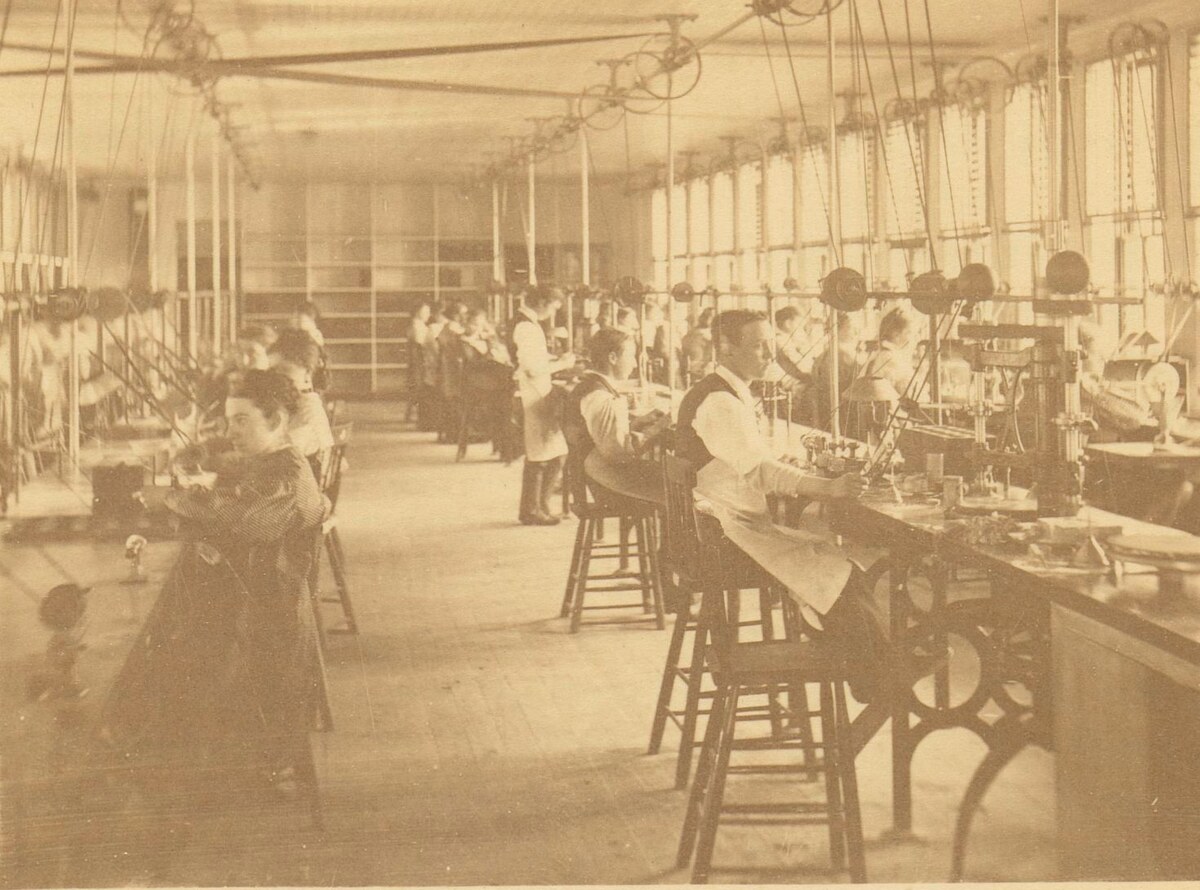
Figure. Pinion finishing room of the American Watch Company’s Waltham factory. Photograph by Thomas R. Lewis, circa 1874–1879. Original from the Rijksmuseum, Amsterdam (RP-F-2001-7-980-60). Source Wikimedia Commons file. Image under CC0 1.0. The photograph was cropped from the spread, resized and recompressed as a JPEG, and metadata was removed.

A. C. Davies’s study of the British watch industry clarifies the comparison through manufacturing processes. Traditional English production divided work among specialists making dials, springs, screws and wheels. At Waltham, specialised machines at different stages made it possible to produce parts of the same dimensions repeatedly. Spring strength still varied, so balance springs were graded by strength and matched with balances. Increasing output thus required more precise machinery and methods for sorting and assembling large numbers of parts. 8
Explaining the spread of clocks and watches#
In his 2003 essay Landes connected the development of the European mechanical clock with a concern for precision and competition in technology. He acknowledged the sophistication of Chinese water clocks and argued that Chinese artisans did not fully acquire the techniques for making European-style clocks after such instruments reached China. His Qing court example comes from the Jesuit Dominique Parrenin’s report of rewards and punishments connected with astronomical observation. 6
Art historian Catherine Pagani examined Qing court records and found that European and Chinese artisans worked in the same workshops under the Kangxi Emperor. Some trained there later became masters during the Yongzheng and Qianlong reigns. The Palace Museum’s clock exhibition identifies the Qing court workshops and Guangzhou as places of manufacture. Pagani’s research adds evidence of manufacturing and the transfer of skills in workshops to Landes’s example of the organisation of observation. 9 10
On the question of invention, Sigaut noted that monasteries’ need to keep prayer times may explain a demand for clocks, while explaining the emergence of the mechanical clock requires evidence beyond that demand. In a 2009 study of England and Wales from 1300 to 1800, Paul Glennie and Nigel Thrift examined how different communities communicated clock time and used it in daily life, through public bells and privately owned timepieces, among other means. Different records document the invention of the clock, the reach of access to clock time and the habit of acting at set times. 5 11
Timeline#
| Year | Event |
|---|---|
| April 1924 | Landes is born in New York City. 1 2 |
| 1942–1953 | He graduates from City College, serves in the US Army Signal Corps and earns his doctorate at Harvard in 1953. 1 |
| 1964–1969 | He joins Harvard’s history department. The Unbound Prometheus is published in 1969. 1 |
| 1972 | Intrigued by a watch Cipolla owns, he seeks a similar one in Paris, according to Sigaut’s account of the original preface. 5 |
| 1977–1979 | He moves to the economics department and publishes his comparative article on watchmaking in 1979. 1 3 |
| 1983 | Revolution in Time is published. 1 |
| 1997–1998 | He retires from Harvard. The Wealth and Poverty of Nations is published the following year. 1 |
| 2000–2003 | A revised and expanded Revolution in Time appears. A lecture of the same name is scheduled at the University of Pennsylvania in November 2001. In 2003 he contributes an essay on timekeeping and economic development to Dædalus. 4 6 |
| August 2013 | He dies aged 89. 1 2 |
| May 2014 | Harvard’s Faculty of Arts and Sciences enters a memorial minute in its records. 1 |
References#
- Benjamin Friedman, Henry Rosovsky and Claudia Goldin, “David Saul Landes”, Harvard Faculty of Arts and Sciences memorial minute, 2014. Accessed 21 November 2026.
- National Academy of Sciences, “David S. Landes”, membership record and life dates. Accessed 21 November 2026.
- David S. Landes, “Watchmaking: A Case Study in Enterprise and Change”, Business History Review 53, no. 1, 1979, pp. 1–39. DOI 10.2307/3114685. The public abstract and notes 1 and 20–22 on Cambridge Core were consulted. Accessed 21 November 2026.
- University of Pennsylvania, Wolf Humanities Center, “Revolution in Time”, notice for the lecture of 14 November 2001 and extract from Part I of the 2000 edition. Accessed 21 November 2026.
- François Sigaut, review of Landes’s L’heure qu’il est, Annales 44, no. 6, 1989, pp. 1554–1556. Accessed 21 November 2026.
- David S. Landes, “Clocks & the wealth of nations”, Dædalus 132, no. 2, spring 2003, pp. 20–26. Accessed 21 November 2026.
- D. Graham Burnett, “Mapping time”, Dædalus 132, no. 2, spring 2003, pp. 5–19, section and sidebar on marine chronometers. Accessed 21 November 2026.
- A. C. Davies, “Time for a Change? Technological Persistence in the British Watchmaking Industry”, Material History Review no. 36, autumn 1992, especially paragraphs 2–10. Accessed 21 November 2026.
- Catherine Pagani, “Clockmaking in China under the Kangxi and Qianlong Emperors”, Arts Asiatiques 50, 1995, pp. 76–84, particularly p. 79 on court workshops and Chinese apprentices. Accessed 21 November 2026.
- The Palace Museum, “The Gallery of Clocks”, gallery description. Accessed 21 November 2026.
- Paul Glennie and Nigel Thrift, Shaping the Day: A History of Timekeeping in England and Wales 1300–1800, Oxford University Press, 2009, public abstracts for chapters 3 and 5. Accessed 21 November 2026.