This article was translated from Japanese using AI. Read the Japanese original
A maker of timekeepers and navigational instruments#
Edward Massey (1768–1852) was an English watchmaker, escapement maker and inventor of navigational instruments. His name is associated with the Massey lever escapement for pocket watches and mechanical instruments for measuring a ship’s speed and the depth of the water. His father, also a clockmaker, had the same name, so early sources distinguish the son as “Edward Massey the Younger”.1 2
Timekeepers and navigational instruments serve different purposes, but both use gears and shafts and require rotation to be controlled and read. Massey made timepieces and escapements for use in other makers’ watches. For use at sea he improved instruments that turned rotation into a reading of distance or depth. This work involved specialist parts suppliers, practical trials and successive refinements.2 3
Life and places of work#
Massey was born in Newcastle-under-Lyme, Staffordshire. According to a maritime history study, he learned clockmaking from his father and became a freeman of the town in 1790. He went into business independently in 1802 after working for his father, and made navigational instruments in Hanley and Burslem. His father died in 1813.1 2
The Science Museum Group’s biographical record says he received 20 guineas from the Society of Arts in 1803 for a striking train without an air-resistance fly, moved to Coventry in 1813 and had opened a manufactory in Clerkenwell, London, by 1825. The maritime history study places his residence and work in Prescot, Lancashire, from 1819 to 1830. A manufactory could be elsewhere than his home, but the sources do not fully establish how the dates fit together.1 2
The area around Prescot supplied watch parts. Escapements bearing Massey’s name also occur in watches signed by other makers or sellers.3 12
The Massey lever escapement#
In a mechanical watch, the escapement releases power from the mainspring and train in steps and supplies energy to the oscillating balance. In a lever escapement the lever, which alternately locks the escape wheel, periodically contacts a part on the balance. In a detached escapement they are apart for most of the oscillation. The earlier rack lever by Litherland was widely used and remained engaged with the balance.3
According to a history of watchmaking, from about 1812 Massey developed a detached design in which a projection on a roller on the balance staff moves the lever. There were several forms, and later variants used a jewelled impulse pin. Later English lever escapements developed a flat roller and a separate, smaller safety roller. Several makers contributed to this development.3 5
A study of technical innovation mentions a patent for a detached lever in 1814. An antique dealer’s description gives No. 3854 as Massey’s patent of the same year concerning pull-push winding. These accounts rely on secondary sources. The original specifications and detailed scope of the claims remain unverified here.6 11
No. 3552 at the National Maritime Museum in Greenwich is signed “John Wood Liverpool” and has Chester hallmarks of 1826–1827. It has a Massey type II escapement, a running time of about 30 hours and maintaining power during winding. The museum questions the provenance relating to its presentation.12
A watch bearing the name Baldwin & Jones is also reported to have a Massey escapement and an “EMP” mark. The stamp provides a clue to the origin of a part. On its own it leaves open who made the complete watch and how it was exported.7
Measuring depth and the ship’s movement#
How the sounding machine worked#
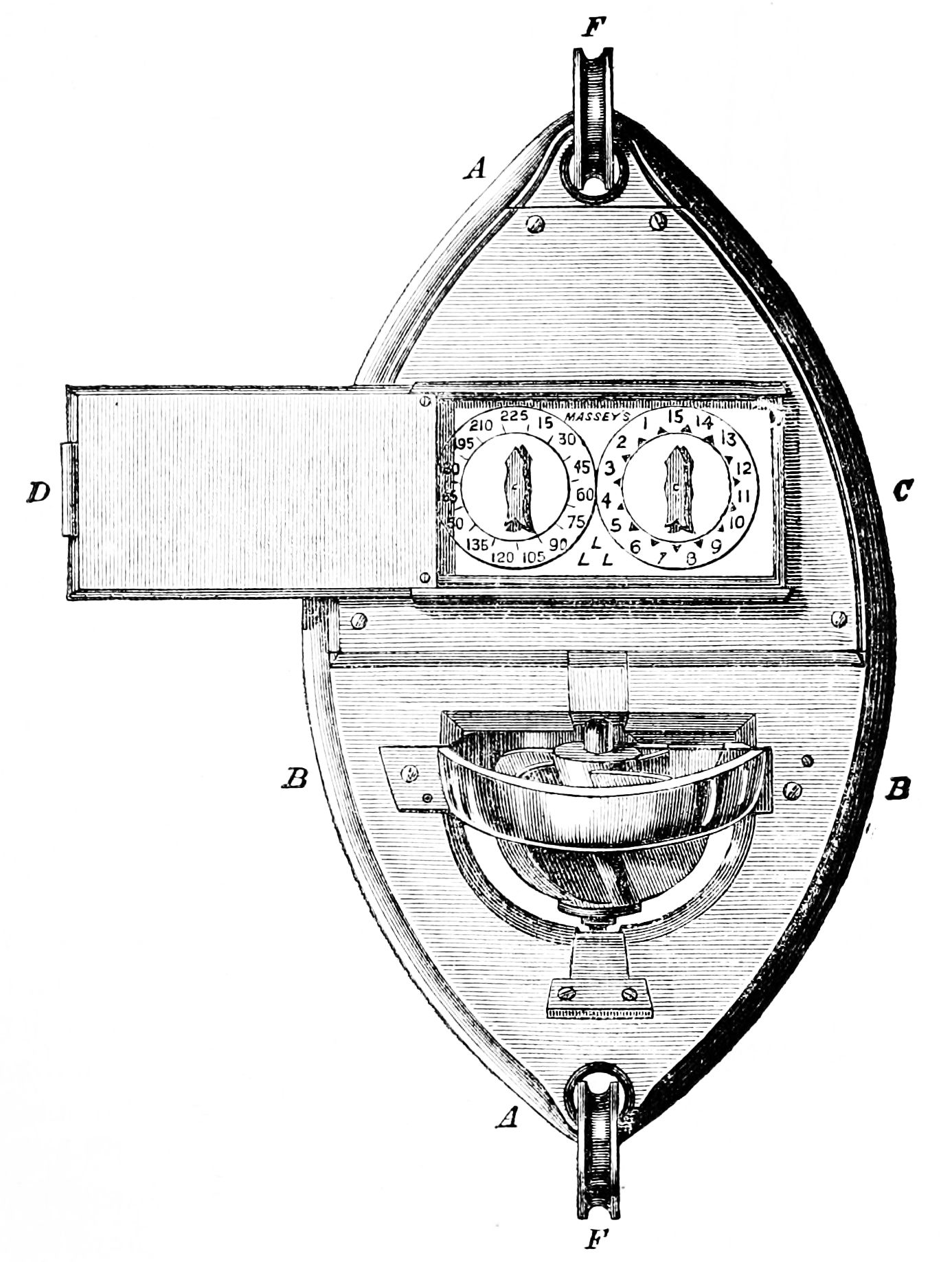
Massey sounding machine as illustrated in a magazine in 1873. Artist unknown. Source: Wikimedia Commons. Public domain under the US copyright term and Japanese copyright law. Unmodified.

Knowing the depth at sea helped prevent grounding. The Science Museum Group describes surviving examples of the sounding machine Massey patented in 1802. As it is lowered on a line, water turns a rotor whose motion passes through a worm to a counting mechanism. The mechanism stops at the seabed. The scales are read once the instrument is brought back up. The instrument records the descent itself, replacing direct counting of the length of line paid out.8
According to the maritime history study, patents No. 2601 of 1802 and No. 2938 of 1806 focused on sounding and also covered measuring a ship’s speed as a secondary use. The early log tended to break the surface, and a simpler competing instrument temporarily displaced the sounder.2
Improvements to the log#
A ship’s log uses the motion of the ship relative to the water to turn a rotor and transmit its rotation to an indicator. A German technical journal of 1835 describes a patent granted to Edward Massey the elder on December 9, 1834. It shows a rotor immersed below the stern, gears and an indicator driven through a vertical link. The account also describes a stop to prevent the worm of a sounder from continuing to turn during retrieval. This is a contemporary description of the patent rather than the original specification.9
A sounder dating to about 1836 in the Science Museum Group collection has a ring protecting the rotor and a mechanism that uses water pressure to stop the vanes turning during retrieval. The museum describes it as an improved version of the 1836 patent. Counting underwater, protection from impact and avoiding false counts during recovery were all practical concerns.10
In 1844 Massey applied for a patent on an electric ship’s log. In the device described by the maritime historian, the rotor towed behind the stern made and broke a contact. An electromagnet aboard the ship advanced a gear one tooth at a time. A Daniell cell on the ship supplied the current and a dial showed distance travelled. Electrical signals carried the motion back to the ship in place of a long mechanical transmission. The same study records an improvement patent in 1848 and further work by Massey’s nephew Thomas F. Walker.2
Surviving work and assessment#
According to the Science Museum Group, the Navy bought Massey’s chronometer No. 1 for 50 guineas in 1842 after trials at Greenwich Observatory. The purchase documents a public use, while the record alone does not give the chronometer’s trial ranking or performance during a voyage.1
Massey worked as a specialist maker of watch parts and a maker of navigational instruments. An escapement connects the oscillator and the wheel train, while a sounder connects motion through water with a counter. The devices are distinct inventions that share an interest in transmitting rotation reliably and stopping it when required.
Timeline#
- 1768 – Born in Newcastle-under-Lyme.1
- 1790 – Becomes a freeman of the town.1
- 1802 – Goes into business independently and obtains a patent chiefly concerned with sounding.2 8
- 1803 – Receives an award from the Society of Arts for his striking train design.1
- 1806 – Applies for patent No. 2938 on improvements to navigational instruments.2
- 1813 – His father dies. The museum’s biographical record records his move to Coventry.1 2
- 1814 – Secondary sources describe a patent for a detached lever and patent No. 3854 relating to pull-push winding.6 11
- By 1825 – Opens a manufactory in Clerkenwell.1
- 1834–1836 – Patents and surviving instruments record improvements to the log and sounder.9 10
- 1842 – The Navy buys chronometer No. 1 after trials.1
- 1844 and 1848 – According to the maritime history study, applies for patents on the electric ship’s log and an improvement.2
- 1852 – Dies.1
References#
1. Science Museum Group, Edward Massey, biographical record. Accessed November 4, 2026.
2. J. Pottinger, “Massey’s Patent Electric Log”, Liverpool Nautical Research Society, Merseyside Maritime Research 2008, pp. 53–59. Accessed November 4, 2026.
3. David Boettcher, English Watchmaking, sections on lever escapements and the division of trade. Accessed November 4, 2026.
5. Joseph Johnson and John Johnson, description of escapement types. Accessed November 4, 2026.
6. BADA, Rare Pull Wind Gold English Duplex, dealer’s object description. Accessed November 4, 2026.
7. Colonial Watches, Baldwin & Jones, object description. Accessed November 4, 2026.
8. Science Museum Group, Massey’s sounding machines, 1876-775/1–2. Accessed November 4, 2026.
9. Polytechnisches Journal, Verbesserungen an den Apparaten zum Messen der Geschwindigkeit von Schiffen und zum Sondiren der See, vol. 58, 1835, p. 214. Accessed November 4, 2026.
10. Science Museum Group, Massey’s patent, frictionless ocean depth sounder, 1874-69. Accessed November 4, 2026.
11. Tony Proctor, Collaboration and networking in the process of innovation: the path to precision time keeping, Journal of Management History 19(2), 2013, p. 179. Accessed November 4, 2026.
12. Royal Museums Greenwich, No.3552, JEW0235. Accessed November 4, 2026.