This article was translated from Japanese using AI. Read the Japanese original
Henry Kater (1777–1835) was a British army officer and geodesist who worked on triangulation in India. In London, he turned a pendulum upside down and compared its swings in the two positions to find the equivalent length of a pendulum that takes one second of mean solar time to swing in one direction. His measurement was later used in the British legal provision for restoring the standard yard if the original were lost. Late in life he also worked on astronomical clocks, devising an escapement designed to reduce how much variations in the force of the gear train affected the pendulum. 1 3 6 10
From Bristol to surveying in India#
Kater was born in Bristol on 16 April 1777. His father was a sugar refiner, and in September 1794 Kater began training in the office of a local solicitor, Matthew Mills Coates. After his father’s death he left the office and resumed studying mathematics in preparation for military service. In April 1799 he became an ensign in the 12th Regiment of Foot and went to Madras. In southern India he assisted William Lambton in surveying between the Malabar and Coromandel coasts. By using a measured baseline and angles taken at different stations to link triangles and determine distances and positions, the work laid the groundwork for the Great Trigonometrical Survey of India. 1 2
Kater was elected a Fellow of the Royal Society in December 1814. In March 1816 the House of Commons called for the length of a seconds pendulum at the latitude of London to be compared with a standard scale and for its variation with latitude to be investigated. As a member of the Royal Society committee, Kater tackled the problem by combining a clock to measure time with a test pendulum to determine length. 1 3 4
Measuring a seconds pendulum with two knife edges#
The period of a pendulum with a rod and weights depends on the distance from the pivot to the centre of mass and the distribution of mass. Kater fitted a brass bar with two steel knife edges. He suspended it from each edge in turn, reversing the pendulum to compare the results. The knife edges stayed fixed while he moved the weights to match the periods about the two pivots. For small swings, when two pivots on opposite sides of the centre of mass and at unequal distances from it give equal periods, their separation is the length of a simple pendulum with that period. The instrument applied Huygens’s principle that the pivot and centre of oscillation are interchangeable to a distance that could be measured directly. In an addendum to his 1826 paper, Kater noted that Johann Gottlieb Friedrich von Bohnenberger had proposed the same measurement principle in 1811. 3 5 7
In June and July 1817 Kater made observations at Henry Browne’s house in Portland Place, London. He watched the clock pendulum and test pendulum through a telescope. The time until they swung in step again gave him the small difference in their rates. He repeated the observations before and after reversing the test pendulum and combined them with measurements of the distance between the edges. His 1818 paper gave the length of the London seconds pendulum reduced to sea level and vacuum as 39.1386 inches on Shuckburgh’s standard scale at 62 °F (about 17 °C). In 1819 he revised the corrections for air buoyancy and the height of the observation site and gave 39.13929 inches on the same scale. See Kater’s reversible pendulum for the instrument and corrections. 3 4 5
Swinging the same pendulum at several places makes it possible to compare local gravity from the number of swings it makes in a given time. For geodesy, Kater used an invariable pendulum of fixed configuration. He made comparisons at London, Unst in the Shetland Islands, Portsoy, Leith Fort, Clifton, Arbury Hill and Shanklin on the Isle of Wight. The resulting estimates of Earth’s flattening ranged from about 1/230 to 1/598 depending on the stations paired. The London–Unst pair gave about 1/323. Kater considered whether local geology might have influenced the result at Arbury Hill, one of the stations where the result differed. 4 5
John Goldingham subsequently used in Madras in 1821 the same invariable pendulum that Kater had swung in London in 1820. The Science Museum Group holds pendulum no. 10 of Kater’s design, made by the London instrument maker Thomas Jones in 1827, along with an agate support plane bearing the same number, a telescope, a thermometer and other accessories. The surface supporting the knife edge and the observation instruments were part of the equipment transported to compare measurements at distant stations. 8 9
The standard yard and references for astronomical observations#
The British Weights and Measures Act 1824 designated a brass scale made by John Bird in 1760 as the Imperial Standard Yard. One yard was the distance, at 62 °F, between the centres of marks on two pieces of gold set into the scale. Section 3 of the act specified the ratio between the yard and the length of a seconds pendulum at London’s latitude, at sea level and in vacuum, in case the scale was lost or otherwise unavailable. The provision restored the standard from a ratio of 39.1393 inches for the pendulum length to 36 inches for the yard. 6 7
Kater’s work went from measuring the ratio with instruments to preparing physical standards for use elsewhere. His 1826 report documents orders placed with instrument maker Robert Brettell Bate, comparisons of troy-pound weights and the procedure for adjusting capacity measures against the weight of distilled water. The Imperial standard measures in the Powerhouse collection are examples of these standards embodied in metal vessels. 7 11
For astronomical observations, Kater designed a floating collimator to establish the scale reading when a telescope pointed horizontally or vertically. He mounted a small telescope on a platform floating on mercury, with its crosshairs visible through the observing instrument’s telescope. The observer aligned the two telescopes, read the scale and combined the result with an observation made after reversing the direction to obtain the reference. Kater received the Royal Astronomical Society’s Gold Medal in 1831 for developing the vertical version. 12 13 14
Giving an astronomical pendulum a consistent impulse#
In an astronomical clock, the escapement replaces the energy a pendulum loses to air resistance and friction at its pivot. Kater reasoned that where a tooth pushes against a sloping pallet to drive the pendulum, as in the Graham escapement, irregularities in the force transmitted by the train reach the pendulum. He therefore devised a layout in which the train raises a component and the component drives the pendulum as it falls under its own weight. 10
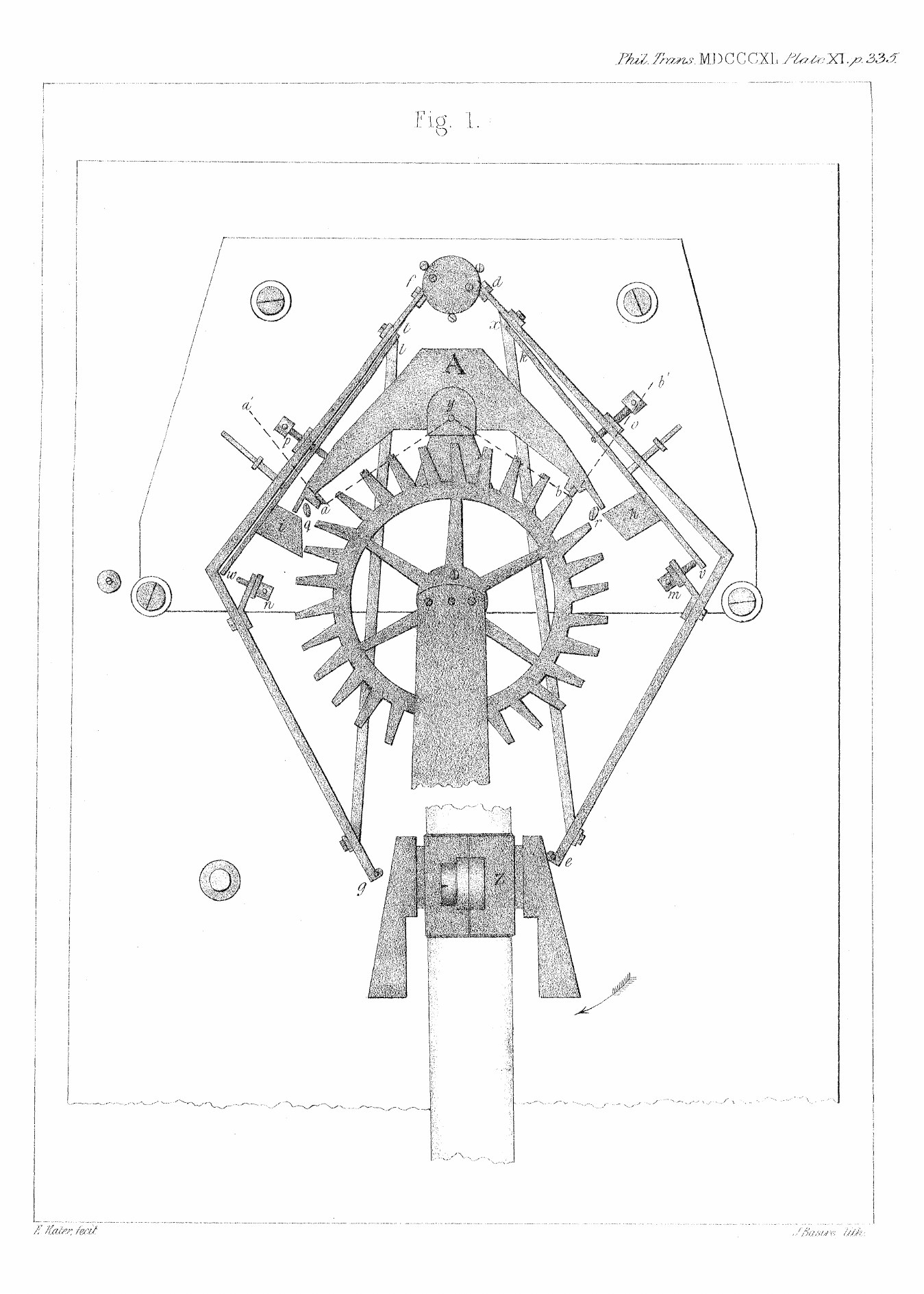
Figure 1. Kater’s escapement for an astronomical clock. Original drawing by Edward Kater, published as plate XI, signed J. Basire. Source: JSTOR scan of the original paper, on Wikimedia Commons. The image is in the public domain. The plate page was converted from PDF to grayscale JPEG.
The central escape wheel is locked by two agate locking pallets on the brass anchor marked A in the diagram. The arms to either side carry separate agate-faced pallets, which the teeth raise by pushing against their sloping faces. As one side falls under its own weight, the arm pushes the pendulum. When the arm’s screw contacts the heavy anchor, the anchor’s inertia briefly slows the arm. In Kater’s design, the pendulum separates from the arm during that interval, and the arm then unlocks the locking pallet. The freed tooth raises the pallet again in preparation for the next swing. By letting the pallet fall under its own weight through the height of the slope, the design aimed to give the pendulum the same impulse each time. 10 15
The clock illustrated in the paper has a glass-tube pendulum rod and a glass vessel below containing mercury for temperature compensation. When the rod expands with heat, the centre of mass moves down, while the mercury’s expansion raises the liquid surface. The two effects balance one another to limit changes in effective length. To keep adhesion to the walls of the vessel from abruptly changing the curvature of the mercury surface, a thin glass disc was floated on it. 10
Kater died in London on 26 April 1835. His son Edward, who had helped with the experiments, compiled his father’s notes and submitted them to the Royal Society through John Herschel. The paper was read on 30 April 1840 and published the same year. According to Edward, his father had continued to modify the design until shortly before his death. Illness prevented him from leaving observations to show how much the last changes stabilised the clock’s rate. 1 10
Chronology#
| Date | Event |
|---|---|
| April 1777 | Born in Bristol. 1 |
| September 1794 | Begins legal training in Matthew Mills Coates’s office. 2 |
| April 1799 | Becomes an ensign in the 12th Regiment of Foot. He goes to Madras and later assists Lambton’s survey. 1 2 |
| December 1814 | Elected a Fellow of the Royal Society. 1 |
| June–July 1817 | Measures the seconds pendulum at Browne’s house. He receives the Royal Society’s Copley Medal in the same year. 1 3 5 |
| January 1818 | Presents his work on the London seconds pendulum to the Royal Society. 3 |
| June 1819 | His paper on observations with an invariable pendulum at survey stations in Britain is read. 4 |
| 1820–1821 | The same invariable pendulum is observed in London and Madras. 8 |
| June 1824 | The Weights and Measures Act defines the Imperial Standard Yard and how to restore it with a seconds pendulum. 6 |
| 1826 | Reports on making and adjusting the new standards of weights and measures. He becomes vice-president of the Royal Society and serves as treasurer from the following year. 1 7 |
| 1831 | Receives the Royal Astronomical Society’s Gold Medal. 14 |
| April 1835 | Dies in London. 1 |
| April 1840 | The paper on the astronomical clock escapement, compiled by Edward from his father’s notes, is read at the Royal Society. 10 |
| 1965 | A Smithsonian study surveys the design and use of reversible and invariable pendulums in nineteenth-century gravity measurements. 8 |
| Verified November 2026 | The Science Museum Group holds invariable pendulum no. 10 of 1827, and the Royal Society holds the original drawing of the astronomical clock escapement. 9 15 |
References#
- Royal Society Archives, “Kater; Henry (1777–1835),” NA1206. Personal authority record. Accessed 21 November 2026.
- Julian Holland, “Kater, Henry (1777–1835), geodesist and metrologist,” Oxford Dictionary of National Biography (2004, 2022 edition). Public excerpt on his birth, training and years in India. Accessed 21 November 2026.
- Henry Kater, “An Account of Experiments for Determining the Length of the Pendulum Vibrating Seconds in the Latitude of London,” Philosophical Transactions of the Royal Society of London 108 (1818), pp. 33–102. Scan of the original paper. Accessed 21 November 2026.
- Henry Kater, “An Account of Experiments for Determining the Variation in the Length of the Pendulum Vibrating Seconds, at the Principal Stations of the Trigonometrical Survey of Great Britain,” Philosophical Transactions of the Royal Society of London 109 (1819), pp. 337–508, especially pp. 337–339 and 414–425. Scan of the original paper. Accessed 21 November 2026.
- Richard J. Howarth, “Gravity Surveying in Early Geophysics. I. From Time-Keeping to Figure of the Earth,” Earth Sciences History 26(2) (2007), pp. 201–228, especially pp. 210–215. Paper at UCL Discovery. Accessed 21 November 2026.
- Parliament of the United Kingdom, An Act for ascertaining and establishing Uniformity of Weights and Measures (1824), 5 Geo. IV c. 74, §§ 1 and 3. Act as enacted. Accessed 21 November 2026.
- Henry Kater, “An Account of the Construction and Adjustment of the New Standards of Weights and Measures of the United Kingdom of Great Britain and Ireland,” Philosophical Transactions 116 (1826), pp. 1–52. Scan of the original paper. Accessed 21 November 2026.
- Victor F. Lenzen and Robert P. Multhauf, Development of Gravity Pendulums in the 19th Century, Smithsonian Institution (1965), pp. 301–348, especially pp. 314–317. Full text. Accessed 21 November 2026.
- Science Museum Group, “Kater’s invariable pendulum, 1827,” inventory no. 1914-587. Collection record. Accessed 21 November 2026.
- Edward Kater, “Description of an Escapement for an Astronomical Clock, Invented by the Late Captain Henry Kater,” Philosophical Transactions 130 (1840), pp. 335–340, plates XI–XII. Scan of the original paper. Accessed 21 November 2026.
- Powerhouse Collection, “Imperial standard measures,” object 408304. Collection record. Science Museum Group, object record and maker’s name. Accessed 21 November 2026.
- Henry Kater, “The description of a floating collimator,” presented to the Royal Society in 1825. Abstract published by the Royal Society. Accessed 21 November 2026.
- Royal Society, “Report of the Royal Society” (1835), obituary of Kater on pp. 350–354, especially pp. 353–354. Scan of the original. Accessed 21 November 2026.
- Royal Astronomical Society, “Gold Medal Winners,” entry for 1831. List of medallists and past awards and citations. Accessed 21 November 2026.
- Royal Society Archives, Edward Kater, “Diagram, design of escapement,” 1840, PT/74/7/3. Record of the original drawing. Accessed 21 November 2026.