This article was translated from Japanese using AI. Read the Japanese original
The Paris clockmaker who put theory into practice#
Isaac Thuret (c. 1630–1706) was a clockmaker active in Paris under Louis XIV. Some sources call him Isaac II Thuret to distinguish him from his son Jacques Thuret (1669–1738). He made pendulum clocks, clocks for astronomical observations and portable watches, turning Christiaan Huygens’s timekeeping mechanisms into working precision instruments. 1 2
His dispute with Huygens over the balance spring in 1675 is well known, but his work ranged further. Museum collections hold spring-driven pendulum clocks, portable watches with different methods of transmitting power and decorative clocks made with cabinetmakers. The same workshop supplied observational instruments to scientists and decorative objects for court society. 3 4 5 6
Life and early collaborations#
Origin and work in Paris#
Reinier Plomp’s research identifies Thuret as a Protestant from Senlis. Available sources give few details of his early education, the master to whom he was apprenticed or the length of his training. He already had an established reputation when he came into contact with Huygens. In the Huygens family correspondence of 1662, Christiaan’s father Constantijn praises a clock by Thuret, and Christiaan asks about its construction. The family already regarded his clocks as worth comparing with others. 7
In 1663–1664 Thuret undertook repairs to Claude Pascal’s clock, sent from The Hague to Paris. Being able to remedy shipping damage or poor running locally supported international sales and gifts among scientists. In 1665 Jean Chapelain acted as an intermediary in negotiations with Huygens about manufacturing and selling timekeepers for navigation. 7
Huygens’s draft of May 1665 gives concrete financial terms for bringing an invention into production. For transfer of the privilege he proposed a lump sum, annual payments or payments per clock. Under the per-clock option he proposed payments of three louis d’or for each sea clock and two for each ordinary clock. Both the annual and per-clock proposals ran for six years. The per-clock privilege would apply to Thuret personally and revert if he died within the term. The draft documents proposals during negotiations and does not establish an agreement. It shows that the work involved sales, fees and exercising rights as well as technical questions. 8
Court, Academy of Sciences and observatory#
Thuret worked for the Crown and on clocks for the Academy of Sciences and Paris Observatory. Musées Occitanie records his position as royal clockmaker in 1684 and residence at the Louvre Palace in 1686. The accounts examined by Plomp show work for the Academy from 1669 and maintenance of pendulum clocks for the observatory and Academy in 1672. His work for scientific institutions predates the later title. 2 7
Court connections extended to the family’s occupations. His daughter Suzanne married Charles-François de Silvestre, drawing teacher to the royal children. His son Jacques married Louise, daughter of designer Jean Bérain. Their circle brought together clock movements, cases and interior decoration. A Met object discussed below is attributed to both father and son as possibilities. 7 6
Isaac died in 1706. Jacques succeeded him and also worked as a royal clockmaker. A clock signed Thuret after 1706 cannot be attributed to the father. The life of Isaac, the family workshop and Jacques’s work each supply context for attributing individual pieces. 1 6
Pendulum clocks and astronomy#
Power, regulation and winding#
A clock needs power to move the hands and a regulator to govern their rate. A weight or mainspring provides power, and a pendulum or balance with a spring regulates the clock. The escapement controls the advance of the train in steps and restores lost energy to the oscillator. In Thuret’s spring-driven pendulum clock the mainspring supplies power and the pendulum regulates it. 3 4
Science Museum Group object 1954-458 is a bracket clock made in Paris in 1665–1670. It is 420 mm high, 276 mm wide and 120 mm deep. The collection records a spring drive, pendulum and verge escapement. Below VI the dial is signed “I Thuret A Paris”. The clock shows that pendulum timekeeping reached homes and other interiors in relatively small instruments. 3
Keeping power flowing during winding and evening out changes in drive were also problems. In the 1660s Thuret and Huygens discussed mechanisms including the remontoire. Maintaining power during winding and replenishing a small source of power at regular intervals are different designs with different purposes. Later terminology alone cannot establish that their clocks used the same construction. 7 9
Clocks that show seconds#
Museum Boerhaave in Leiden holds an astronomical clock by Thuret dated to about 1670. It displays hours, minutes and seconds and is traditionally said to have belonged to Huygens. The Met introduces it as the oldest surviving astronomical regulator. It allowed an observer to look through a telescope and count the clock’s beats to record the time of a celestial transit. 10 11
Museum researcher Hans Hooijmaijers describes its seconds pendulum, which has a cycloidal guide on either side of its suspension thread. A simple pendulum that moves along a circular arc has a longer period at greater amplitude. The thread follows the guides, varying its effective length and adjusting the bob’s path. This put Huygens’s theory of isochronism into practice. A seconds pendulum beats once per second on each half-swing, with a complete oscillation of about two seconds. 11
Jean Richer also used Thuret’s clocks on his expedition to Cayenne in 1672–1673. Plomp cites Richer’s report for two clocks beating seconds and half-seconds. The dependence of a pendulum’s period on gravity fundamentally limits the transfer of time between latitudes, in addition to the practical problem of a ship’s motion. A precision clock could both support astronomical observation and reveal physical differences between places. 7
The balance spring of 1675 and the dispute over credit#
An oscillator in place of the pendulum#
A pendulum is hard to use in a portable watch. The instrument’s movement and its changing orientation interfere with a pendulum that relies on gravity. A balance spring is a fine spring attached at one end to the balance staff and at the other to a fixed point. It winds and unwinds as the balance turns and provides the restoring force. The mainspring is a separate source of power. 12 4
Huygens’s diary says that on 22 January 1675 he explained his design to Thuret in confidence and had him make a first model on the spot. On the 23rd Thuret showed another model he had made for himself. They also tried it in a portable watch on 24–25 January. On 31 January Thuret asked for a share of the credit. Huygens acknowledged his skill as a maker but refused to recognise him as a joint inventor. 12
The diary records one party’s view. Huygens wrote that he began it on 1 February, so the January entries are later recollections by an interested party. Richard de Grijs emphasises the intellectual contribution of the maker in turning a concept into a working watch and challenges the view that Thuret simply followed instructions. 9 12
Royal privilege, retraction and manufacturing licence#
The royal privilege of 15 February 1675 gave Huygens an exclusive right for twenty years to make and sell a new type of watch regulated by a spiral spring on the balance. It describes small pocket watches and the possibility of larger versions for finding longitude on land and at sea. It also authorises a mark to identify licensed products. This was a privilege granted by the Crown under its own procedures. Its statements about performance and use are part of the grant and give no trials demonstrating sufficient accuracy at sea. 13
On 10 September Thuret wrote to Huygens acknowledging that Huygens had explained the design for a new portable watch and that Thuret had made the first model following his explanation. He added that he had recently used a straight spring instead of a thread to suspend the pendulum of a clock, and suggested that this might have prompted rumours that he was the inventor. The spiral spring of the balance and the straight spring supporting the pendulum are different devices. 14
In a licence dated 21 September, Huygens accepted Madame Colbert’s recommendation and allowed Thuret to make and sell the watches in his own name, subject to use of the prescribed mark. Huygens retained credit as inventor while the licence provided for Thuret to continue manufacturing and selling the watches. 15
Letters to and from England identify a customer and his needs. In a letter dated 18 November by the editors, William Brouncker asks for a second watch in gold for the Duke of York, later James II. The Duke liked his earlier watch, but it sometimes stopped and lacked a minute hand. The revised watch needed to keep running and show minutes as well as offer the new mechanism. 18
A letter of 21 November to Oldenburg concerns the same order and shows that the relationship continued. Huygens identifies the watch he was sending as Thuret’s work and says the retraction and apology allowed him to employ Thuret again. The price was 25 louis d’or. Huygens was satisfied after examining it for two days, while cautioning that it could not be expected to keep time as accurately as a pendulum clock. He describes adjusting the rate by changing the active length of the small spring and a separate adjustment for making the escapement act evenly in both directions. The letter describes setting up and assessing a watch for sale as well as the new invention. 16
At the end of the diary Huygens says that on leaving Paris on 1 July 1676 he gave all watchmakers freedom to use the invention. He wished to avoid pursuing registration in the Parlement and the lawsuits he expected afterwards. Issuing the privilege in 1675, registering it for enforcement and choosing to uphold the monopoly were separate steps. The twenty years in the text do not establish the length of an effective monopoly. 12
Technology and craft in surviving pieces#
Different constructions in portable watches#
Musée Paul-Dupuy’s inv. 18237 is an onion watch from about 1680, 54 mm in diameter, signed “Tvret à Paris”. The gilt brass case has black and red lacquer, and the hours appear in enamel panels. The movement has a chain fusee and balance spring. The fusee compensates for changes in mainspring force as it unwinds by changing the radius at which the chain pulls on the cone. 5
The Louvre’s OA7038 is dated 1685–1700. Its catalogue specifies a movement without a fusee. It has a verge escapement, a sprung balance and a circular pierced cock. The movement is signed “AParis Thuret”. Gold studs form a monogram and patterns in the steel case, and there is a single steel hand on the dial. The two objects show that makers used a variety of movement designs after adopting the balance spring. 4
A clock signed “Thuret A Paris”, dated about 1675–1680 and examined by Plomp, is interpreted as a separate attempt at timekeeping at sea. Its cylindrical case measures 16.8 cm in diameter and 8.3 cm in depth. It hangs from a freely moving ball joint and shows hours, minutes and seconds separately. The pirouette arrangement uses gears between the balance and verge. Plomp’s examination gives a balance diameter of 4.9 cm and a running time of three days. A mainspring supplies power without a fusee or remontoire.
The intermediate gearing lets the balance make a large, slow swing while keeping angular motion on the verge side small. It differs from a direct connection. Plomp interprets the slow oscillation and gentler impulse as a way Huygens hoped to improve accuracy and points out that the added transmission could also introduce friction. There is no direct evidence Huygens commissioned the instrument himself. Its performance at sea has not been established as adequate for longitude. 7
Clocks made as part of furniture#
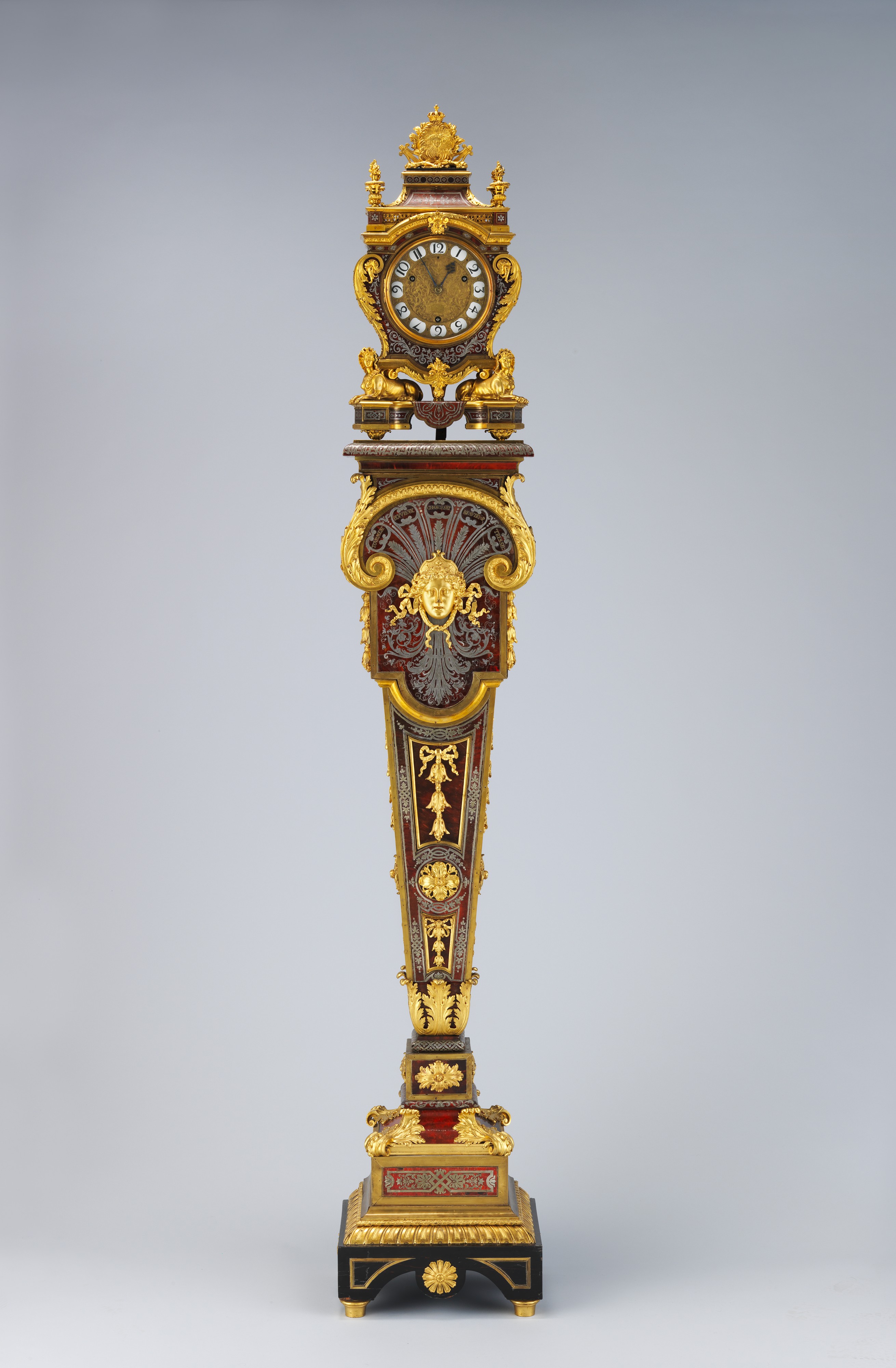
Figure 1. Clock with pedestal, around 1690 (The Met, 58.53a–c). The movement is probably by Isaac Thuret, with his son Jacques also a possible maker. The case is attributed to André-Charles Boulle after a design by Jean Bérain. Photograph supplied by The Metropolitan Museum of Art, individual photographer unidentified. Rogers Fund, 1958. Wikimedia Commons file record, museum record. CC0 1.0. Unmodified.

The Met’s clock has an oak base with tortoiseshell, engraved brass and pewter inlay and gilt bronze mounts. The eight-day movement is signed “J. Thuret”. The museum considers Isaac more likely and lists Jacques as another possibility. The crown and Sun-god motifs are consistent with the reign of Louis XIV. They do not establish that the king owned the clock. 6
The Petit Palais wall clock ODUT1863 also combines a mechanism with decorative work. It is catalogued as made in Paris in 1675–1706 and signed by Thuret on the dial and back of the movement. Wood, tortoiseshell and gilt bronze are decorated with sea deities and plant motifs. 17
Timeline#
| Date | Event and source context |
|---|---|
| Around 1630 | Birth. Plomp gives Senlis as his place of origin. 1 7 |
| 1662 | The Huygens family correspondence praises Thuret’s clock. 7 |
| 1663–1664 | Repairs a clock sent from The Hague to Paris. 7 |
| May 1665 | Huygens drafts terms for transferring the privilege and paying for production. 8 |
| 1665–1670 | Date of the spring-driven pendulum clock in the Science Museum Group. 3 |
| From 1669 | Work for the Academy appears in its accounts. 7 |
| Around 1670 | Date of the astronomical clock preserved in Museum Boerhaave. 10 |
| 1672–1673 | Thuret’s clocks are used on Richer’s Cayenne expedition. 7 |
| 22 January 1675 | Huygens’s diary records the making of the first model. 12 |
| 15 February 1675 | A twenty-year royal privilege is granted for Huygens’s new design. 13 |
| 10 and 21 September 1675 | Thuret acknowledges the attribution in a letter. Huygens authorises manufacture and sale. 14 15 |
| 21 November 1675 | Huygens records the dispatch of a watch by Thuret and his decision to employ him again. 16 |
| 1 July 1676 | Huygens says at the end of his diary that on leaving Paris he allowed all watchmakers to use the invention freely. 12 |
| Around 1680 | Date of the onion watch in Musée Paul-Dupuy. 5 |
| 1686 | Musées Occitanie records residence at the Louvre Palace. 2 |
| 1685–1700 | Period of manufacture of Louvre OA7038. 4 |
| 1706 | Death. 1 |
| 1916 | OA7038 enters the Louvre as a gift from Paul Garnier. 4 |
| 1999 | Plomp publishes his study of the clock interpreted as an instrument for use at sea. It is reprinted in 2008. 7 |
| 2018 | De Grijs reassesses the collaboration in light of the craftsman’s intellectual contribution. 9 |
Place in the history of timekeeping#
Thuret translated theory into working mechanisms made of metal, springs, gears and bearings. His retraction acknowledges the attribution of the invention while leaving room for ingenuity in designing, making and adjusting prototypes. Recognising the maker’s contribution also leaves insufficient evidence to attribute the balance spring to Thuret alone. 9 14
The records show his work growing from repairing and making early pendulum clocks to clocks for astronomical observation and then portable watches with balance springs. Surviving pieces range from scientific instruments to decorative art and show a variety of mechanisms. His collaboration with Huygens included presenting ideas, making objects, negotiating rights, selling watches and assessing their performance. In actual clocks he investigated problems that needed to be solved before the marine chronometer could develop. 3 4 7
References#
Web sources were accessed on 23 October 2026. Attributions and dates of objects follow the collections that hold them.
DBNL, Isaac Thuret — auteursgegevens. Dates and list of correspondence.
Musées Occitanie, Isaac Thuret. Biography and career.
Science Museum Group, Spring-driven Bracket Clock by Isaac Thuret, 1954-458.
Musée du Louvre, Montre ronde, OA7038, catalogue updated 12 June 2023.
Musée Paul-Dupuy / Musées Occitanie, Montre oignon, de Turet à Paris, inv. 18237.
The Metropolitan Museum of Art, Clock with pedestal, 58.53a–c. Daniëlle Kisluk-Grosheide’s 2010 commentary and collection data.
Reinier Plomp, “A Longitude Timekeeper by Isaac Thuret with the Balance Spring Invented by Christiaan Huygens”, Annals of Science 56(4), 1999, pp. 379–394. Consulted in a 2008 reprint, Meddelelser, Ole Rømer Museum, pp. 15–35.
Christiaan Huygens, No.1409, à [Thuret], mai 1665, Oeuvres complètes, vol. V, 1893, pp. 358–359. Draft.
Richard de Grijs, Isaac Thuret: celebrated craftsman denied intellectual credit, 2018, especially pp. 2–9.
Clare Vincent, European Clocks in the Seventeenth and Eighteenth Centuries, The Metropolitan Museum of Art, 2003.
Hans Hooijmaijers / Museum Boerhaave, De klokken van Christiaan Huygens, Cultuurwijzer, 20 December 2004. Archived museum commentary.
Christiaan Huygens, No.2008, 1675–1676, Oeuvres complètes, vol. VII, 1897, pp. 408–416. Diary of the making of models and the dispute over attribution.
No.2011, Colbert à Christiaan Huygens, 15 février 1675, vol. VII, pp. 419–420. Royal privilege for the new type of watch.
Isaac Thuret, No.2055, à Christiaan Huygens, 10 septembre 1675, vol. VII, p. 499.
Christiaan Huygens, No.2055a, à Thuret, 21 septembre 1675, vol. VIII, 1899, p. 561.
Christiaan Huygens, No.2078, à H. Oldenburg, 21 novembre 1675, vol. VII, pp. 542–543.
Paris Musées / Petit Palais, Cartel, ODUT1863.
William Brouncker, No.2073, à Christiaan Huygens, 18 novembre 1675, vol. VII, pp. 533–534. The English date at the foot of the letter is 8 November. The critical edition gives a French translation and the English original.