This article was translated from Japanese using AI. Read the Japanese original
Jacob Frisard, born in 1753, was a Swiss watchmaker who reproduced birdsong and bird movements in small boxes and watches. He worked with Jean-Frédéric Leschot of Geneva to refine the mechanism that returned the bird to the box after it sang and to make the whistle smaller. One of his signed gold and enamel boxes sends up a bird from among fruit and leaves, moving its beak as it sings. 1 2 3 7
Villeret, Geneva and Biel/Bienne#
Frisard was born in 1753 in Villeret in the Saint-Imier valley, then part of the Prince-Bishopric of Basel. His surname is also written Frizard and Fresard. Alfred Chapuis, who examined signed pieces, writes that Frisard made watch ébauches, or unfinished movements, locally with two brothers. Christian Bailly’s short biography says he learned watchmaking in La Chaux-de-Fonds. Loïc Rochat and Laurence Marti say he went to Turin while young, married and spent more than a decade there. 1 4 5
Around 1784 he moved to Geneva and became involved in the business of Pierre Jaquet-Droz, his son Henri-Louis and Leschot. The father died in 1790 and the son the next year, and Leschot took over. In 1792, amid military tensions following the French annexation of Savoy, Frisard moved to Biel/Bienne and kept in touch with Leschot in Geneva by letter. Sandrine Girardier examined four copybooks in the Bibliothèque de Genève and found that of 1,048 business letters written by Leschot between 1792 and 1822, 113 were addressed to Frisard. 2 4
Several workshops contributed to the finished singing-bird mechanisms. According to Chapuis, incomplete trains came from Henry Maillardet in London via Leschot, and Frisard adjusted them and cut the cams. Frisard delegated some operations to the Rochat family at Le Brassus in the Vallée de Joux. In a letter dated 29 December 1797, François Rochat asks Leschot to pass on a request that Frisard send him two small worm screws. 1 4
Making birdsong with a single whistle#
In a serinette, a device also used to teach tunes to birds, a pinned cylinder opens valves in sequence to send air through several pipes of different pitches. A 1954 exhibition catalogue from the Conservatoire national des arts et métiers lists a perfume bottle by Jaquet-Droz and Leschot that sings this way. Brass tubing distributes air from the bellows to six pipes housed within the thickness of the bottle walls. 3 6
In the sliding-piston design, the bellows supply a single whistle. Moving a piston back and forth inside the pipe changes the effective length of the air column. Shortening the column raises the pitch, and lengthening it lowers the pitch. According to Girardier, one set of small cams moves the piston and a second set drives the bellows. The piston follows the cam profile while the bellows supply air, making continuous changes in pitch and quick successions of short notes possible. Using a single whistle made it easier to fit the mechanism into a small box or a pocket-watch-sized case. 2 3
Girardier attributes this improvement to Frisard. The 2012 exhibition Automates & merveilles presented it as an invention involving the two Jaquet-Droz, Leschot and Frisard. In a letter from March 1793 quoted in the exhibition material, Leschot tells Frisard that their mechanism is harder to make than those of other makers using several pipes, and that he wants to keep the technique within the workshop. 2 3
Chapuis believed Frisard also devised a supplementary train around 1790 to return the bird to its nest and close the lid once it finished singing. In addition to controlling the bird’s orientation and beak, the mechanism could make it appear and disappear. 1
Boxes bearing Frisard’s signature#
In 1950, Chapuis reported on an oval box he examined at a Paris antiques dealer’s. It bears Frisard’s signature identifying Geneva as its place of manufacture. The gold case is decorated with painted enamel and half pearls. Pulling a gut cord attached to the barrel winds the mainspring. When the box opens, the bird among the raised enamel leaves changes direction, moves its beak and sings. The lid closes when the song is over. 1
The 1954 exhibition catalogue lists no. 141 as a blue-enamelled gold box in the shape of a basket from the Sandoz collection. Roses are painted on the bottom and fruit on the lid. A lake and trees appear on the underside of the opened lid. Christie’s records a basket-shaped box with a signature beneath the central leaf ornament. It dates the box to around 1800 in Geneva and describes a brightly feathered bird that moves its wings, tail and beak. 6 7
Travels to show his work and the continuation of the craft#
In the early nineteenth century, Frisard attempted to show his work to Napoleon Bonaparte in France. Correspondence between the Haut-Rhin department and the Ministry of the Interior, presented in the 2012 exhibition materials, records that Interior Minister Lucien Bonaparte declined to authorise expenditure, citing the state of the treasury. Frisard went to Constantinople in 1809 and, according to the exhibition material, died on the return journey. The exhibition and Bailly’s biography give 1810 as his year of death, while Chapuis’s 1950 article gives 1812. 1 3 5
Frisard’s relationship with the Rochat family went beyond orders for parts. A baptismal record dated 6 December 1804 lists him as living in Geneva and being godfather to François’s son. Rochat and Marti also report that he was godfather to Frédéric’s daughter in 1808. In 1802 Leschot commissioned clock trains directly from David Rochat and his sons, asking for trains for wall clocks of the same type as those for Frisard. The Rochat brothers made repeated stays in Geneva from 1808. A power of attorney drawn up in July 1813 records François, Frédéric and Samuel as resident there. 4
Their work shows how singing birds came to be combined with clocks and music. A box for the Chinese market dated to around 1815, for example, is recorded by Christie’s as containing the bird mechanism, a watch movement with a central seconds hand, and a music mechanism. Eight cams operate the bird, which returns inside after singing and is covered by the closing lid. “FR” on the mechanism is the Rochat brothers’ mark and “GRC” on the case is the mark of Jean-Georges Rémond. In his 1950 paper, Chapuis corrected his own earlier reading of “FR” as Frisard’s mark. 1 8
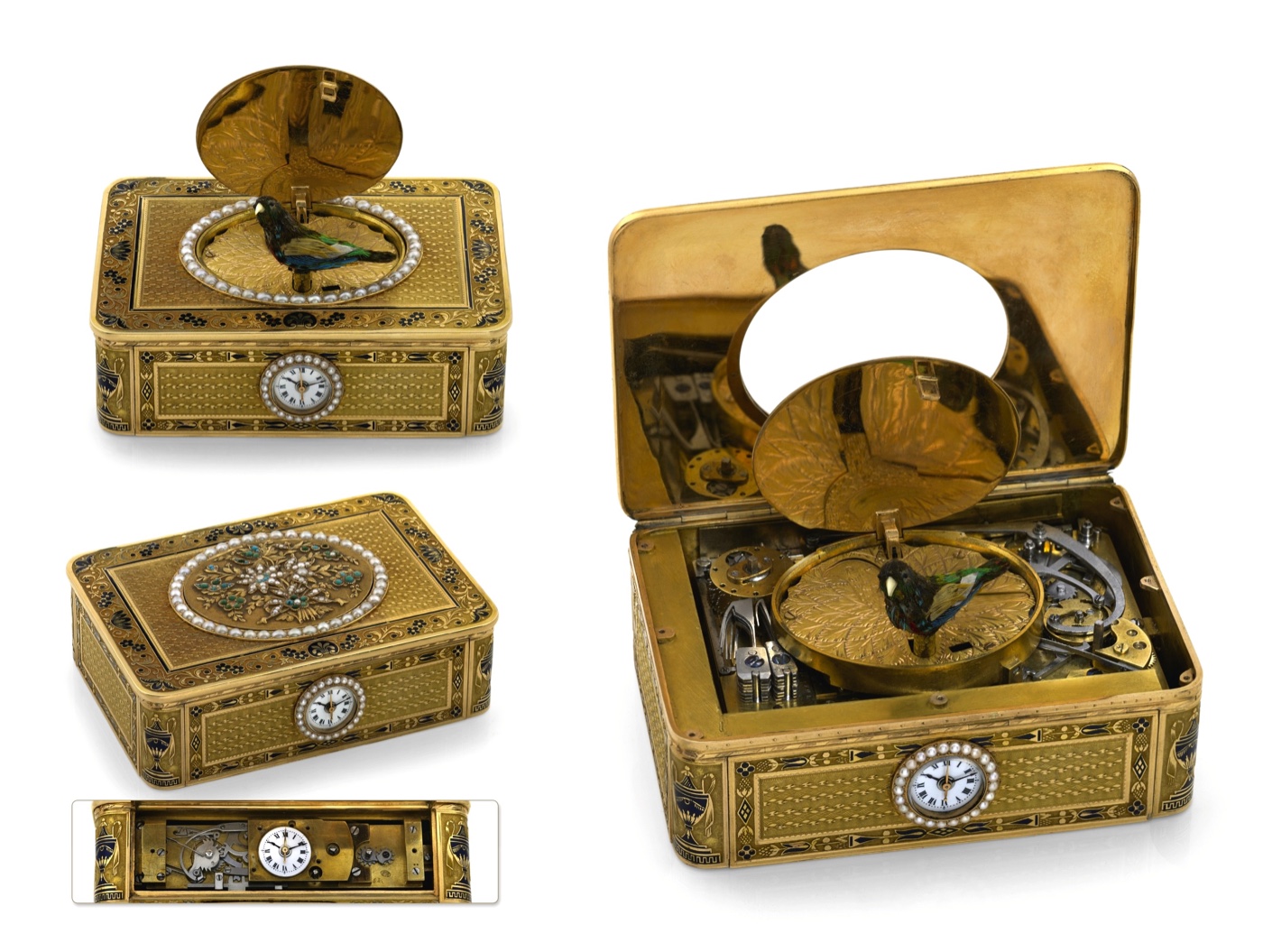
Rochat brothers No. 61, circa 1820. The clock dial is on the front and the bird fits beneath the oval lid on top. The photographs show the box closed, the bird raised and the case open. Photographs by and courtesy of Antiquorum. Source Wikimedia Commons file description. CC BY-SA 3.0. Resized and recompressed as JPEG.

The modern automaton maker Christian Bailly has presented work under a name honouring Frisard. In Bailly’s Le dresseur d’oiseaux, or The Bird Trainer, two birds sing in alternation as though responding to a figure playing a flute. The base holds a clock, combining the figure, birds, music and time display in a single piece. 5
Timeline#
| Year | Event |
|---|---|
| 1753 | Frisard is born in Villeret. 2 4 |
| Around 1784 | Moves to Geneva and joins the work of the two Jaquet-Droz and Leschot. 4 5 |
| Around 1790 | Chapuis dates the invention of the train that retracts the bird and closes the lid to around this time. 1 |
| 1792 | Frisard moves to Biel/Bienne and continues corresponding with Leschot. 2 4 |
| December 1797 | Leschot’s correspondence mentions small worm screws requested by François Rochat. 4 |
| Around 1800 | A signed basket-shaped singing-bird box is made in Geneva. 7 |
| December 1804 | Frisard is godfather at the baptism of François Rochat’s son at Le Sentier. 4 |
| 1808 | Frisard becomes godfather to Frédéric Rochat’s daughter. François and Frédéric begin staying in Geneva that summer. 4 |
| 1809 | Frisard travels to Constantinople. 3 |
| 1810 or 1812 | Years of death in different sources. 1 3 5 |
| Around 1815 | A singing-bird box combines a Rochat brothers mechanism with a Rémond case. 8 |
| 1950 | Chapuis publishes his examination of a signed box. 1 |
| 1954 | The Sandoz basket-shaped singing-bird box is shown at the Conservatoire national des arts et métiers exhibition. 6 |
| 2012 | The Swiss exhibition Automates & merveilles presents the division of work between workshops and the singing-bird mechanisms. 3 |
References#
- Alfred Chapuis, Une œuvre inédite de Jacob Frisard, Revue suisse d’art et d’archéologie 11, no. 4, 1950, pp. 254–255, pl. 86. Accessed 20 November 2026.
- Sandrine Girardier, L’entreprise Jaquet-Droz. Entre merveilles de spectacle, mécaniques luxueuses et machines utiles. 1758–1811, University of Neuchâtel doctoral thesis, 2018, tabulation of business correspondence and description of the whistle in “Les cages à oiseaux chanteurs”. Accessed 20 November 2026.
- Musée international d’horlogerie, La Chaux-de-Fonds, Musée d’horlogerie du Locle and Musée d’art et d’histoire de Neuchâtel, Automates & merveilles, exhibition press kit, 2012, pp. 24–25, 31 and 35–36. Accessed 20 November 2026.
- Loïc Rochat and Laurence Marti, Les frères Rochat, créateurs d’oiseaux chanteurs. Une famille d’horlogers mécaniciens des XVIIIe et XIXe siècles, Revue vaudoise de généalogie et d’histoire des familles 27, 2014, pp. 203–207 and 222. Accessed 20 November 2026.
- Christian Bailly, Jacob Frisard & Christian Bailly, “Jacob Frisard” and “Le dresseur d’oiseaux”. Accessed 20 November 2026.
- Conservatoire national des arts et métiers, Horloges et automates, exhibition catalogue, 1954, nos. 139 and 141. Accessed 20 November 2026.
- Christie’s, An Important Swiss Split-Pearl Set and Enamelled Gold Bird Box, lot record 3103760. Accessed 20 November 2026.
- Christie’s, Frères Rochat and Jean-Georges Rémond, lot record 5367621. Accessed 20 November 2026.