This article was translated from Japanese using AI. Read the Japanese original
Jacques Thuret (also Jacques-Augustin Thuret or Jacques III Thuret, c. 1669–1738) was a royal clockmaker at the Louvre Palace in Paris. He succeeded his father Isaac in the workshop and worked with cabinetmaker André-Charles Boulle and others to make clocks that combined precision movements with elaborate furniture and sculpture. He also published ornamental designs by his father-in-law, Jean Bérain. 1 2 3
Succeeding his father in the royal workshop#
Thuret was born in Paris. His father, Isaac Thuret, was a clockmaker who maintained instruments for the Academy of Sciences and was involved in making a watch with a balance spring designed by Huygens and Rømer’s astronomical instruments. Jacques thus grew up in a household and workshop where scientific instruments and court craftsmanship met. 1
On 22 August 1694, Jacques received the right to occupy the lodging his father used beneath the Grande Galerie of the Louvre after his father’s death, or earlier with his consent. Isaac died in 1706. With workshops and lodgings in the palace, clockmakers could work in close proximity to cabinetmakers and designers. 1 2
The Getty’s clock catalogue says Jacques succeeded his father in 1694 as clockmaker to the king and the Observatory and supplied movements for Boulle’s cases. The finished clocks combined a movement and case made by different specialists. 3
Clocks combining cabinetmaking and sculpture#
Boulle’s cases and Thuret’s movements#
Boulle clocks combine marquetry of metal and tortoiseshell on a wooden ground, gilt-bronze ornaments and enamel numeral plaques. The case housed the mechanism and formed part of the decoration of the room. The work of designers, cabinetmakers and clockmakers came together in the same object. 3 4
The Getty catalogue cites a clock in the Wallace Collection in London with a movement by Jacques Thuret. It is one of a group on the theme of Love triumphing over Time. Clocks with the same composition can differ in their details of marquetry and sculpture. The catalogue compares similar-looking clocks while recording the individual makers of their movements. 3
Signatures and attribution#
The Metropolitan Museum of Art in New York holds a clock with pedestal dating from around 1690 (58.53a–c), an example that helps distinguish the work of father and son. It follows a design by Bérain, and the case is attributed to Boulle. The movement is signed “J. Thuret”. The museum attributes it to either Jacques or his father Isaac, favouring the latter. 4
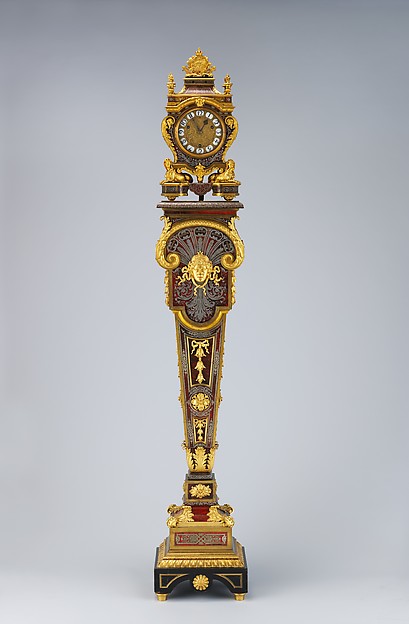
Figure. Clock with pedestal, c. 1690, Met 58.53a–c. Movement by Jacques Thuret or his father Isaac, whom the museum favours. Case attributed to Boulle, after a design by Bérain. Image: The Metropolitan Museum of Art / Rogers Fund, 1958. Source: object page. Terms: CC0 1.0 (museum Open Access policy). The museum’s smaller image was used without further modification.
The clock is spring-driven and runs for eight days. A barometer was planned for the pedestal, and lettering describing the weather survives. A face of the sun god, a crown and a lyre are among the decorations evoking Louis XIV’s kingship. The museum says a royal provenance for the object itself remains unconfirmed. 4
Attribution of movements to father or son varies even among clocks that bear their name. Museum attributions can draw on the signature together with the date, movement construction and provenance. 4
The Berain family and publication of designs#
Thuret married a daughter of the royal designer Jean Bérain. Bérain’s ornament extended from clocks to furniture, interiors and stage design. Neil Jeffares records that Thuret acquired Bérain’s copper printing plates and published the collection of designs Ornemens inventez par J. Berain. 1
Prints circulated ornamental designs independently of the finished objects. Thuret’s activities thus included producing clock movements and disseminating the work of a designer with whom he collaborated. 1
Joseph Vivien made a pastel portrait of Thuret in 1704, and in 1710 Thuret’s niece Suzanne Silvestre engraved it. The clockmaker’s family and acquaintances included painters, sculptors and printmakers outside horology. 1
Later years and surviving work#
The art historian Neil Jeffares dates Thuret’s death to 6 December 1738 based on his posthumous inventory. Older clock catalogues sometimes give 1739. The inventory includes clocks, books and paintings, recording aspects of the life and collecting of a craftsman at the Louvre. 1 3
Museum research on clocks bearing Thuret’s name distinguishes the makers of their movements, cases and designs. His work shows how clockmaking in early eighteenth-century Paris drew on both timekeeping mechanisms and the decorative arts of the interior. 3 4
Chronology#
| Year | Event |
|---|---|
| Around 1669 | Born in Paris. 2 |
| 22 August 1694 | Receives the right to take over his father’s lodging in the Louvre. 2 |
| 1704 | Vivien makes Thuret’s portrait. 1 |
| 1706 | His father Isaac dies. 1 |
| Around 1710 | Publishes Bérain’s designs, according to Jeffares. 1 |
| 1710 | His niece engraves the portrait. 1 |
| 6 December 1738 | Dies, according to Jeffares’s research. 1 |
| 1996 | The Getty clock catalogue discusses related objects and workshop relationships. 3 |
| November 2026 | The Metropolitan Museum of Art lists father and son as possible makers of the movement of the clock with pedestal, favouring the father. 4 |
References#
- Neil Jeffares, “Vivien, Jacques Thuret”, Pastels & pastellists, 2014, updated 22 October 2024, pp. 1 and 3–5.
2. Daniel Thuret, “Reconsidération du protestantisme des Thuret”, Cahiers du Centre de généalogie protestante, no. 145, 2019, p. 36.
3. Gillian Wilson et al., European Clocks in the J. Paul Getty Museum, 1996, pp. 13 and 25.
4. The Metropolitan Museum of Art, “Clock with pedestal”, 58.53a–c, object data and essay by Daniëlle Kisluk-Grosheide (2010).
Sources accessed on 17 November 2026.