This article was translated from Japanese using AI. Read the Japanese original
Pierre Jaquet-Droz (1721–1790) was a clockmaker who made musical clocks and automata in La Chaux-de-Fonds, Switzerland. A boy who writes with a quill, a boy who draws with a pencil and a girl who plays a real organ were the products of collaboration with his son Henri-Louis, Jean-Frédéric Leschot and others. These three automata, now in the Musée d’art et d’histoire de Neuchâtel, combine small clockwork mechanisms, the mechanical reproduction of human gestures and the staging of a public spectacle. 1 2 3 4
Jaquet-Droz also sent out table clocks with pipes and bells, small boxes with singing birds, and pocket watches decorated in gold and enamel, through a wide network of makers and merchants. The roles of the father, the son and Leschot, and the histories of their workshop and the modern brand of the same name, help explain the original work and the business that supported it. 1
Life and formation of the workshop#
Education, family and entry into clockmaking#
Pierre was born in La Chaux-de-Fonds on 28 July 1721. For a time he pursued theology. He received an education in Basel connected with classical languages, philosophy, mathematics and physics, and in 1740 appears in Neuchâtel records as a student preparing for the ministry. Local records mention his early clockmaking in 1747 and refer to him in 1749 as a maker skilled in large clocks. 1 5
Clockmaking drew on local family and workshop connections. The Jaquet-Droz family was linked by marriage and work to the Robert and Sandoz families, and Pierre’s father-in-law Abram-Louis Sandoz also made clock cases. Biographies describe Pierre as a pupil of Josué Robert. Sandrine Girardier’s research has yet to find an apprenticeship contract or similar evidence to confirm it. 1
The modern brand gives 1738 as its starting year. Girardier found no documentary support for a workshop founded that year and draws attention to the records of Pierre’s education. The brand’s official timeline assigns 1738 a place in its history, while the surviving records of his work give a different level of precision. 1 6
Pierre married Marianne Sandoz in 1750. They had three children, Julie, Henri-Louis and Charlotte. His wife and their youngest daughter Charlotte died in 1755. Henri-Louis was born on 13 October 1752. From 1767 he studied mathematics, physics, music and drawing in Nancy with the Abbé de Servan. Such an education served a workshop that combined mechanical design with performance, visual design and dealing with customers. 1 7
Jean-Frédéric Leschot (1746–1824) came from a neighbouring family and learned clockmaking and mechanics under Pierre. Correspondence cited by Girardier says that he was in the workshop from 1764. Henri-Louis, Pierre’s son, and Leschot, trained as a craftsperson in the workshop, grew into collaborators in production and management. 1 8
The journey to Spain in 1758#
An introduction from George Keith, governor of Neuchâtel, helped Pierre develop a market abroad. On 4 April 1758 he left for Spain with his father-in-law Sandoz and the craftsman Jacques Gévril, planning to sell six complicated clocks. They reached Madrid on 22 May and received assistance from the nobleman Don Jacinto Jover. 1
Sandoz’s journal details the trip. Transporting the clocks involved choosing vehicles, packing, customs and adjustment after arrival. Several months passed before the royal presentation. Girardier’s analysis identifies three clocks actually shown to Ferdinand VI at Villaviciosa in early September: a longcase clock with an organ, a clock with figures that struck bells, and a shepherd clock. The six planned for sale and the three shown on that occasion represent different counts. 1
In a letter to Jover dated 5 September 1758, Pierre says the king set the clocks in motion repeatedly and that the musician Farinelli and others praised them. Sandoz copied the letter into his journal, preserving the maker’s own report of the reception. The modern brand history records the purchase of the clocks taken to Spain and a payment of 2,000 pistoles. 1 6
The journey also involved repairs to clocks and cases and work on musical mechanisms. Demonstration, adjustment of existing pieces and securing orders were all parts of the business. 1
Who made the automata and how they worked#
Testimony from 1774 on the collaboration#
The three human figures were made in La Chaux-de-Fonds between 1768 and 1774 and displayed there in 1774. The exhibition also featured La Grotte, a moving landscape with shepherds and animals. Exhibiting the automata showed their capabilities and extended the workshop’s reputation and contacts. 1 9
An important record of collaboration is the legal testimony of October 1774, transcribed in full by Girardier. It names four craftspeople, Leschot, Henry Huguenin, Jean-Baptiste Grisez and Charles Humbert-Droz. Leschot states that the son took over employment from the father in September 1772 and thereafter supplied his pay and meals. 1
The testimony also records stages in the work. In 1772 the Musician had articulated fingers and waist, together with arms and a pinned cylinder. The head, eyes and chest did not yet move. Pipes, bellows and other elements were reportedly ordered from another maker that November. The concept, manufacture, sound production and added movements came together over time. 1
The testimony gives no design register that would identify the inventor of every part. It documents a workshop in which father, son, Leschot and several specialist craftspeople contributed to the finished work. 1
From autumn 1774 the figures travelled abroad. They were exhibited at the Hôtel Lubert in Paris in November. A record for February 1775 cited by Girardier states that they were shown to Queen Marie Antoinette. Near the end of that year they were shown in Covent Garden in London as the “Spectacle Mécanique.” Paid public shows supported the enterprise alongside efforts to obtain royal and aristocratic patronage. 1
The Writer: choosing characters and forming strokes#
The Writer (L’Écrivain, AA2) is a boy seated on a low stool with a quill at a mahogany desk. The museum dates the start of production to 1768 and describes it as the work of Pierre with assistance from Leschot. It stands 76 cm high and can write a chosen text of up to 40 characters. 2
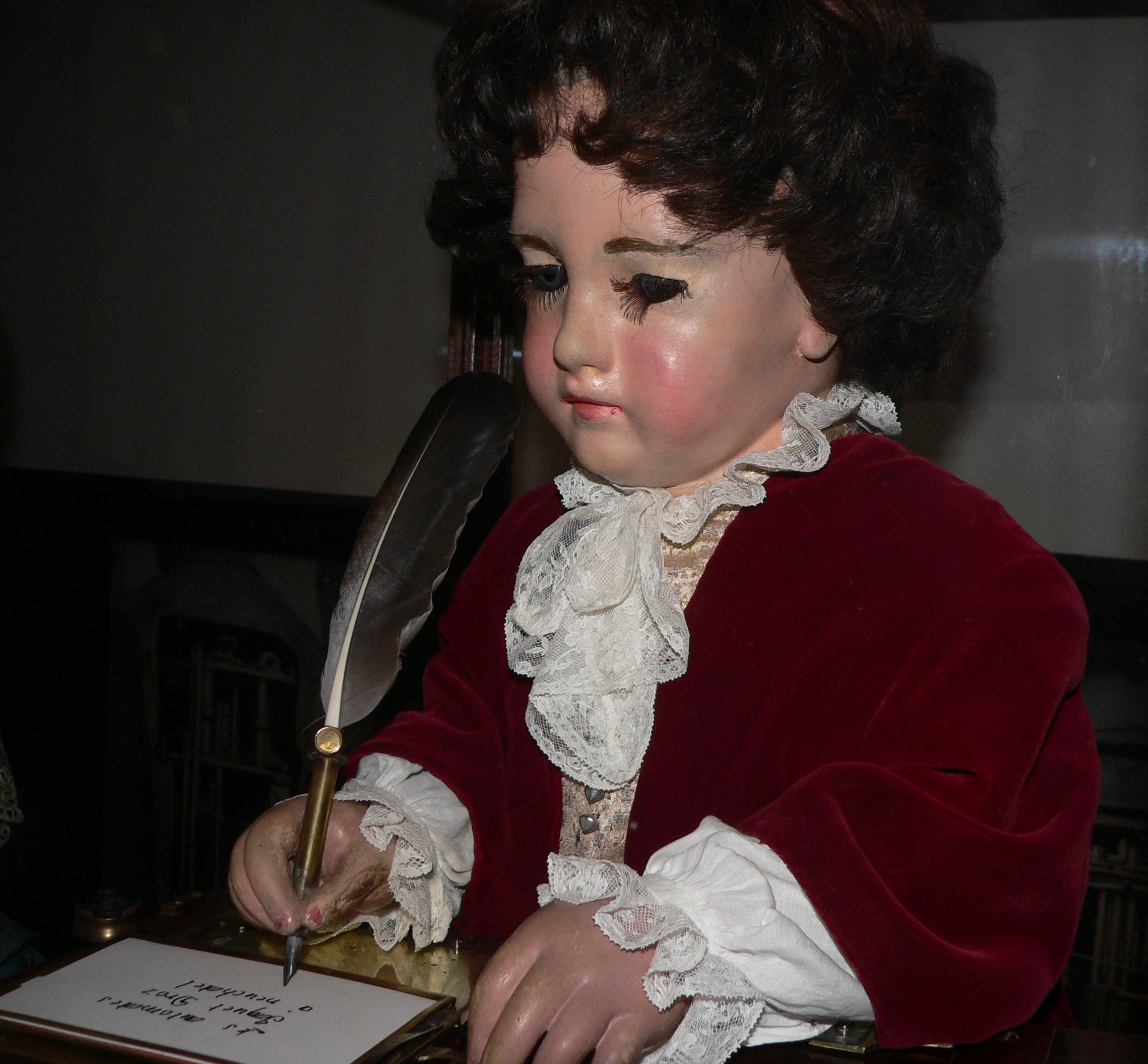
The Writer. Photograph by Rama. Source Wikimedia Commons file page. Licence CC BY-SA 2.0 France. No changes.

Writing requires both selecting the characters and controlling the motion that draws each one. A cam moves a lever that follows its profile. Gears transmit rotation through meshing teeth and serve a different function. 2 10
Philip Morrison’s technical account from 1973 distinguishes three sets of 40 cams on a common shaft from forty setting pieces around a separate wheel. Motions transmitted from three cams to levers determine the path and pressure of the quill. The setting wheel changes the height of the cam shaft for the next selected character. The figure can write different texts because the mechanism that defines character shapes and the mechanism that specifies their sequence operate separately. 10
The right hand writes, and the table carrying the paper moves for each character. The figure also dips the quill in ink, shakes off the excess and looks at the place where it is writing. These gestures make the sequence resemble a person writing. 1 2
Girardier says the forty characters include spaces. The museum’s object record says the figure writes three lines, while the joint exhibition material of 2012 gives four. Both describe a finite sequence set beforehand and put on paper by mechanical selection and movement. This ability is what “programmable” refers to here. Understanding text and general-purpose computation are outside the mechanism’s functions. 1 2 9 10
The Draughtsman: moving the hand over fixed paper#
Henri-Louis made the Draughtsman (Le Dessinateur, AA3) with Leschot’s assistance in 1772–1774. Like the Writer, the boy stands 76 cm high. The paper stays fixed, and the hand moves over it to draw the lines. The figure also blows away pencil dust while drawing. 3
The museum counts three interchangeable cam sets and lists four drawings. The dog with “Mon Toutou” and the portrait of Louis XV share a set. The others show George III and Queen Charlotte, and Cupid drawn by a butterfly. Changing the shaped cams changes the drawing. The supported images are encoded in the cams, which gives the figure a different type of changeable output from the Writer’s selection of characters. 3
Girardier cites the report of a presentation to the queen in 1775 and later accounts of portraits of Louis XVI and Marie Antoinette. The history of the Draughtsman also includes the possibility of remaking its cams in response to new audiences and a change of monarch. 1
The Musician: fingers that press the keys#
The Musician (La Musicienne, AA1) is a 137 cm figure of a girl designed by Henri-Louis. Its fingers press the keys of a real organ, and bellows supply air to sound the pipes. The museum records 48 pipes in two registers and five tunes. A register is a set of pipes contributing a particular tone colour. 4
As the figure plays, its chest moves as if breathing. At the end of a piece, it bows while seated. Movement of the eyes, head and chest accompanies the actual playing of the keys. The museum suggests that Henri-Louis, who studied music, may also have composed the tunes. The identification of the designer is firmer than the attribution of the music. 4
The moving landscape of La Grotte#
La Grotte, shown alongside the three figures, was a moving landscape of rocks, gardens, buildings, shepherds and domestic animals. An account in L’Année littéraire from 1774 mentions a farmer riding a donkey to the mill, a dog, a shepherd playing a pipe and a woman playing the guitar. The device sequenced sound and movement to make a single scene. 1
La Grotte has not survived like the three figures. Girardier compares contemporary accounts, images and testimony on its manufacture to reconstruct its appearance. The workshop’s automata ranged from individual human gestures to miniature theatres coordinating the motion of people and animals. 1
Clocks, singing birds and decorative techniques#
Making sound mechanisms smaller#
Adding figures and music to a table clock required its timekeeping to coordinate with mechanisms for bells, pipes or automata. Workshop clocks combined hours and quarter striking, repeaters on demand, carillons, pipe music and bird movements in various ways. Their construction becomes clearer when the displays of time and the sources of sound and movement are identified separately. 1
Several mechanisms could produce birdsong. A serinette operates a group of small pipes mechanically, with pins on a cylinder programming the sequence. A sliding-piston whistle, attributed to Jacob Frisard, changes pitch by moving a piston in one pipe. Girardier describes two cam systems, one for the piston and one for the bellows. A single variable-pitch pipe helped produce complex calls with a smaller mechanism. 1
Singing birds appeared in clocks, birdcages and snuffboxes. Besides carrying snuff, these luxury boxes brought together metalworking, enamel, gems, sound and the bird’s movements. Birdcages with a clock that strikes quarters also survive. 1
Construction and materials of surviving examples#
Girardier reproduces museum records for the following works. Dates follow the catalogues’ estimates, with signatures and attributions identified where applicable. 1
| Work and collection number | Date, signature or attribution | Mechanism and materials |
|---|---|---|
| Le Locle Museum of Horology, MHL1 | c. 1760–1775. Signed “P. Jaquet Droz a La Chaux de Fonds en Suisse” | Quarter striking, six-tune serinette, seven-tune carillon and singing bird. Wood, tortoiseshell and gilt bronze. The bird moves with the carillon |
| Museum of Music Automatons, Seewen, MMA71883 | c. 1780. Signed “Pierre Jaquet Droz, La Chaux de Fonds” | Eight-tune carillon and figure beating time to the music. Veneered wood, bronze and gilt bronze |
| Same museum, MMA71670 | c. 1790, attributed to Jaquet-Droz | Three birds, seven-tune serinette and quarter striking. Gilt brass, enamel and glass. Thought to have been intended for Constantinople |
| Beyer Clock and Watch Museum, 4374.68 | c. 1780. Signed “Jaquet Droz London” | Portable watch with a carillon activated by pressing at the pendant. Cylinder escapement, pearls and enamel |
| Patek Philippe Museum, S-173 | c. 1785. Signed “Jaquet Droz London” | Singing-bird snuffbox in gold, pearls and enamel with paillonné decoration containing small metal foils. Made for the Chinese market |
Large clocks in wood and tortoiseshell and small portable objects decorated in gold and pearls put decoration to different uses. Cases and boxes used engraving, guilloché, gem setting and painted enamel miniatures. Letters from Leschot cited by Girardier describe variations in painting and ornament even on the same theme, adapting designs to orders. 1
The watches also adopted contemporary techniques such as thin Lépine construction, independent seconds and automatic winding. Leschot’s letter of 31 October 1794 to the Jordan brothers in Berlin lists Lépine-style watches, watches with independent seconds, and watches with weights for automatic winding. It documents the workshop’s offerings after Pierre’s death. These technologies had several origins. 1
Business connecting London, Geneva and China#
The work of makers and merchants#
Henri-Louis and Leschot opened a London workshop in 1774. London was a centre of watch and jewellery production and international trade, with merchants such as James Cox connecting it to the Chinese market. From 1783 Henri-Louis moved to Switzerland, and Henry Maillardet took over the London business. 1 7 8
The Geneva operation developed from about 1784 in partnership with Leschot. Clockmakers, casemakers, engravers, jewellers, enamellers and painters provided mechanisms and designs suited to the order. A “London” signature alone leaves the locations of individual operations open. Manufacture, finishing, signing and sale could take place in different centres. 1
Henri-Louis became a citizen of Geneva in 1785 and joined its Society of Arts in 1786. Leschot was active in the society from 1787. Beyond selling products, they contributed to technical education and the examination of machines intended for public benefit, applying their skills to the community. 1 7
How to read shipment counts and customer records#
China was a major market. The modern brand says it exported more than 600 pieces to China over about a decade. Girardier’s study of the ledgers accounts for the extent of surviving records and for duplications. Her count from a defined set of ledgers for 1784–1808 is 685 items shipped: 481 portable watches, 61 clocks, 15 birdcages, 80 snuffboxes, 28 perfume bottles and 20 rings. The figure covers the selected records and includes destinations besides China. 1 6
Adding other ledgers brings the apparent count to 1,226. Items sent again after repairs or alterations, and duplicate entries for the same piece, could not all be excluded. The study leaves the overall total open. Counts of production, shipments and sales cover different activities and can depend on which ledgers and years are included. 1
The ledgers name merchants including James Cox & Son, Jean Duval & fils & co, and Cox Beale & Laurent. Shipment to a merchant was one stage in the distribution of goods to courts and affluent urban customers. The modern brand history gives prominence to links with the Qianlong Emperor and the Qing court. 1 6
Customers also included people outside royal circles. Leschot’s payment records include fitting a portrait of the late Henri-Louis to the case of watch No. 63 for a gift to his former teacher, de Servan. Personal keepsakes, purchases by merchants and sales efforts directed at courts all formed part of the workshop’s business. 1
Debts, the deaths of father and son, and Leschot’s continuation#
Around 1790, the failure of Cox’s business and unpaid proceeds from China dealt the workshop a severe blow. Girardier calculates £4,570 sterling outstanding from ledgers and Leschot’s letters. Only about a quarter was ultimately recovered. 1
Pierre died in Biel/Bienne on 28 November 1790, aged 69. Henri-Louis, who suffered from a chest illness, travelled to Naples to recover and died there on 15 November 1791. Leschot had to sell finished products, handle unfinished pieces, collect debts and take new orders at the same time. 1 5 7
In a letter of 1793, Leschot says he had taken charge in September 1792 of finished and unfinished pieces remaining from liquidation. On 18 April 1796 he registered a Geneva company in his own name to make and trade in clocks, jewellery and machines. Revolution and war affected transport, payments and wealthy customers’ demand, forcing changes of merchants and markets. Leschot continued to pursue the business. Orders gradually fell, and the workshop ceased activity in 1811. 1 8
Preserving the work and the modern brand#
Keeping the automata and demonstrating them#
After touring Europe and changing ownership, the automata were donated to the city of Neuchâtel on 1 May 1909 and entered its Musée d’art et d’histoire. Their survival makes it possible to study the selection of characters, actual music-making and gestures for an audience directly in the machines as well as in written accounts. 9
In the museum notice checked on 26 October 2026, the Writer was out of operation because of a faulty part and technical problems. It remained on display during repairs. Demonstrations of the Draughtsman and Musician continued. 9
The current company’s use of the name and designs#
On 25 April 2000, Swatch Group announced that it had acquired shares in the existing Montres Jaquet-Droz from Cupola Venture Partners 1 Ltd. and Swiss minority shareholders. 11
Girardier argues that the modern brand history connects eighteenth-century renown to the 2000 acquisition while giving little attention to breaks and to other twentieth-century ventures. Historical works can provide designs and inspiration. Corporate or workshop continuity requires different evidence. 1
In the official chronology, the modern brand introduced the Grande Seconde in 2002. Inspired by an eighteenth-century pocket watch, the design overlaps an upper hours-and-minutes display with a large seconds display below. It moved to a new La Chaux-de-Fonds workshop in 2010 and developed its Ateliers d’Art in 2011 for miniature painting, sculpture, engraving and paillonné enamel. The Bird Repeater of 2012 brought singing birds and automata into a wristwatch. 6
The company’s strategy titled “A Disruptive Legacy” sets out a focus on high-value artistic watches and automata, more custom and unique pieces, and new materials and techniques. It also proposes artistic presentation objects to accompany watches, sometimes as automata themselves. The brand cites the openworked Grande Seconde Skelet-One as a precedent in new design. It intends to put craftspeople in direct contact with clients and tailor the experience of making and receiving a watch. These goals come from the current company’s product and customer strategy. 12
The historical workshop also combined mechanisms and ornament and adapted its work to customers and markets. Its surviving objects, correspondence and ledgers show how several crafts and commercial decisions came together in practice. They add detail to the history of eighteenth-century timekeeping and mechanical art beyond the modern brand’s account. 1
Timeline#
| Date | Event |
|---|---|
| 28 July 1721 | Pierre is born in La Chaux-de-Fonds. 1 5 |
| c. 1739–1740 | Studies at Basel and appears in Neuchâtel’s records in 1740 as a student preparing for the ministry. 1 |
| 1747 and 1749 | Appears in local records as a clockmaker and is noted in 1749 for skill in making large clocks. 1 |
| 1750 | Marries Marianne Sandoz and gains a connection to clock casemaking through his father-in-law. 1 |
| 13 October 1752 | Henri-Louis is born. 1 7 |
| 1755 | Pierre’s wife and youngest daughter Charlotte die. 1 |
| April–September 1758 | Travels to Spain planning to sell six clocks, then shows three to the king in early September. Reports the reception in a letter of 5 September. 1 |
| c. 1764 | Correspondence dates the start of Leschot’s work in Pierre’s workshop. 1 |
| 1767–1769 | Henri-Louis studies mathematics, music, drawing and other subjects in Nancy. 1 7 |
| 1768 | Work on the Writer begins. 2 |
| From September 1772 | According to later testimony, several workers pass from the father’s employment and direction to the son’s. 1 |
| 1772–1774 | Henri-Louis and Leschot make the Draughtsman. 3 |
| 1774 | The three human figures and La Grotte are exhibited locally. Testimony taken in October describes manufacture and employment. The London workshop opens that year. 1 7 8 |
| November 1774–1775 | Public exhibition in Paris. A 1775 record reports presentation to the queen, followed towards the end of the year by public exhibition in London. 1 |
| c. 1783–1784 | Henri-Louis moves to Geneva and develops the business with Leschot. Maillardet is responsible for London. 1 |
| 1785 and 1786 | Henri-Louis becomes a Geneva citizen and joins the city’s Society of Arts the following year. 1 7 |
| 1787 | Leschot joins Geneva’s Society of Arts. 1 |
| c. 1790 | Cox’s failure and unpaid debts damage the business. 1 |
| 28 November 1790 | Pierre dies in Biel/Bienne. 1 5 |
| 15 November 1791 | Henri-Louis dies in Naples. Leschot handles the remaining products and continues the business. 1 7 |
| 31 October 1794 | Leschot writes to the Jordan brothers describing complicated watches and decorative options. 1 |
| 18 April 1796 | Leschot registers a production and trading company in his own name. 1 |
| 1811 | Leschot’s workshop ceases activity. 1 |
| 1 May 1909 | The three automata are donated to the city of Neuchâtel. 9 |
| 25 April 2000 | Swatch Group announces its acquisition of shares in Montres Jaquet-Droz. 11 |
| 2002 | The modern brand introduces the Grande Seconde. 6 |
| 2010–2012 | New workshop, development of the Ateliers d’Art and introduction of the Bird Repeater. 6 |
| As checked in October 2026 | The Writer remains on display while out of operation. The Draughtsman and Musician continue to be demonstrated. 9 |
References#
- Sandrine Girardier, L’entreprise Jaquet-Droz. Entre merveilles de spectacle, mécaniques luxueuses et machines utiles, 1758–1811, Éditions Alphil–Presses universitaires suisses, 2020, DOI 10.33055/ALPHIL.03137. Public PDF. Especially pp. 17–23 (life), 95–97 (brand history), 116–123 and 129–133 (automata, collaboration and exhibitions), 192 and 199–210 (objects and technology), 218–220 (ledger counts), 279–280 (division of labour and company), 320–327 (journey to Spain), 364–370 (trade and debt) and 420 (closure). Pp. 543–545 give the complete October 1774 testimony and p. 547 onwards transcribes the 1774 article from L’Année littéraire. Published transcriptions and analysis consulted. Accessed 26–27 October 2026.
2. Musée d’art et d’histoire de Neuchâtel, Automate “L’Écrivain”, AA2. Collection record for maker, start of production, 40 characters, paper advance, dimensions and materials. Accessed 26 October 2026.
3. Musée d’art et d’histoire de Neuchâtel, Automate “Le Dessinateur”, AA3. Collection record for maker, 1772–1774, fixed paper, three interchangeable cam sets and four drawings. Accessed 26 October 2026.
4. Musée d’art et d’histoire de Neuchâtel, Automate “La Musicienne”, AA1. Collection record for designer, actual playing, 48 pipes in two registers, five pieces, dimensions and materials. Accessed 26 October 2026.
5. Anne Jeanneret-de Rougemont, “Jaquet-Droz, Pierre”, Dictionnaire historique de la Suisse, version of 12 July 2005. Biographical entry. Accessed 26 October 2026.
6. Jaquet Droz, “The extraordinary history of Jaquet Droz”. Manufacturer’s official history. Its account of eighteenth-century origins, quantities and reputation is considered separately from its history of products and workshops from 2002 onwards. Accessed 26–27 October 2026.
7. Myriam Volorio Perriard, “Jaquet-Droz, Henri-Louis”, Dictionnaire historique de la Suisse, version of 12 July 2005. Education, London, Geneva, the Society of Arts and dates of birth and death. Accessed 26 October 2026.
8. Jacques Barrelet, “Leschot, Jean-Frédéric”, Dictionnaire historique de la Suisse, version of 20 July 2006. Training, partnership and company in his own name. Accessed 26 October 2026.
9. Musée d’art et d’histoire de Neuchâtel, “Automates Jaquet-Droz”. Collaboration, donation on 1 May 1909, demonstrations and the Writer’s malfunction. Status checked on 26 October 2026. See also the three museums’ 2012 exhibition Automates & merveilles, official press material PDF, printed p. 8 (PDF p. 6), which gives 40 characters and four lines for the Writer. The PDF page was consulted on 27 October 2026.
10. Philip Morrison, “The Mind of the Machine”, Technology Review, January 1973, p. 16. Technical discussion of the Writer’s cams for character motion and its setting wheel, distinct from an eighteenth-century design document or a new measurement of the object. Accessed 26 October 2026.
11. Swatch Group, “Acquisition of Montres Jaquet-Droz”, 25 April 2000. Announcement by the purchaser of the shares. Accessed 26 October 2026.
12. Jaquet Droz, “A Disruptive Legacy — Jaquet Droz strategic vision 8.0”. The current company’s strategy on products, custom work, new materials and customer experience. Accessed 26–27 October 2026.