This article was translated from Japanese using AI. Read the Japanese original
Jean-Dominique, comte de Cassini (1748–1845), was a French astronomer and geodesist. In horology, he is known for testing Pierre Le Roy’s sea watches on an Atlantic voyage in 1768 and combining astronomical observations at ports with watch comparisons at sea in one report. A well-made watch still needed a reliable procedure to determine a ship’s longitude. Cassini concentrated on transferring time from shore to the watches and detecting changes in their rates during the voyage.12
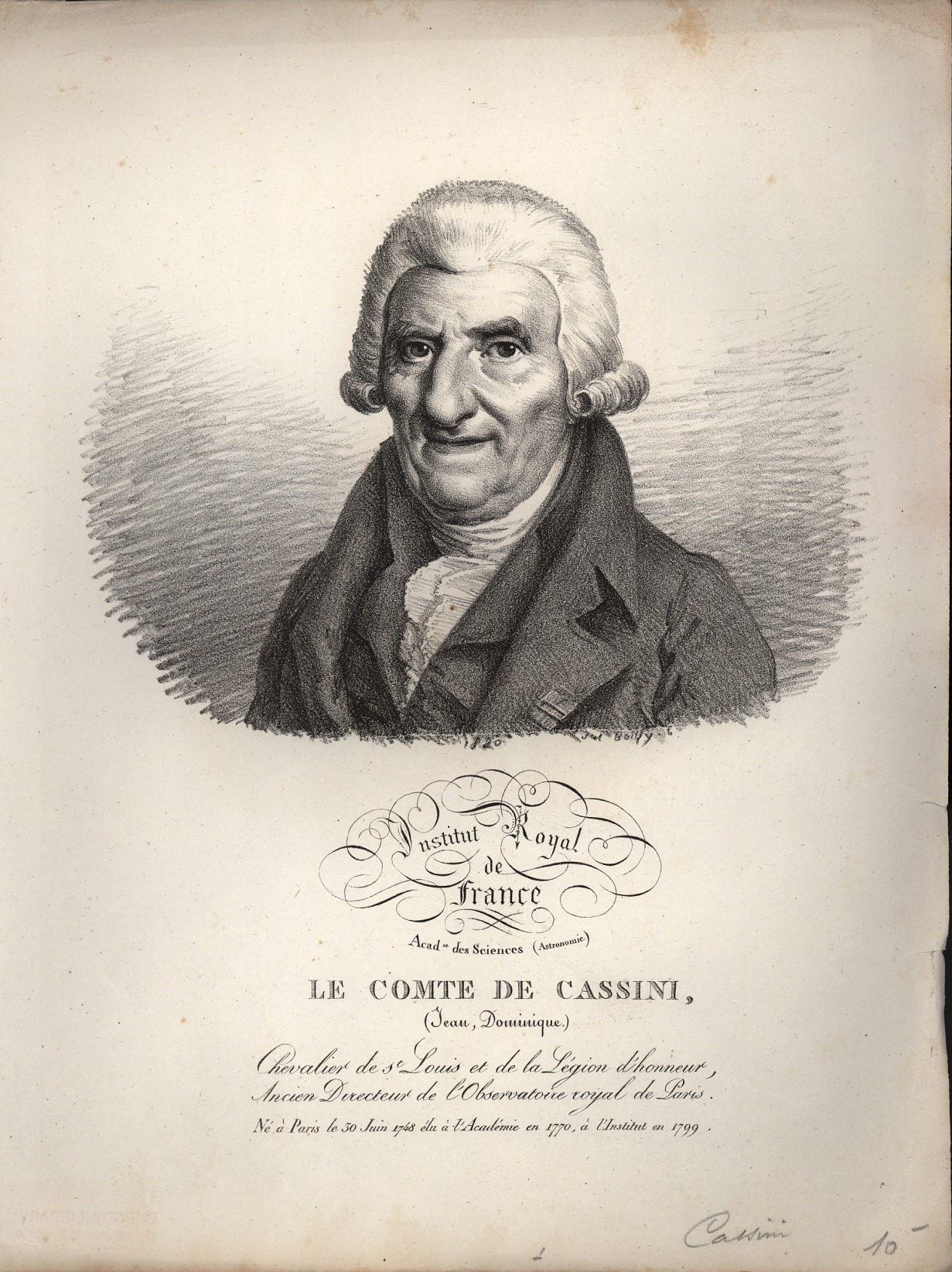
Figure 1. Portrait of Cassini IV by Julien-Léopold Boilly (1796–1874). Source: Wikimedia Commons / Smithsonian Libraries and Archives. Public domain, the artist having died more than 100 years ago. Rights statement. Unmodified.


The fourth Cassini, born at the observatory#
Cassini was born at the Paris Observatory on June 30, 1748, to César-François Cassini, known as Cassini III, and Charlotte Drouin de Vandeuil. He is distinguished from the seventeenth-century Jean-Dominique Cassini I, known for his observations of Saturn, by the number IV, which identifies his place in the family of scholars. He studied at the Collège du Plessis in Paris and then at the Oratorian school at Juilly, and worked with his father in astronomy and geodesy.23
His role in the 1768 voyage#
Maker and observer#
Le Roy made the two sea watches designated A and S in the report. Cassini observed and reported on the sea trial. The ship commanded by Captain de Tronjoly left Le Havre, visited Saint-Pierre near Newfoundland, Salé in Morocco and Cádiz in Spain, and returned to Brest. The voyage account records departure on June 13, arrival in Brest on October 30 and return to Paris on November 28.1
The problem was to keep a reference time at sea, such as the time at the place of departure, and determine the east–west position from the difference between that time and the observed local time. A regular daily gain could be included in the calculations as a known rate, while an irregular change made it harder to determine position. The observations before departure, at ports of call and after returning therefore formed one continuous trial.1
Transferring time from shore to ship#
At Le Havre the reference pendulum clock used for astronomical observations and the sea watches fixed aboard the ship could not be read together. Cassini used a small pocket watch with a seconds indication, made by Le Roy, as an intermediary. He set its hours, minutes and seconds to the shore clock, carried it aboard and compared it with one of the sea watches, then compared the two sea watches.1 (Part II, pp. 59–60)
On the return trip, he set the portable watch to the sea watch and compared it again with the pendulum clock on shore. Agreement on both legs gave him evidence that the portable watch had not varied substantially during the short journey. The procedure tested the time difference between devices in separate places. The report gives five or six minutes for the journey between shore and ship and provides no uncertainty estimate in the modern sense.1
On June 4, at Le Roy’s suggestion, the boxes of the sea watches were sealed with the captain’s seal so that any access to the interior would be apparent. The trial recorded the numerical results and included a means to check for adjustments during the voyage.1 (p. 60)
Questioning an apparently good result#
What a comparison of two watches can establish#
Cassini compared daily differences between the watches with astronomical observations at ports of call. A changing difference showed at least that the watches were keeping different rates. It did not show which watch had changed or by how much. After arrival at Saint-Pierre, observations allowed separate comparisons with the advance of mean time, connecting the differences noticed at sea to the behaviour of each watch.1 (pp. 109–110)
The report says that watch S varied considerably on the outward voyage, while watch A had relatively similar rates at Le Havre and Saint-Pierre. Cassini suspected damp because changes coincided with heavy fog and moisture rather than rough ship motion. That was his interpretation of observed conditions and watch behaviour, without a modern controlled temperature and humidity trial to isolate the cause.1
Accumulated error and rate stability#
From the initial observations at Cádiz, the report calculates a longitude error after 109 days of 56 arcminutes for one watch and 1 degree 45 arcminutes for the other. The figure of 56 arcminutes depended on the accepted longitude of Cádiz. A footnote suggests that the port could be 12 arcminutes west of its previously accepted position, in which case the watch-derived error would be smaller. The figure therefore depends on the historical longitude reference.1 (p. 44)
The watches’ rates changed later in the stay at Cádiz. The report discusses a possible relation to the heat and points out that a close reading at the end cannot establish stability over the whole voyage. A gain in one period can offset a loss in another, producing a good final result despite large errors in between. Cassini explained why intermediate checks were necessary. His report records the conditions under which the watches were useful and the irregularities that set limits on that use.1 (pp. 44–45, 109–114)
From the voyage report to instructions for use#
The 1770 Voyage fait par ordre du roi en 1768, pour éprouver les montres marines inventées par M. Le Roy, an account of the voyage ordered by the king to test Le Roy’s sea watches, has three parts. The first describes the voyage, ports, towns and fisheries. The second covers astronomical observations and watch trials. The third explains how to use the sea watches, find local time at sea, and prepare and use time tables, as well as applications such as determining latitude and instrumental error. The structure turns the observations into procedures that future users could calculate and check for themselves.1
The treatise on methods of measuring time at sea and the construction of the watches appended to the same volume was written by Le Roy himself. The appended treatise provides no basis for attributing timepieces, manufacturing techniques or patents to Cassini.1
The observatory, geodesy and the Revolution#
Cassini became an adjoint of the Academy of Sciences in 1770 and an associé in 1785. As his father fell ill, he gradually took over the running of the observatory and formally became its director in 1784. He explained the need for repairs to Louis XVI and proposed organisational reforms, some of which were not carried out. He also helped complete the map of France and worked on the geodetic survey linking the Paris and Greenwich observatories.2
Early in the Revolution, Cassini accepted political office and joined a commission preparing the metric system. He continued to support the monarchy and resigned his post in September 1793. From February to August 1794 he was imprisoned at the English Benedictine monastery in Paris. After his release he retired to Thury. The IMCCE biography records his resignation from the Bureau des longitudes in 1795, from the Institut national in 1796 and his re-election in 1799. The CTHS membership list gives 1795–1845 for the Bureau des longitudes. The two sources show why the date range alone does not establish continuous service.23
In 1810 he published memoirs on the history of science and of the Royal Observatory in Paris. He died at Thury-sous-Clermont on October 18, 1845. He continued his family’s work in running the observatory and preserved the results of watch trials together with his methods of observation. That record is a primary source for the history of sea watches.23
Timeline#
| Date | Event |
|---|---|
| June 30, 1748 | Born at the Paris Observatory. |
| Youth | Studies at Le Plessis and Juilly and works with his father in astronomy and geodesy. |
| June 4, 1768 | The sea-watch boxes are sealed at Le Havre. |
| June 13–October 30, 1768 | Trials Le Roy’s watches on an Atlantic voyage and returns to Brest. |
| 1770 | Publishes the voyage report and becomes an adjoint of the Academy of Sciences. |
| 1784 | Formally becomes director of the Paris Observatory. |
| 1785 | Becomes an associé of the Academy of Sciences. |
| September 1793 | Resigns his post. |
| February–August 1794 | Imprisoned, then retires to Thury on release. |
| 1795–1799 | Resigns from the Bureau des longitudes and Institut national and is re-elected to a learned body. |
| 1810 | Publishes memoirs on the history of science and the Royal Observatory. |
| October 18, 1845 | Dies at Thury-sous-Clermont. |
| Today | The 1770 voyage report is available from the ETH Library on e-rara, with the original descriptions of observation, comparison and use. |
Voyage dates come from Cassini’s 1770 book. The IMCCE and CTHS provide biographical and institutional dates.123
References#
- Jean-Dominique Cassini, Voyage fait par ordre du roi en 1768, pour éprouver les montres marines inventées par M. Le Roy, Charles-Antoine Jombert, 1770. Part I, pp. 1 and 44–47. Part II, pp. 59–64 and 109–114. Part III and table of contents. ETH-Bibliothek Zürich, Rar 4135. Bibliographic record and digitised original, complete PDF. Accessed November 11, 2026.
2. IMCCE, “Jean-Dominique Cassini (IV)”, Histoire de l’Observatoire de Paris. Biography. Accessed November 11, 2026.
3. Martine François, Marjorie Jung and Bruno Delmas / CTHS, “CASSINI Jean Dominique, comte dit Cassini IV”, La France savante. Created in 2007 and updated July 3, 2024. Biography and bibliography. Accessed November 11, 2026.