This article was translated from Japanese using AI. Read the Japanese original
The astronomer who turned clock readings into longitude#
John Crosley (1762–1817) was a British mathematician who worked as an assistant at the Royal Observatory, Greenwich, an astronomical observer at sea and a computer for the Nautical Almanac. Some records spell his name John Crossley. He operated precision marine timekeepers, determined their errors from astronomical observations and recalculated observations after a voyage. 1 2
On Matthew Flinders’s expedition, Crosley took observations and tested the timekeepers from departure as far as the Cape of Good Hope. After illness forced him to leave the ship, he remained involved in the calculations that established the longitudes of the Australian coast. Flinders’s 1814 account says explicitly that the Board of Longitude commissioned Crosley to recalculate lunar distances and other observations. 3
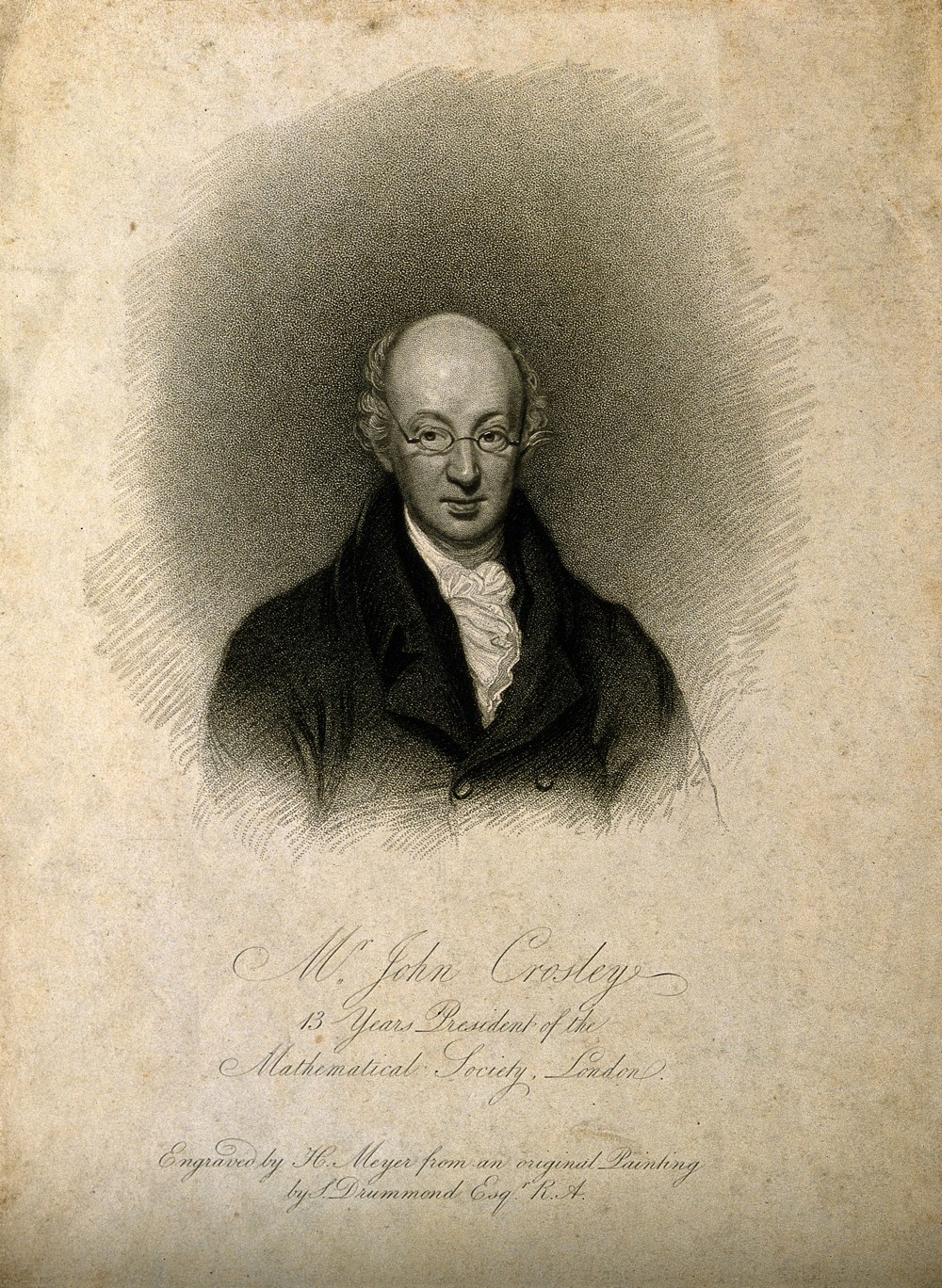
Figure 1. Portrait of John Crosley. Original by Samuel Drummond, engraved by Henry Meyer. Image courtesy of Wellcome Library, London / Wellcome Images (V0001360). Sources Wikimedia Commons file and Wellcome Collection. CC BY 4.0. Resized without cropping or tonal changes.

Greenwich and calculations for the Nautical Almanac#
Working as an assistant#
Crosley was reportedly from Yorkshire. He assisted Nevil Maskelyne at Greenwich from 16 July 1789 to 1 April 1792 and returned briefly from 21 July to 22 September 1798. This employment record leaves his early education and any apprenticeship in clockmaking unconfirmed. 1
An observatory assistant took observations, while a computer preparing tables for the Nautical Almanac calculated and checked results using theory and observational data. Crosley did both kinds of work and was also appointed to voyages. At sea he helped connect timekeeping to survey work. 1 4
Correspondence with Hitchins#
Maskelyne’s office notebook has a page headed “Mr John Crosley”. It records the supply of tables, almanacs and printed forms in June 1799, followed by the receipt and return of calculations. A June 1801 entry records that Hitchins found a substantial error in the Moon’s position and asked Crosley to recalculate it. The notebook’s general instructions assigned work to two computers and a comparer, so the tables underwent independent checking. 12
Letters from Malachy Hitchins, who checked the Nautical Almanac calculations, show how the work was done. In a letter dated 6 August 1799 reproduced by Carolyn Kennett, Hitchins acknowledges a detected error, corrects another value and asks for the October calculations promptly. Kennett describes the exchange of advice and corrections in 1799–1800. 4
The tables were the product of exchanges between the people who calculated them and those who checked their results. Crosley had also used such tables at sea. 4
A North Pacific voyage and shipwreck#
The plan to join Vancouver#
Crosley was appointed an observer for the Board of Longitude on 7 December 1793. He was to join George Vancouver’s North Pacific survey, but served instead on the Providence under William Robert Broughton. Broughton’s letter of 1 April 1797 says that, on learning Vancouver’s Discovery was already on its way home, he kept Crosley on his ship to continue making astronomical observations. 5
Crosley’s observing book records receipt of four timekeepers from William Bayly at Portsmouth on 9 October 1794. They were Earnshaw’s portable watches Nos. 1 and 2 and box timekeeper No. 248, and Arnold’s box timekeeper No. 56. Their errors against Greenwich mean time and daily rates were supplied. Crosley carried them aboard the Providence and secured them to a bulkhead in the captain’s cabin. Ashore he determined the time from solar altitudes with a mercury artificial horizon and compared the readings of the timekeepers. 10
The Providence was wrecked on 16 May 1797. Miyakojima’s cultural heritage guide places the wreck at Yabiji Reef off Miyako Island. 13 Crosley returned to Britain in 1798 and submitted a claim to the Board of Longitude for equipment, books and other property lost in the wreck. His letter of 30 November 1798 records his appointment date and shows how the assignment led to a long negotiation over payments and compensation. 1 5
Personal instruments and public equipment#
The loss list accompanying his claim mentions Earnshaw’s box timekeeper No. 248, silver portable watch No. 1522 and other items. This is Crosley’s own declaration of losses. The full Board of Longitude inventory issued for a separate voyage and the eventual settlement require their own records. 5
An observer had to look after the timekeepers and books brought aboard and record their use and the measurements obtained. The work also exposed him to loss of his personal property and the cost of travelling home after a wreck. Crosley’s papers document how practical marine timekeeping depended on observers and their instruments as well as the manufacture of the timekeepers. 5
Operating timekeepers aboard the Investigator#
The reference for longitude#
At one full revolution of Earth in 24 hours, a time difference of one hour corresponds to 15 degrees of longitude. The timekeeper method converts the difference between local and Greenwich time, expressed on the same timescale, into an angle. A marine timekeeper carries the time at the reference point and astronomical observation gives local time. With the lunar-distance method, the angular separation between the Moon and the Sun or a star is compared with values in the almanac to obtain Greenwich time, which is then compared with local time. Using both methods made it possible to check the timekeepers independently. 3 6
Timekeepers from two sources#
The Investigator, which sailed on 18 July 1801, carried equipment entrusted to Crosley by the Board of Longitude and equipment issued to Flinders by the Navy. The chapter on preparations lists the following numbers. 2
| Timekeeper | Role in the records |
|---|---|
| Thomas Earnshaw Nos. 543 and 520 | Marine timekeepers brought by Crosley and rated at the Cape of Good Hope |
| John Arnold Nos. 176 and 82 | Part of the same group of equipment. No. 82 took an irregular rate at the Cape |
| Earnshaw watch No. 465 | Crosley’s own watch, taken with him when he left the ship |
| Arnold watch No. 1736 | Issued to Flinders by the Navy for portable use in boats, on rivers and similar settings |
A pendulum regulator provided a reference ashore in addition to the portable and shipboard timekeepers. At ports of call, the observers set up a station on land and rated the shipboard timekeepers there, since the pendulum could not serve as a steady reference aboard a moving ship. 6
Rating the timekeepers at the Cape of Good Hope#
Crosley determined the rates from three days of equal-altitude observations of the Sun between 21 and 27 October 1801 at the Cape. He used a sextant and mercury artificial horizon. Observations at the same solar altitude in the morning and afternoon gave local time for comparison with the timekeepers. Repeating the observations on different days separated the amount a reading was fast or slow at an instant from the change in that error per day. 7
Flinders extended the measurement with an observation on 1 November. The table on p. 41 of the original gives No. 543 as 14 minutes 35.33 seconds slow on Greenwich mean time and losing 5.33 seconds a day. No. 520 was 34 minutes 16.62 seconds slow and losing 15.84 seconds a day. Offset and rate are different quantities. A reading over 14 minutes slow can still be corrected if the rate is known, though a change in rate during the voyage makes the estimate accumulate error. 7
No. 82 changed rate sharply on the final day and a rate that could be expected to hold could not be established. Suitability for use depended on what the comparisons and measurements showed as well as the maker’s reputation. 7
Leaving the ship and handing over instruments#
Crosley became unwell on the passage from Madeira. After resting ashore for several days at the Cape, he gave up continuing with the expedition. He left in October–November 1801, before the survey of Australia. He entrusted the Board of Longitude instruments to Flinders and gave him a copy of the observing instructions. 7
He took his own Earnshaw No. 465 and Troughton reflecting circle No. 74 with him. Flinders regretted losing both a specialist and useful instruments. The captain and his brother Samuel Ward Flinders, among others, carried on the observing. Command and survey work left them less time for astronomy than a dedicated astronomer could give it. 7 6
According to a claim Crosley later submitted, he sailed from the Cape in the Hindostan on 5 March 1803 and returned to St Helens on 27 May. He says he submitted his observations to Maskelyne after reaching Britain. 5
Recalculating the observations after the voyage#
In a letter to the Board of Longitude on 3 March 1814, Crosley reported that he had finished recalculating Flinders’s observations and had spent more than two and a half years on the work. He also asked the Board to consider his compensation, which had yet to be settled. The letter reports completion from his perspective, and the Board’s decision on payment would require a separate record. 11
Correcting apparent angular distances#
Flinders’s 1814 appendix says Crosley recalculated the lunar distances using Joseph Mendoza de Rios’s 1809 tables and method. Refraction, lunar parallax and the apparent semidiameters affect the angular distance between the Moon and the Sun or a star as seen from Earth’s surface. The observation has to be corrected for comparison with the almanac. Temperature, pressure and the pairing of objects observed also entered the calculation. 3
The Nautical Almanac gives lunar distances at three-hour intervals, but the Moon does not move uniformly between the tabulated values. The recalculation used adjacent values to derive hourly distances for the times of observation. When the observation site differed from the reference point on the chart, differences in longitude from the timekeepers reduced the observations to a common location. Timekeepers carried time between observations and linked observations from different places. 3
Checking the almanac for errors#
The almanac’s theoretical positions for the Moon and Sun also had errors. Astronomer Royal John Pond permitted use of tables of errors determined from observations at Greenwich, and Crosley calculated their effects on longitude. Observations pairing the Moon with the Sun and those pairing it with a star called for different corrections. When Greenwich observations of the Moon were widely spaced and errors varied irregularly, simple proportional interpolation had limits. 3
The recomputed lunar distances were used to correct the times obtained from the timekeepers, and the longitudes on the charts came from the timekeeper results. The records kept during the voyage made it possible to go back and examine errors in the reference tables after the expedition. This work connects the observer who had to leave early with the completed charts of the Australian coast. 3
The Mathematical Society and surviving records#
Crosley also served as president of the Spitalfields Mathematical Society. His portrait is inscribed “13 Years President”. Some studies and biographical sketches start his presidency in 1805, and the portrait alone provides too little evidence to work back to an uninterrupted tenure. Stewart and Weindling describe his long membership and refer to an extract from the minutes of 4 October 1817. 1 8 9
Crosley died in 1817. His letters, observational tables, calculations and portrait document the work of looking after instruments, making observations and correcting calculations. His contribution connected the making of a timekeeper with using it to determine a position at sea. 3 4 5
Timeline#
| Date | Event | Source |
|---|---|---|
| 1762 | Reportedly born in Yorkshire | 1 |
| July 1789–April 1792 | Works at Greenwich as Maskelyne’s assistant | 1 |
| 7 December 1793 | Appointed observer by the Board of Longitude | 5 |
| October 1794 | Receives three Earnshaw timekeepers and one Arnold from Bayly | 10 |
| April 1797 | Broughton reports Crosley’s service and observations to the Board | 5 |
| May 1797 | The Providence is wrecked | 1 5 |
| July–September 1798 | Returns briefly as a Greenwich assistant after reaching Britain | 1 |
| November 1798 | Submits claim letter recording the appointment date and losses | 5 |
| 1799–1800 | Receives advice and corrections from Hitchins | 4 |
| July 1801 | Sails as astronomer on the Investigator | 2 |
| October–November 1801 | Rates the timekeepers at the Cape and leaves the expedition because of illness | 7 |
| March–May 1803 | Returns from the Cape to Britain, according to his claim letter | 5 |
| March 1814 | Reports completing the recalculations after more than two and a half years | 11 |
| 1814 | Flinders publishes his voyage account, identifying Crosley’s role in recalculation | 3 |
| 1817 | Dies | 1 |
| 2017 | Publication of research on the correspondence with Hitchins and on finding longitude aboard the Investigator | 4 6 |
References#
- Graham Dolan, People: John Crosley. Employment dates, years of birth and death, and career. Accessed 20 October 2026.
2. Matthew Flinders, A Voyage to Terra Australis, vol. I, 1814, Book I, Chapter I, pp. 14–16. Transcription. Accessed 20 October 2026.
3. Flinders, same work, vol. I, Appendix, pp. 255–261. Transcription. Accessed 20 October 2026.
4. Carolyn Kennett, “An 18th-century astronomical hub in west Cornwall”, The Antiquarian Astronomer 11, 2017, pp. 45–54, especially p. 51, fig. 8 and §5.5. Journal issue. Accessed 20 October 2026.
5. Cambridge University Library, Board of Longitude Papers, RGO 14/1, correspondence concerning John Crosley, fols. 157–178. Manuscript images. Broughton’s letter of 1 April 1797, Crosley’s of 30 November 1798, the loss list and the claim letter describing his return in 1803, fols. 171r–173r. Accessed 20 October 2026.
6. Kenneth Morgan, “Finding longitude: The Investigator expedition, 1801–1803”, The International Journal of Maritime History 29(4), 2017, pp. 771–787, especially pp. 775–779 and 785. Copy at the author’s university. Accessed 20 October 2026.
7. Flinders, same work, vol. I, Book I, Chapter II, pp. 39–41. Transcription. Figures on p. 41 checked against the original page image. Accessed 20 October 2026.
8. Larry Stewart and Paul Weindling, “Philosophical threads: natural philosophy and public experiment among the weavers of Spitalfields”, The British Journal for the History of Science, 1995, note 15. Accessed 20 October 2026.
9. Wellcome Collection, John Crosley. Stipple engraving by H. Meyer after S. Drummond., V0001360, 2215i. Catalogue API. Accessed 20 October 2026.
10. John Crosley, Astronomical Observations on board HMS Providence, Cambridge University Library, RGO14/67, fols. 82r–83v. Original observing book. Receipt, installation and comparison of the four timekeepers. Accessed 20 October 2026.
11. John Crosley to the Board of Longitude, 3 March 1814, Cambridge University Library, RGO14/68, fol. 67r. Original letter. Accessed 20 October 2026.
12. Nevil Maskelyne et al., Nautical Almanac office notebook, Cambridge University Library, RGO4/324. Fol. 20r, “Mr John Crosley”, assignments in 1799–1801 and other years, and fols. 36r–37r, general directions for computers and comparers. Crosley’s page and general directions. Later additions, including those from 1813, are left unattributed to Maskelyne’s hand. Accessed 20 October 2026.
13. City of Miyakojima, “The Providence wreck at Yabiji Reef”, cultural heritage guide, p. 21. City PDF. Also mentions the underwater heritage outreach event of 18 October 2020. Accessed 20 October 2026.