This article was translated from Japanese using AI. Read the Japanese original
Joseph Williamson (birth year unknown, died 1725) was a clockmaker active in London from the late seventeenth to the early eighteenth century. He is known for equation clocks, which connect the uniform time of a mechanical clock with the seasonally varying time of a sundial. His claim of priority in a published letter, sales through Daniel Quare, and surviving pocket watches and astronomical clocks show a career that encompassed more than one invention. His work also exemplifies a division of labour in London, where a clockmaker’s designs could reach royal customers under other merchants’ or makers’ names. 1 2 3
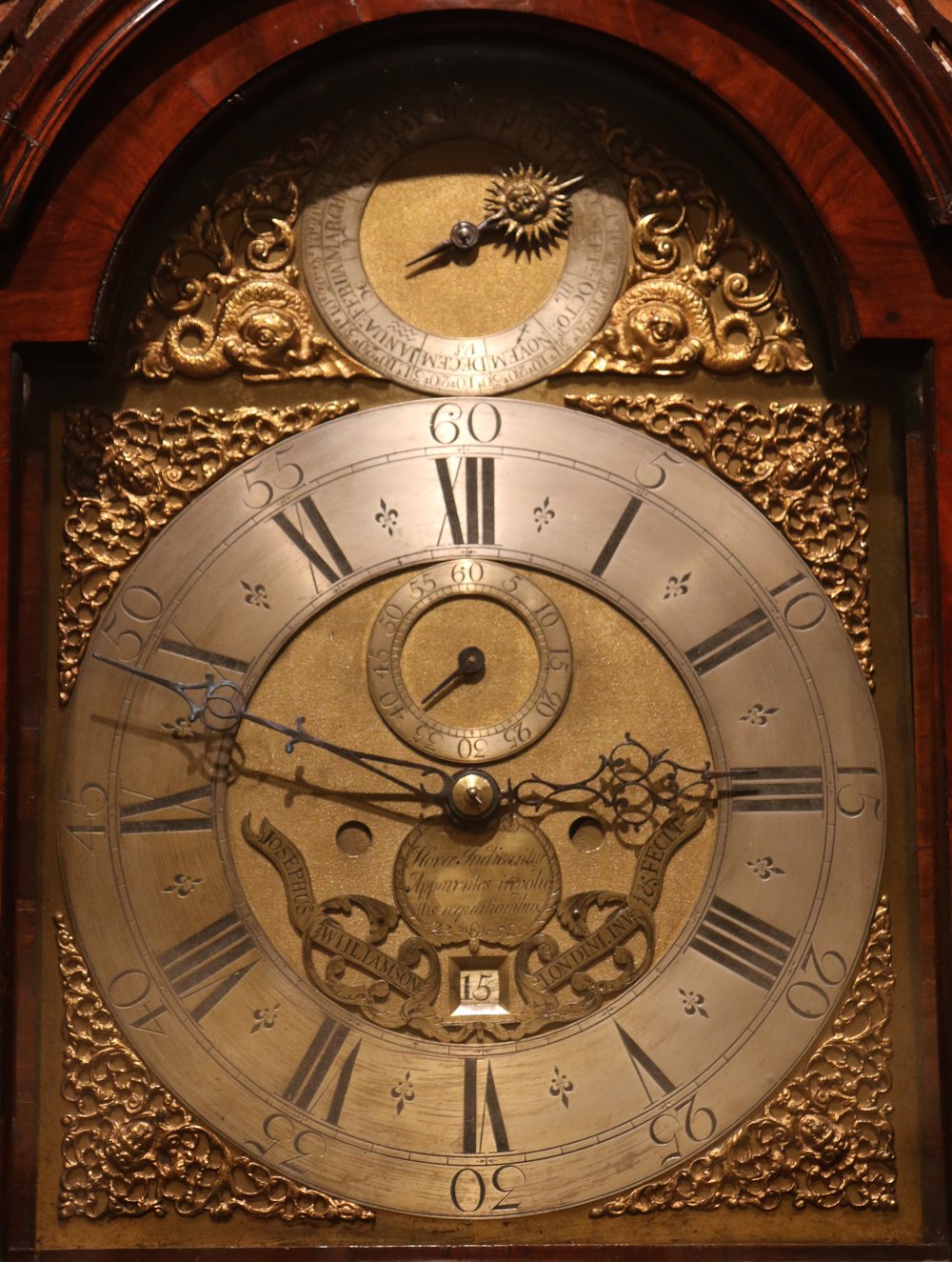
Figure 1. Equation clock at the Ashmolean Museum. The Commons description dates it to around 1720 and describes it as an eight-day clock. Photograph by Andrewrabbott, 2015. Source Wikimedia Commons. Licence CC BY-SA 4.0. Resized and recompressed as a JPEG. The displayed image carries the same licence.

What the records establish about his life#
The London Museum’s collection record says Williamson became a Free Brother of the Clockmakers’ Company in 1686 and served as Master in 1724. He worked in Clements Lane in the City of London. Sotheby’s research on a surviving clock also says he died in office in June 1725. The sources used here leave his birth year, parents and apprenticeship unconfirmed by contemporary records. 1 4
Accounts of his early career differ. Sotheby’s suggests an apprenticeship beginning in 1683, while the Waterford museum describes him as Irish and trained in Dublin. The accounts do not identify original registers that would establish the details of his birth or training. Sir Joseph Williamson (1633–1701), the politician and president of the Royal Society, was a different person. 2 4 8
His working relationship with Quare appears in Williamson’s claim to priority for an invention. An extract reprinted in a specialist catalogue says a clock placed in the chamber of King Charles II of Spain around 1699 or 1700 had been supplied by Quare, and that Williamson judged it to be his own work. The later title of clockmaker to the King of Spain may reflect a royal supply. A formal court appointment would require separate evidence. 3
How to relate solar time to a mechanical clock#
What the equation of time shows#
A sundial follows the apparent motion of the Sun. A mechanical clock counts equal intervals. The difference between the two changes over the year. A watch or clock can therefore disagree with a sundial even when correctly adjusted and working normally. An equation-of-time mechanism accounts for the difference mechanically. 5
Williamson disputed a French author’s description of a clock following the Sun’s apparent motion as a new invention. His letter in volume 30 of Philosophical Transactions makes that claim of priority the subject of its title. Williamson’s statement that he made such a clock earlier represents his own account. The Antiquarian Horological Society timeline notes an earlier example by Thomas Tompion. 3 5 9
Changing the pendulum’s rate over the course of a year#
In the longcase clock formerly numbered 1209 at the Time Museum and documented by Sotheby’s, the annual calendar arbor extends behind the movement and turns an irregularly shaped disc. A lever follows the disc and changes the effective length of the pendulum through the year, so the clock itself runs at apparent solar time corresponding to a sundial. The calendar provides an input to regulation as well as an indication. 4
Effective length is the length that governs the period of oscillation. The cam profile alters it with the seasons. Another approach would keep the clock running uniformly and add a scale to show the difference. The surviving clock documents one of Williamson’s designs. 4
Its dial has a seconds indication, date aperture and annual calendar at the top. The movement has five pillars and a bell for hour striking. The case is described as a later pairing. The catalogue dates the clock to around 1730 and also records Williamson’s death in 1725, leaving the dates of the movement, dial and case and their later association to be considered separately. 4
Williamson’s three designs and the limits of observation#
The full letter distinguishes the reported date of the king’s chamber clock, around 1699 or 1700, from the time Williamson made it for Quare about six years earlier. He gives it a running time of 400 days. He says he adjusted the pendulum to mean solar time, with two fixed circles showing mean hours and minutes, and two other circles moving forwards and backwards over the year so the same hands showed apparent solar time. 9
The later design raised and lowered the pendulum to vary its effective length. Williamson describes a roughly elliptical roller acting on a slit in a brass piece through which the spring at the top of the pendulum passes. He says Quare sold one of these clocks, which showed sunrise and sunset, to William III and that it was installed at Hampton Court in the king’s lifetime. Williamson also says he made a mean-time clock with a separate hand that moved in either direction from the top of its circle to show how much it was ahead of or behind the Sun. 9
Williamson also acknowledged that a clock might differ from astronomical tables. Cold and heat could change the pendulum’s length and cause errors in both mean-time and apparent-time clocks. He says he spent years comparing the Sun’s meridian transit on clear days with his mean-time clock, checked the reference clock’s gain or loss at the end of each year, and completed his own table in 1711. 9
The letter names a clock he had made five or six years earlier for Lord Chancellor Parker. The overall output is described only as many clocks, so the total remains unknown. 9
Other work and surviving timepieces#
| Object or record | Documented features | Points to consider |
|---|---|---|
| London Museum 32.68/2 | Pocket watch of 1716, gold pair case, enamel dial and steel hands | The outer case dates to 1791, so the timepiece as it appears today spans more than one date |
| BADA listing HW6376 | Ebony-veneered bracket clock, about 1715–1720, with a spherical Moon, eight-day movement and pull repeat | Dealer’s description of the object, giving only part of its ownership and manufacturing history |
| Former Time Museum 1209 | Apparent-time clock whose annual calendar cam changes the effective pendulum length | Married case and a date of around 1730 at odds with the maker’s death date |
| Astronomical bracket clock listed by Christie’s | Terrestrial globe that tilts with the season, annual calendar, alarm and quarter repeat | The scale ring may be a replacement and the date of around 1730 also needs qualification |
In the BADA bracket clock, a spherical Moon turns to show the lunar phase. Its movement has two fusees and six pillars, and the clock has blued steel hands and an engraved backplate. A fusee is a conical component that transmits mainspring power to the gears. A pull repeat sounds the time on demand. The description of this example says it distinguishes hours and quarters by striking bells. 6
Another astronomical bracket clock uses a brass cam rotating behind the annual wheel to change the orientation of a terrestrial globe with the seasons. Here the cam makes an astronomical phenomenon visible. The time, calendar, globe and audible signals combined in one movement show the range of Williamson’s work beyond equation clocks. 7
The gold watch of 1716 has an inner case engraved with animals, birds and plants, and a later outer case. The replacement during its long use shows why a signed watch may include work from different dates. The museum mentions a possible clock for Philip V of Spain. That customer remains a tentative attribution. 1
Timeline and later research#
| Date | Event |
|---|---|
| 1686 | According to the London Museum, Williamson becomes a Free Brother of the Clockmakers’ Company |
| Around 1699–1700 | In his later letter he claims to have made a clock delivered to the King of Spain through Quare |
| 1711 | According to Williamson, he completes his own table based on observations of the Sun |
| 1716 | Date of manufacture of the gold pocket watch at the London Museum |
| 1719–1720 | Publication window for his letter claiming priority in equation clocks. Volume 30 covers 1717–1719 and the Antiquarian Horological Society lists it under 1720 |
| 1724 | Master of the Clockmakers’ Company |
| June 1725 | Clock research records that he died in office |
| December 1955 | H. von Bertele discusses the invention of the equation clock in a specialist journal |
| 2004 | The former Time Museum apparent-time longcase clock appears in a Sotheby’s record |
| Fiscal year 2009–2010 | The PRISM Fund supports conservation of the Ashmolean Museum’s Williamson equation clock |
| November 2026 | Public museum records, photographs and auction records document surviving pieces |
Williamson used the motion of cams and calendars to account for the difference between the Sun and a clock. Quare’s sales network also helped carry that work to customers. Details of Williamson’s birth, apprenticeship, family, output and any formal court appointment remain uncertain. The account here does not draw on original patents or examinations of every surviving movement. The letters and individual clocks document a career extending beyond a single claim of invention.
References#
All sources accessed on 13 November 2026.
- London Museum, “Watch”, object 32.68/2. Collection record.
2. Waterford Treasures, “It’s About Time – The man who accidentally became a clock-maker to the King of Spain”. Museum account.
3. Carter Marsh & Co., Exceptional English Clocks and Watches, 2024, p. 167. Reprints excerpts from Williamson’s letter. PDF.
4. Sotheby’s, Masterpieces from the Time Museum, 2004, lot 536. Lot record. H. von Bertele’s 1955 paper is known here from the entry’s bibliography.
5. Antiquarian Horological Society, “Clock Timeline”. Timeline.
6. Howard Walwyn / BADA, “Joseph Williamson: George I Period Ebony Bracket Clock with Globe Moon”, stock HW6376. Object description.
7. Christie’s, “A George II ebony astronomical striking bracket clock with revolving terrestrial sphere, year calendar, alarm and pull quarter repeat”, lot 4128207. Lot record.
8. The Royal Society, “Joseph Williamson”, NA8408. Biographical record for the politician. Record of the namesake.
9. Joseph Williamson, “A Letter … Making Clocks to Keep Time with the Suns Apparent Motion”, Philosophical Transactions, vol. 30, pp. 1080–1082. The text on pp. 1080–1082 was checked in the public scan of the volume. Bibliographic record, volume 30 contents, original at Internet Archive.
10. PRISM Fund, Annual Report 2009–10, p. 9. Conservation grant report.