This article was translated from Japanese using AI. Read the Japanese original
Jost Bürgi (1552–1632) was a Swiss-born clockmaker, instrument maker and mathematician who worked at the courts of Kassel and Prague. He made clocks for observations, models of celestial motion and instruments for measuring angular and terrestrial distances. He also sought ways to simplify the calculations with many digits that astronomy required. Surviving clocks and surveying instruments, his method for calculating sines, an algebra manuscript and his progression tables of 1620 show how precision manufacturing and calculation came together in court work. 13 14
Life in Kassel and Prague#
Training before the surviving records#
Bürgi was born on 28 February 1552 in Lichtensteig in the Toggenburg region. His father, Lienz, is thought to have been a locksmith. Little is known of Bürgi’s career before he was employed at the Kassel court in 1579, and where he learned to make clocks and instruments remains uncertain. Scholars have discussed a possible association with the Strasbourg mathematician Conrad Dasypodius and exposure to the making of the cathedral’s astronomical clock. The evidence gives no continuous record of the sequence of cities or length of training. 13 14
The gap between his obscure early life and his later skills contributes to the impression of a self-taught maker. Waldvogel mentions the possibility that Bürgi trained in Schaffhausen as well as the Strasbourg theory, and treats both as tentative. 14
The landgrave’s observing programme#
Appointed court clockmaker on 25 July 1579, Bürgi served Wilhelm IV, Landgrave of Hesse-Kassel, as clockmaker and astronomer. An enthusiastic astronomer, the landgrave had established a permanent observatory in 1560. Bürgi made and maintained clocks and celestial globes and took part in observations with Christoph Rothmann and others. 13 14 19
An instrument with a finely divided scale still requires an accurate record of when the observation took place. Calculating positions from observations also required trigonometric tables and multiplication and division with many digits. Stable timekeeping and fast, reliable calculation were parts of the same work. Bürgi’s clocks and tables addressed those two requirements. 1 9 14
In 1592 Bürgi showed a celestial globe to Rudolf II in Prague. After Wilhelm IV’s death that year, he remained at Kassel under the patronage of Wilhelm’s son Moritz. Intricate works from this court period survive in museums, including a small celestial globe of 1594. 11 14 15
Bürgi’s lack of Latin illuminates one way knowledge reached him. MacTutor reports that Nicolaus Reimers Ursus, who worked in Kassel in 1586–1587, translated Copernicus’s principal work into German for him, and that the manuscript survives. Translation and assistance from colleagues allowed Bürgi to learn the theory and apply it to instruments without direct access to the scholarly language. 18
The imperial workshop and Kepler#
On 23 December 1604, Bürgi became imperial clockmaker to Rudolf II in Prague. 19 There he became close to Johannes Kepler, who esteemed him as an observer, instrument maker and mathematician and urged him to write down his mathematical discoveries. They worked as colleagues exchanging knowledge about instruments and calculation. 13 15
Their exchange is documented by the algebra manuscript known as the Coss, which survives with Kepler’s editing. It is a separate work from the progression tables Bürgi printed in 1620 and describes using algebra to construct a table of sines. Kepler published his first two laws of planetary motion in 1609 and the third in 1619. Their discussions are documented. Direct derivation of any particular law from Bürgi’s tables would require further evidence. 10 16
Benjamin Bramer describes his teacher as imperial clockmaker to Rudolf II, Matthias and Ferdinand II. 5 Bürgi maintained his ties with Prague and also spent time in Kassel. He returned to Kassel in 1631 and died there on 31 January 1632. Bramer, his brother-in-law and pupil, later published an account of the triangulation instrument and became an important witness to Bürgi’s instruments and mathematics. 5 13 15
Observing clocks: sound and display#
An observing clock preserved in Kassel, APK U43, illustrates Bürgi’s use of a cross-beat escapement and spring remontoire. The museum attributes it to him, giving dates before 1590 or before 1600. That range and attribution differ in certainty from the dating of a signed clock. 1
The cross-beat arrangement makes two arms coupled by teeth oscillate in opposite directions. The remontoire rewinds every hour so that the same part of the spring’s operating range is used repeatedly. It reduces changes in the drive compared with using the full range from a tight wind until the spring runs down. 1
The accuracy of a clock and what its dial indicates are separate questions. In sixteenth-century observing records cited by the museum, Rothmann and others measured intervals shorter than a minute. A clock with two regulating arms had neither a minute nor a seconds hand, and they counted fractions of a minute by listening. The museum finds that description consistent with U43 and says it suggests a period of one second. Counting beats by ear was an important way to use a clock in observations. 1
On 14 April 1586 Wilhelm IV described Bürgi’s clock in a letter to Tycho Brahe. MacTutor reports that the clock displayed minutes, measured seconds and had an error of less than one minute a day. The letter reporting performance outside the court and comparisons of surviving mechanisms offer two kinds of evidence about the clocks. 1 18
The 1591 clock showing mean and true motions of the Sun and Moon#
Kassel’s lunar anomaly clock, APK U24, was made in 1591 by Bürgi and Hans Jacob Emck. The small table clock is made of gilt brass, iron and engraved silver. With its lid closed it is 11 cm high and 15.5 cm square. The museum describes its principal function as displaying the difference between the mean and true motions of the Sun and Moon. 2
Mean motion assumes that an object travels at a uniform rate, while true motion corresponds to the observed non-uniform motion. Representing irregular astronomical motion from the uniform turning of clock gears required combining multiple cycles. According to the catalogue, U24 uses Copernicus’s two-epicycle lunar theory, combining circular motions of different speeds and directions with planetary and differential planetary gearing. 2
This is a mechanical translation of Copernicus’s lunar theory. The gearing shows how sixteenth-century theory represented variations in the Moon’s position by combining circular motions and how precision craftsmanship embodied that theory. 2 3
The triangulation instrument: scaling down a distant triangle#
Bürgi’s geometry also appears in his surveying instruments. The signed gilt brass triangulation instrument at Oxford’s History of Science Museum (inv. 54181, c. 1600) has a 324 mm baseline arm and bears the name of its original owner, Alberto Marchoni. The catalogue describes an instrument for measuring range and notes scales on the backs of the arms for sizes and weights of shot of different materials. 4
An observed baseline is transferred to the instrument to scale, and the target is sighted from both ends. The resulting triangle on the instrument is similar to the triangle on the ground, allowing a distance to be read from the scale. The instrument replaces numerical trigonometry with operations using geometry and scale. 4
Bürgi’s pupil and relative Benjamin Bramer describes two brass rules of equal length, a third longer rule attached to a movable slider, a locking screw, equally spaced graduations and sights. The preface to readers in the 1684 reprint says Rudolf II granted a privilege in 1602. It also recalls earlier preparation of the explanatory illustrations. The two events are recorded separately. 5
The ETH Library biography gives 1592 as the patent year, while Bramer’s preface gives 1602. The privilege document was unavailable in this research and would be needed to resolve the discrepancy. The year 1602 here is attributed to Bramer’s dated testimony. 15 The scope of the historical privilege and the text of any claims remain open. Instrument makers such as Danfrie and Zubler had similar instruments at the time. Triangulation itself had a broader history. 4 5
The experimental clock in Dresden#
An experimental clock in Dresden’s Mathematisch-Physikalischer Salon stands 50.8 cm high in a wooden case. It has coaxial hour and minute hands, hour striking and a remontoire. Chandler and Vincent describe its brass movement and two crossed arms tipped with weights in the form of winged cherub heads. These decorated weights are functional parts of the regulator. 19
The study treats the Dresden clock and the Viennese rock crystal clock as separate works. It mentions a proposed date of about 1625 for the Dresden clock and points out that no supporting evidence was offered. Its year of manufacture remains unconfirmed. 19
The astronomical clock with an armillary sphere in Stockholm#
The astronomical clock with an armillary sphere at Nordiska museet (NM301.573) is a large piece, 88.3 cm high, combining gilt brass and bronze with an ebony base. Above the horizontal table clock is an armillary sphere that represents the celestial sphere with rings. In the museum’s account, Barbro Bursell considers it very likely that Bürgi designed and made the instrument and notes Eisenhoit’s signature on the metalwork. The year is unknown, with proposed limits of 1582, the introduction of the Gregorian calendar, and 1603, the year of Eisenhoit’s death. 21
The table clock carries a star map engraved with 49 constellations and two rings for the Julian and Gregorian calendars. According to the account, the star map and calendars originally turned once a year, while the brass lattice above them turned once a day in the opposite direction. The clock struck quarters and hours and showed the time, date and position of stars. The armillary sphere above also represented motions of the Sun and Moon. Some links and the parts representing the Moon were already missing when it was described. 21
Bursell suggests that it may be the clock from the imperial collection in Prague. It was at the royal palace in Stockholm in 1695 and suffered major damage in the fire of 1697. It went to the history museum in the mid-nineteenth century and was deposited with Nordiska museet in the 1930s. Records also mention restoration for a 1980 horological exhibition in Munich. This court model survived fire, changes in collection and restoration. 21
Progression tables: adding red numbers to multiply black numbers#
The 1620 Arithmetic and Geometric Progression Tables pair an arithmetic progression of red numbers with a geometric progression of black ones. Roegel’s analysis of the original tables gives black 100000000 for red 0 and black 100010000 for red 10. Each increase of 10 in the red number multiplies the black number by 1.0001. With r for the red number and b for the black one, the modern expression before rounding is b=10^8×1.0001^(r/10). 6
Dividing the black numbers by 10^8, red 10 corresponds to 1.0001, red 20 to 1.00020001, and red 30 to 1.000300030001. To multiply the first two normalised numbers, add red 10 and 20 and read the black value at 30. This modern example illustrates the principle without reproducing the table’s integer rounding. Subtracting the red numbers gives division, multiplying them gives powers, and dividing them gives roots. The scale of the black numbers and interpolation also have to be taken into account. 6
The planetary clock and rock crystal clock in Vienna#
The Kunsthistorisches Museum attributes the planetary clock (Kunstkammer 846) to Bürgi and dates it to about 1605 in Prague. The 39.3 cm table clock is made of gilt copper alloy, painted silver, rock crystal, glass and iron. On its large upper dial, five hands representing Mercury, Venus, Mars, Jupiter and Saturn revolve around a fixed Sun in the centre. The museum describes it as the first clock to depict the heliocentric planetary system mechanically and mentions consultation with Kepler. 3 7
The moving hands represent the five planets around the central Sun. The display shows how the Prague court translated a new view of the universe into a mechanism. 3 7
The museum’s rock crystal clock (Kunstkammer 1116) was made in Prague around 1622–1627 and carries two signatures by Bürgi inside the mechanism. The museum describes it as the oldest surviving clock with a seconds display. It is made of gilt copper alloy, silver and rock crystal and is an important comparison for the observing clock U43, which is only attributed to Bürgi. Chandler and Vincent describe quarter striking, a remontoire operating every fifteen minutes, lunar age and phase indications, and a moving crystal celestial globe inside the outer crystal case, with a blued steel armillary sphere inside the globe. Its modified cross-beat escapement uses two balances in place of the observing clock’s two arms. 19 1 8
The sine algorithm: constructing tables by repeated addition#
Finding celestial positions from angular distances required tables of trigonometric functions such as the sine. Bürgi’s Kunstweg, or Artificium, approximates a set of sines for equally spaced angles at once. In Waldvogel’s modern explanation, halve the bottom value and sum upwards, then take the results and sum downwards. Repeat the process, finally dividing each entry by the bottom one to normalise the sine of 90° to 1. 9
A modern example starts with tentative values 4, 7 and 8 for 30°, 60° and 90°. Working up from half of 8 gives 4, 11 and 15. The intermediate column from top to bottom is 15, 11, 4. Summing down gives 15, 26, 30. Another round gives 56, 97, 112, then 209, 362, 418. Dividing by the lowest entry in each column takes the approximation to the sine of 60° from 7/8 = 0.875 to 26/30, 97/112 and 362/418, approaching 0.8660254. Repeated cumulative addition with little multiplication can therefore build a high-precision table. 9
The algorithm constructs sine values. The 1620 tables instead use red and black numbers to simplify multiplication. 5 9
The algebra manuscript known as the Coss#
Bürgi’s algebra manuscript, conventionally called the Coss, is thought to have been written about 1596–1603 and passed to Kepler for editing. In Moosbrugger’s reassessment of the manuscript, Bürgi treats the problem of finding the chord of one fifth of a 60° arc in a circle of diameter 2 with the equation 1=5x−5x³+x⁵. Here x represents the chord of a 12° arc. Bürgi relates the existence of multiple solutions to the geometry of a circle, where different arcs can share a chord and adding a full revolution leaves its length unchanged. 10
The clockmaker’s mathematics went beyond making calculation faster. Here algebra helps construct a sine table and raises the question of what each solution represents in geometry. The algebra manuscript edited by Kepler and the progression tables printed in 1620 are separate works. 10
The celestial globe and sextant#
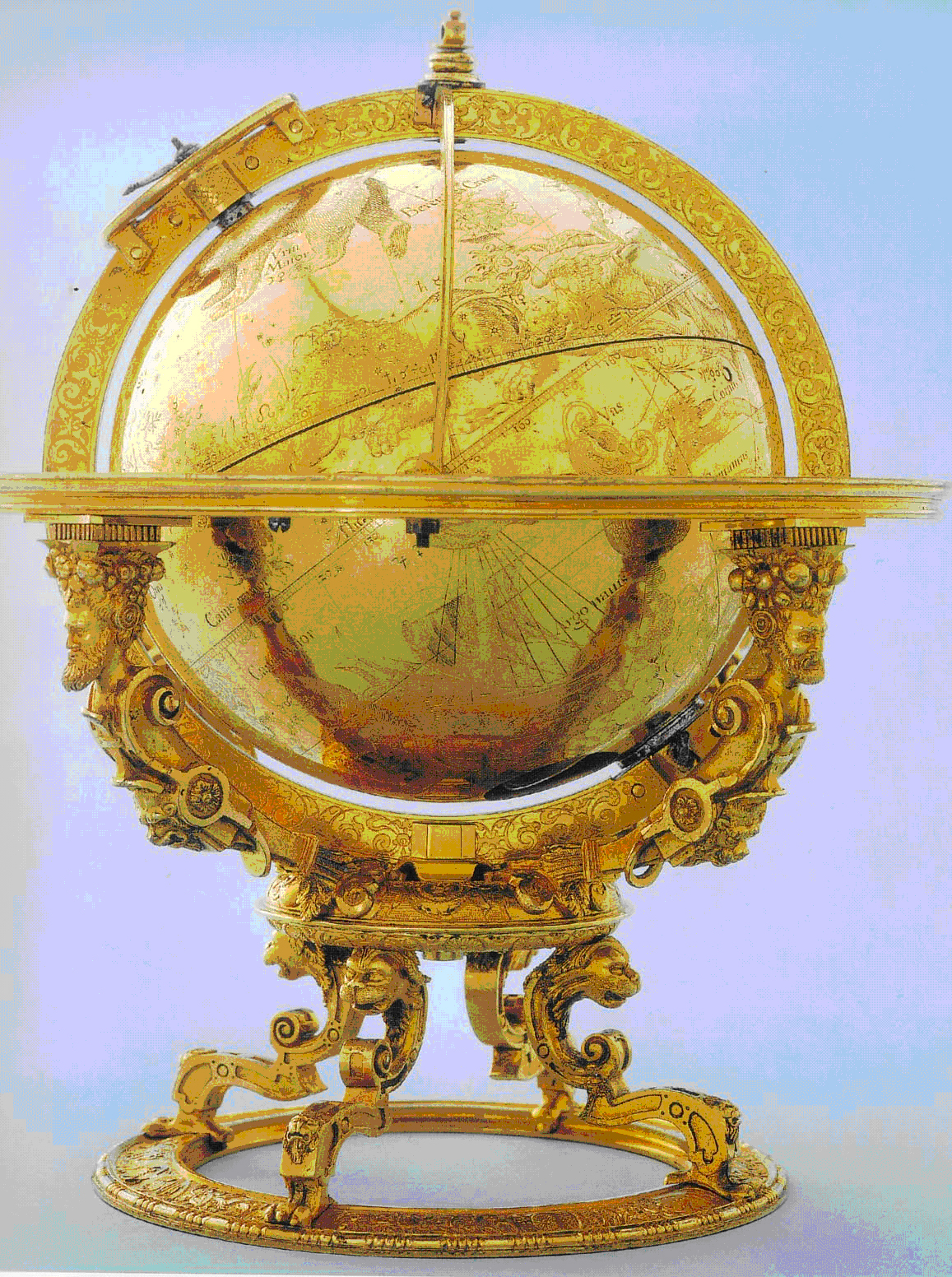
Fig. 1. The mechanised celestial globe of 1594 in the Swiss National Museum, Zurich. Photograph by Horology. Globe made by Jost Bürgi. Source Wikimedia Commons file page. Licence CC BY-SA 3.0 Unported. No changes.

The Swiss National Museum in Zurich describes the small gilt brass globe of 1594. Waldvogel gives the globe diameter as 142 mm and the total height as 255 mm. He explains that clockwork shows the motion of the celestial sphere and Sun and indicates the time. Bürgi brought regular celestial motions into a small three-dimensional model as well as making large instruments for observation. 11 14
The sextant in Prague’s National Technical Museum (inv. 17195) has been studied as an instrument by Bürgi from about 1600. According to Antonín Švejda’s collection study, its frame consists of two end arms and two braces. An arc of radius 1122 mm and two sights allow measurement of angles between celestial objects in any plane. A reading aid reportedly allowed measurements down to one arcminute. Outdoors the instrument was fixed to a stone block, and elsewhere it was placed in a light wrought-metal stand with woodwork. The support and the angle-measuring instrument were separate parts. 20
The museum also has a different instrument by Habermel (inv. 24551). It mentions Kepler’s use of Bürgi’s sextant for observing, and Švejda notes that he may have used it. A clock measures time and a sextant measures angular distance. Court astronomy needed the skills to make both. 12 20
Other surviving celestial globes#
Bürgi’s clockwork celestial globes survive in places besides Zurich. Dekker’s catalogue of globes lists these as separate objects. Diameters are as given in the study, where the Zurich globe is rounded to 14 cm. 22
| Globe and collection | Date in the study | Diameter |
|---|---|---|
| Paris, Musée des Arts et Métiers (CNAM) | 1582 | 23 cm |
| Weimar, Duchess Anna Amalia Library | c. 1585 | 23 cm |
| Kassel I | c. 1585 | 23 cm |
| Kassel II | c. 1594 | 23 cm |
| Zurich, Swiss National Museum | 1594 | 14 cm |
For the Paris globe (inv. 07490), Lionel Dufaux’s account for the Musée des Arts et Métiers credits Bürgi and Eisenhoit as collaborators and describes the rotating sphere of constellations and a perpetual calendar accounting for leap years. It formerly belonged to the Academy of Sciences and entered the museum in the mid-nineteenth century. Dufaux gives 1580, compared with 1582 in Dekker’s list. Both dates are reported with their attribution. 23
The people who passed on his instruments and mathematics#
Wilhelm IV was Bürgi’s first major patron, commissioning clocks and instruments for his observing programme. Moritz supported Bürgi after his father’s death, and Rudolf II welcomed the maker of celestial globes to his court. Court employment and collecting made it possible to build both practical observatory clocks and elaborate astronomical models. 13 14 15
The works were often collaborations. Hans Jacob Emck shares credit for the lunar anomaly clock of 1591. Bramer’s instrument manual recounts how the goldsmith and engraver Antonius Eisenhoit was asked to prepare illustrations. Instrument design, metalworking, engraving and explanation through drawings required different skills. 2 5
The history of the mathematics likewise has several strands. Bürgi’s progression tables appeared in 1620, after Napier’s printed logarithmic tables of 1614. The Historical Dictionary of Switzerland and other sources describe independent discovery by about 1588. Roegel interprets contemporary testimony as referring to simplification of sine calculations and places the progression tables around 1605–1610. The evidence admits different interpretations of discovery and distinguishes the date of printing from the origins of the separate methods. 6 13
In his Rudolphine Tables of 1627, Kepler said that Bürgi had found logarithms years before Napier’s publication and criticised him for failing to make his results widely available. This records a contemporary view without fixing the discovery in 1588. Roegel considers Kepler’s testimony and remains cautious about the interpretation of evidence for an earlier date. 6 18
Later research also shaped transmission of the progression tables. Roegel recounts how Kästner found them amid material he bought at the 1776 sale of Lowitz’s library and identified the author with Bramer’s account. Rudolf Wolf rediscovered the Munich copy in 1847. Locating the surviving tables and recalculating their entries has made it possible to assess the substance and quality of the work as well as its reputation. 6 14
Bramer describes a sine table at intervals of two arcseconds. This is distinct from the manuscript Fundamentum astronomiae, which records the sine algorithm. The surviving direct evidence leaves the full extent of the finished table uncertain. The manuscript with the algorithm was rediscovered in Wrocław in 2013 and modern scholars have interpreted and tested it as an iterative method of cumulative summation. The surviving procedure can be reproduced to evaluate its performance independently of the missing table. 5 9 10
Chandler and Vincent identify Hans von Bertele’s 1953 mechanical study of surviving clocks as a turning point in recognising the significance of the cross-beat escapement. The study of clocks, tables and manuscripts all helps reconstruct Bürgi’s work. 19
Bürgi’s name also survives in the lunar crater Byrgius. The International Astronomical Union’s gazetteer, published by the USGS, names the Swiss clockmaker Bürgi (1552–1632) as its namesake and gives 1935 as the year of approval. Museums and researchers continue to establish his work more concretely by investigating the attribution of clocks, the operation of his instruments and the accuracy of his tables. 17
Timeline#
| Year | Main event |
|---|---|
| 1552 | Born in Lichtensteig on 28 February. 13 |
| 1579 | Employed as clockmaker and astronomer at Wilhelm IV’s Kassel court. 13 14 |
| 1586 | On 14 April Wilhelm IV is reported to have described the clock in a letter to Tycho. 18 |
| 1591 | Makes lunar anomaly clock U24 in collaboration with Emck. 2 |
| 1592 | Shows a celestial globe to Rudolf II in Prague. Enters Moritz’s service after Wilhelm IV’s death. 14 15 |
| 1594 | Makes the small celestial globe now in the Swiss National Museum. 11 |
| c. 1596–1603 | Compiles the algebra manuscript known as the Coss, which goes to Kepler for editing. 10 |
| 1602 | The emperor grants a privilege for the triangulation instrument, according to Bramer. 5 |
| 1604 | Becomes imperial clockmaker to Rudolf II in Prague. 13 |
| c. 1605 | Estimated date of the planetary clock in Vienna. 7 |
| 1614 | Napier’s logarithmic tables published. 6 14 |
| 1620 | Bürgi’s progression tables printed in Prague. 6 14 |
| c. 1622–1627 | Estimated date of the signed rock crystal clock in Vienna. 8 |
| 1627 | In the Rudolphine Tables, Kepler credits Bürgi with reaching logarithms earlier. 6 |
| 1631 | Returns to Kassel. 15 |
| 1632 | Dies in Kassel on 31 January. 13 15 |
| 1648 | Bramer publishes his manual for the triangulation instrument. 5 15 |
| 1776 | Kästner buys at auction the collection in which he later finds Bürgi’s tables. 6 |
| 1847 | Wolf rediscovers the Munich progression tables. 6 14 |
| 1935 | The IAU approves the name Byrgius for the lunar crater. 17 |
| 1973 | A modern edition of the Coss with Kepler’s editing is published. 10 13 |
| 2013 | Rediscovery of the Fundamentum astronomiae manuscript advances reassessment of the sine algorithm. 9 |
References#
Online sources accessed 23 October 2026. Dates are given for the edition, study or collection record cited.
2. Hessen Kassel Heritage, lunar anomaly clock APK U24
3. KHM, The Times of Nature exhibition, Chapter I
4. Oxford, Epact: Triangulation Instrument, inv. 54181
5. Benjamin Bramer, Apollonius Cattus, part 3 of the 1684 edition, A3r–v, including the 1648 dedication
6. Denis Roegel, Bürgi’s Progress Tabulen (1620): logarithmic tables without logarithms, revision of 2013, pp. 8–13
7. KHM, So-called Viennese Planetary Clock, inv. 846
8. KHM, So-called Viennese Crystal Clock, inv. 1116
9. Jörg Waldvogel, Jost Bürgi’s Artificium of 1586 in modern view, March 2016, pp. 2–3
10. Damian Moosbrugger, “A clockmaker’s mathematics”, Archive for History of Exact Sciences 79, 8 (2025)
11. Landesmuseum Zürich, Sammlung im Westflügel, account of the celestial globe of 1594
12. Národní technické muzeum, national cultural heritage designation of three collection objects, including the sextant
13. Erwin Neuenschwander, “Bürgi, Jost”, Historisches Lexikon der Schweiz, updated 2005
14. Jörg Waldvogel, Jost Bürgi and the Discovery of the Logarithms, ETH report 2012-43, pp. 3–4 and 8
15. ETH-Bibliothek, Jost Bürgi (1552–1632), biography and guide to holdings
16. BAdW Kepler works project, The Planetary Laws
17. USGS/IAU Gazetteer of Planetary Nomenclature, Byrgius, Feature 943
18. J. J. O’Connor and E. F. Robertson, Jost Bürgi, MacTutor History of Mathematics, updated May 2010, on the letter of 1586, Ursus’s German translation and Kepler’s testimony of 1627
19. Bruce Chandler and Clare Vincent, “A Rock Crystal Watch with a Cross-Beat Escapement”, The Metropolitan Museum Journal 15 (1980), figs. 3–6 on pp. 194–196, appendix pp. 200–201
20. Antonín Švejda, “Přístroje a pomůcky z Klementina ve sbírce Národního technického muzea”, Acta Universitatis Carolinae – Historia Universitatis Carolinae Pragensis 57(2), 2017, published 2018, table p. 111 and text pp. 112–114
21. Barbro Bursell, Något makalöst! Nordiska museets astronomiska ur med armillarsfär, Nordiska museet, 1987, both pages
22. Elly Dekker, “Globes in Renaissance Europe”, The History of Cartography, vol. 3, part 1, ch. 6, appendix pp. 167–169, nos. 120, 126, 127, 149 and 150
23. Lionel Dufaux / Musée des Arts et Métiers, Sphère céleste, dite sphère de Bürgi, inv. 07490, museum account on Google Arts & Culture