This article was translated from Japanese using AI. Read the Japanese original
Louis Moinet was a French watchmaker and author who also pursued the arts and astronomical observation. He is known for the Compteur de tierces, an instrument that reads intervals down to one sixtieth of a second, and for a two-volume horological treatise published in 1848. His book brings together accounts of instruments he completed and used, descriptions of other watchmakers’ techniques, and proposals that still required testing. Reading these distinctions reveals work concerned not only with high-speed timekeeping, but also with materials, assembly and adjustment, sound, and the procedures of observation. 1 2 3
Life and watchmaking#
From the arts to precision mechanisms#
Moinet was born in 1768 in Bourges, central France. A modern biography by the Fondation de la Haute Horlogerie (FHH) says he came from a prosperous farming family, visited a local watchmaker from childhood, and went to Italy at around age twenty. In Rome and Florence he is said to have studied architecture, sculpture, painting, and gem engraving. His own book preserves specific recollections of this stay. 1 3
In a footnote on pp. 314–315 of volume I, he says that he obtained tools for cameo-making from a French watchmaker in Rome and had a rose-engine lathe fitted with an oval-turning attachment completed for his friend, the cabinetmaker Yves Livinec. In Florence, he engraved gems in a workshop made available by Count Manfredini, a minister of the Grand Duke of Tuscany; he adds that he still owned the workbench when he wrote. His later treatise thus incorporates youthful experiences at the intersection of art and mechanical work. 1
FHH says that after returning to Paris he taught art and shifted his main activity to horology around 1800. It also mentions a lengthy stay in Swiss watchmaking centres and contacts with Lalande, the bronze artist Pierre-Philippe Thomire, and automaton-maker Robert-Houdin. These encounters cannot all be assigned to the same year. A modern digital exhibition separately records that he taught art in Bourges in 1804–1806. 3 4
Collaboration with Breguet and a dispute over a manuscript#
Moinet became close to Abraham-Louis Breguet and also served as a secretary and writing collaborator in organizing ideas about watchmaking. According to FHH, the planned work was never completed and many manuscripts remained. A modern brand chronology dates their collaboration to 1815–1823. 3 4 7
On p. 512 of volume II, Moinet recounts a dispute involving an unnamed elderly watchmaker and that man’s heirs. After Moinet showed him early chapters of his own technical book, the watchmaker reportedly urged him to write up the older man’s work; Moinet says he began on the basis of a verbal agreement. After the man died, the heirs demanded the manuscript. Negotiations over a copy, seizure of horological papers, and litigation followed, ending with the sale of the manuscript documented by a notarial deed. Moinet maintained that the technical book he published did not include that early draft. 2
This is an account by one of the writers involved, not a record that establishes the unnamed man’s feelings or every stage of the litigation. It nevertheless shows that Moinet’s writing was entangled with questions about who recorded a craftsperson’s technique and who owned the resulting manuscript. 2
A modern digital exhibition says that in 1823 he established a precision-instrument workshop at 32 Rue Meslay, near Porte Saint-Martin in Paris, and founded and chaired the Paris Chronometry Society in 1837. The society initially had 37 members. FHH also mentions his contacts with Louis Berthoud, Antide Janvier, Louis-Frédéric Perrelet, and Benjamin Vulliamy. 3 4
He is said to have died in Paris on 21 May 1853 and to have been buried at Père-Lachaise. The exhibition’s account of his birth certificate gives 7 December 1768, making him 84 at death by completed years. 4
The Compteur de tierces and astronomical observation#
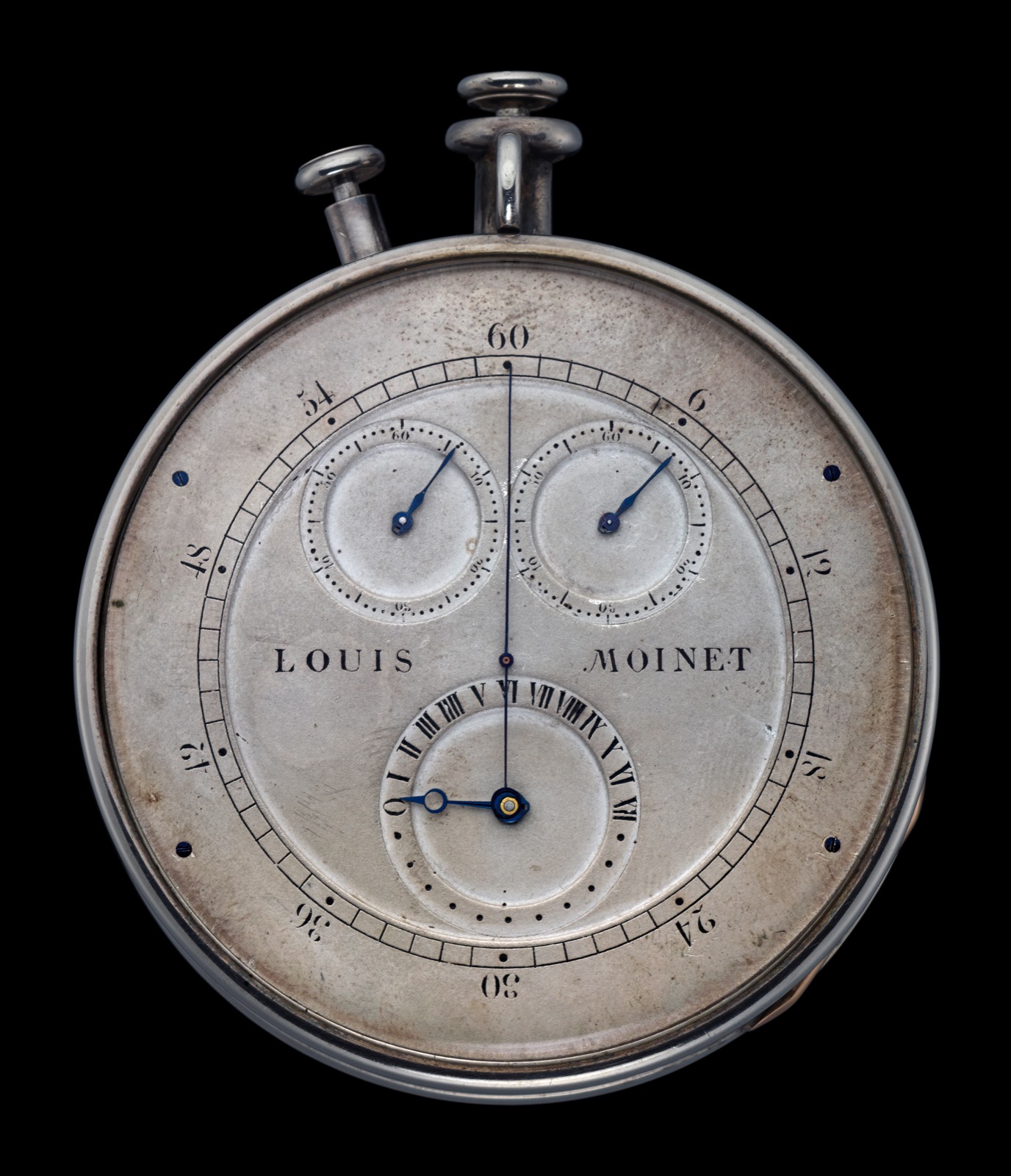
Figure 1. Louis Moinet’s Compteur de tierces. Photograph by LouisMoinet. Source: individual Wikimedia Commons file page. License: CC BY-SA 3.0 Unported. Processing: reduced from an existing crop by Hohum. The published image is also under CC BY-SA 3.0.

Why measure one sixtieth of a second?#
A tierce is a unit reached by dividing an hour into minutes, a minute into seconds, and then a second into sixty parts. In §1531 of volume II, Moinet describes his instrument as a clock-shaped apparatus intended for astronomical observation and physical experiments: it measured short intervals needed in observation and experiment. 2
In his account, when the fine wires in a telescope’s field of view are close together, an observer can miss the next wire while watching a star cross, reading a clock through a magnifier, recording the time, and returning to the eyepiece. If the star’s transit time between wires has first been measured with the Compteur de tierces, the time of crossing the central wire can be estimated from a correctly observed crossing of the neighbouring wire even if one observation is missed. The need was not merely for a small displayed unit: the instrument supported a procedure combining the observer’s eye, the sound of a clock, reading, and note-taking. 2
Moinet names a small movable quadrant associated with Borda as the inspiration. Originally intended for use aboard ship, it was adapted for land observations by adding a horizontal circle, crossing levels, an axis, and a tripod. Fortin is named as the person who graduated the horizontal circle in minutes. His role in this passage is the graduation of an optical instrument. 2
High-frequency regulator and the surviving instrument#
In a footnote on p. 127 of volume II, Moinet reports having a lubricated escapement fitted with rubies made and run at 216,000 vibrations per hour, without noticeable wear or increased friction over a long period. Counting each vibration as a beat gives 60 beats per second, or 30 Hz when a complete back-and-forth cycle is counted. That is 7.5 times 28,800 beats per hour, or 4 Hz. 2
A display divided into 1/60-second units does not by itself establish that measurement error stays within that interval under all conditions. Likewise, Moinet’s report of long use is valuable, but is not a modern accuracy or endurance test conducted under specified conditions. 2
Christie’s catalogue entry for the surviving instrument describes a silver case, 64.7 mm in diameter, a gilt-brass movement, fusee and chain, cylinder escapement, and a blued flat balance spring. The fusee changes the radius at which the chain acts to reduce changes in force transmitted to the train as the mainspring unwinds. 5
According to Revolution’s technical account, which includes photographs of the instrument, the central hand makes one revolution per second while three other displays totalize seconds, minutes, and hours. Two pushers control start/stop and return of the central hand to zero; the remaining displays are reset manually. This is not the same as the modern heart-cam reset. The account also lists a ruby cylinder, bar-shaped balance, platinum adjusting weights, 13 jewels, and a duration of about 30 hours. These details come from a later examination of the surviving object; Moinet’s §1531 does not give all of these specifications. 6
FHH says the instrument was made in 1815–1816 by Jean-Nicolas Fortin in Breguet’s workshop. Moinet’s relevant passage does not name its maker. The conception, manufacture, and later restoration and dating are facts reported by different sources. 2 3
Dating and the “first chronograph”#
Christie’s gave the instrument an approximate date of 1820–1830. Ateliers Louis Moinet, its present owner, says an inscription on the dust cover led it to date the start of work to 1815 and completion to 1816. The dating therefore differs between the auction catalogue and the later reassessment. The sources also disagree about the escape wheel: the auction entry gives 32 teeth, while the later photographic account gives 30. These are separate reported descriptions, not a single measurement. 5 6 7
Guinness World Records records that on 1 June 2016 it recognized the instrument made by Moinet in 1816 as the “First chronograph.” Its entry also says Jean-Marie Schaller bought it at Christie’s in Geneva in 2012. The “first” designation is an attestation based on the surviving instrument’s start, stop, and reset functions and its dating. The name chronograph, instruments that inscribed times on paper, and designs that added a totalizer to an ordinary watch belong to distinct historical stages. 14
In a footnote to §1531, Moinet says he could supply the instrument on mutually advantageous terms to anyone wishing to manufacture it. This records his intention to enable production. Its technical importance lies in applying a high-frequency portable instrument to a specific observational difficulty and documenting its purpose, rather than in broad commercial adoption. 2
The train, adjustment, and materials#
Two prototypes with 12-tooth pinions throughout#
In footnotes on pp. 366 and 479 of volume II, Moinet says he had the ébauche maker Audemar of Vaud make two watch movements with an original layout. Every pinion in the train, including the escapement side, had 12 teeth. He kept them as unused blancs-roulants and cited them as evidence that 12-tooth pinions could be used in small watches. 2
With a low tooth count, the point and profile of contact, tooth clearance, and cutting errors strongly affect meshing. Moinet’s discussion addresses how to avoid making the teeth too thin while retaining sufficient clearance and smooth transmission. On p. 479 he praises the precision of Swiss tools and says that the Paris-made pinions he had planned were no longer needed. He was demonstrating a design possibility together with the machining precision it required. 2
FHH links these two calibres to improved timekeeping across temperature differences. The footnotes cited above, however, discuss the feasibility and meshing of 12-tooth pinions and report no temperature-compensation test results. Train design and compensation for temperature-related rate changes should not be presented as the same effect. 2 3
A ball-ended stud and an adjustment mechanism for watchmakers#
At the beginning of chapter 10 in volume II, Moinet describes a specific combination of a stud that fixes the outer end of the balance spring and a balance cock. The stud’s head is a small steel ball held between two grooved steel plates and tightened with four screws. The idea is first to loosen the screws so the spring can take an unstressed position, then tighten them without shifting it. 2
The arm carrying the stud can also turn slightly around the balance’s centre, adjusted by a small square-holed pinion on the opposite arm. Moinet says this preserves the relationship between stud and spring when a watch is reassembled and allows the escapement to be adjusted without removing the balance and disturbing its oil. The aim is the watchmaker’s work during assembly and repair, not a mechanism that makes daily winding easier for the owner. 2
The movable stud on p. 200 of volume I is presented as an improvement by Vallet. It should not all be attributed to Moinet as an invention. His book records, compares, and preserves others’ improvements as well as presenting his own work. 1
What was the shock protection intended to do?#
In §1446 of volume II, Moinet proposes shock protection that would cushion impacts without changing the distance between the escapement pivots. He criticizes conventional spring cocks as too flexible and proposes a structure whose outline resembles an ordinary cock, whose pivot support remains firm, and whose outer edge provides sufficient length. Even a deflection too small to see, he argues, can cushion a shock. 2
He connects the proposal with protecting a ruby cylinder and explicitly asks watchmakers with the time and inclination to test it. 2
Heat treatment of springs and the barrel#
On p. 42 of volume I, Moinet describes heating a spring-steel strip evenly to red heat and quenching it in oil, then tempering it by sliding it over heated iron and watching the colours progress through pale straw, gold, purple, and blue. The process aims not only at hardness but also at elasticity that will recover after bending without breaking. Colour serves as a craftsperson’s guide to the process in place of a numerical thermometer reading. 1
FHH separately lists a “ressort de barillet denté” among Moinet’s improvements. That brief phrase does not establish a structure in which teeth were cut into the spring strip itself, nor its efficiency. Moinet’s heat-treatment description is not, by itself, evidence that he invented a toothed mainspring. 1 3
Alarm clocks and the conical pendulum#
Combining dust protection with a loud alarm#
Moinet gives a detailed account of an alarm clock he made for himself in §154 of volume I. The timekeeping train used a cylinder escapement and the striking train a lever escapement. When he added an inner cover to keep dust out, he found the sound became weak despite the large bell and hammer; it rang well when the cover was removed. He did not want to leave the mechanism exposed to dust. 1
He therefore made the bell somewhat larger and taller and rebuilt the case. Openings in the case side and a brass ring inside could be aligned or covered by moving the inner ring with a side button. Moinet reports that opening these vents while keeping the inner cover in place gave a sound close to that of the bell outside the case. Rather than solve volume only by striking harder, he designed the bell’s surrounding space, dust protection, and path for sound through the case together. 1
He also notes that people can become accustomed to the same alarm and fall asleep again. His account considers the user’s habits as well as the mechanism, though it is based on personal experience, not modern sound-pressure measurements or sleep experiments. 1
A public clock proposal drawing on Huygens#
Moinet’s account of the “parabolic pendulum” concerns a conical pendulum, whose weight travels continuously in a circle, rather than a pendulum swinging back and forth. In §1587 of volume II he treats it as an invention of Huygens. The mechanism uses a parabolic path and suspension intended to limit changes in period as the circle’s radius varies. 1 2
Moinet discusses practical weaknesses in guiding a silk thread along a curved surface and describes a suspension using two perpendicular blades, as well as an arrangement that makes a small circle. Power is transmitted by a slotted crank arm, allowing the amplitude of circular motion to vary. Since it lacks the sound of an escapement with pauses and drops, he considers it suitable for quiet settings such as a sickroom, but not necessarily for astronomical observations that rely on a stopped second and an audible beat. 2
He intended to use such a mechanism in a clock decorating a Parisian passage. The project progressed slowly, and he recalls that after he withdrew, it was replaced with an ordinary clock design. The decorative composition was the work of the architect Normand père and was also used for the frontispiece of his treatise. This is not a claim to have invented the principle, but an attempt to reconsider an existing principle and connect quiet motion with public-space design. 2
Clocks and patrons#
For Moinet’s decorative clocks, the maker of the movement must be distinguished from the craftspeople responsible for figures, bases, casting, and chasing. His collaboration with Thomire is also mentioned by FHH, but clocks depicting the same mythological figure do not necessarily represent the same object or commission. Objects with collection numbers, signatures, and provenance make it possible to see specifically how clocks were situated within the decorative arts. 3
The bust clock of Ferdinand III at the Pitti Palace#
The Italian Ministry of Culture catalogue 0900095710 attributes the clock held at the Pitti Palace as MPP12276 to Thomire and Moinet, dating it to around 1815. It combines a bust commemorating the return of Ferdinand III, Grand Duke of Tuscany, with gilt and chased bronze, black marble, and white enamel. The book held by a female figure bears the date 1 May 1814, linking the decoration to a political commemoration. 8
The Duke of Cumberland’s vase clock#
Research by the David Roche Foundation describes a vase clock made in Paris in 1810 on commission from Ernest Augustus while he was Duke of Cumberland, before he became King of Hanover. It incorporates a Neoclassical vase into the clock design, unlike the bust clocks with large figures. The foundation also records that David Roche acquired it through an agent at a Hanover sale in October 2005. 9
The White House Minerva clock#
The Minerva clock, known among the furnishings of the White House during James Monroe’s presidency, is also presented as a work by Moinet and Thomire. Its purchase is dated to 1817. A letter from President Truman dated 14 August 1952 says it was bought during Monroe’s presidency and that Monroe approved the payment papers on 4 May 1818. Purchase and payment approval were separate events; the two years need not be conflated. 3 7 10
Identifying the Napoleon and Jefferson clocks#
The “Napoleon clock,” no. 0602, at Museum Speelklok in Utrecht is described as a Paris-made musical vase clock from around 1805. It has portraits of Napoleon and Joséphine beneath the dial; while it plays, two angels lower a crown over them. Its organ has 12 keys and 12 metal open pipes, with a single melody arranged spirally on the cylinder. 12
FHH describes an 1806 “Napoleon clock” with an eight-day movement, hour, minute, and date displays, and a moon-phase indication made by a small ivory ball inside the date hand. Speelklok, by contrast, dates its object to around 1805 and names its maker as Louis Moinet le jeune. The descriptions cannot automatically be combined into specifications for one object, and the maker’s designation also matters when identifying this article’s subject. 3 12
Regarding a story that the city of Lyon presented the clock to the Emperor in 1805, the museum explains that a letter which appeared in a later auction does not by itself prove a commission from the city or an actual presentation. The existence of an object depicting the imperial couple and proof of an imperial commission are separate matters. 12
A clock attributed to Moinet in Paris is also associated with Thomas Jefferson. A museum article by Poplar Forest, drawing on Susan R. Stein’s study of the Monticello collection, describes a gilt-brass mantel clock. A classical figure reaches toward a globe on a column; a winged figure appears below the dial and a lamp above it. The maker is identified as Louis Moinet of Paris. 11
Jefferson’s detailed specification sent to William Short in 1790, however, concerns a different clock between two obelisks. Monticello attributes its manufacture in 1791 to Louis Chantrot. That specification cannot be read as an order to Moinet. Separating the objects makes it possible to follow Jefferson’s interest in clocks without conflating the work of particular clockmakers and artisans. 13 16
FHH and the modern brand also name Alexander I of Russia, George IV, Michel Ney, and Joachim Murat, King of Naples, among Moinet’s patrons. The brand describes Murat’s clock as combining hours, minutes, seconds, weekday, date, month, and moon phase across four dials, with the movement visible from behind. 3 7
The treatise and later reputation#
Moinet’s technical book is commonly called Traité d’Horlogerie. It is known as a work published in 1848, although titles vary by edition and catalogue; ETH Library lists it as Nouveau traité général astronomique et civil d’horlogerie théorique et pratique. Its two volumes cover mechanical principles, train calculations, machining and assembly, precision clocks for astronomy and navigation, pendulums, and measuring instruments. Moinet checks figures and numbers against the text, corrects statements by other authors, and incorporates communications from practitioners. 1 2
On p. 514 of volume II, he cites the intervals between publication of the parts, his lack of printing experience, and having parted with an earlier manuscript among the reasons the work is incomplete. He thanks Wormser for engraving the figures, Douchin for the ornamental lettering, and printer Malteste. The book depended not only on one watchmaker’s knowledge but also on the work of the people who drew, engraved, and printed it. 2
The rediscovery of the Compteur de tierces and its collection and exhibition by the modern brand brought Moinet wider attention. The label “forgotten genius” can be considered separately from his specific work. An unused prototype train, a watchmaker’s balance-spring stud, a shock-protection proposal submitted for testing, and an alarm clock designed around sound and dust protection differ in completion and purpose. Rather than treating all of them as inventions directly inherited by modern watches, examining the problem each addressed gives a clearer view of the breadth of his technical work. 1 2
A 2014 company announcement by the namesake brand says Ateliers Louis Moinet was founded in 2004. 17 The present-day Swiss company using the name is separated in time from the historical Moinet’s own workshop. Its digital exhibition presents objects and documents, while Guinness also identifies the company as the owner of the surviving instrument. The exhibition records that Impasse Louis Moinet was named in Bourges in 2018. Digitized books and renewed examination of the object allow readers in the twenty-first century to return to Moinet’s own accounts of observation and workshop practice rather than relying only on later biographical summaries. 4 14
Timeline#
| Date or period | Event | Source |
|---|---|---|
| 1768 | Born in Bourges; a modern exhibition gives 7 December as the date on the birth certificate | 3 4 |
| Around the late 1780s–1790s | Stays in Rome and Florence; recalls gem engraving and Manfredini’s workshop | 1 3 |
| Late 1790s | Later biographies say he taught art in Paris after returning | 3 4 |
| From around 1800 | Makes horology his main work and stays in Swiss watchmaking centres | 3 |
| 1804–1806 | Modern exhibition records that he taught art in Bourges | 4 |
| Around 1810 | Duke of Cumberland vase clock; later collection research dates it to Paris, 1810 | 9 |
| Around 1815 | Ferdinand III bust clock; date in the Italian cultural heritage catalogue | 8 |
| 1815–1816 | Present owner dates the start and completion of the Compteur de tierces; auction catalogue had given circa 1820–1830 | 5 7 |
| 1810s–1823 | Collaboration on Breguet’s writing; modern brand chronology gives 1815–1823 | 3 4 7 |
| 1817–1818 | Purchase and payment approval of the Minerva clock during Monroe’s presidency | 7 10 |
| 1823 | Modern exhibition records a precision-instrument workshop at 32 Rue Meslay | 4 |
| 1837 | Modern exhibition records his founding and chairing of the Paris Chronometry Society | 4 |
| 1848 | Publication of the two-volume horological treatise, collecting his instrument and workshop experience and others’ techniques | 1 2 3 |
| 21 May 1853 | Dies in Paris; modern exhibition records burial at Père-Lachaise | 4 |
| 14 August 1952 | Truman writes about the Minerva clock and antique White House furnishings | 10 |
| 2004 | Ateliers Louis Moinet later states that the company was founded | 17 |
| October 2005 | David Roche acquires the Duke of Cumberland clock at a Hanover sale | 9 |
| 2012 | Schaller of the modern brand buys the Compteur de tierces at Christie’s in Geneva | 14 |
| From 2013 | Renewed examination and public presentation of the instrument; modern accounts of its dating and mechanism circulate | 6 7 |
| 1 June 2016 | Guinness recognizes the 1816 instrument as the First chronograph | 14 |
| 2018 | Modern exhibition records the naming of Impasse Louis Moinet in Bourges | 4 |
| 1 October 2020 | Guinness recognizes the 1816 instrument as the First high-frequency stopwatch | 15 |
Bibliography#
- Louis Moinet, Nouveau traité général astronomique et civil d’horlogerie théorique et pratique, volume I, known as a work published in 1848. ETH-Bibliothek Zürich, Rar 17375:1. Digital edition. Passages consulted: printed pp. 42, 83–84, 197–198, 200, 205–206, 314–315. Accessed 23 October 2026.
2. Same work, volume II. ETH-Bibliothek Zürich, Rar 17375:2. Digital edition. Passages consulted: printed pp. 127, 365–366, 430–431, 451–452, 479, 512–514. The unnumbered opening page of chapter 10 falls between pp. 512 and 514. Accessed 23 October 2026.
3. Fondation Haute Horlogerie, Louis Moinet. Modern biographical account. Accessed 23 October 2026.
4. Louis Moinet Digital Museum, The Life of Louis Moinet. Modern historical exhibition by the brand. Accessed 23 October 2026.
5. Christie’s, Louis Moinet, Compteur de tierces, lot 5553708. Record of the surviving object, Details / Lot Essay. Accessed 23 October 2026.
6. Revolution Watch, Ahead Of Its Time: Louis Moinet’s “Compteur de Tierces” From 1816 Is Now Earliest Known Chronograph. Photographs and technical discussion of the object. Accessed 23 October 2026.
7. Ateliers Louis Moinet, Inventor of the Chronograph and Yesterday. Dating assessment and historical account by the current owner. Accessed 23 October 2026.
8. Italian Ministry of Culture, Object catalogue 0900095710, collection number MPP12276. Accessed 23 October 2026.
9. The David Roche Foundation, Club Fermoy, no. 31, 2022, pp. 7–8, “Today’s Treasure.” Collection research PDF. Accessed 23 October 2026.
10. Harry S. Truman, letter to Junius B. Wood, 14 August 1952. Transcription. Accessed 23 October 2026.
11. Karen E. McIlvoy, Traces of Jefferson’s Time at Poplar Forest, Thomas Jefferson’s Poplar Forest. Museum article referring to Susan R. Stein, The Worlds of Thomas Jefferson at Monticello, 1993, p. 381. Accessed 23 October 2026.
12. Museum Speelklok, Tafelklok met orgelpijpen en automaten, Napoleonklok, 0602. Accessed 23 October 2026.
13. Thomas Jefferson Foundation, Mantel Clocks, David Thorson, June 2024. Accessed 23 October 2026.
14. Guinness World Records, First chronograph. Record verified 1 June 2016. Accessed 23 October 2026.
15. Guinness World Records, First high-frequency stopwatch. Record verified 1 October 2020. Accessed 23 October 2026.
16. Thomas Jefferson, Enclosure: Jefferson’s Instructions for Procuring Household Goods, 6 April 1790, Founders Online, U.S. National Archives, Papers of Thomas Jefferson, vol. 16, pp. 321–324. Transcription of the original text. Accessed 23 October 2026.
17. Ateliers Louis Moinet, Les Ateliers Louis Moinet receives an IIPP award at UNESCO, 11 July 2014. Company statement about its founding year. Accessed 23 October 2026.