This article was translated from Japanese using AI. Read the Japanese original
Paul Perret (mid-1850s–1904) was a watch adjuster working in La Chaux-de-Fonds, Switzerland. He made instruments for bringing balance springs to a target frequency, and in 1888 received Swiss patent No. 1 for a watch movement designed to be easier to dismantle for servicing. In 1897 he made a balance spring from nickel steel supplied by physicist Charles-Édouard Guillaume and found that a watch fitted with it and a brass balance gained when warmed. A watch with a conventional steel spring tended to lose under those conditions. The observation led to collaboration on using the spring material to compensate for temperature-dependent changes in rate. 1 2 3 4
From La Sagne to a watch adjustment workshop#
According to Hans Weil’s account of an 1889 article in the local newspaper L’Impartial, Perret was born in La Sagne, in the canton of Neuchâtel, and worked in farming as a young man. In his late teens he became a watchmaker’s apprentice in La Chaux-de-Fonds. He reportedly served as technical manager at the Fontainemelon ébauche factory in 1874. In the late 1870s he worked in La Chaux-de-Fonds and developed adjusting tools there. In 1881 he was considered for the directorship of the city’s watchmaking school. 1 5
Perret’s advertisement in the 1883–1884 Indicateur Davoine offered instruments and watch adjustment at 65 rue du Parc, opposite the station. It listed precision adjustment with a test certificate from the Neuchâtel or Geneva observatory, adjusting Breguet overcoils and flat balance springs, and work on cut balances. Weil cites Girard-Perregaux and Agassiz fils among firms that commissioned adjustment of watches submitted to observatories. 4 5
Measuring spring length and the outer terminal curve#
The balance spring returns the balance towards its centre position after it turns. For springs of the same material and cross section, a longer active length gives a weaker restoring force and a lower frequency with the same balance. Perret’s Talantoscope compared the vibrations of the balance being adjusted with those of a reference balance to find the spring length for the target frequency. His Campyloscope let the adjuster compare the spring’s outer terminal curve with an enlarged drawing. The two instruments were used to estimate length and check the shape of the outer end, respectively. 4 5 6
The Musée du Temps in Besançon holds Perret adjusting instrument No. 904, made in La Chaux-de-Fonds. The brass instrument has steel grips and a tripod, with a balance and spring in a circular glazed cover. Its inscription records a diploma in 1880 and a first prize in 1881. The museum traces it to the precision adjuster Cécile Richert. Another instrument, No. 190, dating to around 1880, has a hand-operated slide. Christie’s describes it as a tool for determining the length of a new balance spring. 6 7
Swiss patent No. 1 and a movement designed for dismantling#
In Swiss patent No. 1 of November 1888, Perret aimed to reduce the number of screws and allow the movement to be partly dismantled according to which parts needed servicing. In Fig. 1, bridge P supports part of the train and the barrel, and retaining piece G holds the winding mechanism. Removing screws 1, 3 and 4 gives access to the winding mechanism alone while screw 2 keeps bridge P in place. For access to the train, screws 1, 2 and 3 are removed and the bridge lifts out with the winding mechanism still mounted on it. 1 2
On the hand-setting side, a bridge held by one screw retains the spring operating the setting lever and the wheel that drives the motion work. The dial fits into a ring whose height can be adjusted to give a consistent overall movement height with dials of different thicknesses. A surviving movement dismantled by Andreas Kelz, marked “BREVET No. 1” and “CHRONOMETRIE CIVILE”, has a retaining piece covering the winding and ratchet wheels, showing the patent’s design in use. The cam-operated fine regulator on this example corresponds to Perret’s separate patent No. 21. 2
Using the spring’s elasticity for temperature compensation#
Experiments with Guillaume#
The period depends on the balance’s moment of inertia and the torsional stiffness of the spring. As the rim expands with heat, mass moves farther from the axis and the moment of inertia increases. A conventional steel spring’s elastic modulus also falls as temperature rises. Both changes lengthen the period. In a cut bimetallic balance of steel and brass, warming bends the rim near the cuts inwards, reducing the moment of inertia to compensate for changes in the spring. 8 9
According to Guillaume’s recollections, in March 1897 Perret requested a sample of Invar, an alloy with low thermal expansion. With a brass balance and a spring made from the sample, the watch gained as it warmed. Perret inferred that the temperature-related rise in the spring’s elastic modulus outweighed the loss from the balance’s expansion. Guillaume notes that Marc Thury independently discovered the same anomaly shortly afterwards. Perret and Guillaume tested different compositions. Guillaume reported that in a trial in La Chaux-de-Fonds on 20 August that year, a watch with one nickel-steel spring showed the same rate at 0 °C and 30 °C. 3 8 9
A brass balance and about 28 percent nickel by weight#
Perret’s US patent US669763 pairs an ordinary-shaped balance spring of an alloy of about 72 parts steel and 28 parts nickel by weight with an uncut brass balance. The rising restoring force of the spring as temperature climbs offsets the increasing inertia of the expanding balance. Nickel in the specification means commercial-grade material, and brass includes copper alloys with nearly the same expansion coefficient as ordinary brass. The specification gives the corresponding Swiss patent as No. 14270, dated 6 May 1897. 10
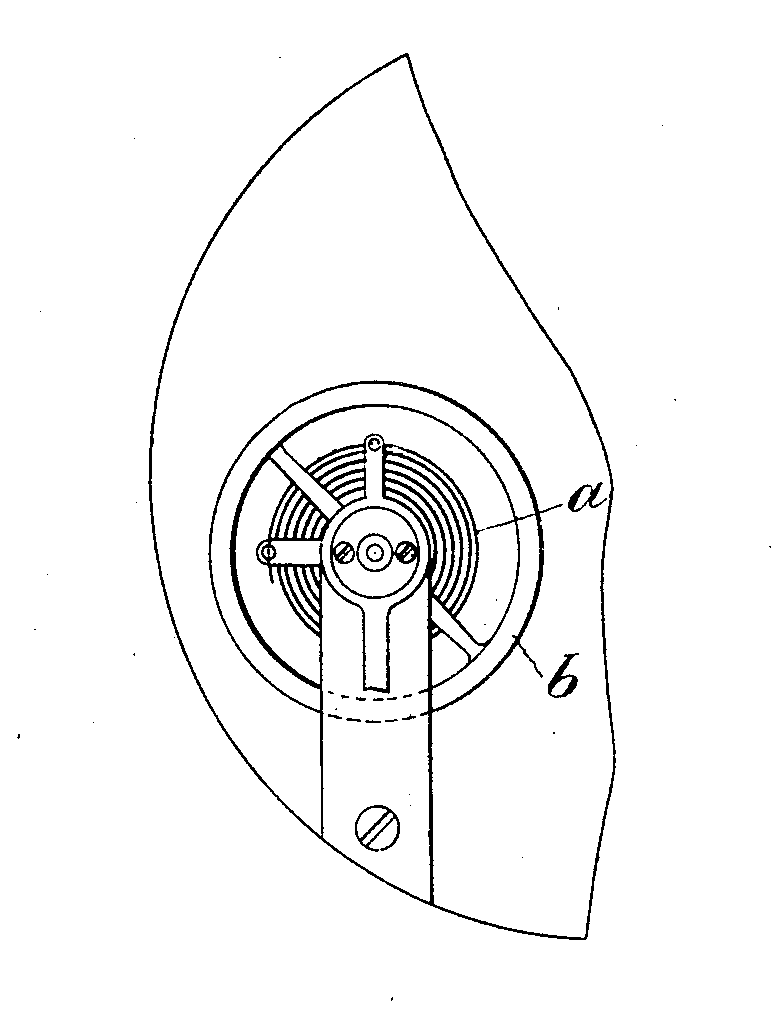
Figure 1. Paul Perret’s balance spring a and brass balance b. Paul Perret was the inventor and submitted the drawing, published by the United States Patent Office in 1901. The figure was cropped from the original plate. Original US patent US669763 Public domain, US Copyright Office guidance on duration of copyright
A 1912 retrospective in La Fédération horlogère suisse reports that alloys in two nickel ranges, 27–28 percent and 39–46 percent, could compensate for the increase in balance inertia with temperature. The first range was put into practice. The spring was called a spiral blanc, or white spring, because it could be distinguished from blued steel, and was also known as a Perret spring. The Neuchâtel Observatory tested it in 1901 and 1907. According to Thury, the 1907 example had a steadier rate than the 1901 one and the rate changed very little from before to after testing. The retrospective says early springs had a low elastic limit and could take a permanent set as amplitude varied. They were useful for temperature compensation in ordinary watches but difficult to use in precision adjustment. 9
Production in Fleurier and subsequent work#
Perret started making and selling nickel-steel balance springs in Fleurier in August 1901. A September advertisement recommended pairing them with brass balances so the conventional cut balance could be dispensed with. In December 1902 the business became the Société anonyme des spiraux Paul Perret à Fleurier. Perret died on 30 March 1904. That July, after his death, a licence to use patent No. 14270 was registered for the company in Emma Perret’s name. 3 5 11 12 13
The Fleurier manufacturing operation passed to Fabriques de Spiraux Réunies (FSR), a combination of balance spring manufacturers. A 1907 letter discussed by Johann Boillat records problems working the supplied alloy because of segregation and cracking. Guillaume and FSR continued their research and jointly applied for a patent in 1918 on an alloy connected with the later Elinvar. In his 1920 Nobel lecture, Guillaume described compensation by pairing a spring with a low thermoelastic coefficient with a balance of suitable thermal expansion. He credited Perret as the skilled adjuster who took the initiative in the early work. 8 11
Chronology#
| Period | Event |
|---|---|
| Mid-1850s | Reportedly born in La Sagne. Sources give 1854 and 1855. 1 5 11 |
| 1870s | Apprenticed in La Chaux-de-Fonds and works at Fontainemelon. Reportedly exhibits an adjusting instrument at the 1878 Paris exposition. 4 5 |
| 1880–1881 | Awards in Geneva and La Chaux-de-Fonds are recorded in the inscription on instrument No. 904 and in advertisements. 4 6 |
| 1883–1884 | Advertises adjustment and manufacture of adjusting instruments at 65 rue du Parc. 4 |
| November 1888 | Swiss patent No. 1 for the movement construction. 1 2 |
| From March 1897 | Tries Guillaume’s alloy in a balance spring. Swiss patent No. 14270 is dated 6 May, and on 20 August they compare rates at two temperatures. 3 10 |
| 1901 | US patent granted in March. The Neuchâtel Observatory tests a white spring, and production and sales begin in Fleurier in August. 9 10 11 |
| December 1902 | The Fleurier balance spring business is incorporated. 11 |
| March 1904 | Dies on the 30th. Manufacturing equipment later passes to FSR. 3 5 11 |
| 1907 | The Neuchâtel Observatory tests the Perret spring again. 9 |
| 1918–1920 | Guillaume and FSR jointly apply for a patent on a related alloy. Guillaume reviews watch-adjusting alloys and their application in his Nobel lecture. 8 11 |
| 2026 | The Musée du Temps record for adjusting instrument No. 904 is updated in the French Ministry of Culture’s public database. 6 |
Related articles#
References#
- Anatol Heib, Swiss Federal Institute of Intellectual Property, This is the first Swiss Patent, 1 February 2019. Publication of CH1 and account of the watchmaking school. Accessed 20 November 2026.
- Paul Perret, Swiss patent No. 1, Perfectionnements apportés à la construction de mouvements de montres de toutes dimensions, 1888, two pages of specification and one plate. Facsimile and dismantling of a surviving movement by Andreas Kelz, 3 July 2021. Accessed 20 November 2026.
- La Fédération horlogère suisse, Paul Perret, 3 April 1904, p. 187. Obituary and reprint of Guillaume’s lecture. Accessed 20 November 2026.
- Indicateur Davoine 1883–1884, La Chaux-de-Fonds, Paul Perret’s advertisement. Accessed 20 November 2026.
- Hans Weil, La Sagne und seine Pioniere, “Paul Perret und seine Verbindung zum Maison Paul Jeannot”. Includes the L’Impartial career account, death notices and obituaries, instruments and test records. Accessed 20 November 2026.
- Musée du Temps and French Ministry of Culture, Joconde, Machine à régler, boîte, accession No. 1972.12.1. Accessed 20 November 2026.
- Christie’s, Paul Perret, brass hand-operated hairspring vibrating tool, Important Watches, lot 2445, instrument No. 190. Accessed 20 November 2026.
- Charles-Édouard Guillaume, Invar and Elinvar, Nobel lecture, 11 December 1920, pp. 455 and 469–473. Accessed 20 November 2026.
- La Fédération horlogère suisse, Le spiral Guillaume, 30 November 1912, pp. 628–629. Retrospective on early nickel-steel springs and observatory tests. Accessed 20 November 2026.
- Paul Perret, Compensation Watch Balance and Hair Spring, US669763, filed 26 November 1897, granted 12 March 1901. Specification, drawing and claims. Accessed 20 November 2026.
- Johann Boillat, Des alliances pour des alliages III : le béryllium des spiraux, Bulletin de la Société suisse de Chronométrie, No. 88, December 2019, pp. 30–32 and notes 19–23 and 31–40. Accessed 20 November 2026.
- David Boettcher and Richard Edwards, The Submarine Commanders’ Watch, NAWCC Watch & Clock Bulletin, May–June 2014, pp. 301–302, Fig. 10 (Perret’s advertisement of 15 September 1901). Accessed 20 November 2026.
- La Fédération horlogère suisse, Brevets d’invention, 18 August 1904, p. 483, licence to use patent No. 14270. Accessed 20 November 2026.