This article was translated from Japanese using AI. Read the Japanese original
Introduction#
Pierre Le Roy (1717–1785) was a watchmaker active in Paris. He worked on clocks that could keep a reference time at sea, combining a freely oscillating balance, the isochronism of the hairspring, and compensation for temperature changes in a single mechanism. The marine clock he presented to the king in 1766 and his treatise, published in 1770, which explains in detail the reasons behind its design, are important sources for understanding the emergence of the marine chronometer.12
Le Roy’s work was about more than simply reducing how much a clock gained or lost. He considered separately why a change in amplitude affected timekeeping, how much force and friction from the gear train should be transmitted to the oscillator, and what should move to compensate when temperature changed the behavior of the hairspring. At the same time, he addressed the practical problem of taking such a mechanism aboard a ship, checking its rate through observations, and using it amid shocks and damp conditions.13
His large marine clock, the smaller clocks tested on voyages, and the portable watches recorded in later museum and auction catalogues differ in both construction and documentary context. Distinguishing them reveals a process of experiment and improvement that cannot be seen in the broad summary of three inventions alone.
Life and the Development of His Research#
From a Parisian Watchmaking Family to Timekeeping at Sea#
Le Roy was born in Paris in 1717. His father, Julien Le Roy (1686–1759), was a distinguished watchmaker who served the king, and Pierre belonged to this watchmaking family. Sotheby’s catalogue note gives 1737 as the year Pierre qualified as a master. This biographical detail is based on later research into his works; it does not document the particulars of his childhood education or his specific role within the workshop.28
Distinguishing father and son, as well as watchmakers who bore the same name Pierre Le Roy, is also necessary when examining works. For example, the Louvre’s pocket watch OA8345 lists its maker as “Le Roy, Pierre (Tours, 1687).” This maker attribution cannot simply be reassigned to the person discussed here, who was born in Paris in 1717. Works are also said to survive in which the son used movements bearing his father’s name.69
Le Roy looked back on his 1748 escapement proposal in his 1770 treatise, explaining how that proposal, recorded in the Academy’s publications, differed from the mechanism he adopted in his new marine clock. The CNAM clock catalogue also states that in 1754 he submitted a plan for a marine clock to the Academy in a sealed letter. His research into timekeeping at sea did not suddenly appear with the completed instrument of 1766; it followed earlier prototypes and investigations.12
On the early mechanisms, horologist R. T. Gould, in his 1923 book, recounts testimony later cited by Le Roy. According to this account, a marine clock with a balance supported by wires was shown in December 1756; a marine clock three feet high was made in 1763, followed the next year by a mechanism half that size. These dimensions refer to the height of the early instruments described by Gould, not to the 1766 clock or the diameter of its balance. Gould’s wording also stops short of identifying the form of the escapement in the 1756 clock with certainty.4
Even after his father died in 1759, Pierre continued working in Paris as a watchmaker associated with the royal household. His own 1770 treatise bears the title of watchmaker to the king. But succession to a workshop, a royal residence or appointment, and individual commissions are distinct facts. The title alone cannot be used to compile a list of deliveries to particular kings or nobles.12
The 1766 Presentation, the 1768 Voyage, and the 1769 Award#
On 5 August 1766, Le Roy presented a new marine clock to Louis XV. The title of the treatise published later gives this date and also records that he received the Academy’s double prize (prix double) for the best method of measuring time at sea. The 1769 award is treated as an important turning point in the CNAM catalogue and later histories of horology. The title alone does not support interpreting “double prize” as awards in two separate categories, one for clockmaking and the other for a method of measurement.124
There was more than one sea trial. The CNAM catalogue distinguishes trials in 1767, 1768, and 1771–72. The 1768 trial can be followed in detail through the account by the astronomer who took part in the voyage, Jean-Dominique Cassini, or Cassini IV: Voyage Made by Order of the King in 1768. The two clocks tested were distinguished as A, the earlier clock, and S, the later one.23
This voyage was not simply a matter of taking a completed clock aboard and reading its error at the end. The clocks’ time and rate were established at Le Havre, compared with astronomical observations at ports of call, and the relative gains and losses of the two clocks, air temperature, and ship movement were recorded during the voyage. Since the longitude of Saint-Pierre Island had not been established with sufficient certainty, Cassini focused there on checking the rate; for longitude comparisons he used the known positions of Cadiz and Brest. The reliability of observation sites also affected the evaluation of the clocks.3
Portable Watches and Later Years#
Alongside his large marine clock, Le Roy also considered how to carry precise time in a device closer in size to an ordinary pocket watch. In the appendix to his 1770 treatise, he acknowledges that a portable watch is too small to use all the resources of a large mechanism, then discusses improvements through isochronism, temperature compensation, and an escapement with reduced friction. His own account shows that he did not treat a small watch as merely a scaled-down version of a large one.1
On the 1771–72 voyage of the Flore, a small Le Roy watch called the “petite ronde” was carried alongside A and S. According to the officers’ account, Le Roy described it in writing as only a prototype, not one from which the same performance as the other two clocks should be expected, and not an entrant in the prize competition. It is therefore inappropriate to read its subsequent stoppages as the result of its large marine clocks defeating it in the competition for the award.5
Records of improvements to the small watch survive in auction catalogues quoting Le Roy’s treatise, museum descriptions, and accounts of works reconstructed later. These make his attempts at a portable marine clock more concrete, but they do not establish a complete continuous provenance from the 1771 trial watch to surviving objects. The differences among the individual works are discussed below.
The CNAM catalogue says Le Roy retired from the forefront of the field around 1773. He died in 1785. A story that he was disillusioned by how a rival was treated often appears in later accounts, but it is not enough on its own to determine the cause of his retirement or his state of mind.24
Other members of the Le Roy family were active in scholarship. Jean-Baptiste Le Roy, listed in Maindron’s study of former members of the French Academy of Sciences, must be distinguished from Pierre, who submitted the marine-clock treatise. The membership list compiled by the Royal Society records Jean-Baptiste’s election in 1773 and Charles’s in 1770. Having one’s clock examined by an academic institution is not the same as being a member of that institution.1011
What a Clock Needed to Determine Longitude#
One way to determine longitude at sea is to compare the local time where the ship is with the time at a reference location. If one rotation of the Earth is taken as 24 hours, a one-hour time difference corresponds to 15 degrees of longitude, and a one-minute difference to 15 arcminutes. If a clock preserves the time at a reference location, such as the port of departure, that time can be compared with the local time found aboard ship and the difference converted into longitude. At the beginning of his treatise, Le Roy also discusses cases in which weather and other conditions prevent the necessary astronomical observations, and explains the role of a mechanism that preserves time.1
The problem was that a pendulum clock could not simply be put aboard ship and expected to work in the same way. A pendulum depends on gravity and is affected by movement or changes in the position of its support. A balance and hairspring offered another possibility, but portable watches also suffered rate changes due to amplitude, friction, temperature, position, and shocks. Le Roy organized these as independent sources of error and applied mechanical remedies to them one by one.1
It is important to distinguish a clock that gains or loses absolutely nothing each day from one whose rate of gain or loss remains stable. If the rate is known and constant, it can be corrected for the elapsed time. But if the rate itself changes during a voyage, it becomes difficult to reconstruct the reference time from the clock’s reading. The officers on the Flore also explicitly state that the aim was not perfect agreement with mean time, but gaining or losing the same amount over equal periods.5
The procedure combined establishing the rate before departure, astronomical observations at ports of call, recording temperature, comparing clocks with one another, and correcting for residual temperature error. A marine clock was also a device for preserving the time established by observation until the ship reached the next place where a reliable observation could be made.35
The Technology of the 1766 Marine Clock#
An Escapement That Freed the Oscillator#
A mechanical clock escapement divides the rotation of the gear train according to the oscillator while replenishing energy lost through oscillation. But if a gear remains in contact with the balance for a long time, changes in driving force and friction are also transmitted to the oscillation. Le Roy reasoned that it would be pointless to combine an escapement with a balance oscillating solely under the hairspring if the escapement undermined the isochronism thereby achieved.1
Figure III and the text of the 1770 treatise distinguish the part that holds the wheel from the part that gives impulse to the balance. Two pins moving with the balance move the holding part step by step, and once the wheel is released, a tooth passes force to the pallet on the balance. In what Le Roy calls two vibrations—that is, one impulse per complete oscillation—the action is confined to a short interval near the neutral position. For most of the balance’s motion, friction from the escape-wheel teeth does not act directly on it.1
“Free” here does not mean that there is no resistance whatsoever. To release the wheel, a part on the balance must move the holding part, and the teeth make contact at the moment of impulse. The bearings, air, and hairspring attachment also have effects. What matters is that the gear-train force is not carried through the entire oscillation, leaving a longer interval in which the oscillator can move according to its own properties.1
The 1748 proposal and the 1766 clock did not have the same construction. Le Roy explains that the holding part in the earlier proposal was returned by a spring, whereas the later mechanism used a different arrangement. “Detent” refers to a part involved in holding and releasing the wheel, and should be distinguished from the suspension of the entire clock and from the wires supporting the balance’s weight.12
Later marine chronometers also exhibit the principle of keeping the oscillator as free as possible and maintaining its motion with a brief impulse. The CNAM catalogue recognizes the important conceptual relationship between Le Roy’s clock and later mechanisms, while avoiding a simplistic claim that later makers’ clocks derived directly from this particular object.2
Hairspring Length and Isochronism#
Isochronism is the property by which the period remains unchanged as the amplitude of oscillation varies. A clock’s amplitude can change with variations in driving force, friction, and the motion of a ship. If the period changes whenever the amplitude changes, the very standard that regulates the rotation of the wheels will shift. Le Roy’s concern was not only to regulate the clock to keep average time, but to stabilize the period against variations in amplitude.1
Le Roy says that in experiments varying the hairspring’s length, the relationship between the gains and losses of large and small oscillations reverses at a certain length. He observed that shortening it made larger oscillations faster, while lengthening it made smaller oscillations faster. He sought a length between those extremes at which the times of both came closer together. This aim differs from simply adjusting the average period by making a spring stronger to speed it up or weaker to slow it down.1
The way the end of the hairspring is attached also matters in this research. The marine clock has two opposed hairsprings, and their attachment points were designed not to constrain the springs’ action unnecessarily. The consistent design challenge was not merely to have two springs in appearance, but to retain the freedom of oscillation while adjusting the clock. Le Roy also stressed that regulation should be done without changing the chosen length of the hairspring.12
However, the rule Le Roy describes for the attachment point cannot be read as a necessary and sufficient condition that guarantees perfect isochronism in every hairspring. The CNAM catalogue qualifies this point. It is important not to conflate Le Roy’s experimental findings with explanations provided by later hairspring theory, but to examine which conditions he changed and what he observed in making his choice.2
Isochronism and the free escapement are not simply two separate achievements listed side by side. Even if the hairspring’s oscillations are less affected by their amplitude, a strong frictional impulse from the escapement during the oscillation would undermine that advantage. Conversely, even if the escapement is disengaged, a hairspring with strong amplitude dependence will show rate changes when disturbances aboard ship change its amplitude. Le Roy’s treatise treats these as a single design problem.1
Compensating for Temperature by Moving Liquid#
When temperature changes, it affects not only the dimensions of the balance but also the dimensions and elasticity of the hairspring. Le Roy separately examined why a portable watch lost time when warm and gained time when cold. For compensation in his marine clock, he chose to alter the arrangement of the rotating masses rather than move the hairspring’s effective length in response to temperature.1
The device shown in Figure V and the text on pp. 41–43 of the 1770 treatise consists of two curved glass tubes containing alcohol and mercury. As the temperature rises, the alcohol expands and moves mercury from the outer edge of the balance toward its axis of rotation. Moving mass inward from farther away from the axis reduces the moment of inertia, counteracting the loss of time caused by the hairspring’s weakening action. Using two tubes also helped limit imbalance of mass on the balance.1
The device does not change the effect of temperature itself; instead, it creates a separate effect that acts in the opposite direction. While maintaining the hairspring length chosen for isochronism, it changes the inertia of the balance to counteract rate variation. One reason Le Roy chose this form of compensation was the connection it offered between making temperature and isochronism adjustments separately.1
Le Roy also actually tested a bimetallic compensation balance. On pp. 55–57 of the treatise, he describes an attempt to compensate for temperature changes using a semicircular component combining copper and steel. But he says he was dissatisfied with its adequate rigidity, balance, stability of shape after heating, and stability of rate, and chose the liquid-based method. This does not mean that he never conceived of bimetallic compensation, nor that the completed marine clock had the same bimetallic ring as the cut compensation balances of a later era.1
If the state of a material changes after heating, the clock may not return to its former rate even when brought back to the original temperature. Le Roy also discusses the need to expose the clock in advance to the highest anticipated temperature. This passage shows an awareness that clock performance depended not only on thermal expansion coefficients but also on processing and heating history and stability over time. An ideal compensation principle and the challenge of reproducing its action repeatedly in real materials were not the same thing.1
Bearings, Drive, Case, and Suspension#
Friction in the balance does not arise only from the escapement. If the weight of a large balance is supported on a fine pivot, the conditions at the support also affect the rate. Le Roy’s marine clock combined support by fine wires with rollers to reduce friction at the balance staff. The two opposed hairsprings, the support, and the escapement were combined to keep the oscillation as free as possible.12
The large marine clock described by Le Roy has neither a fusee to even out the force of the mainspring nor a remontoire that periodically winds a separate spring and passes its force to the end of the train. He argues that such devices add parts and adjustments, increasing the risk of failure and difficulty of repair. This is not a specification common to every Le Roy clock; it differs from descriptions of his later small watches. A mechanism that keeps the clock running while it is being wound is also distinct from one that periodically supplies and evens out driving force.1
Le Roy considered a fusee unnecessary for this mechanism because he had chosen a powerful, isochronous oscillator. He points out that a fusee adds the possibility of a broken chain and requires a separate device to keep the clock running during winding. He also says that users could verify the isochronism of large and small amplitudes by observing the rate as the mainspring’s force changed. Rather than treating equalizing the drive as the only solution, the design aimed for an oscillator whose period would change little even as the force changed.1
Le Roy also describes an experiment in which he removed the wires and supported the balance pivots on polished hardened-steel plates. According to him, after three days the plates had become indented, impairing the amplitude and accuracy of the clock; the same problem occurred when agate was used. This is his report of the experiment, and it illustrates concretely why he chose a low-friction support. A large balance could provide greater resistance to disturbances, but its weight also made it necessary to address friction and wear at the contact points that supported it.1
Measures to counter the motion of a ship extended to the clock’s case and support. Pages 48–49 and the plates of the 1770 treatise show an arrangement that allows tilting and uses soft cushioning to moderate sudden movement transmitted to the clock. The case and box were also intended to protect the mechanism from rust, brief and severe temperature changes, and accidental impacts aboard ship.1
The large gimbal frame on CNAM’s surviving object no. 1395 was added later, according to the catalogue. The entire present appearance therefore cannot be taken as the original form of 1766. But this does not mean that the original clock lacked a suspension to isolate it from movement. Distinguishing the suspension described in Le Roy’s design from the frame added to the surviving object later helps us understand both the original ingenuity and the history of preservation and modification.12
Performance and Limitations Shown by Sea Trials#
Cassini’s 1768 Trial#
Cassini records that before leaving Le Havre, he did not have enough time to finish adjusting the clocks to agree perfectly with mean time. Instead, he prioritized sufficiently verifying the reference time and the rate. This allowed him to distinguish an offset in the reading at departure, a steady daily gain or loss, and a change in rate during the voyage.3
Since the longitude of Saint-Pierre Island was not known with sufficient certainty, the clocks’ readings could not simply be compared there against a correct longitude. Cassini therefore checked whether their rate was the same as at departure, and compared them with known longitudes at Cadiz and Brest. An important part of the trial was evaluating the clocks not only through daily comparisons between the two, but also through external astronomical observations.3
The report offers evaluations for the full 161 days and for intervals assessed from observations made along the way. For the 40 days from Cadiz to Brest in particular, it gives a longitude error of one-eighth of a degree for A and one-half of a degree for S. These figures apply to that interval and its starting conditions. They do not mean that either clock maintained the same error throughout the voyage, or that it was tested against Harrison’s H4 at the same time and under the same conditions.3
Cassini also paid attention to the relationship between temperature, humidity, ship motion, and rate, recording when the agreement between the two clocks was lost and when it returned. Rather than compressing the marine clocks’ value into a single “highest accuracy” figure, tracing the conditions under which they remained stable and those under which they changed better conveys their actual performance.3
The 1771–72 Trial on the Flore#
The voyage account by Verdun de la Crenne, Borda, and Pingré distinguishes Le Roy’s A and S, Berthoud’s No. 8, and the small petite ronde. The comparison over the 16 days from 10 to 26 October 1771 records that No. 8 gained 22.25 seconds, A lost 34.25 seconds, S gained 23.7 seconds, and the small watch lost 13 seconds. These are the gains and losses for that period; they do not constitute a ranking of rate stability over the entire voyage.5
The expedition carried tables of residual temperature error for clocks with mechanical compensation. Both Le Roy and Berthoud provided tables, which the officers used to make corrections according to temperature. Having a temperature-compensation mechanism is not the same as having zero error across the full temperature range; practical operation also required observational and mathematical corrections.5
The petite ronde stopped on 13 January 1772, and stopped again on the 20th, 26th, and 28th. The officers state that these stoppages happened while the ship was anchored off Gorée Island and could not be directly attributed to the ship’s movement in heavy seas. What this establishes is the operating limit of this prototype.5
The large clocks also suffered an accident. On 17 March 1772, a box that had not been sufficiently secured fell, breaking the compensation tubes in A and subjecting S to an impact as well. The report assesses A’s performance before the accident as better than a longitude error of two-thirds of a degree over six weeks. The officers also considered the impact’s effect on the change in S’s rate during the latter part of the voyage. Values after the accident cannot simply be substituted for normal performance when undamaged.5
For S, the officers summarize the longitude error over six weeks as generally better than half a degree, with one exception of three-quarters of a degree, and suggest that the exception may have been related to the accident. This is a qualified assessment, not a complete demonstration of the cause of the accident’s effects or a claim that the same accuracy was guaranteed under all conditions at sea.5
The concluding summary says that both Le Roy’s S and Berthoud’s No. 8 met expectations and could be relied on for determining longitude when appropriate precautions were taken. It says much the same of A, while noting that the accident prevented a long-term trial. The conclusion was based not only on the agreement between the clocks made by the two makers but also on comparison with separately established longitudes at ports of call.5
The same report also considers possible errors in daily readings caused by lighting and recording seconds. The trial’s historical significance lies less in a story of Le Roy or Berthoud unilaterally winning than in the officers’ comparison of different clocks, checks against independent observations, and examination of the accident and reading errors.5
Small Marine Watches and Surviving Works#
What Changed in Moving from a Large Clock to a Portable One#
In the appendix to his 1770 treatise, Le Roy explicitly says that he did not propose his detent escapement for small watches, because it was difficult to fit the mechanism into a small clock. Instead, he improved Sully’s arrangement, which placed the wheel perpendicular to the plate, believing that friction could be reduced by having contact occur close to the balance staff. He also mentions making the wheel larger while lightening it with radial teeth.1
The description “a Le Roy clock, therefore with a free detent and liquid compensation” does not apply to the small mechanisms. Under different constraints of limited volume, position while being carried, winding, and bearing fabrication, other escapements and compensation devices were tried. The inability to transfer the solutions reached in the large clock simply by scaling them down is an important aspect of this research.17
The Two-Faced Watch, the Petite Ronde, and a Reconstructed Object#
Antiquorum lot 66 from 2002 describes a two-faced watch said to have been made in 1774 for the Duke of Penthièvre. The object description lists a 41 mm movement, a total watch diameter of 67 mm, dials showing hours and minutes and seconds on separate faces, a Sully-type frictional rest escapement, a fusee and chain, maintaining power during winding, and hardened-steel bearings with ruby endstones. The attribution to the duke and the designation “the first deck watch in the world” are the catalogue’s judgments.7
In an account of improvements quoted by the same catalogue, the fusee absent from the 1771 mechanism was adopted and the compensation plate moved to the back. The movement of the bimetallic plate was transmitted to the hairspring through a lever, amplifying its action. This was different from the mercury-displacement method of the large marine clock. The object also bears signatures from 1772 and 1804, which do not agree with the 1806 restoration date in the catalogue heading. It should be treated as a watch that has undergone later additions and modifications.7
Beyer Clock and Watch Museum in Zurich separately presents “La Petite Ronde” as a marine chronometer/pocket watch by Pierre Le Roy, Paris, circa 1771, and explains that it could be removed from its holder and carried. This museum description is evidence for how it was carried, but it does not establish that it is the same object as the prototype that stopped on the Flore or the two-faced watch made for the duke.12
The small watch with movement plate no. 4732 in Chayette & Cheval’s official 2015 material must be distinguished further. The auction house describes it as made by Pierre around 1774 using a movement signed by his father Julien, while also explicitly stating that the mechanism is a reconstruction. Its present, orderly appearance cannot simply be treated as the unaltered state of the original 18th-century object. The father’s signature, attribution to the son, and later reconstruction are all pieces of information that coexist.6
Taken together, these sources show that attempts to make a portable marine clock survive as specific objects. But the approximate dates given by museums, production dates in auction catalogues, and dates signed on later-added dials are based on different evidence. Rather than asserting that a single completed mechanism was successively improved in 1771, 1772, and 1774, it is better for understanding the works to preserve what each source says about each individual object.56712
Decorative Watches and Records of Patrons#
Works associated with Le Roy’s name survive beyond marine clocks. The Metropolitan Museum of Art attributes gold and enamel pocket watch 17.190.1586 to Pierre Le Roy (1717–1785). Its diameter is 4.1 cm, and the museum gives a broad date of circa 1770–95. Since the end of this range falls after his death, the date alone cannot establish that he made the movement, case, and decoration all in a particular year.13
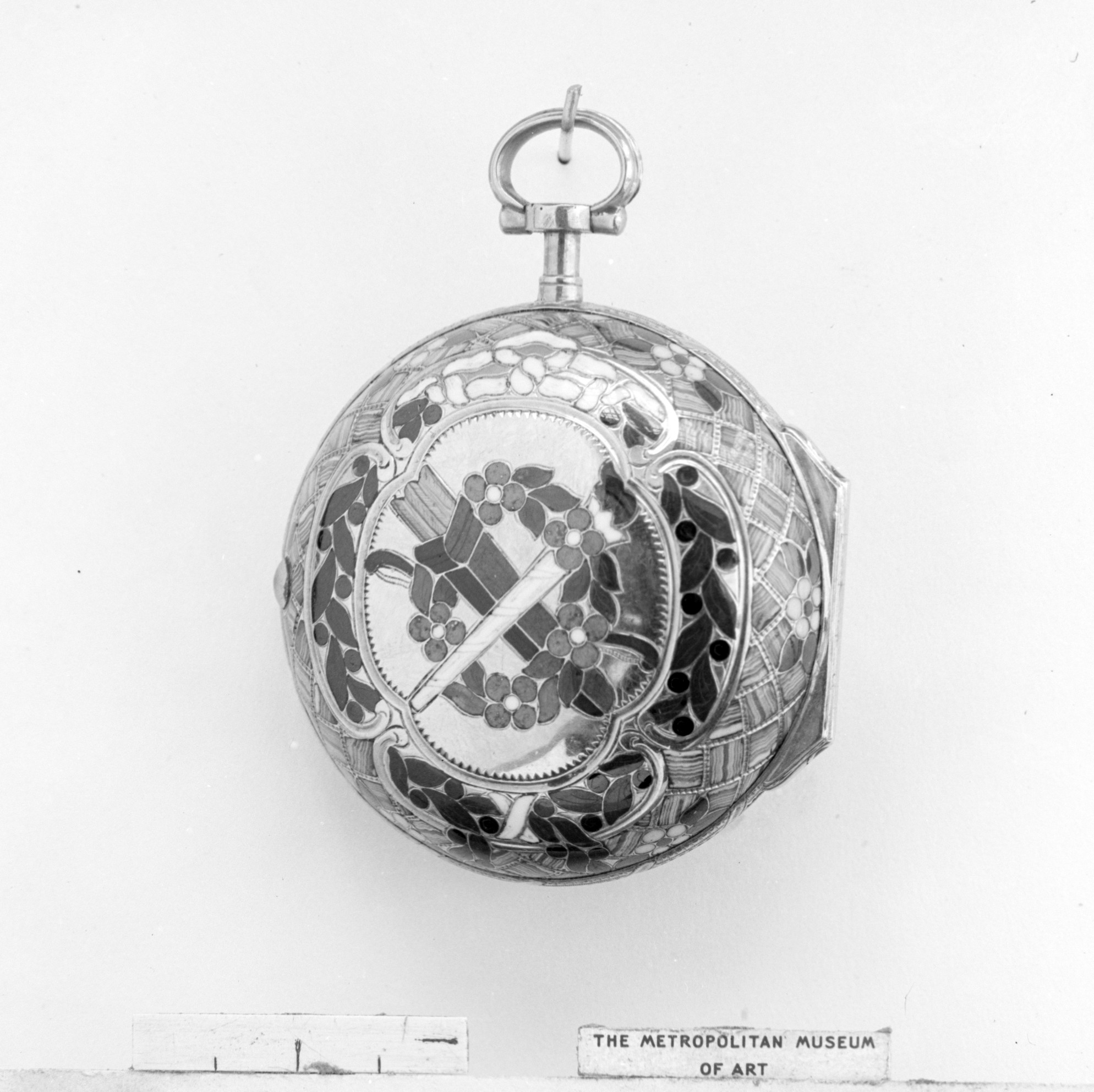
Decorative case of a gold and enamel pocket watch. Maker attribution: Pierre Le Roy, circa 1770–95 (museum date). Collection and image courtesy of The Metropolitan Museum of Art, 17.190.1586, Gift of J. Pierpont Morgan, 1917. Individual photographer not identified. License used: CC0 1.0 Universal (the museum’s Open Access policy). No alterations.
This image shows the decorative case; it is not a photograph of the marine clock’s escapement or compensation mechanism. Morgan’s gift in 1917 also does not identify an 18th-century patron. Le Roy’s role as a designer of precision mechanisms and the attribution of decorative watches can be traced separately through specific sources.13
Sotheby’s 2009 lot 112 discusses a wall clock featuring a figure of Hercules, recording the PIERRE LE ROY signature on the dial, its former ownership by Doistau, its appearance in a 1909 auction, and its exhibition history in the early 20th century. This is a source for the object’s signature and later provenance.8
The relationships that should be most clearly distinguished when discussing patrons are the presentation to the king, cooperation in sea trials, and attribution of a work to the duke. The presentation to Louis XV in 1766 is confirmed by the title of Le Roy’s treatise. Cassini and the officers on the voyage conducted trials and observations. The Antiquorum catalogue explains the connection with the Duke of Penthièvre. Grouping all of them together as “customers” who bought a normal commercial product would obscure the distinct roles of the royal household, scientists, navy, and patron.1357
Rivals and Later Assessments#
Comparison with Berthoud#
Ferdinand Berthoud (1727–1807) was another important watchmaker developing marine clocks in France at the same time. The Royal Society list records his election in 1764. Le Roy’s and Berthoud’s manufacture, presentations, appointments, and awards were separate events; a single year’s award or appointment cannot determine the performance of both men’s clocks or priority for all their inventions.11
The Flore records are especially important as a source evaluating both men’s clocks on the same voyage. The officers concluded that both S and No. 8 were reliable, and wrote that the agreement between the two makers’ clocks had improved compared with earlier voyages. Their explanation that both makers had probably improved their designs based on prior experience is the officers’ inference, however, not the result of testing each change in isolation.5
Seen from a later perspective, Le Roy’s free escapement and isochronism research have features close to the principles of the modern marine clock. There were also practical challenges in manufacturing them reliably, supplying them to ships, and maintaining and adjusting them in continued use. To understand the competition, it is necessary to assess the advanced nature of the ideas, the precision of prototypes, and the establishment of a supply system using their respective evidence rather than combining them on a single scale.125
The Design Process Preserved in His Writings#
Le Roy’s 1770 Treatise on the Best Way to Measure Time at Sea is more than a specification for a completed mechanism. It begins by considering an oscillator for timekeeping at sea, then organizes the causes of variation in ordinary clocks, and finally explains how the new clock addresses each cause. The decision to prioritize free oscillation and isochronism comes first, followed by the escapement, support, compensation, and choice of case.1
At the end is also printed a record by De Fouchy attesting to the state of the manuscript when it was submitted for the prize. It records submission on 31 August 1766 and a signature dated 2 May 1767, indicating an intent to establish its original state while acknowledging subsequent changes. The distinction between the publication year, the date the clock was presented, and the date the manuscript was submitted for the prize matters when considering the order of research and publication.1
Gould also refers to the 1768 Exposé succinct des travaux de MM. Harrison et Le Roy (Brief Account of the Work of Messrs. Harrison and Le Roy). But references to this work and direct explanations of mechanisms in the 1770 treatise rest on different levels of evidence. For reading Le Roy’s own design rationale, the 1770 treatise plays a central role, as it brings together descriptions of mechanisms and experiments, including prototypes he chose not to adopt.14
Three Principles Recognized by Gould#
In his 1923 The Marine Chronometer, Gould acknowledges Harrison’s achievement in producing a marine clock fit for practical use, while also highly praising Le Roy as the inventor of the modern-type chronometer. He identifies a free chronometer escapement, a compensation balance, and a method for achieving isochronism in the hairspring. He further emphasizes that Le Roy’s 1770 treatise clearly explains not only the results of his design but also the reasoning that led to it.4
This is the assessment of a 20th-century horologist. It is not direct proof that Le Roy’s clock itself became a mass-produced chronometer or that all later makers copied his mechanism. Considered alongside the CNAM catalogue’s recognition of the importance of the three principles while cautiously treating direct descent from the object, it is possible to distinguish the pioneering nature of the principles from the history of the products.24
A 1943 review in The Hydrographic Review presents Pierre Le Roy et la chronométrie by Ditisheim, Lallier, Reverchon, and Vivielle as an important study of the history of precision timekeeping in France. The review dates the book to 1941 and explains that it covers the history of marine timekeeping, biography, mechanisms and trials, and later research into hairsprings and alloys, quoting and reproducing original treatises and drawings. What can be established from this source is how the book was presented at the time and how the research was situated.14
The review argues that even in an era when radio time signals were widespread, chronometers were needed to keep time between observations, and that their value would become clear again if communications were disrupted. This is not a story of linear development from Le Roy’s clock to radio time signals; it is a later perspective illustrating the different roles of determining time, transmitting it, and preserving it mechanically.14
Temperature Compensation Also Became a Materials Problem#
Research into temperature-related rate changes continued after Le Roy. In his 1920 Nobel lecture, Charles-Édouard Guillaume explains the temperature properties of steel hairsprings and metal balances, the secondary error that remains at intermediate temperatures even when a watch is adjusted at two points, and compensation using nickel steel. Although structurally different from a device that moves liquid, the underlying problem—how to balance the hairspring’s elasticity and the balance’s inertia against temperature—is shared.15
Guillaume describes the design calculations for a compensation balance in 1899 and its realization by Nardin and Ditisheim in 1900, and separately discusses research on Elinvar hairsprings beginning around 1912. Combining a hairspring whose elasticity changes little with temperature and a suitable monometallic balance offered the possibility of reducing the number of moving compensation parts. The lecture also notes the need for fine adjustment of the combination and its limitations in precision applications.15
This later materials research cannot be treated as evidence that Le Roy’s device was directly inherited. Rather, it shows that the same challenge of rate stability was addressed in different ways: in the 18th century, by moving mass through a mechanism; in the 20th century, through the properties of alloys. The value of the invention need not rest on the claim that “today’s clocks use the same structure”; it can be assessed by asking what problem was recognized at the time and what solutions were tested in actual objects.115
Timeline#
| Year or period | Event and scope of the evidence |
|---|---|
| 1717 | Born in Paris. His father was the watchmaker Julien Le Roy.2 |
| 1737 | Sotheby’s biographical note gives this as the year he qualified as a master.8 |
| 1748 | Earlier escapement proposal. In a later treatise, Le Roy explains how its construction differed from the 1766 clock.1 |
| 1754 | According to the CNAM catalogue, he submitted a plan for a marine clock to the Academy in a sealed letter.2 |
| December 1756 | Based on testimony later quoted by Le Roy, Gould records that a marine clock with a wire-supported balance was demonstrated.4 |
| 1759 | His father Julien died. Pierre continued to work as watchmaker to the king.12 |
| 1763–64 | Gould describes an early marine clock three feet high and a smaller mechanism made the following year.4 |
| 5 August 1766 | Presented a new marine clock to Louis XV. The date appears in the title of Le Roy’s treatise.1 |
| 1767 | First sea trial recorded in the CNAM catalogue, distinct from those of 1768 and 1771–72.2 |
| 1768 | A and S were tested on Cassini IV’s voyage, with observations and comparisons at Le Havre, Saint-Pierre, Cadiz, Brest, and elsewhere.3 |
| 1769 | Received the Academy’s double prize for timekeeping at sea.12 |
| 1770 | Cassini’s voyage account and Le Roy’s treatise on measuring time at sea were published. The appendix also discusses a small portable watch.13 |
| 1771–72 | A, S, and the small petite ronde were tested aboard the Flore. Berthoud’s No. 8 was also included for comparison.5 |
| January 1772 | The prototype petite ronde stopped repeatedly. The voyage account explicitly states that it was not entered in the prize competition.5 |
| 17 March 1772 | A falling box broke A’s compensation tubes and impacted S as well.5 |
| Around 1773 | The CNAM catalogue places Le Roy’s retirement from the forefront of the field around this time.2 |
| Around 1774 | Later auction records attribute the two-faced watch for the duke and the small watch no. 4732 to this period. Their modifications, reconstruction, and separate identities should be kept in mind.67 |
| 1778 | The account of the Flore voyage of 1771–72 was published, detailing comparisons, accidents, and assessments of performance.5 |
| 1785 | Died.213 |
| 1804 | A signature by Laresche documenting modifications appears on the seconds dial of the two-faced watch in the Antiquorum catalogue. It differs from the 1806 restoration date in the catalogue heading.7 |
| 1909 | According to the later provenance given by Sotheby’s, a wall clock signed PIERRE LE ROY was offered at auction from the Doistau collection.8 |
| 1917 | Gold and enamel pocket watch 17.190.1586 entered the Met’s collection as a gift from Morgan.13 |
| 1920 | Guillaume discussed compensation balances and Elinvar research in his Nobel lecture. This was later materials research, separate from Le Roy’s inventions.15 |
| 1923 | Gould highly praised Le Roy’s designs and treatise in The Marine Chronometer.4 |
| 1943 | The Hydrographic Review reviewed Pierre Le Roy et la chronométrie, which it dated to 1941.14 |
| 1949 | The CNAM clock catalogue discussed the construction, trial history, and later-added frame of object no. 1395.2 |
| 2002 | Antiquorum offered the modified two-faced watch and published its attribution to a 1774 work for the duke along with a technical description.7 |
| 2015 | Chayette & Cheval presented small watch no. 4732, noting its use of the father’s movement and that it was a reconstruction.6 |
| Current collection records | CNAM, the Met, and Beyer preserve records of marine clocks, decorative watches, and portable marine watches. Collection records and the availability of permanent display are distinct matters.21213 |
How to Understand Le Roy’s Work#
In Le Roy’s marine clock, a free oscillator, an isochronous hairspring, temperature compensation, low-friction support, and a case that softened shocks were combined toward a single aim. The voyage accounts further show that even an excellent mechanism required temperature corrections, careful readings, accident prevention, and comparison with external observations.135
Small watches required different choices because of constraints of volume and portability. The prototype’s stoppages, surviving descriptions of improvements, and later additions or reconstructions to existing objects each represent a different stage of the research. Rather than telling the history of invention from the appearance of finished objects alone, combining Le Roy’s design rationale, the officers’ measurements, and collection records makes it possible to understand his achievements and limitations concretely.
References#
Primary sources, collection records, and later studies are distinguished in the text. Digitally available sources and preserved images or texts of originals were consulted (checked: October 2026).
- Pierre Le Roy, Mémoire sur la meilleure manière de mesurer le tems en mer, 1770. Bound with Cassini’s voyage account. Especially pp. 3–20, 28–43, 48–60, and plates I–VI. Copy held by ETH-Bibliothek, e-rara.
2. Conservatoire national des arts et métiers, Catalogue du musée, Section JB: Horlogerie, 1949, pp. 247–250, object no. 1395. CNAM digital library. Description of the mechanism in the collection and later historical assessments.
3. Jean-Dominique Cassini, Voyage fait par ordre du roi en 1768, Paris, Jombert, 1770. Part II, pp. 49–51, 95–96, 109–113. Copy at e-rara. Observation and trial records from the 1768 voyage.
4. Rupert T. Gould, The Marine Chronometer: Its History and Development, 1923, pp. 86–87, 93–94. Text at the Internet Archive. Cited as Gould’s account of sources for the early mechanisms and as a 1923 historical assessment of the three principles.
5. Verdun de la Crenne, Borda, Pingré, Voyage fait par ordre du Roi en 1771 et 1772, en diverses parties de l’Europe, de l’Afrique et de l’Amérique, Paris, Imprimerie Royale, 1778. Vol. 1, p. 19, pp. 30–32. Vol. 2, pp. 366–378. Distinguishes the prototype, large clocks, accidents, comparisons, and assessments.
6. Chayette & Cheval, La collection scientifique de Jean-Claude Sabrier, press material for the auction of 6 May 2015, PDF pp. 4–5. Official PDF. Attribution and statement that no. 4732 is a reconstruction. A separate source from the full lot catalogue.
7. Antiquorum, Exceptional Horological Works of Art, Geneva, 19 October 2002, lot 66. Object description and account of the two-faced watch. The 1771 and improvement-treatise quotations are cited through this catalogue, not as direct quotations from the original manuscript.
8. Sotheby’s, Important French Furniture and Sculpture, Paris, 2009, lot 112. Wall clock signed PIERRE LE ROY. Object signature and provenance, with biographical note.
9. Musée du Louvre, OA8345. Pocket watch attributed to the watchmaker Pierre Le Roy (Tours, 1687), a namesake. Cited to distinguish him from the subject of this article.
10. Ernest Maindron, Les académiciens 1666–1793, Paris, Bernard Tignol, 1895, p. 59. Digital image of a copy. A 19th-century study of former members. Distinguished from original election records and current official lists; cited for identifying the Le Roy brothers.
11. Royal Society, Library and Information Services, List of Fellows of the Royal Society 1660–2007, July 2007, entries for Roy and Berthoud. Reproduced PDF hosted by IIT Hyderabad. A list compiled by the Society, distinguished from the original election certificates for each person.
12. Beyer Uhrenmuseum, “3. Advent im Uhrenmuseum”, collection description of La Petite Ronde. The attribution to Paris, circa 1771, and the portable method of removing it from its holder.
13. The Metropolitan Museum of Art, Watch, 17.190.1586. Attribution to Pierre Le Roy (1717–1785), circa 1770–95, gold and enamel, 4.1 cm diameter, gift in 1917.
14. P. V., “Pierre Le Roy et la chronométrie” (review), The Hydrographic Review, 1943. Review text. A contemporary review introducing a book by Paul Ditisheim, Roger Lallier, L. Reverchon, and Commandant Vivielle as published in 1941.
15. Charles-Édouard Guillaume, “Invar and Elinvar,” Nobel Lecture, 11 December 1920, pp. 469–472. Reprinted PDF on the Columbia University website. Cited with a distinction between the author’s lecture and its reproduction site.