This article was translated from Japanese using AI. Read the Japanese original
A Liverpool watchmaker and the watches that bear his name#
Robert Roskell, active from around 1790 to 1847, made and sold pocket watches in Liverpool, England. Surviving examples include watches with rack-lever escapements and repeating mechanisms. His name also appears on marine chronometers. His birth year and early career are uncertain. 1
Liverpool was then a centre for watchmaking and trade. Completed watches combined work by different specialists, including escapement makers and casemakers. 1 2
Watchmaking and business#
According to the Metropolitan Museum of Art, accounts of Roskell’s early life conflict and his birth year is unconfirmed. A successor firm cited by the museum claimed a founding date of 1790. The horological researcher Michael Edidin examined surviving watches and dates the start of manufacture to around 1798. The successor’s claim and Edidin’s findings address different questions and carry different degrees of certainty. 1 2
For the later partnerships, the museum cites research by horological historian John Culme. Roskell’s partnership with Nicholas Roskell was dissolved in 1832, Robert Roskell and Son with his son Robert Roskell Jr in 1842, and his partnership with John Roskell Jr in 1847. The elder Robert no longer appears in those records after 1847. The partnership of William and Richard went on until 1877, and the museum notes that the business became a limited company in 1897. 1
In 1843, Robert Jr partnered with John Samuel Hunt of London and joined what became the jewellers and silversmiths Hunt & Roskell. The business served Queen Victoria and also dealt in watches. This part of the record concerns the son and the successor business. The claim that the elder Robert was the Queen’s watchmaker would require separate evidence. 1
Rack-lever escapements and division of labour#
A mechanical watch escapement releases the power transmitted from the mainspring through the gears in small steps and sustains the balance’s oscillation. In a rack-lever escapement, a small toothed rack and a wheel link the action that locks the escape wheel to the oscillation of the balance. Peter Litherland of Liverpool obtained patents for the design in 1791 and 1792. Roskell used the rack lever, whose principle was Litherland’s. 1 2
Edidin notes that Roskell-signed rack-lever watches whose cases date to about 1798–1808 have distinctive balance cocks and numbers that fall into Litherland’s series. On the basis of those examples, he argues that Litherland may have supplied Roskell with watches during the patent period instead of granting permission to manufacture them. It is an inference from the numbers and surviving objects. The supply of parts for each watch remains uncertain. 2
Watches signed by Roskell also include examples with detached lever escapements. In this type, the balance is free of the lever for most of each oscillation. English watches continued to use the chain fusee to even out the variation in mainspring force, along with a construction in which the train was supported between two plates. 1 3
Surviving pocket watches#
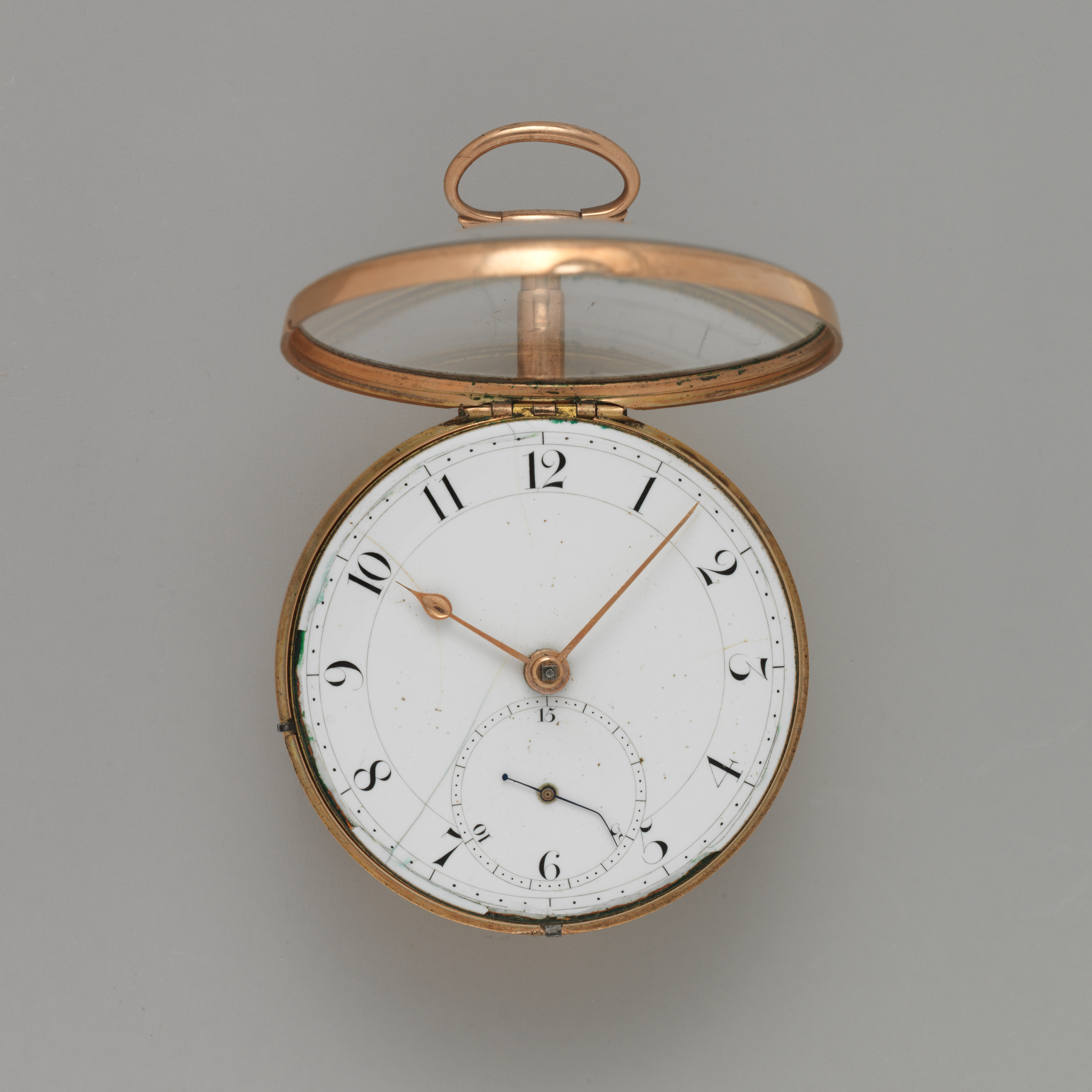
Pocket watch signed Roskell, early nineteenth century. The case may be by Thomas Helsby. Photograph by Richard Lee. Collection of the Metropolitan Museum of Art. Source Wikimedia Commons. CC0 1.0. Reproduced unchanged.

A different gold watch at the Metropolitan Museum of Art, No. 29664, has Chester assay marks dating the case to 1820–21. The gold dial has a subsidiary seconds register. The movement has a chain fusee, a rack-lever escapement and a diamond endstone. The balance cock is inscribed “PATENT,” and the plate carries Roskell’s name, Liverpool and the number. The case marks indicate the work of Thomas and John Helsby, allowing the watchmaker’s signature and the casemakers’ work to be distinguished. 1
No. 22994 of 1814, in London’s Science Museum, has a lever escapement, a Berollas-type repeating mechanism and an alarm. A repeating mechanism sounds the time when the user operates it. Another watch, No. 10030, is inscribed “Roskell’s Patent Repeater” and has case marks for 1832. An auction record links its mechanism to Joseph Berrollas’s 1808 patent. The Metropolitan Museum of Art says Roskell obtained a patent for a repeating mechanism in 1832. The primary patent specification remained unverified for this article. 1 4 5
Marine chronometers and later use#
The boxed chronometer No. 874/50318, bearing Roskell’s name, survives in Australia’s Powerhouse collection. The museum dates manufacture to about 1839 and records its use at the Sydney Observatory. The observatory is part of its provenance. Direct delivery there by the elder Robert would require further evidence. 6
The National Maritime Museum in Greenwich holds another Roskell-signed chronometer, No. 216/33501. The museum records its use as a reserve chronometer aboard the passenger liner Queen Elizabeth 2 in 1969. The present box came from another chronometer, and most of the escapement was remade during restoration. The surviving object documents both nineteenth-century manufacture and its later use and restoration. 7
Timeline#
- Around 1790 — The year a successor business claimed as its founding date. 1
- Around 1798 — Edidin’s research dates the start of watch manufacture to this time. 2
- 1814 — Museum date of manufacture for No. 22994, with repeater and alarm. 4
- 1820–21 — Chester assay marks on the case of No. 29664. 1
- 1832 — The partnership with Nicholas is dissolved. Repeating watch No. 10030 survives with case marks for this year. 1 5
- Around 1839 — The boxed chronometer later used at Sydney Observatory is made. 6
- 1842–47 — The partnerships with Robert’s son Robert and then with John Jr are dissolved. 1
- 1877 — The partnership of William and Richard lasts until this year. 1
References#
1. Metropolitan Museum of Art, Pocket watch, Robert Roskell, 1820–21, object description and notes (accessed 4 November 2026).
2. Michael Edidin, Peter Litherland’s patent watches and their successors, Antiquarian Horology, June 2023, pp. 223–230, especially pp. 227–229 (accessed 4 November 2026).
3. Fitzwilliam Museum, Watch: PW.30-1923, movement collection record (accessed 4 November 2026).
4. Science Museum Group, Gold watch by Robert Roskell, collection record (accessed 4 November 2026).
5. Sotheby’s, Robert Roskell, Liverpool, No.10030, 2016 auction description (accessed 4 November 2026).
6. Powerhouse Collection, Chronometer made by Robert Roskell, collection record for H9921 (accessed 4 November 2026).
7. Royal Museums Greenwich, 216/33501 and 956, provenance and restoration record (accessed 4 November 2026).