This article was translated from Japanese using AI. Read the Japanese original
Salomon Coster (birth year unknown, died 1659) was a Dutch clockmaker from Haarlem who worked in The Hague. He built clocks using the pendulum regulation devised by Christiaan Huygens and in 1657 obtained a patent in his own name to make and sell them. He made spring-driven domestic clocks and striking clocks and converted existing turret clocks. He also trained workers and ran a workshop that filled orders from abroad. 1 2 3
The advance was to connect the driving power that advanced the gears with the pendulum that determined the rate. The mechanism displayed time while sustaining the swing. The patented clocks, clocks for scientific observation and small clocks offered for sale took different forms. Coster’s career shows how an invention made its way into a range of products and public installations. 1 4 5
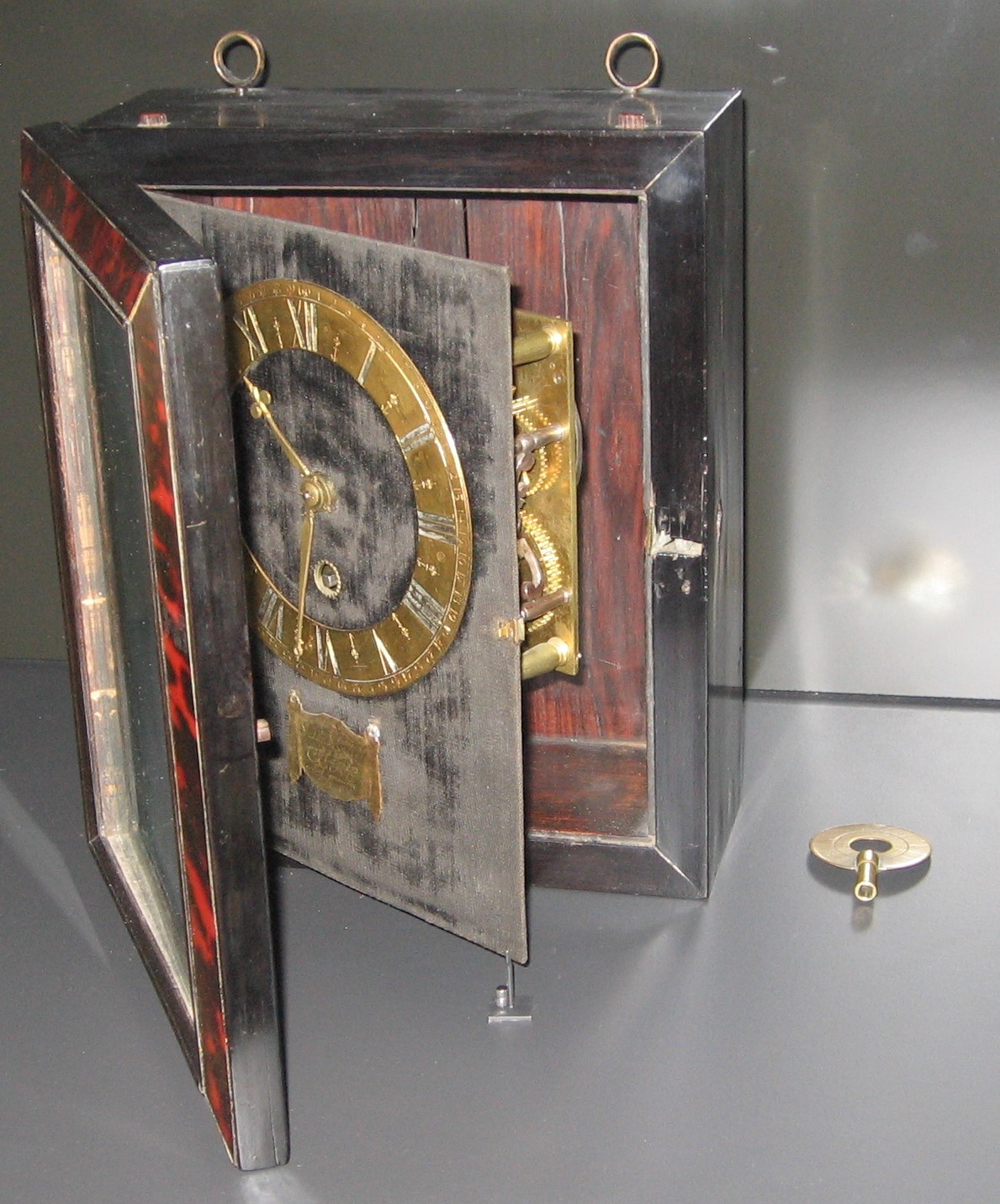
Figure 1. Clock signed by Coster, photographed at the Rijksmuseum in Amsterdam. The open dial reveals the mechanism, with the short pendulum projecting below it. Made by Salomon Coster to a design by Christiaan Huygens. Photograph by Hansmuller, 30 January 2015. Original image and description, Wikimedia Commons. CC BY-SA 4.0. Unmodified. The photograph and clock date to different periods.

Life and workshop#
Haarlem and the year of his birth#
Coster also appears in records as Salomon Hendricxzn Coster and Salomon Hendriksz. Coster. Hendricxzn refers to his father Hendrick. Objects and notarial records also bear a signature identifying him as Coster of Haarlem. Kersing and Memel’s 2018 study traces family and property records of his parents Hendrick Adamsz and Anneken Maben and documents his family connections in Haarlem. 6 7
Dates of about 1620 or 1622 are sometimes given for his birth. The 2014 study finds insufficient evidence to derive 1622 by assuming an age at marriage. His 1643 marriage record gives no age, and its term for an unmarried man does not establish one. Although his birth year remains unknown, signatures, family documents and contracts provide details of his career. 6 7
He married Jannetje Harmens in Delft on 22 March 1643. The date of his move to The Hague is unclear. By 31 January 1646 he was making an apprenticeship agreement there as a clockmaker. That document places him in The Hague independently of his marriage date. 6
Training apprentices and running a shop#
The apprentice was Pieter Visbach, also spelled Visbagh, who became a clockmaker. The agreement between his father Rerick Eraerts and Coster provided for nine years of training from 1 May 1645 and was notarised on 31 January 1646. His father provided clothes and subsistence for the first three years. He received room and board in Coster’s household for the remaining six. 6 8
In 1652 Coster rented a house on the Veerkade in The Hague, now Stille Veerkade, for 160 guilders a year according to the records. As well as making clocks, the workshop repaired them, trained apprentices and managed stock and completed goods. Christiaen Rijnaerts and John Fromanteel, who arrived in 1657, were also part of this working environment. 6 1
Coster was making clocks before introducing the pendulum. Experience making small clocks, working with gears and springs and organising work in the shop helped bring the new regulator into production. The records cited here leave his own master’s identity uncertain. 6 7
Turning Huygens’s idea into a clock#
Inventor and maker#
Huygens wrote on 26 December 1657 that he made the first model exactly one year and one day earlier, on 25 December 1656. Letters from the first half of 1657 describe a new weight-driven clock and work to improve its accuracy. Hordijk and Memel’s archival study finds a working clock by 18 May 1657 at the latest and an adjustment note recording a loss of two minutes over six days between 31 May and 6 June. 1
The records of the time leave the maker of the first model of late 1656 unnamed. Coster was named in the patent proceedings of June 1657. The inventor developed the idea for the period and mechanism, and a professional clockmaker made, adjusted and supplied working clocks. 1 2
Galileo and others had already considered the use of pendulum oscillations for timekeeping. Huygens’s Horologium of 1658 drew on earlier knowledge of pendulums and gave a detailed design for a continuously running clock. Coster developed this method of regulation into clocks that could be made and sold. 4 5
What the patent of 1657 covered#
On 14 June 1657 the States General considered Coster’s application and instructed Glas and Mauregnault to examine and report on the invention. After receiving the report, the resolution of the 16th gave an exclusive right to Coster, to whom Huygens had entrusted his invention. The patent itself distinguishes the inventor from the maker entitled to exercise the right. 1 2
The patent of 16 June specified a term of 21 years. It forbade making or having clocks of this kind made, large or small, without permission, and bringing imitations into the country for sale. It prescribed confiscation and a fine of 300 Carolus guilders. Coster had to obtain separate endorsements in provinces where the invention would be used. It granted a monopoly in the form then in use and did not set out specific tooth counts and dimensions as in a modern technical specification. 3
On 16 July 1657 the States of Holland and West Friesland granted an endorsement for twenty years. The federal term of 21 years, the provincial term of 20 years and the later advertisement’s “20 years” each come from separate documents. On 19 October 1658 an endorsement in Gelderland named the clockmaker Jan van Call as well as Coster. 9 10
Hordijk and Memel’s archival research did not identify the original application or its accompanying drawings. Surviving drawings cannot automatically be treated as patent drawings, and the evidence does not identify the patent with a particular weight-driven or spring-driven construction. 1 11
Mechanisms and surviving clocks#
Power, escapement and pendulum#
Mechanical clocks use a falling weight or a mainspring to drive the wheels. The escapement divides rotation into regular steps and supplies enough energy to the pendulum to sustain its swing. The pendulum determines the period, while power comes from the weight or spring. 4 5
An early arrangement used the existing crown wheel and verge, an arbor carrying pallets. Adapting it to a pendulum involved changing the orientation of the existing regulating parts and transmitting reciprocating motion from the wheel. Science Museum Group object 1980-108, a spring-driven Coster clock dated 1657–1659, measures 25.5 × 21 × 9 cm and is made of brass, steel, wood and glass. 12
The compact box became a characteristic form of Hague clocks. Glass in the front door displayed the chapter ring and signature plate. Materials and ornament varied, and some clocks could strike or had an alarm. 12 13
Limiting the swing and using curved guides#
At greater amplitude a pendulum takes slightly longer to complete an oscillation. Changes in mainspring force or resistance that affect swing can also change rate. Huygens tried placing curved plates at the suspension, so the effective length changed as the swing increased. In a letter of 1 November 1658 to Petit he also described removing the plates in a design because tilting the clock could change the pendulum length. 5 14
O and P in the figure in Horologium show a different solution. A small wheel O on the verge side meshes with a larger wheel P on the pendulum side, allowing the verge to move through the required angle while the pendulum swings through a small one. The text gives examples with P twice or three times O’s diameter. This provides both a small swing and enough angular motion at the verge to release the teeth. 5
The later cycloidal guides belong to research in late 1659. A cycloid is the path of a point on a circle rolling along a straight line. Huygens related its properties to isochronism. The presence of curved plates in a 1657 clock alone cannot establish that it had the later cycloidal design. 11 12
Spring drive and striking#
At the end of Horologium Huygens says that he also saw spring-driven clocks at the workshop of the maker he first commissioned. They had teeth on the mainspring barrel and dispensed with the conical fusee and chain that usually evened out its force. He also mentions clocks that drove both the hands and striking from the same power source. He credited the maker with finding further applications for the invention. 5
The letter of November 1658 describes restricting the mainspring’s unwinding to about one or two turns and the advantage of continuing to run during winding. The same letter reports a clock that ran seven days and struck the hours from one mainspring. These examples give no universal specifications for Coster clocks. 14
A clock with an alarm dated 1658, recorded by Christie’s, has a separate alarm mechanism and a bell on top of the case in addition to an ordinary time display. The catalogue describes a thirty-hour running time, one barrel and a silk-thread suspension for the pendulum. It also notes restoration of the case. Striking the hours and sounding an alarm at a chosen time are different functions. 13
Scientific and household displays#
In the weight-driven clock shown in the 1658 Horologium, the long central seconds hand makes one revolution in five minutes. A separate small dial shows the minutes. A long seconds hand helped observers read small intervals. Huygens suggested using it to measure right ascension of stars, the apparent diameters of the Sun and Moon and differences in the lengths of days. 5 14
The same letter says that for ordinary customers, the makers put a minute scale outside the hour ring and mounted both hands concentrically. Displays for observation and displays for reading the time at home were both considered early in the invention’s development. 14
Public clocks and international trade#
Applying the pendulum to turret clocks#
From late 1657 to early 1658, Coster and Huygens worked on converting the church turret clock in Scheveningen to pendulum regulation. A short letter attributed to Coster dated 23 January 1658 says the clock had run overnight and lost about fifteen minutes in fourteen hours. He proposed making the spherical weight lighter and changing the spring and chain. The retrofit needed trial running and adjustment after installation. 1 15
Forging large parts also required a different set of skills. Hordijk and Memel cite an advertisement of 1659 recording the involvement of the Delft turret clockmaker and smith Coenraet Harmanszoon Brouckman. The public clock brought together the skills of Coster as a maker of domestic clocks and a smith who could forge large iron parts. 1
The Utrecht Cathedral contract is more specific. The text is dated 19 April 1658, and Coster signed on 1 May. It set a maximum error of 7 minutes 30 seconds in eight days and payment of 350 guilders after a two-month trial. Other terms included lodging during the work, a separate gift to his wife, and provision of an escape wheel, pulleys and hands at the client’s expense. These were acceptance conditions under the contract, distinct from modern measurements of the surviving clock. 16
Fromanteel, France and Tuscany#
On 3 September 1657 John Fromanteel contracted to finish clock movements in Coster’s shop and house until the following May. The rate was 20 Carolus guilders per movement if Fromanteel supplied the brass and steel or 18 guilders and 10 stuivers if Coster supplied them. The contract also dealt with payment for beer, fire and light. The text alone leaves the type of clock and the nature of the “secret” uncertain. It cannot establish that all of the work was instruction in the use of the pendulum. 17 1
The agreement documents a personal connection from the London Fromanteel family to the workshop in The Hague. The Fromanteels advertised pendulum clocks in England in 1658. The French clockmaker Nicolas Hanet also worked in Coster’s shop in 1658, subsequently taking clocks to Paris and helping sell them. 1
The 1690 Medici inventory records a clock sent to Ferdinando II, Grand Duke of Tuscany, by Tito Livio Burattini on 25 September 1657. It describes a wall clock with a short pendulum, ebony case, front glass, silver chapter ring on velvet and a silver plate with Coster’s signature. The clock’s whereabouts are unknown today. The description comes from the inventory. 1
Advertising and prices#
An advertisement in Tijdinghe uijt verscheyden Quartieren of 22 December 1657 announced that Coster was making and would soon supply weight-driven and spring-driven clocks using Huygens’s invention. It offered conversions to existing clocks, including turret clocks, and stated that the pendulum could not be used in a pocket watch. The principal products were wall and table clocks. The advertised claims of precision are distinct from tests of individual pieces. 1
On 16 January 1659 Huygens forwarded to Boulliau a price list from the clockmaker. The prices depended on the power source, running time and whether the clock struck. 18
| Power and function | Running time after winding | Price in Dutch guilders |
|---|---|---|
| Weight-driven, time only | 30 hours | 48 |
| Weight-driven, time only | 8–10 days | 60 |
| Weight-driven, striking | 30 hours | 80 |
| Weight-driven, striking | 8 days | 130 |
| Spring-driven, time only | 30 hours | 80 |
| Spring-driven, striking | 30 hours | 120 |
| Spring-driven, time only | 8 days | 130 |
The table shows the pendulum clock becoming a range of products with selectable specifications after its use as an expensive experimental instrument. The letter calls the currency livres argent d’Hollande in French. This means Dutch money, so a simple conversion as French livres or into modern currency is inappropriate. 18
The patent dispute, Coster’s death and succession#
The dispute with Simon Douw#
As the new clocks became known, a dispute arose with Simon Douw over rights. In September 1658 Coster petitioned against granting Douw a patent, arguing that Douw’s mechanism depended on a pendulum and therefore embodied the same invention. The accusations in the petition are a party’s legal arguments. 19
The dispute involved comparing actual mechanisms and hearing clockmakers and mathematicians. In the agreement of 9 December 1658 printed in the collected works, Douw could also seek provincial endorsements. Revenue from both inventions was to be divided into thirds among Huygens, Coster and Douw. They agreed to cooperate if a third party sought another patent or made imitations. The agreement adjusted how the exclusive rights worked in practice. 20
What passed on from the workshop#
Coster died in late 1659. The 2018 study of his inventory records valuations of small work and large completed and unfinished pieces, as well as debts to collaborators. These are monetary values of assets, which cannot provide a count of clocks or lifetime production. 7
His widow Jannetje took over the shop, and Visbach was given a seven-year lease. Stock was sold or auctioned separately. Manufacture, use of the premises, inventory and patent rights were passed on in different ways. 7
Surviving clocks signed by Coster include time-only, striking and alarm models. Christie’s listed seven signed clocks in 2007. Replaced plates, later restoration and the possibility that a date in the signature records a patent affect attribution and dating. The 2021 study also discusses whether “met privilege 1657” refers to the patent year. 13 1
Before Coster died, the pendulum clock had become a scientific instrument, a way to read time at home, a means of improving turret clocks and a product sold internationally. Huygens’s theory and Coster’s craft both mattered. Contracts, trial runs, division of work and sales document how Coster brought the clocks into use. 1 5 14 18
Timeline#
| Date | Event |
|---|---|
| Date of birth unknown | Born and raised in a Haarlem family. Dates around 1620 and 1622 have been proposed. 6 7 |
| March 1643 | Marries Jannetje Harmens at Delft. 6 |
| May 1645 | Start date for Visbach’s nine-year apprenticeship. 8 |
| January 1646 | Apprenticeship agreement notarised in The Hague. 8 |
| 1652 | Rents a house on the Veerkade. 6 |
| December 1656 | Date Huygens recalls for making the first model of his pendulum clock. 1 |
| May–June 1657 | Record of a working clock and adjustment of its rate. 1 |
| June 1657 | Examination ordered on the 14th and a 21-year patent granted to Coster on the 16th. 1 2 3 |
| July 1657 | Provincial endorsement in Holland and West Friesland. 9 |
| September 1657 | Manufacturing agreement with Fromanteel. A later inventory also dates Burattini’s dispatch of a clock to Tuscany to this month. 17 1 |
| December 1657 | Newspaper advertisement for weight- and spring-driven models and conversions. 1 |
| January 1658 | Report of test operation of the converted Scheveningen turret clock. 15 |
| April–May 1658 | Contract for the Utrecht Cathedral conversion, signed on 1 May. 16 |
| Summer to autumn 1658 | Hanet joins the workshop and takes clocks to Paris. 1 |
| September 1658 | Huygens publishes Horologium. Coster opposes Douw’s patent application. 1 19 |
| October–November 1658 | Work at Utrecht ends. A letter records the price and delivery period for Petit’s order. 14 |
| December 1658 | Agreement in the dispute with Douw. 20 |
| January 1659 | Letter to Boulliau lists prices in seven categories. 18 |
| Late 1659 | Coster dies. His widow continues the business while arranging its affairs. 7 |
| 1660 | Records of the lease to Visbach and the disposal of stock. 7 |
| 1673 | Huygens publishes Horologium oscillatorium, a later work that includes the cycloid and is separate from the book of 1658. 11 |
| 2014–2018 | Kersing and Memel publish archival studies of the family, apprenticeship and workshop. 6 7 |
| 2021–2022 | Archival research appears on the patent proceedings, newspaper advertising, early drawings and printing. 1 11 |
References#
Online sources accessed on 23 October 2026. Letters and contracts from the collected works are later edited transcriptions of the manuscripts.
Ben Hordijk and Rob Memel, “Salomon Coster, the clockmaker of Christiaan Huygens”, Antiquarian Horology 42/3, 2021, pp. 323–344. Paper.
States General, resolution of 16 June 1657. Huygens, Oeuvres complètes, vol. II, no. 524, pp. 236–237, 1889 edition. Text.
Patent to Coster, 16 June 1657. Oeuvres complètes, vol. II, no. 525, pp. 237–238. Text.
Christiaan Huygens, Horologium, 1658, dedication. Oeuvres complètes, vol. XVII, pp. 41–51, 1932 edition, Latin and French translation. Text.
Christiaan Huygens, Horologium, 1658, description of the clock. Oeuvres complètes, vol. XVII, pp. 52–73, Latin and French translation. Text.
Victor Kersing and Rob Memel, “Salomon Coster, de Haagse periode”, TIJDschrift 4/2014, pp. 4–7. Paper.
Victor Kersing and Rob Memel, “In de voetsporen van Salomon Coster”, TIJDschrift 2/2018, pp. 4–6 and 8–9. Paper.
Haegsche Tijd Foundation, transcription of the apprenticeship agreement between Coster and Pieter Visbach, 31 January 1646. Haags Gemeentearchief 0372-01, inv. 20, fol. 321. Transcription.
Endorsement by Holland and West Friesland, 16 July 1657. Oeuvres complètes, vol. II, no. 526, p. 239. Text.
Documents concerning provincial endorsements. Oeuvres complètes, vol. XVII, pp. 78–79, including the Gelderland endorsement of 19 October 1658. Text.
Mart van Duijn, Ben Hordijk, Rob Memel and Jef Schaeps, “Scrutinizing Huygens’s Figura drawing”, Antiquarian Horology 43/2, 2022, pp. 208–213. Paper.
Science Museum Group, “Early pendulum clock by Salomon Coster, c.1657.” Object 1980-108. Collection record.
Christie’s, “An important early Dutch ebony and rosewood pendulum clock with alarm, Salomon Coster, The Hague. Dated 1658”, lot 5026856. Specifications, provenance and related objects. Auction catalogue.
Christiaan Huygens to Pierre Petit, 1 November 1658. Oeuvres complètes, vol. II, no. 546, pp. 270–274. Letter.
Letter to Huygens attributed to Coster, 23 January 1658. Oeuvres complètes, vol. II, no. 452, p. 125. The editors add a question mark to the sender’s name. Letter.
Agreement between the chapter of Utrecht Cathedral and Coster, 1658. Oeuvres complètes, vol. XVII, p. 77. Text.
Contract between Coster and John Fromanteel, 3 September 1657. Oeuvres complètes, vol. XVII, pp. 21–23. Text.
Christiaan Huygens to Ismaël Boulliau, 16 January 1659. Oeuvres complètes, vol. II, no. 565, pp. 313–314, with price list. Letter.
Salomon Coster’s petition to Holland and West Friesland, 1658. Oeuvres complètes, vol. II, no. 530, pp. 244–245. Text.
Agreement between Huygens, Coster and Douw, 9 December 1658. Oeuvres complètes, vol. II, no. 556, p. 290. Text.