Thomas Loomes#
This article was translated from Japanese using AI. Read the Japanese original
Thomas Loomes was a clockmaker who made lantern clocks in London in the mid-seventeenth century. His clocks bear the name of the Mermaid, the sign of his shop in Lothbury. The same sign appeared in an advertisement for pendulum clocks in 1658. The surviving clocks and the advertisement show how clocks with a new regulating mechanism were marketed on a street with a tradition of making weight-driven household clocks. 1 2 3
Taking over the Selwood brothers’ shop#
The horological historian Brian Loomes estimates that Thomas was born around 1628 or earlier. The first part of his career can be traced to the workshop of John Selwood. In the Company records Brian examined, Thomas worked under John and is described as his former apprentice in the court minutes and as his former servant in a separate draft book. He joined the Clockmakers’ Company as a Free Brother. The admissions table in the Company’s history, published in 1881, gives the date as 14 January 1649–50. With the year reckoned on today’s convention, that is 14 January 1650. 1 2
After John died, his apprentices Richard Beck and Simon Dutson were transferred to Loomes. When John’s brother William Selwood died in 1653, Loomes took over the Mermaid shop in Lothbury. It stood near the junction with Bartholomew Lane in the parish of St Margaret Lothbury. Founders also worked in Lothbury. In his 1598 survey of London, John Stow describes the street ringing with the sound of casting, turning and polishing copper-alloy goods such as candlesticks. Mid-seventeenth-century clock inscriptions preserve shop signs including the Mermaid, the Cross Keys and the Dial. 2 4
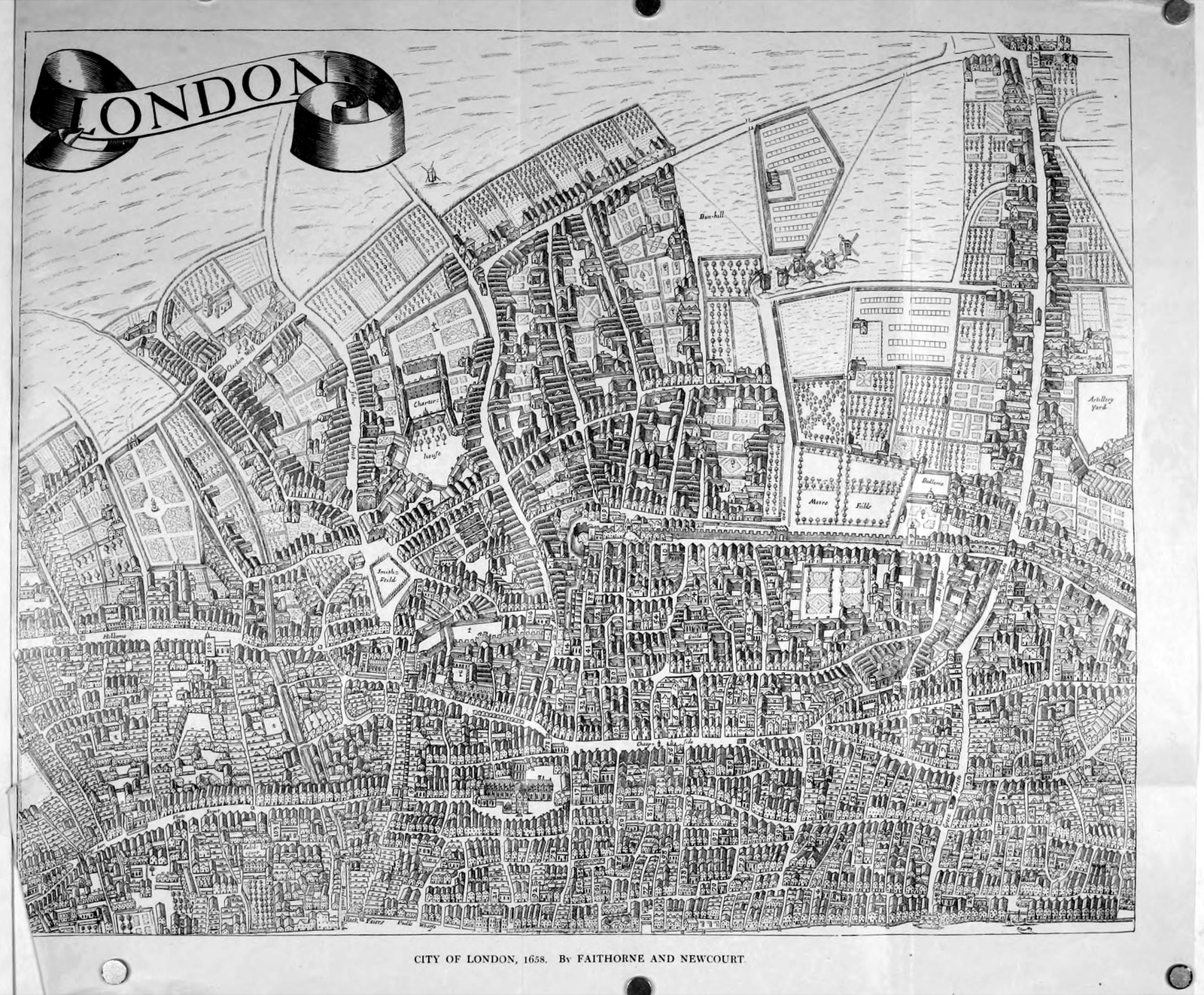
Figure 1. The City before the Great Fire of London. Moorfields is towards the right, with the streets inside the city wall to the south. Map by Richard Newcourt, engraved by William Faithorne, in the version published in Maps of Old London in 1908. Source Wikimedia Commons. Rights Public Domain Mark 1.0. Resized to 1,600 pixels on the longer side and recompressed as a JPEG.

A dispute over the number of apprentices#
Loomes received apprentices who had begun training with a previous master. The apprentice register also records John Fromanteel under Loomes. The register published in 1931 names Loomes in the entry of 11 March 1651 and records John’s transfer to his father. John entered into a clockmaking contract with Salomon Coster in The Hague in 1657 and gained the freedom of the London Clockmakers’ Company on 6 July 1663. 2 5 13
Company rules applied to workshop staffing. In an order of 25 February 1656/57, dated 1656 in the original and transcribed in the Company history, Lord Mayor Robert Tichborne told Loomes, who had five apprentices, to let three go. In 1656, Company members including Loomes and Ahasuerus Fromanteel petitioned the Lord Mayor over the operation of the rules and the number of apprentices. The Company history also reproduces the opposing response. In July 1658 Loomes was fined 40 shillings for taking an apprentice without the Company’s consent. 1 10
Pendulum clocks sold at the Mermaid#
On 18 July 1654, Loomes married Mary, daughter of the clockmaker Ahasuerus Fromanteel, at St Saviour’s Church in Southwark. In the 21–28 October 1658 issue of Mercurius Politicus, Ahasuerus advertised clocks that kept time more evenly than earlier models through a new regulator. The advertisement lists two places of sale, his home in Southwark on the south bank of the Thames and the Mermaid in Lothbury on the north bank. His father-in-law’s pendulum clocks were thus sold at the shop whose name appears on Loomes’s lantern clocks. 2 3 4
Loomes served as a steward of the Clockmakers’ Company in 1663. Brian Loomes notes a tax payment for the shop in 1664, estimates that Thomas died in late 1664 or in 1665, and suggests that plague may have been the cause. The Science Museum Group’s account of Ahasuerus, however, says that John and Loomes ran the family business in London during Ahasuerus’s stay in the Netherlands from 1667. The two sources differ on the dates of Loomes’s later life. 2 6
What signed pieces show#
A small lantern clock with two weights#
A brass lantern clock dated around 1650 and recorded by Gude & Meis is 24 cm high, 9.5 cm wide and 11 cm deep. A single iron hour hand reads against Roman numerals with quarter-hour divisions inside them. The dial bears Loomes’s signature with Lothbury and engraved flowers, and a central brass disc sets the alarm. The pierced front fret is decorated with dolphins and leaves. The side doors give access to the movement. A hoop at the back and spurs below allow the clock to hang on a wall, with room for the weights to descend. 7
Two weights drive the movement. A verge escapement and an oscillating balance meter the going train. The count wheel determines the number of blows for the hour, and the alarm strikes the same bell at the top. Another clock at Christie’s has a Latin inscription on the front fret identifying London as the place of manufacture. Christie’s records a balance escapement and alarm for that example. It stands 38.7 cm high, so both the location of the signature and the dimensions differ. 7 8
A clock converted to a long pendulum#
Fontaine’s 2014 catalogue lists a lantern clock about 39.4 cm high and inscribed with the Mermaid sign. As offered, it had a long pendulum and a recoil escapement. The auction house says that a recoil escapement of this kind often replaced the early verge and crown-wheel arrangement. The 1881 Company history also says the Company held an example of Loomes’s work. The signature on the dial and the regulator now fitted to the clock record its manufacture and later conversion respectively. 1 9
A portable watch showing Moon phase and high tide#
A 56 mm silver pair-cased watch sold in Geneva in 1991 bears Loomes’s signature on the backplate. Antiquorum dates it to around 1665 and records a verge escapement, a balance without a balance spring, and a fusee with gut line. At the centre of the dial a rotating disc shows the Moon phase. The lot description says a blued steel pointer gives the time of high tide against a manually adjustable ring. The outer part also has a date ring and a month ring that is set by hand. One hour hand shows the time while the dial also displays information about the Moon and tides. 11
Timeline#
| Date | Event |
|---|---|
| Around 1628 or earlier | Estimated date of birth by Brian Loomes. |
| 14 January 1650 | Joins the London Clockmakers’ Company. The Company’s history dates this 1649–50. |
| March 1651 | Appears in the published apprentice register as John Fromanteel’s master. |
| 1653 | Takes over the Mermaid in Lothbury after William Selwood dies. |
| July 1654 | Marries Mary, daughter of Ahasuerus Fromanteel. |
| 1656 | Signs the petition on the administration of the Company. |
| February 1656/57 | The Lord Mayor orders him to reduce his apprentices from five to two. |
| July 1658 | The Company fines him 40 shillings over the taking of an apprentice. |
| October 1658 | A newspaper advertisement gives the Mermaid as a place where pendulum clocks can be bought. |
| 1663 | Serves as a steward of the Company. |
| Late 1664 to about 1665 | Estimated date of death by Brian Loomes. |
| 1881 | The Company history records his admission, the order and petition about apprentices, and the Company’s ownership of a clock by him. |
| 1991 | Auction record of a signed portable watch with a tidal display. |
| 2023 | The horological historian James Nye publishes how he found records locating the Mermaid. 12 |
The timeline draws on 1–6 and 10–12.
References#
1. Samuel Elliott Atkins and William Henry Overall, Some Account of the Worshipful Company of Clockmakers of the City of London, 1881, pp. 60–64, 150–152 and 159. Digital scan of the Company history. Accessed 20 November 2026.
2. Brian Loomes, “LOOMES, THOMAS. London.” Authorised extract from Clockmakers of Britain 1286–1700 (2014), Early Clocks booklet, p. 20. Public PDF. Accessed 20 November 2026.
3. The Metropolitan Museum of Art, “Hooded wall clock with calendar”, 1974.28.93. Notes based on the 2015 research catalogue, including a transcription of the advertisement from 21–28 October 1658. Collection record. Accessed 20 November 2026.
4. George S. J. White, “A Lantern Clock Signed ‘Thomas Knifton at the [Crossed Keys] in Lothbury Fecit’ and its Context”, The Antiquaries Journal 67, no. 2, 1987, pp. 324–337, especially notes 23, 37, 40 and 57. Abstract and notes. Accessed 20 November 2026.
5. Charles Edward Atkins, ed., Register of Apprentices of the Worshipful Company of Clockmakers of the City of London from its Incorporation in 1631 to its Tercentenary in 1931, 1931, p. 110, John Fromanteel entry. Company PDF. Accessed 20 November 2026.
6. Science Museum Group, “Ahasuerus Fromanteel”, biographical record cp109263. Collection record. Accessed 20 November 2026.
7. Gude & Meis, “An English miniature balance wheel lantern clock with striking and alarm, Thomas Loomes, circa 1650.” Object record. Accessed 20 November 2026.
8. Christie’s, “A brass striking lantern clock, Thomas Loomes, London, mid-17th century and later”, sale 9441, lot 43. Lot record. Accessed 20 November 2026.
9. Fontaine’s Auction Gallery, “17th C. Thos. Loomes Brass Lantern Clock”, 22 November 2014, lot 159. Lot record. Accessed 20 November 2026.
10. The Livery Committee, “Current and past Lord Mayors and Sheriffs”, entries for 1655–1657. List of Lord Mayors. Accessed 20 November 2026.
11. Antiquorum, “Thomas Loomes, Londini, circa 1665”, 20 October 1991, Geneva, lot 250. Lot record. Accessed 20 November 2026.
12. James Nye, “Light among the lanterns”, Antiquarian Horological Society, 3 October 2023. Account of the author’s findings. Accessed 20 November 2026.
13. Christiaan Huygens, Oeuvres complètes, tome XVII, ed. J. A. Vollgraff, 1932, pp. 21–22. Transcription of the notarial agreement of 3 September 1657 between Coster and John Fromanteel. Text at DBNL. Accessed 20 November 2026.