This article was translated from Japanese using AI. Read the Japanese original
Thomas Mudge (c. 1715/16–1794) was an English clockmaker who worked in London and Plymouth. He is known for developing the detached lever escapement, which allows a mechanical watch balance to spend part of its motion swinging freely out of contact with the escapement. For the marine timekeepers that occupied his later years, he used a different constant-force escapement that delivered impulses from small springs to the balance. These two lines of work show what it took to make a high-precision individual object and to make a practical instrument that other craftspeople could reproduce. 1 2 3
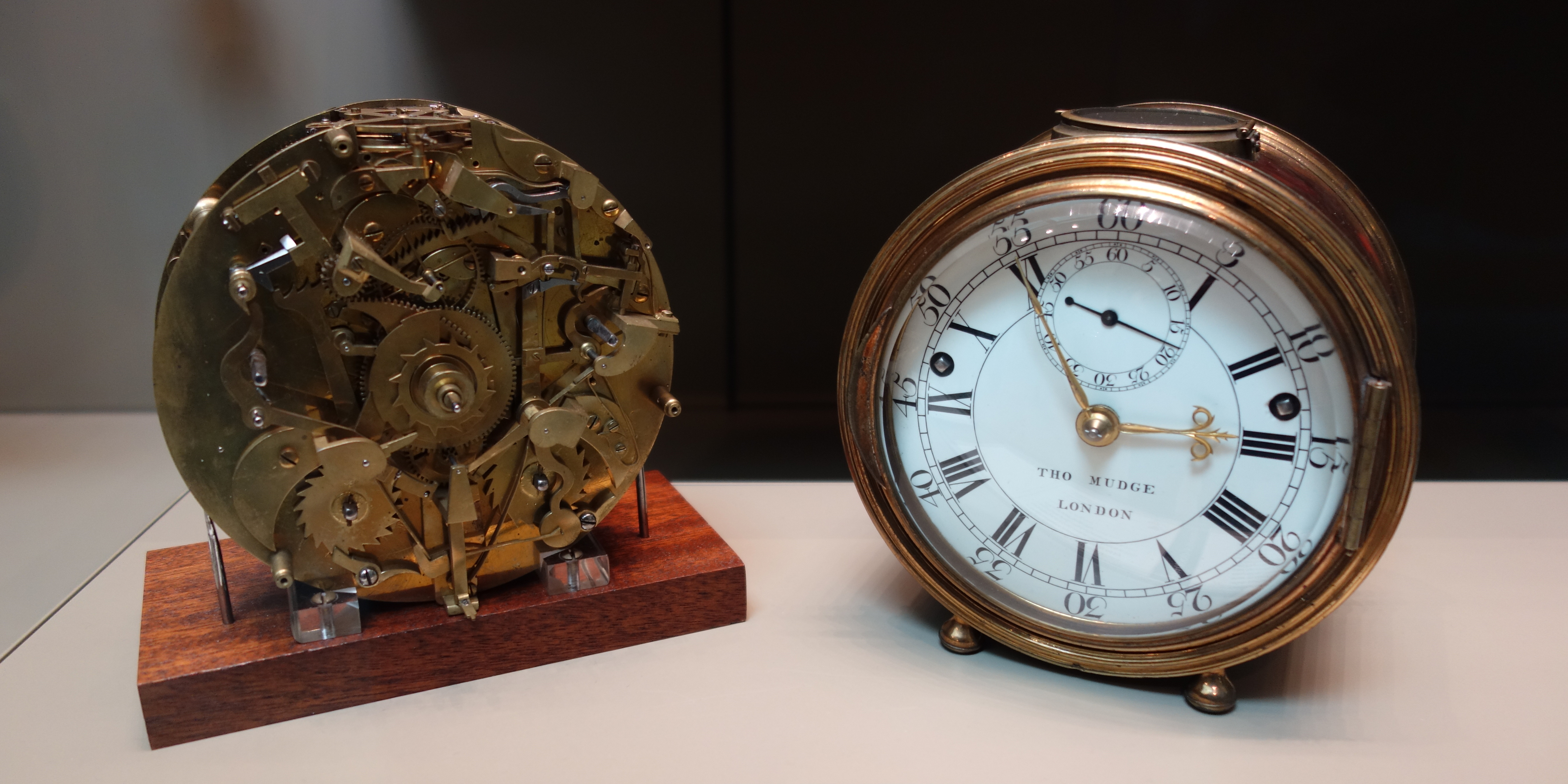
Fig. 1. Travelling clock, c. 1768–1770 (British Museum 1995,0207.1). The displayed movement at left has been removed from the case, shown with its dial at right. Photograph by Daderot (2024). Source Wikimedia Commons file page. Terms CC0 1.0 Universal. No changes.

Surviving objects, Mudge’s letters to Count Brühl, and accounts of the mechanism and parliamentary inquiry published by his son document his work. The son edited the 1799 book to defend his father’s reputation and promote his designs. It preserves specific technical descriptions and letters, and criticisms of opponents reflect the dispute in which the book was written. 3
The London workshop and international customers#
Learning under Graham#
Mudge was born in Exeter into the family of the clergyman and educator Zachariah Mudge. His family reportedly moved to Bideford during his childhood, where he attended his father’s school. Science Museum Group gives 1715 for his birth, the title of the revised Oxford Dictionary of National Biography entry gives 1715/16, and the nineteenth-century dictionary gives September 1717. The approximate date of 1715/16 used here follows the revised biography and current collection sources. The exact date has yet to be established from a birth record. 1 4 5
In the early 1730s he was apprenticed to George Graham in London. Graham inherited Thomas Tompion’s workshop and worked on the deadbeat escapement for clocks, the cylinder escapement for watches and instruments for astronomy. Mudge learned in an environment where finish, friction, temperature and mechanism geometry all mattered to accuracy. Accounts place the start of his apprenticeship in 1730 or 1731. The older biography records that he became free of the Clockmakers’ Company on 15 January 1738. 1 5
In London, the seller, movement maker, escapement maker and casemaker could all be different people. A signature alone leaves the individual makers of parts open. The young Mudge worked for John Ellicott and others and gained a reputation for building complicated mechanisms. The nineteenth-century biography relates that he made an equation-of-time clock signed by Ellicott for Ferdinand VI of Spain, who learned the maker’s identity after the clock failed and needed repair. The story comes from a later biography. Museum records of surviving pieces independently establish that Mudge made watches for the Spanish court. 5 6
Dutton, the Spanish court and Count Brühl#
Mudge ran a Fleet Street workshop and worked with William Dutton, another pupil of Graham. Biographies differ on when he opened and when they became formal partners. He built a London business in the 1750s and 1760s that became known as Mudge & Dutton. The Science Museum Group’s entry records Samuel Johnson buying his first watch there in 1768. 1 5
The older biography says the workshop also made a watch with a temperature-compensating regulator for civil engineer John Smeaton. 5
Movement No. 260 of 1755 is a surviving example made for the king of Spain. Science Museum Group holds the Clockmakers’ Company collection and records sale to Ferdinand on 22 August 1755. The watch combines a white enamel dial, central seconds, fusee, verge escapement, remontoire and two balance springs, one for temperature compensation and the other for rate adjustment. The minute hand jumps once a minute, and a mechanism helps restart the seconds after stopping. This early movement brings several problems together in a small space. The later lever watch and larger marine timekeepers used other arrangements. 6
Biographies also describe a clock in the handle of the Spanish king’s cane. It kept mean and apparent solar time and reportedly struck the hours and quarters according to apparent solar time, with a small window to see the mechanism. The equation of time is the difference between time based on the Sun’s actual motion and uniform mean solar time. A display of the seasonal difference and a striking mechanism were fitted into a cane handle. The biographies give limited evidence of its complete mechanism and current condition. 5
Another important customer was Count Hans Moritz von Brühl, a Saxon diplomat involved in astronomy. He bought watches, recorded their rates, sought tests by clockmakers and scientists and supported Mudge’s work. Mudge’s letters discuss temperature, amplitude, mounting, position and changes after repair in more detail than prices or orders. The patron also supported testing and the exchange of information. 3
What the lever escapement changed#
Detaching the balance from the train#
Power passes from the mainspring through a train to the escape wheel. The escapement lets the wheel advance tooth by tooth and supplies impulses to sustain the balance. Contact and friction from this transmission can disturb the balance and hairspring that form the time reference. The design problem was to supply the necessary energy and reduce interference during the rest of the cycle. 2 3
Mudge placed a lever between the escape wheel and balance. Its pallets lock the wheel. During a short interval when the balance returns, the mechanism unlocks and the lever transfers impulse from the wheel to the balance. The balance then leaves the lever and completes its swing freely. “Detached” describes this freedom from direct contact with the escapement during most of the oscillation. 2
Plate IX and its explanation, published in 1799, show particulars of the first design. The pallets on the escape side resemble deadbeat clock pallets, and a forked arm extends from their centre. The transmission parts on the balance staff and the ends of the two branches lie at different heights. An added part on the arm and a roller keep the escape wheel from releasing inadvertently while contact is broken. The geometry of impulse and the safety arrangement were developed for this early construction, which differs from the later Swiss lever. 3 (pp. 173–174, pl. IX)
The designs have different dates. Museum and horological sources identify experimental clocks in the early to mid-1750s and date the surviving queen’s pocket watch to about 1769–1770. Conception, application in an experimental clock and a working pocket watch mark successive stages. An invention date of 1754 is compatible with the date of the watch in 1770. 2 7
The queen’s watch and the travelling clock#
The Royal Collection preserves the lever pocket watch made for Queen Charlotte. Royal Collection Trust dates it to 1770 and gives London case hallmarks for 1769–1770. It has a gold case and white enamel dial and survives with a pedestal that was paired with it later. Whether the pedestal was originally intended for this watch remains uncertain. 7
Testing continued after delivery. In a letter to Brühl dated 10 September 1773, Mudge says he kept the queen’s watch and recorded its going and temperature over forty days, with average rates over periods of five and ten days. He investigated whether hanging it against a wall or allowing it to swing freely changed the motion of the whole watch and interacted with the balance to affect the rate. The letter mentions faster running in warmer conditions and slower running in the cold. The royal watch still needed assessment under actual conditions of mounting and temperature. 3 (pp. 50–52)
The British Museum’s travelling clock (1995,0207.1) is a separate object dated to about 1768–1770. It has a lever escapement, eight-day running time, hour striking and quarter repetition on two bells. A window on top of its tortoiseshell-covered cylindrical case shows the new escapement alongside the dial and striking features. The museum identifies Geddes as the original customer and says Brühl acquired it by 1774. 8
In a letter of April 1774 Mudge says he was pleased that Brühl had obtained the little clock formerly owned by Geddes and wanted to improve it while retaining the case shape. In a later letter he expressed satisfaction with its performance, acknowledging the limits of a decorated striking clock while continuing to adjust it. The travelling clock combined design, portability, sound and a view of its mechanism in a piece with different aims from a regulator for observations. 3 (pp. 56–58) 8
Emery’s development of the lever#
At Brühl’s urging, Josiah Emery worked with escapement maker Richard Pendleton to develop the lever in portable watches. Emery No. 1089 in the British Museum, with hallmarks for 1786, is one example. The regulator, lever contacts and safety arrangement needed to fit into a small pocket watch. 2
The museum says at least 38 lever watches were made from 1782 to 1786. That figure concerns Emery’s production in those years. Mudge’s output and total early lever production are separate questions. Cooperation helped turn the invention into a mechanism other makers could build and adjust. Changes to design, pallet and tooth shapes, and manufacturing methods in the nineteenth century led to the Swiss lever. The modern standard reflects these later developments. 2 9
A different approach to marine timekeeping#
Making Huber’s design and examining Harrison’s watch#
In 1755 Mudge also made a mechanism designed by the Basel mathematician and astronomer Johann Jakob Huber. Historisches Museum Basel says Huber showed the idea to James Bradley while in London and commissioned Mudge on Bradley’s advice. The timekeeper went to Basel and entered the university’s physics collection in 1829 from the estate of Huber’s son Daniel. The museum credits Huber with the concept and Mudge with manufacture. 10
This was separate from Mudge’s three later marine timekeepers. It shows that he was investigating how to deliver even force to an oscillator alongside his work on the lever. “Constant force” describes the effort to isolate variations in drive and deliver more nearly uniform force over the intended interval or operating range. Other sources of error can remain. 3 10
In 1765 Mudge helped examine John Harrison’s H4 as an expert for the Board of Longitude. That year he published Thoughts on the Means of Improving Watches, and More Particularly Those for the Use of the Sea. The paper appears in the 1799 book with a closing date of 25 June 1763. That date, publication in 1765 and examination of H4 describe distinct events and leave room for earlier development of the ideas. 1 3 (pp. 5–16)
The paper discusses amplitude and frequency, changes in mainspring force, friction at pivots and pallets, thermal changes in the spring, magnetism and the condition of oil. Mudge argues that the mainspring can wind a small spring at short intervals and that the small spring can then supply the balance while reducing variations from the train and mainspring. He also says experiments were needed to establish the best relationship between balance size and weight. The theoretical aim and the practical dimensions called for different evidence. 3
Two small springs delivering alternate impulses#
Around 1771 Mudge withdrew from the front line of the London business, moved to Plymouth where his physician brother John lived, and concentrated on marine timekeepers. In 1776 he was appointed watchmaker to George III. He completed his first marine timekeeper in 1774. Two others followed and became known as the Green and the Blue after their case colours. 1 3
Their constant-force mechanism differs from the queen’s lever. In Pennington’s 1799 description, the escape wheel acts on two pallets, each with a small spiral spring, and a pin on the balance-staff crank makes contact with an arm. As one pallet locks the wheel, motion of the balance unlocks it and the spring’s return assists the balance. The escape wheel then winds the other small spring, and the process repeats on the opposite half-oscillation. 3 (pp. 170–172, pls. V–VII)
The small springs supply the impulses, instead of sustained direct drive from the mainspring through the escape wheel to the balance. The two springs that deliver impulse are separate from the two hairsprings that determine the balance’s period. 3
The aim is to prepare each small spring under nearly the same conditions each time. In practice, pallet release, contact between arm and pin, pivot friction and spring preload all need attention. In 1923 Gould judged the design theoretically excellent and too complicated for ordinary use. 11 (pp. 77–81)
The arrangement of the escape wheel resembles a verge in some respects, with the impulse springs giving it a different function. Mudge’s reason for choosing it over a lever for marine work cannot be established from conjecture about how safe he considered the lever at sea. His paper and surviving work show two lines of investigation: reducing contact time in portable watches and using small springs to isolate variations in power in marine timekeepers. 3
Temperature compensation and friction#
Heat changes metal dimensions and the elasticity of the hairsprings and can affect the rate. Mudge’s marine timekeepers correct for temperature by changing a spring’s active length. The familiar split balance instead varies inertia. Pennington describes two composite pieces of brass and steel. Brass expands more when heated, bending the pieces and moving an arm and regulator. 3 (pp. 168–170, pl. IV)
At higher temperatures the aim is to shorten the active part of the spring and increase its restoring torque. At lower temperatures the mechanism moves in the opposite direction. One hairspring works with temperature compensation and the other with ordinary rate adjustment. The bimetallic pieces, hairsprings and constant-force springs have separate roles. The 2004 examination of the Green records compensation acting on the lower spring, with adjustment on the upper one. 3 12
Small friction rollers also support the ends of the balance staff. Pennington illustrates a frame holding four rollers, bridges supporting the pallet arbors and the adjustment parts. He describes contact with the pins that vary the spring’s active length, with a small spring controlling a part that supports one pin. These components were intended to reduce disturbances to the oscillator. They added complexity for other craftspeople attempting to service and adjust the timekeeper to the same standard. 3 (pp. 166–168)
The display also identifies the first instrument. Plate VIII of the 1799 book distinguishes 36-hour and eight-day forms. The upper arc of the eight-day dial has eight divisions indicating days since winding. Hours are at right, minutes at left and seconds below. Pennington gives this as the dial of Brühl’s first timekeeper. The upper hand anticipates power-reserve displays, and its scale directly reads elapsed days since winding. 3 (pp. 172–173, pl. VIII)
The timekeepers also have maintaining power during winding, a fusee and additional gearing to turn the hands in the right direction. The 1799 explanation says the train runs in the reverse of the usual direction, and two equal 45-tooth wheels make the seconds hand turn correctly. This layout brings together the choices made for power transmission and friction. 3 (pp. 165–166)
Trials, controversy and parliamentary review#
Good results and the statutory criteria#
Longitude at sea can be found by carrying time from a reference point, such as the port of departure, and comparing it with local time obtained by observation. For one rotation in 24 hours, a time difference of one hour equals 15 degrees of longitude, and four minutes equals one degree. Daily rate matters, as do changes in rate with temperature or time and how well the rate before departure predicts errors during a voyage. 3
The first timekeeper was used or tested by Thomas Hornsby of Oxford, Astronomer Royal Nevil Maskelyne, Brühl, Admiral Campbell and astronomer Zach, among others. A committee report reproduced in the 1799 book distinguishes one instrument of 1774 from two dated 1777 and discusses how to compare the results. Comparisons depend on the individual timekeepers, dates, temperatures and handling. 3 (introduction, pp. viii–x)
The first timekeeper stopped and its mainspring broke during the Greenwich trials. Mudge’s side blamed handling in transit, which assistant John Hellins disputed. The Royal Society’s catalogue confirms the existence and subject of his response. Gould later discusses rotation during transport and its relation to the limited amplitude. An independent accident record would be needed to establish responsibility at the time. 11 (p. 79) 13
Tests from late 1776 also gave good results. Gould reproduces Maskelyne’s report of 1 March 1777 that the instrument had gained 1 minute 19 seconds in 109 days and outperformed any he had previously seen. Dividing 79 seconds by 109 days gives an average gain of about 0.72 seconds per day. Day-to-day variation and the full effectiveness of temperature compensation require separate figures. Over the longer term, the rate increased and another failure occurred. 11
The Green and Blue were tested in 1779–1780, 1783–1784 and 1789–1790. The reviewers asked whether they met legal conditions and offered predictable stability on future voyages. Mudge’s supporters cited good results with other owners and argued that the calculation increased apparent error. The other side emphasised consistent trial conditions and the scope of the law. The 1799 book reproduces Joseph Banks’s opposing view and the committee’s comparisons along with arguments favouring Mudge. 3 (introduction, pp. ii–x) 11
£500, a further £2,500, and the production venture#
The Board of Longitude gave Mudge £500 and encouraged him to make several timekeepers to show that performance could be reproduced. The Board did not award a further premium, and his son Thomas Mudge Jr. took the case to Parliament. Both Mudge’s side and Maskelyne’s published replies in 1792. Following parliamentary inquiry, an additional £2,500 was approved in 1793, bringing the total with the earlier payment to £3,000. 3 (introduction, pp. iii, liii–liv) 14
Parliament’s recognition of the design’s technical merits was separate from deciding whether each Greenwich result was valid and whether the watches fully met the statutory requirements. The inquiry reproduced in 1799 examines theoretical properties and prior trials separately. It shows differences between the grounds for publicly rewarding an invention and for certifying an instrument for navigation. 3
To spread his father’s design, Mudge Jr. started a manufacturing venture and hired William Howells, Robert Pennington and others. The 1799 introduction describes agreements on wages and division of profits and shows that teaching the makers the design was substantial work. Mudge Sr. died on 14 November 1794, and his son and the makers carried on. 3 5
Royal Museums Greenwich describes the venture from 1794 to 1797, the split with Howells in 1796, a new arrangement with Pendleton, and production on the scale of about 27 pieces. Both workshops eventually used numbers from nine onwards, so those numbers can refer to more than one series. The museum’s No. 12 (ZAA0132) is marked “Pennington, Pendleton and Others for the Son of the Inventor 1796.” It was later fitted with an Earnshaw-type spring detent and converted to a conventional chronometer case. The current movement preserves those later changes. 15
The venture was difficult to sustain because of high costs and the complexity of adjustment. Originals, reproductions and conversions show the additional work needed to bring an invention into regular manufacture. Producing a fine individual instrument and enabling other makers to reproduce it to a consistent standard required different provisions for manufacture and service. 3 15
Another precision mechanism: the Moon’s mean motion#
The end of the 1799 book includes gearing for the Moon’s mean motion alongside the lever escapement. Mudge starts with a wheel turning once a day and combines an eight-leaf pinion, a 45-tooth wheel, an eight-leaf pinion and a 42-tooth wheel. In the basic arrangement the lunar arbor turns once in about 29 days, 12 hours and 45 minutes. This leaves about 57 seconds of error per cycle. A worm and a slow differential motion provide a further correction. 3 (pp. 173–176, pl. IX)
After correction, the text gives 29 days, 12 hours, 44 minutes and 3 seconds. A note cites James Ferguson’s calculation and explains that the correction reduces the difference from the accepted mean synodic month. It compares a period from astronomical tables with the gear ratio. 3
As in marine timekeeping, Mudge expressed the target motion using numbers and geometry and considered where error could enter the actual mechanism. The lever, power transmission, oscillator, temperature compensation and display form connected lines of his work.
Later uses of Mudge’s ideas and reading his surviving clocks#
Mudge’s idea of a detached lever survives in later designs including the Swiss lever. Mechanical timekeepers also continue to use other escapements, including the detent and co-axial. 9
Queen Charlotte’s watch, the tortoiseshell travelling clock, the first marine timekeeper of 1774, the Green and Blue, and the watches from his son’s venture represent different work. Similar names, signatures or cases can obscure the division between makers, constructions, dates and later alterations. Mudge’s work shows how making and observing timekeepers can establish which conditions affect their rates. 3
Timeline#
| Date | Event and evidence |
|---|---|
| c. 1715/16 | Born in Exeter. The earlier biography also gives September 1717. 1 4 5 |
| c. 1730–1731 | Apprenticed to Graham. The dates in sources differ by one year. 1 5 |
| 15 January 1738 | Becomes free of the Clockmakers’ Company according to the older biography. 5 |
| 1740s–1750s | Works for Ellicott and others, establishes a Fleet Street workshop and works with Dutton. 1 5 |
| Early to mid-1750s | Applies the detached lever to an experimental clock. 2 8 |
| 22 August 1755 | No. 260 sold to the king of Spain according to the collection record. 6 |
| 1755 | Makes the mechanism designed by Huber, later taken to Basel. 10 |
| c. 1760 | Establishes a relationship with Brühl. 5 |
| 25 June 1763 | Closing date of the essay on improving watches reprinted in 1799. 3 |
| 1765 | Publishes the essay and examines H4 as an expert. 1 3 |
| 1768 | Supplies a watch to Samuel Johnson. 1 |
| c. 1768–1770 | Dates of manufacture of the British Museum’s travelling clock. 8 |
| c. 1769–1770 | Makes and delivers the queen’s lever pocket watch. Case hallmarks 1769–1770. 2 7 |
| c. 1771 | Withdraws from the front line of the London business and moves to Plymouth. 1 |
| 10 September 1773 | Discusses how the queen’s watch was hung and its rate in a letter to Brühl. 3 (pp. 50–52) |
| 1774 | Completes the first marine timekeeper, tested at Greenwich late in the year. 3 11 |
| 1776 | Hornsby’s trial and renewed testing at Greenwich. Appointed watchmaker to the king. 1 3 |
| 1777 | Date inscribed on the Green. The committee report dates the later two timekeepers to this year. 3 12 |
| 1779–1780 | Trials of the Green and Blue. Inscription dates, manufacture and trials are separate. 3 11 |
| 1782–1786 | Emery and Pendleton develop lever watches. 2 |
| 1783–1784 | Further trials of the two later timekeepers. 11 |
| 1780s | Brühl, Admiral Campbell and Zach are among the users and testers of the first timekeeper. 3 |
| 1789–1790 | Final Greenwich trials of the Green and Blue. 3 11 |
| 1791–1792 | Mudge Jr. seeks another award. Both sides publish their arguments in 1792. 3 5 |
| 1793 | Parliament approves a further £2,500, bringing the total with the earlier £500 to £3,000. 3 14 |
| 14 November 1794 | Mudge dies. His son continues production based on his design. 3 5 |
| 1796 | Production venture splits. Pennington, Pendleton and others make No. 12. 15 |
| c. 1798 | His son’s production venture ceases. Some of the approximately 27 pieces were unfinished. 15 |
| 1799 | His son publishes Mudge’s paper and correspondence and Pennington’s description and plates. 3 |
| 1829 | Huber’s timekeeper enters the University of Basel physics collection. 10 |
| 1850 | No. 260, made for the king of Spain, is donated to the Clockmakers’ Company. 6 |
| 1923 | Gould analyses Mudge’s designs and trials in his history of marine timekeeping. 11 |
| 1995 | The British Museum acquires the travelling clock that had passed through the Brühl family. 8 |
| 2004 | The Green appears in the Time Museum sale, with its mechanism and provenance recorded. 12 |
| 2026 | Public collection entries and digitised original texts document original and converted examples. Current display status is given in each museum’s notices. 3 6 15 |
References#
- Science Museum Group, Thomas Mudge. Collection biography. Accessed 26 October 2026.
2. British Museum, Josiah Emery pocket watch, 1958,1201.1645. Includes David Thompson, Watches (2008), pp. 98–99, and Richard Good’s examination. Accessed 26 October 2026.
3. Thomas Mudge Jr., A Description … of the Time-Keeper Invented by the Late Mr. Thomas Mudge, London, 1799. ETH-Bibliothek Zürich, Rar 4152. Introduction pp. ii–x and liii–liv, essay pp. 5–16, letters pp. 50–60, Robert Pennington’s explanation pp. 163–176 and pls. I–IX. The editor’s defence of his father and opposing arguments reproduced in the book were considered separately. Accessed 26 October 2026.
4. Thomas Seccombe, revised by David Penney, “Mudge, Thomas (1715/16–1794), horologist”, Oxford Dictionary of National Biography, 2004, revised 2022. Public entry title, author and revision details consulted. The main text was not consulted. Accessed 26 October 2026.
5. Thomas Seccombe, “Mudge, Thomas”, Dictionary of National Biography, vol. 39, 1894. Later biography, with dates, awards and manufacturing history considered alongside different evidence from original publications and surviving objects. Accessed 26 October 2026.
6. Science Museum Group, Watch movement with remontoir and two balance springs by Thomas Mudge, L2015-3217, Clockmakers’ Museum No. 189. Mechanism, sale and donation of No. 260. Accessed 26 October 2026.
7. Royal Collection Trust, Queen Charlotte’s Lever Watch and Pedestal, RCIN 63759. Date of 1770, hallmarks of 1769–1770, pedestal and provenance. See also RCT’s Google Arts & Culture entry. Accessed 26 October 2026.
8. British Museum, Travelling clock, 1995,0207.1. Collection description including David Thompson, Clocks (2004), p. 120. Accessed 26 October 2026.
9. The Seiko Museum Ginza, The invention of the lever escapement, still in use today, English version. Principle and later developments. Accessed 26 October 2026.
10. Historisches Museum Basel, Chronometer, inv. 1960.20, Physical Collection No. 110. Huber’s concept, Mudge’s manufacture and provenance in 1755 and 1829. Accessed 26 October 2026.
11. Rupert T. Gould, The Marine Chronometer: Its History and Development, 1923, pp. 74–81. Twentieth-century study of construction, mechanism, trials and dispute. Some dates for the queen’s watch and locations of the later chronometers differ from current collection records. Accessed 26 October 2026.
12. Sotheby’s, Thomas Mudge, “Mudge Green”, Masterpieces from the Time Museum, 2004, lot 672. Auctioneer’s examination of construction, 1777 inscription, manufacturing period and provenance. Accessed 26 October 2026.
13. Royal Society, Extracts from a letter from John Hellins to Francis Maseres, MM/7/94, c. 1792. Catalogue listing establishes the response and its subject. The four-page text was not read in full. Accessed 26 October 2026.
14. Alexi Baker et al., The Board of Longitude, front matter, timeline. Confirms Parliament’s award of £2,500 to Mudge on appeal. Accessed 26 October 2026.
15. Royal Museums Greenwich, Marine chronometer No.12, ZAA0132. Manufacture in 1796 by Pennington, Pendleton and others, later conversion, workshop split and numbering. Accessed 26 October 2026.