This article was translated from Japanese using AI. Read the Japanese original
William Ludlam (1717–1788) was an English mathematician, clergyman and astronomical observer. At St John’s College, Cambridge, he used the Sun and stars to find how much the observatory clock gained each day and considered its rate in relation to how the clock was mounted and how its pendulum compensated for temperature. He was also among the witnesses who compared drawings with the components of H4, John Harrison’s longitude timekeeper, when Harrison dismantled it and explained its mechanism. 1 2 3
From Leicester to Cambridge#
Ludlam was born in Leicester in 1717 and baptised on 8 April at St Mary de Castro. His father Richard had studied at St John’s College and practised medicine in Leicester. William attended the local grammar school and then the same college. His admission record from July 1734 names Clayton as his schoolmaster and Wrigley as his college tutor. He obtained a bachelor’s degree in 1738 and a master’s in 1742, became a fellow in 1744 and obtained a degree in divinity in 1749. 3 4 5
In 1749 he became parish priest at Norton by Galby near Leicester. In Cambridge he stood for the Lucasian Professorship of Mathematics in 1760, supported by his college colleague William Powell. Edward Waring was elected. In 1767, after Powell became Master, Ludlam was authorised to buy two globes for the observatory. The college’s instruments included gifts from the surveyor Richard Dunthorne. 3 5 6
Mounting Shelton’s pendulum clock#
One of Dunthorne’s gifts was a regulator by John Shelton, a pendulum clock that provided a time reference for observations. It had a gridiron pendulum and deadbeat escapement. The gridiron uses steel and brass rods with different rates of thermal expansion to maintain the pendulum’s effective length as temperature changes. Ludlam noted that even samples of the same metal might expand differently depending on composition and manufacture. He advised measuring and adjusting the completed pendulum. 1 6
Before it moved to the observatory, the clock was fixed to the wainscot in a private room. From 13 to 29 December 1765 it lost about half a second per day, then began losing about two seconds per day around the turn of the year. It returned to its previous rate on 30 January. Ludlam suggested that a door slamming on the floor below might have transmitted vibration to the pendulum. 1
At the observatory above Shrewsbury Tower, two pieces of oak were fixed with bolts passing through the wall, and the clock case was screwed to the oak. The case back was about half an inch thick and carried the pendulum support, so it was reinforced with mahogany. The case stood on a stone supported by an arch independently of the floor. Ludlam added that hanging the pendulum directly from the wall or oak would allow the train to be removed for cleaning while the pendulum stayed in place, saving readjustment. 1 6
Measuring gain from the Sun and stars#
Tables in Ludlam’s 1769 book list the dates of transit observations, the gain of the clock, the intervals between measurements, and indoor and outdoor noon temperatures. For solar observations, he compared the clock at the Sun’s meridian transit with mean solar time derived using the equation of time in the Nautical Almanac. Subtracting the clock errors on two observation dates gave the gain in seconds between them. 1
For stellar observations he timed individual stars crossing the telescope wire and averaged the changes in transit times derived from five or six stars. The difference between that average and the expected value from Lalande’s tables gave the gain between observations. Dividing by the number of days gave the daily rate. In the 13 days from 11 to 24 July 1767, the Sun gave a gain of 9.5 seconds and the stars gave 9.35 seconds. The mean stellar rate was a gain of about 0.72 seconds per day. 1
Ludlam found that the observatory clock tended to gain as the temperature rose and considered its gridiron rods insufficiently adjusted. He also noted a separate clock with a wooden pendulum rod that tended to gain in warm weather and lose in cold weather. The readings for the wooden rod were taken in the room where the Shelton clock had been before the move, using the same mounting method. Ludlam treated them as preliminary. 1 7
The book also examines the telescope mounting. Timing the passages of Capella as it circled in the northern sky showed that the telescope’s alignment had changed. Ludlam cited subsidence of an arch and noted a shift of the telescope wire relative to a stone parapet of King’s College Chapel. Observations depended both on the clock marking the time and on the telescope defining the direction of the transit. 1
Examining Harrison’s H4#
In August 1765 John Harrison disclosed the construction of H4, his longitude timekeeper, to experts chosen by the Board of Longitude. According to the certificate reproduced in Harrison’s 1767 reply, he dismantled the watch before the witnesses, explained its principles and construction, and answered questions. The witnesses checked the drawings against the parts. Ludlam appears alongside the Astronomer Royal Nevil Maskelyne, instrument maker John Bird and watchmakers Thomas Mudge and Larcum Kendall, among others. 2
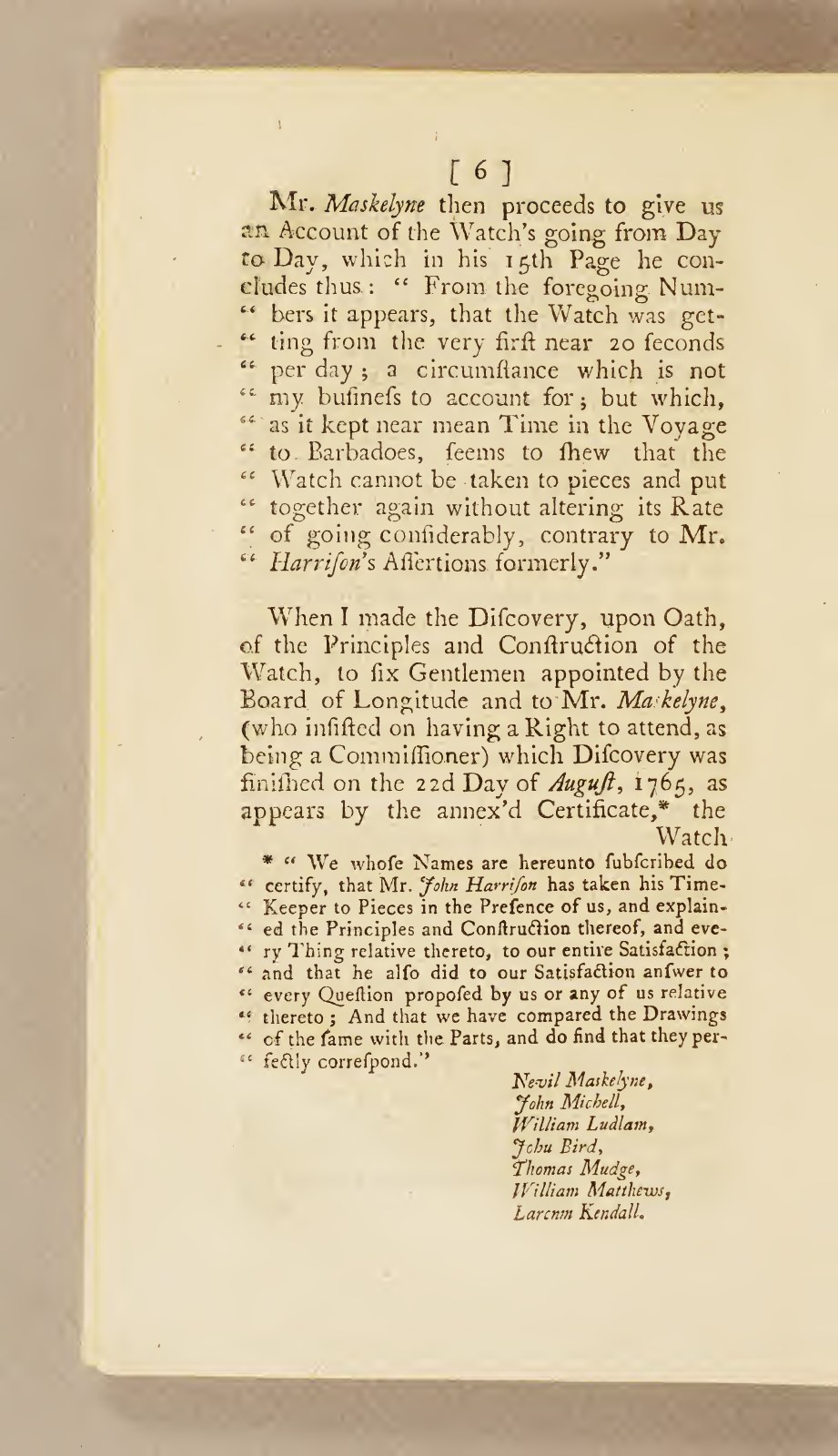
Page 6 of John Harrison’s 1767 reply, with a copy of the certificate of the H4 examination at the foot. The John Carter Brown Library holds the original, digitised by the Internet Archive. The page was extracted from the PDF, resized and converted to JPEG. Wikimedia Commons file page Public Domain Mark 1.0
On p. 22 of the same reply, Harrison protests that a report under Ludlam’s name appeared in a newspaper less than six weeks after the disclosure. Harrison himself speculates that the Board had permitted publication. In 1767 the Board published the explanation of the watch and its drawings as The Principles of Mr. Harrison’s Time-Keeper. 2 8
Observations in Leicester and later work#
In the late 1760s Ludlam became parish priest of Cockfield, Suffolk, and set up an observatory at the top of St Peter’s church tower. The church guide describes an opening through which a meridian telescope could view the sky. Traces remain on the outside wall. 3 12
Ludlam continued observing after returning to Leicester. The Royal Society published his observations there of the transit of Venus on 3 June 1769. Its journal for 1775 contains another report from Leicester communicated by Maskelyne. The Royal Society also holds the manuscript. Ludlam’s interest in mechanics appears in papers on scales for wool manufacture and devices for producing ellipses in wood and metal or drawing them on paper. 3 9 10
His textbook The Rudiments of Mathematics, published in 1785, went through several editions. In 1786 he published notes on John Bird’s work on dividing angular scales, with an English and French glossary of technical terms. 3 13
Ludlam died in 1788 and was buried at St Mary de Castro in Leicester. An auction catalogue that year lists his instruments, including telescopes and quadrants. Shelton’s clock stayed at the college and was used until the observatory closed in 1859. It was lent to the National Maritime Museum from 1966 and returned to the college in 1992. 3 4 6 11
Chronology#
| Date | Event |
|---|---|
| April 1717 | Baptised in Leicester. 4 |
| July 1734 | Admitted to St John’s College, Cambridge. 5 |
| March 1744 | Elected a fellow of the college. 3 5 |
| 1749 | Obtains a degree in divinity and becomes parish priest at Norton by Galby. 3 |
| January 1765–July 1766 | The rate of the Shelton clock is recorded over time before it moves to the observatory. 1 |
| August 1765 | Witnesses Harrison dismantle and explain H4. 2 |
| July 1767 | Rate records begin for the clock installed at the St John’s observatory. 1 6 |
| 1769 | Publishes his Cambridge observations. Observes the transit of Venus in Leicester in June. 1 9 |
| 1775 | The Royal Society publishes his report of observations in Leicester. 10 |
| 1785 | Publishes The Rudiments of Mathematics. 3 |
| 1786 | Publishes notes on Bird’s method of dividing astronomical instruments. 13 |
| March 1788 | Dies and is buried in Leicester on the 21st. His instruments are auctioned that year. 3 4 11 |
| 1992 | The Shelton clock returns from the National Maritime Museum to the college. 6 |
| 2020 | Rory McEvoy discusses Ludlam’s account of the clock in a study of precision pendulum clocks. 7 |
References#
- William Ludlam, Astronomical Observations Made in St. John’s College, Cambridge, in the Years 1767 and 1768, 1769, pp. 37–45. ETH-Bibliothek Zürich, Rar 4246. Scan at e-rara (accessed 18 November 2026).
- John Harrison, Remarks on a Pamphlet Lately Published by the Rev. Mr. Maskelyne, Under the Authority of the Board of Longitude, 1767, pp. 6, 21–22. Scan of the Wellcome Collection copy (accessed 18 November 2026).
- Charles Platts, “Ludlam, William”, Dictionary of National Biography, vol. 34, 1893. Wikisource transcription (accessed 18 November 2026).
- University of Exeter, Medical Practitioners in Early Modern England, “Leicestershire Medics”, person ID 8608, pp. 91–92. Research data (accessed 18 November 2026).
- Churchill Babington, “Materials for a History of Cockfield”, Proceedings of the Suffolk Institute of Archaeology, vol. 5, 1880, pp. 232–234, quoting the St John’s admissions register. Scan (accessed 18 November 2026).
- St John’s College, University of Cambridge, “John Shelton Regulator c.1764”. Earlier collection entry checked on 18 November 2026. The current description is in the “St John’s College” section of University of Cambridge, “A Brief History of Time”.
- Rory McEvoy, “Introducing the Precision Pendulum Clock”, Harrison Decoded, Oxford University Press, 2020. Publisher’s record and author’s final manuscript, “The trouble with pendulums” (accessed 18 November 2026).
- Commissioners for the Discovery of the Longitude at Sea, The Principles of Mr. Harrison’s Time-Keeper; with Plates of the Same, 1767. Wellcome Collection catalogue (accessed 18 November 2026).
- William Ludlam, “Observations Made at Leicester on the Transit of Venus Over the Sun, June 3, 1769”, Philosophical Transactions, vol. 59, 1769, pp. 236–240. Volume contents (accessed 18 November 2026).
- William Ludlam, “Astronomical Observations Made at Leicester”, 1775, The Royal Society Archives, L&P/6/115. Manuscript record, Philosophical Transactions, vol. 65, pp. 366–372. Volume contents (accessed 18 November 2026).
- History of Science Museum, University of Oxford, Historical Auction Catalogues, “William Ludlam, 1788”. Auction catalogue transcription (accessed 18 November 2026).
- Cockfield Church Guide, “The Tower”, pp. 16–17. Guide hosted by Suffolk Historic Churches Trust (accessed 18 November 2026).
- Maria Curie-Skłodowska University Library, catalogue of eighteenth-century books, William Ludlam, An Introduction and Notes, on Mr. Bird’s Method of Dividing Astronomical Instruments: To Which Is Added, a Vocabulary of English and French Technical Terms, London, 1786, shelfmark St. 16172. Catalogue (accessed 18 November 2026).