This article was translated from Japanese using AI. Read the Japanese original
William Oughtred (baptised in 1575, died in 1660) was a seventeenth-century English mathematician who taught mathematics while serving as a parish clergyman in Surrey. To tell the time from the Sun’s position, he designed a double horizontal sundial and a portable equinoctial ring dial that could be set to the local latitude. The portable instrument he made with instrument maker Elias Allen combined a circular slide rule and a projection of the celestial sphere on opposite faces of a single brass plate. His posthumously published method of calculating the tooth counts of watch gears also worked out the ratios for a calendar display. 14 1 2 3 4 11 12
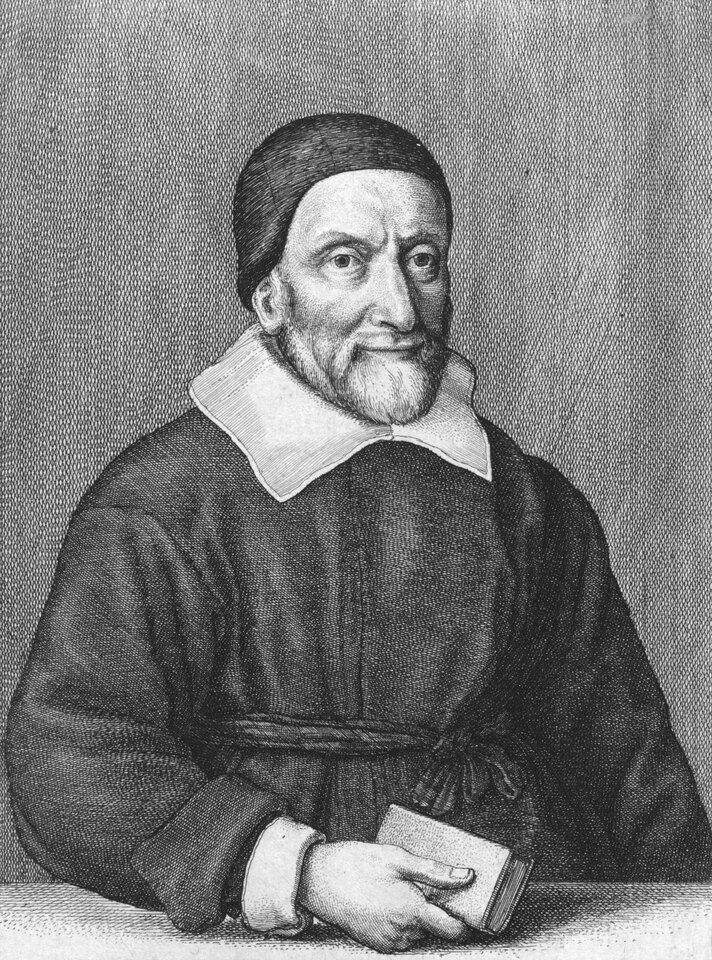
Figure 1. Portrait made by Wenceslaus Hollar in 1646. It also appeared in the 1647 English edition of The Key of the Mathematics. Original by Hollar, digitised by the Rijksmuseum, Amsterdam (RP-P-1907-2855). Source: Wikimedia Commons file. CC0 1.0. Resized, recompressed as a JPEG and stripped of metadata for publication.

From Eton to Albury#
Oughtred learned arithmetic from his father Benjamin, who taught writing at Eton. He went to Eton College and then to King’s College, Cambridge, in 1592. He became a fellow in 1595 and gained his master’s degree in 1600. He took holy orders in 1603 and served as parish clergyman at Albury from 1610. The Oxford Dictionary of National Biography dates his baptism to 5 March 1575, while John Aubrey gives his date of birth as 5 March 1574. The English year then began on 25 March, so a date of 5 March can differ by a year depending on the dating convention used. 1 5 6
Oughtred taught mathematics at home alongside his parish duties in Albury. His pupil William Forster, who stayed with him during the 1630 vacation, wrote that Oughtred showed him how to slide two straight logarithmic scales directly against one another, and an instrument that applied the same idea to circular scales. Forster translated his teacher’s Latin manuscript into English and dedicated it to Kenelm Digby. Allen of London is named as the seller in the 1632 edition and Nicholas Bourne in the 1633 edition. The instrument book gave readers operating instructions and drawing examples, alongside Oughtred’s separate arithmetic and algebra textbook, The Key of the Mathematics, published in 1631. 2 6 7
A circular slide rule with the heavens on its reverse#
On a logarithmic scale, the distance between two values corresponds to their ratio. The distance from 2 to 6, for example, equals that from 3 to 9 on the same scale. On a circular scale, that interval can be transferred as the angle between two pointers extending from the centre. The prototype rings Forster saw could move relative to each other. According to the Whipple Museum of the History of Science, Allen proposed fixing the concentric scales and pivoting two pointers at the centre to save the trouble of making the scales turn. The museum’s brass No. 0833, made around 1635, has two pointers on the calculating face and one on the reverse. 2 3
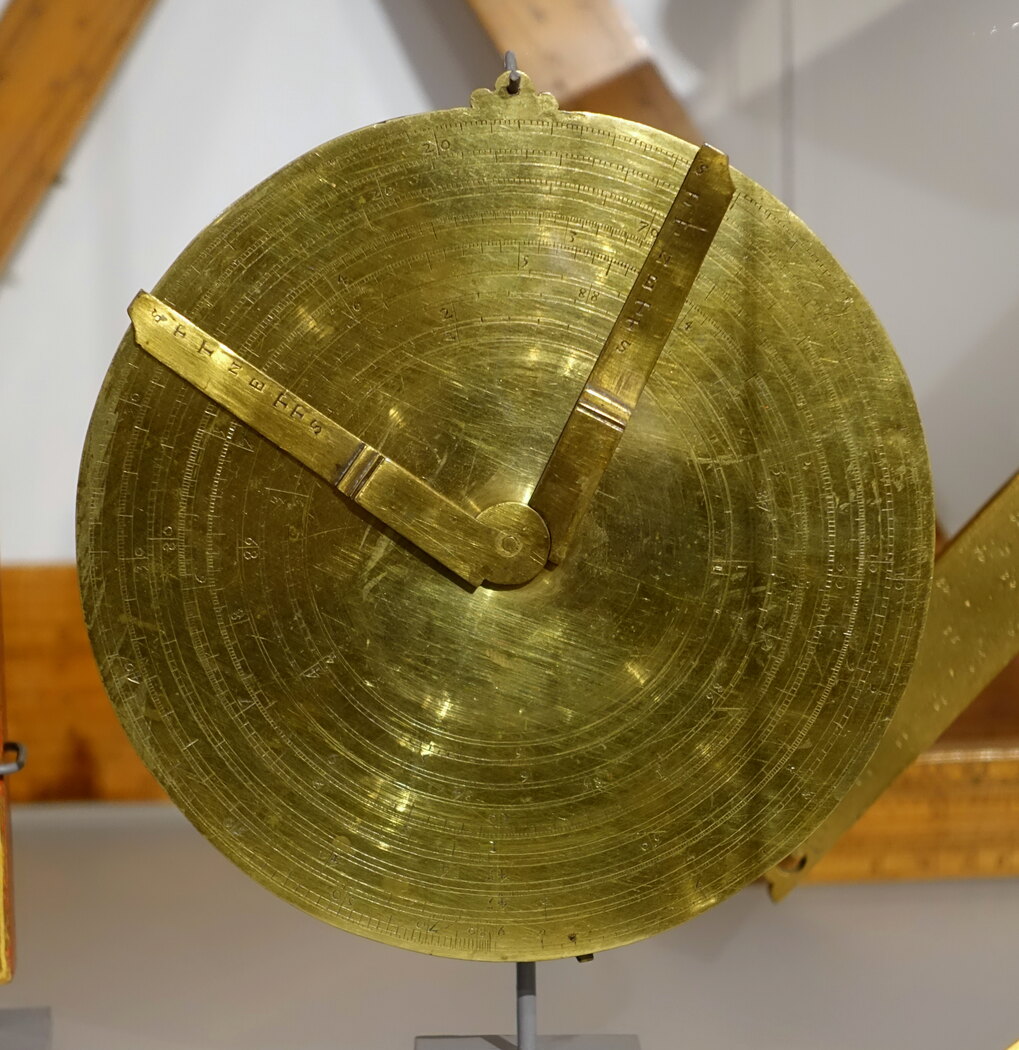
Figure 2. Calculating face of the portable instrument made by Elias Allen in London, c. 1633–1640. Photographed by Daderot on display in Harvard University’s Putnam Gallery. Source: Wikimedia Commons file. Photograph under CC0 1.0. Resized, recompressed as a JPEG and stripped of metadata for publication.

On the reverse, the horizontal instrument carries lines of the celestial sphere projected onto the observer’s horizon plane. The plate shows the ecliptic, the Sun’s yearly path, the celestial equator and the Sun’s daily paths. From the date and the Sun’s altitude, the user can find the time for the morning or afternoon. The user hangs the instrument, turns the edge of the plate towards the Sun and reads the altitude from the place where the shadow of the central projection falls on the rim. One example in the second part of the book assumes a latitude of 51°30′ north and constructs a sundial for a surface declining 35° east of north and inclined by 41°30′. The projection served both to tell the time and to lay out hour lines on another plane. 2 3 8
Oxford’s History of Science Museum holds a double-sided instrument by Allen that George Barkham gave to St John’s College. The dedication inscription gives the year 1635. The instrument has the two circles introduced in the 1633 supplement for use at sea. In the centre of the calculating face is a celestial projection in place of the nocturnal time scale described in the book. Comparison of book and instrument shows that the maker had choices about which features to fit into the available space. 2 9
The circular slide rule prompted a priority dispute with Richard Delamain. In 1630 Delamain published Grammelogia, which describes a circular logarithmic instrument. 13 Forster’s dedication says Delamain forestalled them. Oughtred’s response recounted how he had shown the instrument to Forster and credited Edmund Gunter for earlier work turning logarithms into a scale. Putting the logarithmic scale to practical use, arranging it in a circle and making an instrument with two pointers involved distinct contributions. 2 3 10
A sundial that uses two shadows#
The double horizontal dial has two sets of hour lines on a horizontal plate. To read the outer scale, the user follows the shadow of the inclined edge of a gnomon set parallel to the Earth’s axis. The inner scale gives the time where the shadow of an upright edge at the centre meets the curve representing the Sun’s path that day. The earlier portable instrument measures solar altitude. The inner dial of the double horizontal dial reads the direction of the shadow from above, corresponding to the Sun’s azimuth. 4 8 11
With a dial fixed on a pedestal, the user takes the time from the outer scale and uses the shadow of the upright edge to plot the Sun’s position on the inner diagram. For a dial that is only temporarily placed, the user selects the Sun’s path from the date and then turns the dial while keeping it level until both shadows indicate the same time. Oughtred gives this as a way of aligning the dial’s meridian north–south. The thickness of the gnomon can shade the upright edge near noon, so he advises making the edge thin and sharp. 4 11
The octagonal pedestal dial by Allen at Royal Museums Greenwich is for a latitude of 51°30′ north. Scales for minutes, hours, bearings and angles lie in succession from the rim, with the celestial projection inside. Its calendar scales retain the contemporary dates of 10 March for the spring equinox and 13 September for the autumn equinox. Oughtred’s description appeared separately in London in 1632 and 1636 and was included in the 1653 edition of Mathematicall Recreations. It explains how to find the times and bearings of sunrise and sunset at the intersections of the Sun’s path with the horizon. 4 8 11 15
An equinoctial ring dial set to the local latitude#
The instrument Oughtred called a general horological ring consists of an outer meridian ring, an inner equinoctial ring and a bridge or bar representing the direction of the Earth’s axis. The user sets the suspension ring to the local latitude and moves the small aperture on the bridge to the date on its calendar scale. With the rings at right angles and the dial suspended, the user turns the instrument until sunlight through the aperture falls on the central hour line of the inner ring. The spot gives local apparent solar time. The suspension point corresponds to the inclination of the Earth’s axis and the aperture position to the Sun’s seasonal declination. The inner ring folds away after use. The 1653 description is for use in the Northern Hemisphere and records that Allen made the instrument in brass. 11 12
Makers continued producing this type after Oughtred died in 1660. An example in the Whipple Museum by Thomas Tuttell, made around 1700, is a 150 mm brass instrument with the maker’s name on its outer ring. The double horizontal dial for a fixed latitude and the adjustable equinoctial ring dial for travellers illustrate two ways of telling the time from the Sun’s position. 4 5 12
Driving a calendar display with gear ratios#
In 1675, after Oughtred’s death, the London clockmaker John Smith published Oughtred’s method of calculating watch gear teeth as an appendix to Horological Dialogues. Smith’s preface says Oughtred compiled it for friends at the university who were studying how timepieces work. Aubrey records that Oughtred apprenticed his eldest son Benjamin to a clockmaker and wrote about watchmaking for him as well. 5 14
The appendix explains, by function, the gears that take power from the barrel through the fusee, a conical pulley, and transmit it to the balance, as well as those that set the periods of the dial displays. The overall ratio of the train is calculated by multiplying the ratios of wheel and pinion tooth counts at each stage. Several combinations can give the same ratio, allowing the maker to choose tooth counts that can actually be cut. 14
In the design for displaying the day of the month, a 10-tooth pinion on the arbor of the dial wheel, which turns once in 12 hours, drives a 40-tooth wheel. A 4-tooth pinion on the same arbor as that wheel drives a ring of 62 teeth marked with 31 days. For one turn of the ring, the dial wheel makes (40 ÷ 10) × (62 ÷ 4) = 62 turns, so 12 hours × 62 gives 31 days. Whether projecting the position of the Sun onto a sundial or choosing gear teeth to drive a watch’s calendar, Oughtred expressed time relationships through scales and ratios. 11 14
Timeline#
| Year | Event |
|---|---|
| March 1575 | Baptised at Eton. 1 |
| 1592 | Enters King’s College, Cambridge. 1 |
| 1603 and 1610 | Takes holy orders and later becomes parish clergyman of Albury. 6 |
| Summer 1630 | Shows Forster instruments with logarithmic scales at Albury. 2 |
| 1631–1633 | Publishes The Key of the Mathematics. Forster’s translation of the account of the circular slide rule and horizontal instrument appears in 1632, and the 1633 edition adds a supplement for use at sea. 2 6 7 |
| 1635 | Barkham gives Allen’s double-sided instrument to St John’s College, Oxford. 9 |
| 1632 and 1636 | Separate editions of the account of the double horizontal dial appear in London. 8 15 |
| 1653 | Mathematicall Recreations appears with accounts of the double horizontal and equinoctial ring dials. 11 |
| June 1660 | Oughtred dies. Aubrey records his burial in Albury church. 5 6 |
| 1675 | The method of calculating watch gear teeth appears as an appendix to Smith’s Horological Dialogues. 14 |
| Around 1700 | Tuttell makes an equinoctial ring dial of this type. 12 |
Related articles#
References#
Online sources accessed on 21 November 2026. Printed works are cited by edition.
- Frances Willmoth, “Oughtred, William (bap. 1575, d. 1660)”, Oxford Dictionary of National Biography, 2004. The publicly available opening gives his baptism and education.
- William Oughtred, translated by William Forster, The Circles of Proportion and the Horizontal Instrument, 1633 edition, EEBO-TCP transcription A08582. Title page, dedication, chapters 1–2 of Part I, the construction of a north-facing dial in Part II, and the supplement for navigation.
- Whipple Museum of the History of Science, Elias Allen circular slide rule and horizontal instrument, No. 0833. Specifications, the two faces and pointers, and Allen’s proposed changes.
- Royal Museums Greenwich, “Horizontal pedestal dial”. Scales, latitude, gnomon and inscriptions of Allen’s double horizontal dial.
- John Aubrey, “William Oughtred”, Brief Lives, transcribed by MacTutor. Birth year as recorded, parish and burial.
- Richard S. Westfall, “Oughtred, William”, Rice University, The Galileo Project. Education, holy orders, textbook and year of death. For year numbering, see also the Beinecke Library’s guide to citing Old Style dates.
- History of Science Museum, Oxford, “The Geometry of War: Catalogue No. 78”. Bibliography of the 1632 first edition and the 1633 edition.
- Michael Lowne, “The Design and Characteristics of the Double-Horizontal Sundial”, Bulletin of the British Sundial Society, 13(ii), 2001. Portable instrument for measuring altitude, double horizontal sundial and the 1636 edition.
- History of Science Museum, Oxford, “The Geometry of War: Catalogue No. 79”, No. 40,847. Dedication inscription, additional scales for navigation and the central projection.
- William Oughtred, The Just Apologie of Wil: Oughtred, seventeenth-century edition, EEBO-TCP transcription A08589. “Of the Circles of proportion” and the title of the work to which he responds.
- William Oughtred, The Description, and Use of the Double Horizontall Diall / Generall Horologicall Ring, appendices to the 1653 edition of Mathematicall Recreations, EEBO-TCP transcription A48262. Uses IV, VIII–X and XIII of the double horizontal dial, and the description and operation of the equinoctial ring dial.
- Whipple Museum of the History of Science, Equinoctial ring dial by Thomas Tuttell. Date, dimensions, signature and functions of the parts.
- British Library, Sloane MS 1983 B. Bibliography for the year of publication of Delamain’s Grammelogia and Oughtred’s reply.
- William Oughtred, published by J. S., A Method of Calculating all Numbers for Watches, appendix to John Smith, Horological Dialogues, 1675, EEBO-TCP transcription A60472. Title page, preface to the reader, I. 1–5, II. 14–16, III. 25–26. See also the digitised 1675 edition.
- The Grub Street Project, The Description and Use of the Double Horizontall Dyall, ESTC S3161. Bibliographic record for the 1632 London edition.