Yulia Frumer#
This article was translated from Japanese using AI. Read the Japanese original
Yulia Frumer is a historian of science and technology whose research has explored how reading clocks and thinking about time changed in Edo-period Japan. She traces when hours of equal length proved useful and how they eventually became the basis of a time system, drawing on Japanese clock dials, astronomers’ calculations and diagrams, and instruments used in surveying and navigation. At Johns Hopkins University she studies the history of East Asian science and technology. Her recent work also examines the relationship between robotics and emotions in Japan. 1 3 7
Career and research origins#
According to her university profile, she was born in Tallinn, Estonia, and her experience of living between languages and cultures sparked an interest in scientific translation and technology transfer. Even words that seem to share a meaning can acquire different associations from the tools people use and the situations in which they use them. Frumer explored those differences through the history of Japanese timekeeping. 1
She earned her doctorate at Princeton University in 2012. Her adviser was Benjamin A. Elman, and her research focused on clocks and timekeeping in Edo-period Japan. From 2012 to 2013, she worked on a Max Planck Institute for the History of Science project exploring how astronomers’ observations and calculations, and their use of clocks and diagrams, related to ideas about time. 2 3
Her research in Japan included periods at the International Research Center for Japanese Studies and the University of Tokyo. The Johns Hopkins autumn 2013 course schedule lists her as teaching a course on East Asian science and technology and a first-year seminar on how people read instruments and use them to think. In 2014 she was a visiting researcher in the history of science at Ludwig Maximilian University of Munich, writing a book on clocks and astronomical timekeeping in early nineteenth-century Japan. 14 15 16
Reading Japanese clocks#
Under the Edo-period system of unequal hours, daylight and night were each divided into six parts. A daylight hour grew longer in summer as a night hour grew shorter. In winter the reverse held. Agreeing on when to mark dawn and dusk and sharing the time in a town required conventions for determining and communicating time. Frumer notes that people could arrange meetings and agree on working hours even when the length of an hour varied with the seasons. 5 7 12
A mechanical clock could show unequal hours either by running at different rates during daylight and at night or by pairing a mechanism that ran at a constant rate with a scale of variable spacing. Moving the weights on a foliot is an example of the first method. On the pillar clock illustrated here, calendar markings at the top of the scale indicate the season, and the height of the hour lines crossing the vertical divisions changes with the season. The user reads the time by comparing the indicator to the column for the season. 7 11
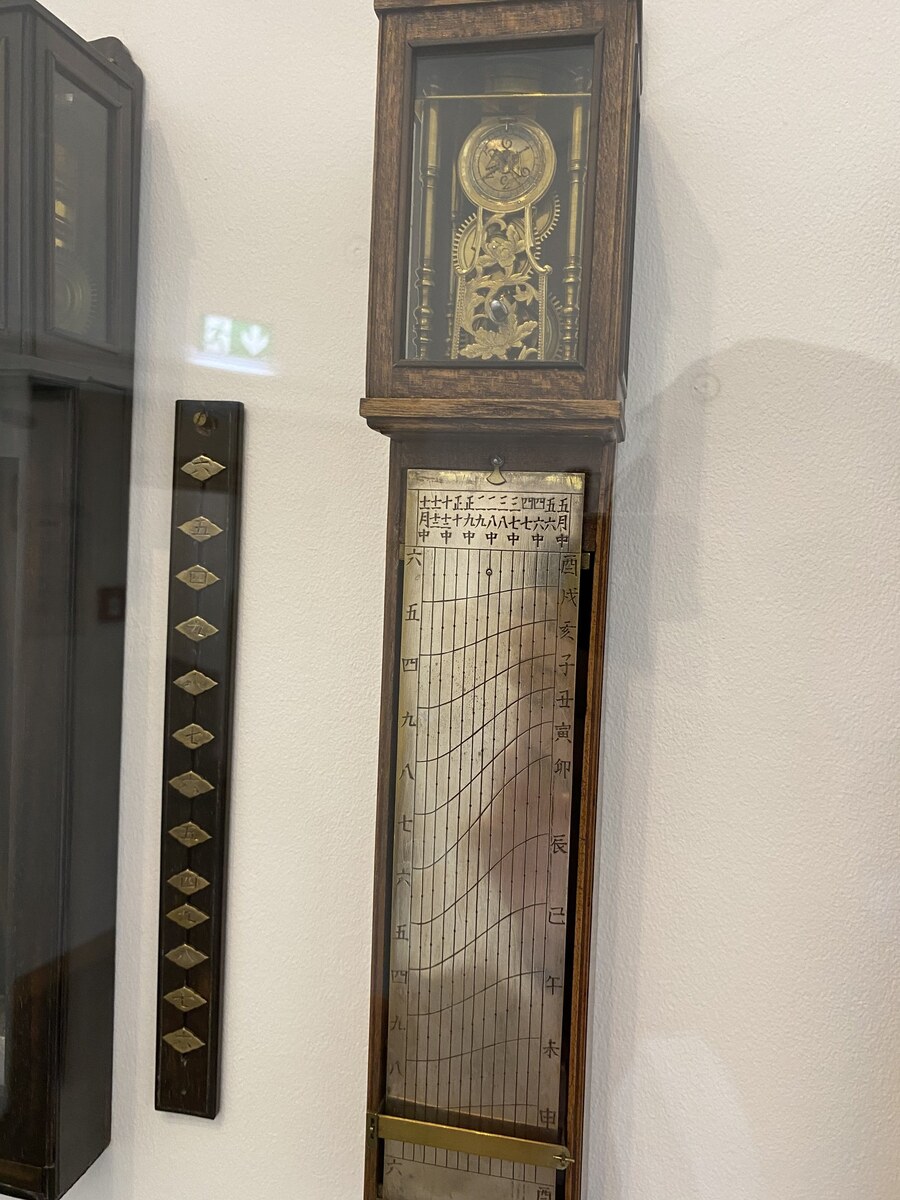
Figure 1. Pillar clock on display at the Vienna Clock Museum. Photograph by Furkan Akkurt, taken on 22 June 2024. The image was oriented according to the EXIF data, resized, recompressed as a JPEG and stripped of metadata. The same licence applies to the modified image. Wikimedia Commons file description CC BY-SA 4.0

Her 2014 article “Translating Time” reverses the question by asking how a person familiar with Japanese clocks learned to read a Western clock dial. Reading positions on a dial as times depends on the shape of the scale, the arrangement of the numbers and the ways people normally keep time. Frumer argues that late Edo users drew on familiar practices of measurement, calculation and diagramming to understand Western clocks. 4 5
Time in observation, surveying and navigation#
In Making Time, published in 2018, Frumer moves from the techniques of reading time to the meaning of the times measured. Through the observational instruments, spherical trigonometry and calculation diagrams used by Takahashi Yoshitoki, Hazama Shigetomi and others, she shows how measuring the positions of celestial bodies led to thinking of time as arcs and angles on the celestial sphere. In another article she traces how Yoshitoki redrew diagrams and symbols in familiar forms while reading a Dutch translation of Lalande’s Astronomy. Reworking the diagrams was itself a way to understand the calculations. 5 6 7
The relation between time and angles also mattered in surveying, where distant places needed to be plotted on the same map. Frumer discusses Inō Tadataka’s comparison of astronomical observations made with a pendulum clock at his survey sites with records from the observatory at Asakusa in Edo. In her chapter on navigation, she connects Honda Toshiaki’s proposal for measuring longitude with Western chronometers to Japanese astronomers’ use of the British Nautical Almanac. Relating celestial motion to time gave observers a way to locate an observation site or a ship at sea. 7
In the Kaga domain, Frumer discusses the case of Endō Takanori, who studied astronomy and surveying and considered Japan’s geographical position after speaking with castaways who brought back a Russian clock. In his study of Dutch learning in Kaga, Motoyasu Hiroshi reports that Endō and his colleagues used a suiyōkyūgi, a pendulum clock used for astronomical observations, and established a local system that divided time into thirteen parts. Knowledge that linked astronomical observation and land surveying through clocks was thus put to use in the domain’s time system. 7 9
Frumer also discusses Tanaka Hisashige’s Myriad-Year Clock as an instrument that displays several ways of representing time. She argues that its six dials, driven by the same mechanism, and the apparatus at the top displaying the apparent motions of the Sun and Moon were designed to let users read the time alongside the calendar and the movement of celestial bodies. 7
Explaining calendar reform#
The Meiji government promulgated a solar calendar and a 24-hour day in Grand Council of State Proclamation No. 337, issued on the ninth day of the eleventh month of 1872 according to the old calendar. It designated the third day of the twelfth month of Meiji 5 as 1 January 1873 in the new calendar. Frumer studies how equal intervals, previously used in particular observations and calculations, had already gained credibility as a standard for society as a whole. In her account, the methods of representing time spread from astronomers’ calculations to surveying and navigation, and then to instruments made by clockmakers and guides to Western clocks. 7 8
In his review, the historian Mark Ravina points to Frumer’s evidence from Edo-period diaries and agreements on overtime pay that people acted with attention to time before factory labour became widespread. The historian of science Sara J. Schechner highlights the variety of solutions for displaying time under the same system, including movable hour markers and hour lines on Japanese clocks. 11 12
Later research#
In a 2018 article on compasses with east and west reversed, Frumer examined how their layout helped users read the direction they were facing on board ship. She also explored habits common to reading compass bearings and telling time in the Edo period. In her chapter on scientific communities for The New Cambridge History of Japan, she traces how separate fields of study began to share judgements, including what counted as evidence. 5 10 13
Her current work on the history of robotics explores how the emotions of designers and users affect the design and reception of technology. Frumer identifies Making Time and its study of the relationships between clocks, observational instruments and their users as a methodological starting point for this research. 1
Chronology#
| Year | Activity |
|---|---|
| 2012 | Earns her doctorate at Princeton University. 2 |
| 2012–2013 | Studies changes in Japanese timekeeping at the Max Planck Institute for the History of Science. 3 |
| Autumn 2013 | Teaches the history of East Asian science and technology and other courses at Johns Hopkins University. 15 |
| 2014 | Visiting researcher in the history of science at Ludwig Maximilian University of Munich. Her profile describes her as writing a book on Japanese clocks and timekeeping. 16 |
| October 2014 | Publishes “Translating Time” in Technology and Culture. 1 4 |
| April 2016 | Publishes an article on Takahashi Yoshitoki’s reading of Western astronomy in Annals of Science, vol. 73, no. 2. 5 6 |
| 2018 | Publishes Making Time. Her article on Japanese compasses appears online in May. 7 10 |
| January 2024 | Her chapter on scientific communities in early modern Japan is published online. The print volume appeared in 2023. 13 |
| As of November 2026 | Her Johns Hopkins University profile describes her work on emotions and robotics in Japan. 1 |
References#
All sources accessed on 21 November 2026.
- Johns Hopkins University, Yulia Frumer. Career and research profile with a list of publications.
- Princeton University, Yulia Frumer and Doctoral Degrees Awarded. Degree year, adviser and dissertation topic.
- Max Planck Institute for the History of Science, A Matter of Time: Transforming Timekeeping in Nineteenth-century Japan, 2012–2013 project record.
- Yulia Frumer, “Translating Time: Habits of Western-Style Timekeeping in Late Edo Japan”, Technology and Culture 55(4), 2014, pp. 785–820. Public abstract. DOI 10.1353/tech.2014.0116.
- Yulia Frumer, “In Praise of the Counterintuitive”, Surprise, 2019, pp. 116–118.
- Yulia Frumer, “Before words: reading western astronomical texts in early nineteenth-century Japan”, Annals of Science 73(2), April 2016, pp. 170–194. Public abstract on PubMed, published online ahead of print on 4 February 2015. DOI 10.1080/00033790.2014.974070.
- Yulia Frumer, Making Time: Astronomical Time Measurement in Tokugawa Japan (public chapter abstracts), University of Chicago Press, 2018. Bibliographic record on Chicago Scholarship Online.
- National Archives of Japan, “Adoption of the solar calendar”. Grand Council of State Proclamation No. 337, file 太00224.
- Motoyasu Hiroshi, “Technical Culture in Kaga and Regional Rangaku (Section II. Regional Developments and Exchange in Rangaku)”, Bulletin of the National Museum of Japanese History 116, 2004. Japanese and English abstracts on the Kaga domain’s time system.
- Yulia Frumer, “Japanese Reverse Compasses: Grounding Cognition in History and Society”, Science in Context 31(2), 2018, pp. 155–187. Public abstract.
- Sara J. Schechner, “Telling time in Tokugawa Japan”, Physics Today 72(6), 2019, pp. 57–58. Book review.
- Mark Ravina, Review of Making Time, The American Historical Review 124(1), 2019, pp. 221–222. Public excerpt.
- Yulia Frumer, “Scientific Communities and the Emergence of Science in Early Modern Japan”, The New Cambridge History of Japan, 2023, pp. 342–362. Public abstract dated 15 January 2024.
- The Japan Foundation, Meet the Fellows: Cohort 4 Program (2016–2018), entry for Yulia Frumer.
- Johns Hopkins University Office of the Registrar, Fall 2013 Term Course Schedule, pp. 43 and 91, AS.140.115 and AS.140.305.
- Ludwig-Maximilians-Universität München, Prof. Dr. Yulia Frumer, visiting researcher profile, 2014.