This article was translated from Japanese using AI. Read the Japanese original
One watch carries reference time#
Arnold No. 485/786 is a pocket chronometer made by the workshop of London watchmaker John Arnold. The surviving movement dates to about 1794, the silver case bears hallmarks for 1840, and the mechanism was altered later. The watch was rebuilt over the course of its long service. 1
Three members of the Belville family used the watch in succession to carry Greenwich Observatory time to customers in London. The watch continued running after comparison with the observatory’s reference clock, allowing customers to check their own timepieces at a distance. Ruth Belville (article in Japanese) called the watch “Mr. Arnold.” 1 2
Reading the surviving watch#
Numbers and exterior#
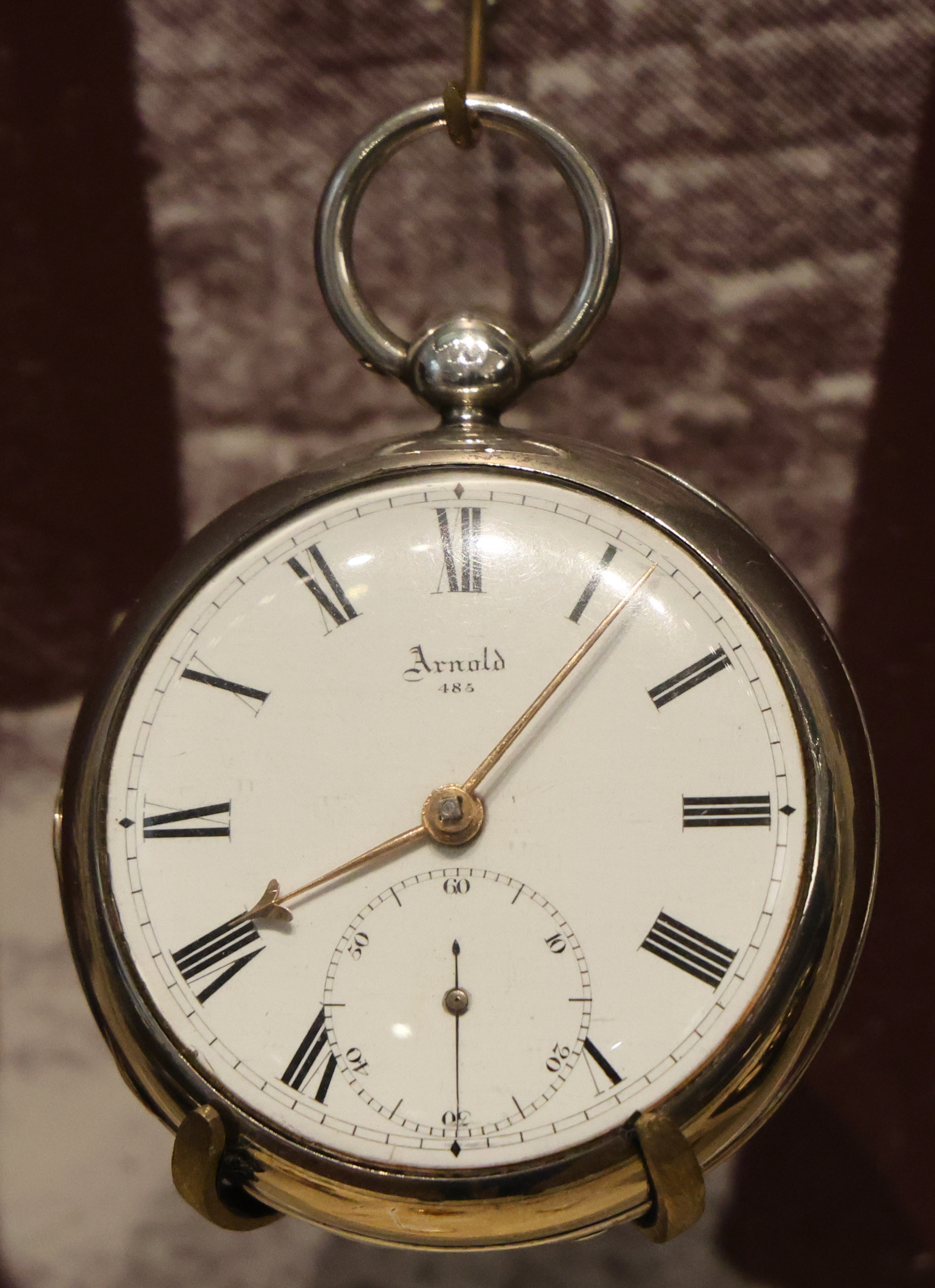
Dial of Arnold No. 485/786. Photograph by Geni. Source Wikimedia Commons. CC BY-SA 4.0. Reproduced unchanged.

The movement is signed John Arnold & Son, London. Invenit & fecit 485/786. The signature with two numbers identifies the one surviving object. The numbers need not denote separate watches. The surviving silver case bears 1840 hallmarks, the casemaker’s mark “CBH” and the number 485. The Science Museum Group’s record describes a white enamel dial with subsidiary seconds and gold spade hands, and a jewelled movement with a diamond endstone. The overall dimensions with the bow raised are 78 × 56 × 25 mm. 1
The collection record says the watch was made for the Duke of Sussex and substantially rebuilt around 1840. The movement’s estimated date and the case’s hallmark year differ. The surviving case belongs to the later history of the watch. Manufacture, alteration and use by the family mark distinct stages in its provenance. 1
Escapement and temperature compensation#
The original escapement was replaced with an Earnshaw-type spring detent. The two-arm compensation balance is also later. The museum records these as features of the watch as it survives. The maker of the alterations and the exact dates when individual parts were replaced remain uncertain from the collection record. 1
In a detent escapement, the detent locks the escape wheel. When the oscillating balance moves the detent to unlock the wheel, the escape wheel delivers an impulse to the balance. A thin passing spring allows the balance to pass in the opposite direction without releasing the wheel. The balance receives one impulse per full oscillation. The watchmaker Bernhard Stoeber’s account of restoring another chronometer describes the action and the importance of machining and heat treating the springs. It concerns a different watch. 3
A compensation balance reduces the effect of temperature changes on rate. Position and handling also matter when comparing portable watches. Working out the watch’s gain or loss on a particular day in transit would require measurements beyond the record of its construction. 1 4
Carrying a watch as the reference#
From comparison to the customer#
The portable watch was compared with the reference clock maintained at Greenwich through astronomical observations to establish the difference between them. Customers used the delivered watch and information about this difference to set their own timepieces. Observatory staff member E. Walter Maunder explained in 1900 that knowing the difference was essential, and that the hands could be left as they were after a comparison. 4
Observatory employee John Henry Belville began taking the watch to customers, saving individual watch shops from sending someone to Greenwich. Observatory historian Graham Dolan records that the arrangement was in use by 1840. The museum dates the family’s first use to 1834, while biographer David Rooney gives 1836. 1 2 5
When John Henry died in 1856, his wife Maria took over the service and watch. She passed them to their daughter Ruth in 1892. In a 1908 interview cited by Dolan, Ruth said she compared the watch at the observatory on Mondays and visited about 40 customers at least once a fortnight. Observatory checks and visits to individual customers could take place at different intervals. 2 5
What the accuracy figure describes#
Royal Museums Greenwich describes the service as accurate to 0.1 second. The error measured against the reference, variations in rate during transport and customers’ readings were separate stages. A figure for weekly drift or the accuracy to which each customer could set a clock would require more evidence. The service depended on a precision watch, repeated comparisons, transport and visits. 4 6
Telegraphic time distribution from Greenwich began in 1852, and the Belvilles’ service continued alongside it. Telegraphy required receiving equipment and a line. Some customers still chose to have the time carried to them in person. 5
Preservation after retirement#
Ruth retired in 1940. According to Rooney, in 1908 she said she would like the watch to go to a museum, and in 1921 she wanted to give the observatory first opportunity to buy it. After receiving a pension from the Worshipful Company of Clockmakers in 1941, she said in January 1943 that she intended to leave it to the company’s museum. It entered the collection after her death. 2
The company now lends it to the Clockmakers’ Museum in London’s Science Museum. Its Clockmakers’ Museum number is 429 and its Science Museum Group object number L2015-3341. The museum advises checking whether it is on display before visiting. 1
This late eighteenth-century precision watch was rebuilt in the nineteenth century and used for urban time delivery into the twentieth. The signature records its workshop, and the case marks and later escapement document changes during its working life. The performance of the watch, comparisons against a reference and the service to customers together explain how it could carry the time.
Timeline#
| Date | Event |
|---|---|
| Around 1794 | Estimated manufacture of the surviving movement. 1 |
| 1830s | The Belville family starts delivering the time. Sources differ on the first year. 1 2 |
| Around 1840 | The watch is substantially rebuilt. The surviving silver case is hallmarked 1840. 1 |
| 1856 and 1892 | Maria and then Ruth take over the family business. 2 |
| 1940 | Ruth retires. 2 |
| 1943 | Ruth offers to donate the watch. It enters the Clockmakers’ Company collection after her death. 2 |
| 2015 | The Clockmakers’ Museum opens in the Science Museum. 2 |
References#
- Science Museum Group, “Spring detent watch by John Arnold, used by Ruth Bellville and family to distribute GMT c.1834–1940”, L2015-3341, Clockmakers’ Museum No. 429. Accessed 3 November 2026.
- David Rooney, “How did Arnold get to the Clockmakers’ Museum?”, Antiquarian Horological Society, 23 November 2015. Accessed 3 November 2026.
- Bernhard Stoeber, “Restoration Projects Done at WOSTEP in 1991, Part 7”, Horological Times, September 2021, pp. 25–27. Report on the restoration of a different watch.
- E. Walter Maunder, The Royal Observatory Greenwich: A Glance at Its History and Work, 1900, chapter VI. Accessed 3 November 2026.
- Graham Dolan, “Distribution of time by the Belvilles”, Royal Observatory Greenwich history website. Accessed 3 November 2026.
- Royal Museums Greenwich, “The Greenwich Time Lady: Ruth Belville”, 8 March 2023. Accessed 3 November 2026.