This article was translated from Japanese using AI. Read the Japanese original
The Atmos is a family of table clocks that winds its mainspring with energy from room temperature changes and keeps time with a slowly turning torsion pendulum. Conceived by Swiss engineer Jean-Léon Reutter, it was refined during the 1930s by the technical and manufacturing teams at LeCoultre and Jaeger. Jaeger-LeCoultre makes it today. Its characteristic arrangement combines a train and annular pendulum visible through glass with a winding mechanism at the back. 12
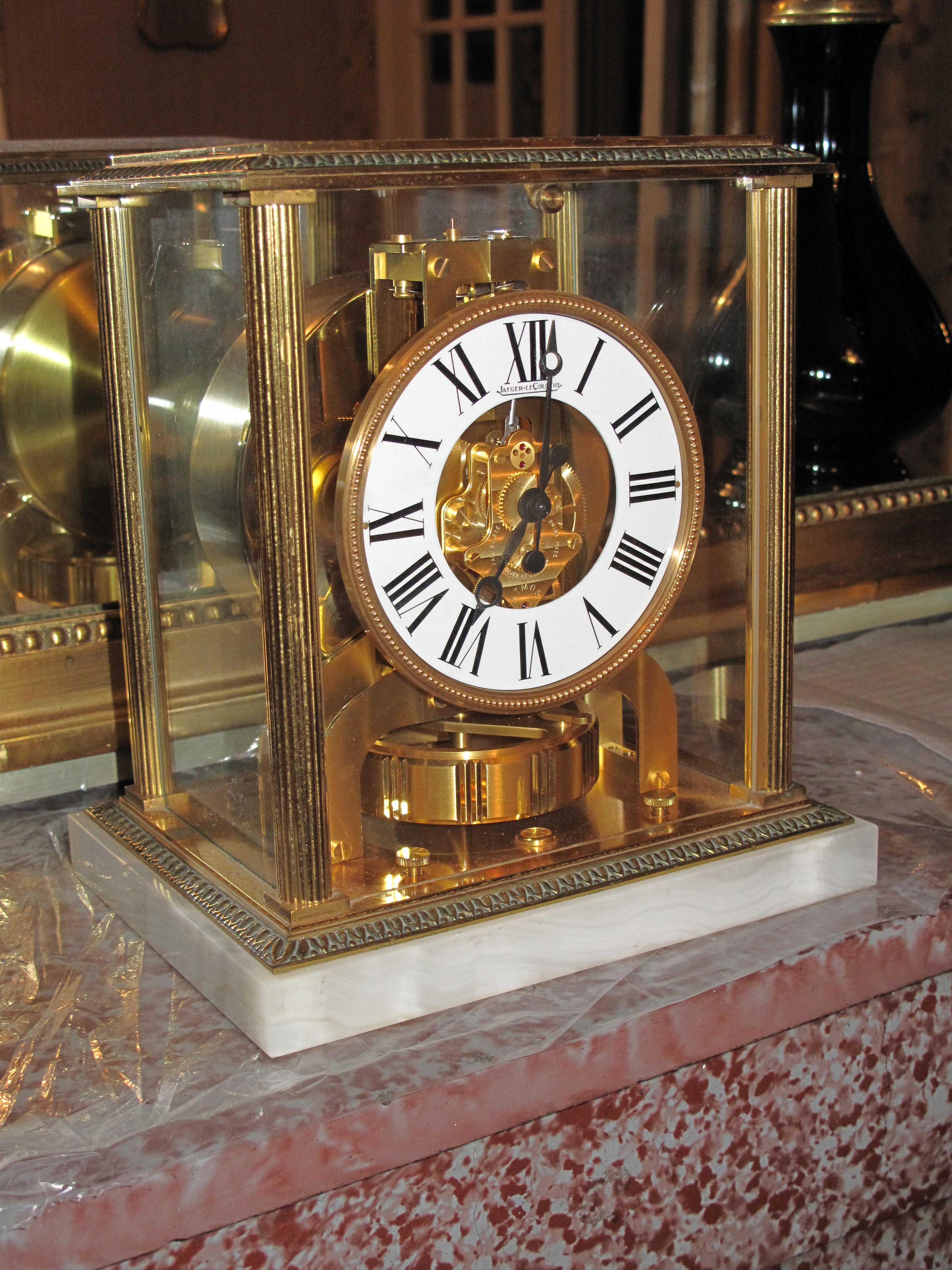
Figure 1. An Atmos clock, with dial, train and torsion pendulum visible through the case. Photograph by Tangopaso, unchanged. The file description dates the clock to around 1965. Wikimedia Commons, “Pendule Atmos.jpg” CC BY-SA 3.0

From prototype to product#
The 1927 prototype and its unveiling in 1928#
Reutter was born in Neuchâtel in 1899 and studied engineering at the Federal Institute of Technology in Zürich and in Paris. According to Living on Air by Jean Lebet, who helped run LeCoultre’s factory, Reutter had investigated winding clocks through atmospheric changes since childhood and got his first prototype running on 11 September 1927. It appeared in the January 1928 Journal suisse d’horlogerie and was reported in newspapers in several countries. The manufacturer dates the beginnings to 1928, the year it became public. 23
The prototype later known as Atmos 0 used a glass bell enclosing air and an aneroid capsule connected to the outside air. The difference in pressure moved the capsule, whose motion wound the clock through a lever and pawl. British publication GB280536A, which claims priority from a French application of 15 November 1926, describes the vessel, bellows, valve and ratchet and a torsion pendulum to reduce energy use. 24
The mercury-driven Atmos I#
The next version, Atmos I, had a separate temperature-responsive power unit. On 1 June 1929 Reutter signed a licence agreement with Gaiffe-Gallot et Pilon and headed its clock division. The associated Compagnie générale de radiologie (CGR) began manufacture and sales in 1930. 2
The principle is detailed in US1885479, granted in the United States on 1 November 1932 and citing a French filing of 28 November 1928. A U-tube holds mercury and liquefied gas in equilibrium with saturated vapour. One arm contacts an insulated part with high thermal capacity, while the other follows ambient temperature quickly. Changes in room temperature create a difference in temperature and vapour pressure between the two sides and move the mercury. The shift in centre of mass tilts the assembly and a pawl and ratchet transmit that motion to the winding mechanism. The patent gives ammonia as one example of a working fluid. 5
Early movements were made in Cluses, France, but they were difficult to keep running on little power. Lebet dates LeCoultre’s design of an interchangeable new movement to September 1932 and the supply of calibre 30A to CGR from summer 1933. Refining the bearings, pivots, tooth profiles and working range of the mainspring helped turn the winding invention into an everyday clock. 2
The Atmos II and series production#
On 27 July 1935 CGR agreed to transfer its contract with Reutter to Jaeger. The Banco de España collection entry also treats this date as a milestone in the takeover of production by what became Jaeger-LeCoultre. Lebet describes sales of remaining parts and stock, development of a new version and renewal of contracts proceeding in parallel. 26
Atmos II replaced the mercury-powered unit with a sealed device using the liquid and gas phases of chloroethane, or ethyl chloride. The company’s history dates Atmos II to 1938. Lebet records that the first 25 were delivered to Reutter for testing on 28 March 1938 and that full production began towards the end of the first half of 1939. Case manufacture and preventing leaks in the sealed unit had to be addressed between testing and series production. 23
Metal bellows manufacture improved after the war. Lebet says that in 1946 BOA in Lucerne could supply thin stainless-steel bellows, letting the capsule and the rest of the drive be produced separately and making them easier to manufacture and finish. Further process improvements secured the seal. Long-term automatic operation depended on controlling materials, joints and friction as well as using a gas. 2
Turning temperature changes into clock power#
The sealed capsule, spring and winding#
In later Atmos clocks, the proportions of liquid and gaseous chloroethane change with temperature in a sealed capsule at the back. Changes in pressure expand and contract a bellows and transmit force to a spring. This reciprocation winds the mainspring. The mainspring drives the train, and the escapement delivers small impulses to the pendulum. 67
In Lebet’s diagram of Atmos II, capsule motion loads an auxiliary spring. As that spring unwinds, a chain, pulley, pawl and ratchet wind the mainspring. Winding stops when the torque balances the mainspring’s, and can resume as the clock runs and the mainspring torque drops. This stores limited energy while keeping variations in driving torque small. 2
Jaeger-LeCoultre says a change of about 1 °C supplies enough energy to run for about 48 hours. Continued fluctuations in room temperature sustain automatic operation. The clock converts energy from those thermal changes into stored mechanical energy and motion. 37
A regulator with a one-minute period#
The large annular pendulum hangs from a fine metal ribbon, turning one way and then the other as the ribbon twists and untwists. The torsion pendulum and escapement regulate the advance of the train. The restoring torque comes from twisting the ribbon, in place of gravity acting on a long swinging pendulum. 26
The official specification for the Classic Q5102201 gives 120 vibrations per hour. The manufacturer counts two vibrations per complete oscillation. It makes 60 complete oscillations per hour, with a period of 60 seconds. This low frequency and very small friction losses let the clock run on the little power it gets from temperature changes. 8
The Atmos I suspension ribbon in Lebet’s account was Elinvar and measured 0.19 × 0.06 mm in cross section. It bears the pendulum’s weight and regulates its period, making material stability, attachment and length adjustment important. A device to lock the pendulum during transport was also an early design requirement. 2
Installation and servicing#
The manufacturer directs owners to place the clock on a stable, level surface free of vibration and shocks. Use the locking device to secure the suspended pendulum during transport or time setting. Set the time by moving the minute hand forwards. Follow the manual for the particular model. 9
The manufacturer recommends a complete service if accuracy changes significantly. The interval depends on humidity, airborne impurities and the stability of the installation. Long-term use requires automatic winding and maintenance of the movement’s condition. 9
Cases and model development#
The glazed form and post-war models#
Atmos I cases ranged from classical wood to modern metal and glass. Lebet found 19 models in the January 1931 catalogue and 24 in January 1934. Glass panels that reveal the mechanism have been a recurring feature since the early years. 2
Post-war designs included Atmos III, IV and V. Production of calibre 526 for the Atmos V was streamlined in 1955 to meet a large US order. The 500,000th clock left the factory in 1979. That year’s Jubilé was an edition of 1,500 with calibre 550, updating the appearance of the K2 of 1931. 2
Banco de España object R_88 documents an individual example. The catalogue dates it to the second half of the twentieth century and records Swiss manufacture, bronze, brass, metal and glass, casting and gilding, and dimensions of 23 × 18 × 14 cm. Its gold-coloured frame and white enamel dial are part of a table clock that shows its mechanism through glass. 6
Calibre 540 and astronomical displays#
Development of calibre 540 in 1982 involved an extensive redesign, with changes to the power unit and joining techniques. According to Lebet, the train was designed so the barrel’s rotation period would match the lunar phases and allow a moon-phase display later. Matching a slow display to the movement’s rotation made good use of the limited power. 2
Jaeger-LeCoultre’s 2026 retrospective presents the 540 as a basis for complications, linking it to the late 1990s moon-phase display and the Atmos Tellurium, calibre 590, in 2022. The tellurium depicts cycles of the Earth, Moon and Sun in a three-dimensional mechanical model. 10
The Classic Q5102201 pairs a rhodium-plated brass case with a white lacquered dial and Roman numerals. The official specifications give 200 × 155 × 225 mm, calibre 560, 207 components, 15 jewels, one barrel and an hours and minutes display. Individual references and calibres identify specifications within the series. 8
Marc Newson and the 2026 models#
Collaboration with Marc Newson produced the 561 in 2008, the 566 in 2010 and the 568 in 2016. The rounded Baccarat crystal case of the 568 supports the movement and makes it appear suspended in air. 711
A new interpretation of the 568 announced in April 2026 adds sunrise, sunset and equation of time to the month and high-precision moon-phase displays. The equation of time is the difference between mean and apparent solar time. The sunrise and sunset displays are offered in versions for latitudes of 30°, 40° and 50°. The theoretical gearing error given by the manufacturer for the moon phase is one day in 4,087 years. 7
Newson also designed a new case for the tellurium that year. The designer’s account says the spherical glass is engraved with 64 constellations visible from the Northern Hemisphere, with 539 sapphires marking the main stars. Limited to three, it brings temperature-driven winding to a three-dimensional piece showing the relationship between Earth, Moon and Sun. 12
The Atmos integrates a power unit using temperature fluctuations, a regulator that uses little energy and a case that shows the mechanism. From that arrangement came changes in industrial production, decorative cases and astronomical displays. 210
Chronology#
| Date | Event |
|---|---|
| November 1926 | French application for Reutter’s automatic winding device, the priority of GB280536A. 4 |
| September 1927 | The first prototype runs, according to Lebet. 2 |
| January 1928 | The prototype appears in a horological journal. 2 |
| November 1928 | French application for the mercury winding mechanism corresponding to US1885479. 5 |
| June 1929 | Reutter signs a licence agreement with Gaiffe-Gallot et Pilon. 2 |
| 1930 | Production and sale of Atmos I begin. 23 |
| September 1932–summer 1933 | LeCoultre designs the 30A and supplies it to CGR. 2 |
| July 1935 | CGR agrees to transfer the contract to Jaeger. 26 |
| 1938–1939 | Gas-driven Atmos II goes from tests into full production. 23 |
| From 1946 | Improvements to stainless-steel bellows and sealing. 2 |
| 1955 | Streamlined series production for Atmos V calibre 526. 2 |
| 1979 | The 500,000th clock is made and 1,500 Jubilé commemorative models are produced. 2 |
| 1982 | Development of calibre 540 revises the construction. 210 |
| Late 1990s | Moon-phase display follows, according to the manufacturer’s retrospective. 10 |
| 2008, 2010 and 2016 | The 561, 566 and 568 with Newson. 7 |
| 2022 | Tellurium with calibre 590. 10 |
| April 2026 | New interpretation of the 568 and other designs announced in Milan. 710 |
References#
Online sources accessed on 13 November 2026.
- Jaeger-LeCoultre, Atmos collection. Current range and overview of power and cases.
- Jean Lebet, Living on Air: History of the Atmos Clock, Jaeger-LeCoultre, 1997, pp. 24–57, early history, mechanisms and industrialisation. The author worked at the factory and used records of the Reutter family and LeCoultre. PDF hosted by Rutgers University.
- Jaeger-LeCoultre, The History of Atmos Luxury Clocks. Official chronology and production overview.
- Jean Léon Reutter, GB280536A, Improvements in or relating to automatically re-winding clocks, published 22 March 1928. Abstract and bibliographic data.
- Jean Léon Reutter, US1885479A, Device for automatically re-winding clocks or other mechanisms by the variations of the atmospheric temperature, 1 November 1932. Text, Figs. 1–5 and French filing date.
- Amelia Aranda Huete and Colección Banco de España, Reloj de sobremesa, Cat. R_88. Object and mechanism. Related publication, La tiranía de Cronos, 2024, pp. 134–135.
- Jaeger-LeCoultre, Introducing Atmos Designer 568 by Marc Newson, 20 April 2026. Mechanism, displays and materials.
- Jaeger-LeCoultre, Atmos Collection Classic, Q5102201. Listed reference, calibre 560, frequency, dimensions and materials.
- Jaeger-LeCoultre, Atmos Luxury Clocks Customer Care. Installation, transport, setting and complete service.
- Jaeger-LeCoultre, Introducing the Perpetual Timekeeper, 21 April 2026. Chapters I–III, recent developments and exhibition overview.
- Jaeger-LeCoultre, Atmos Designer 568 by Marc Newson, Q516510J. Crystal case and reference.
- Marc Newson Ltd, Atmos Tellurium, 2026. Designer’s production record, materials and edition size.