This article was translated from Japanese using AI. Read the Japanese original
Breguet No. 1135 is a gold pocket watch 42 mm in diameter made in Abraham-Louis Breguet’s workshop from 1802 to 1806. Commissioned by the Spanish Duke of the Infantado, it combines a quarter repeater, which sounds the time at fifteen-minute resolution, with an early natural escapement using two escape wheels. Workshop records and the surviving movement show how Breguet put the new escapement into a small portable watch. 1 2
No. 1135 is the serial number of the individual watch. The case has a separate number, 1945. The buyer’s official announcement confirms that Breguet acquired it again in 2014 for its historical collection. 1 2
Four years of work on one watch#
The Duke’s order and the workshop’s experiments#
The customer was Pedro Alcántara de Toledo y Salm-Salm (1768–1841), 13th Duke of the Infantado. The records cited by Christie’s date the order to March 1802 and dispatch to January 1806. Those nearly four years included making and improving the new escapement as well as work on the case and dial. 1
Charles Bernaudat, who made the escapement, reportedly delivered the first escapement in March 1803 and made further changes in April 1804 and in September and December 1805. The auction essay gives approximately 1,900 francs as the total paid for work connected with the escapement, including about 300 francs for repassage, or finishing and overall adjustment. The estimates involve interpretation of the workshop records and cover more than the cost of the escapement components. 1
The sale price is recorded as 4,200 francs. The accounts differ over the dates in January 1806. The auction heading gives the 13th as the sale date, the provenance gives the 12th for dispatch, and the essay and official press release give the 16th for delivery. Dispatch, sale and delivery can be different events. The original records would be needed to reconcile the dates. 1 3
What was Breguet trying to solve?#
An escapement releases the train in regular steps and returns small amounts of energy to the oscillating balance. This replenishment is called impulse. A conventional lever escapement transfers impulse through a lever in each direction of the swing. A detent escapement gives direct impulse from the escape wheel to the balance once per full oscillation. 4
Breguet sought to combine the reduced sliding of direct impulse with impulse in both directions. The auction essay explains that he tried to reduce the susceptibility of pocket chronometers to stopping when moved about while retaining the advantage of direct impulse. The design aim and the mechanism actually fitted to No. 1135 show different parts of the experiment. 1 4
Two escape wheels on a removable platform#
Delivering impulse in both directions#
In No. 1135 the fourth wheel drives a brass escape wheel, which drives the second, steel escape wheel through coupling gears. Between them a detent rocks on its pivot and locks the wheels alternately by pins projecting above their rims. Each wheel gives impulse in one direction of the balance’s swing, providing direct impulse in both directions. 1
The gearing couples the two wheels so they move together in opposite directions. They share a drive rather than having separate trains. Derek Pratt discusses two general drawbacks of this design family, the inertia of the parts that have to start moving and the slight variation in the driven wheel’s position caused by backlash. Smooth meshing needs some clearance, while consistent impulse needs the position to repeat. 4
The “natural” impulse aims to avoid substantial sliding on the impulse faces and reduce their dependence on oil. Other parts of the watch still have their own lubrication requirements. The auction essay also notes that the early construction differs in detail from familiar diagrams by Chamberlain and Daniels. General illustrations of the natural escapement do not necessarily depict No. 1135. 1 4
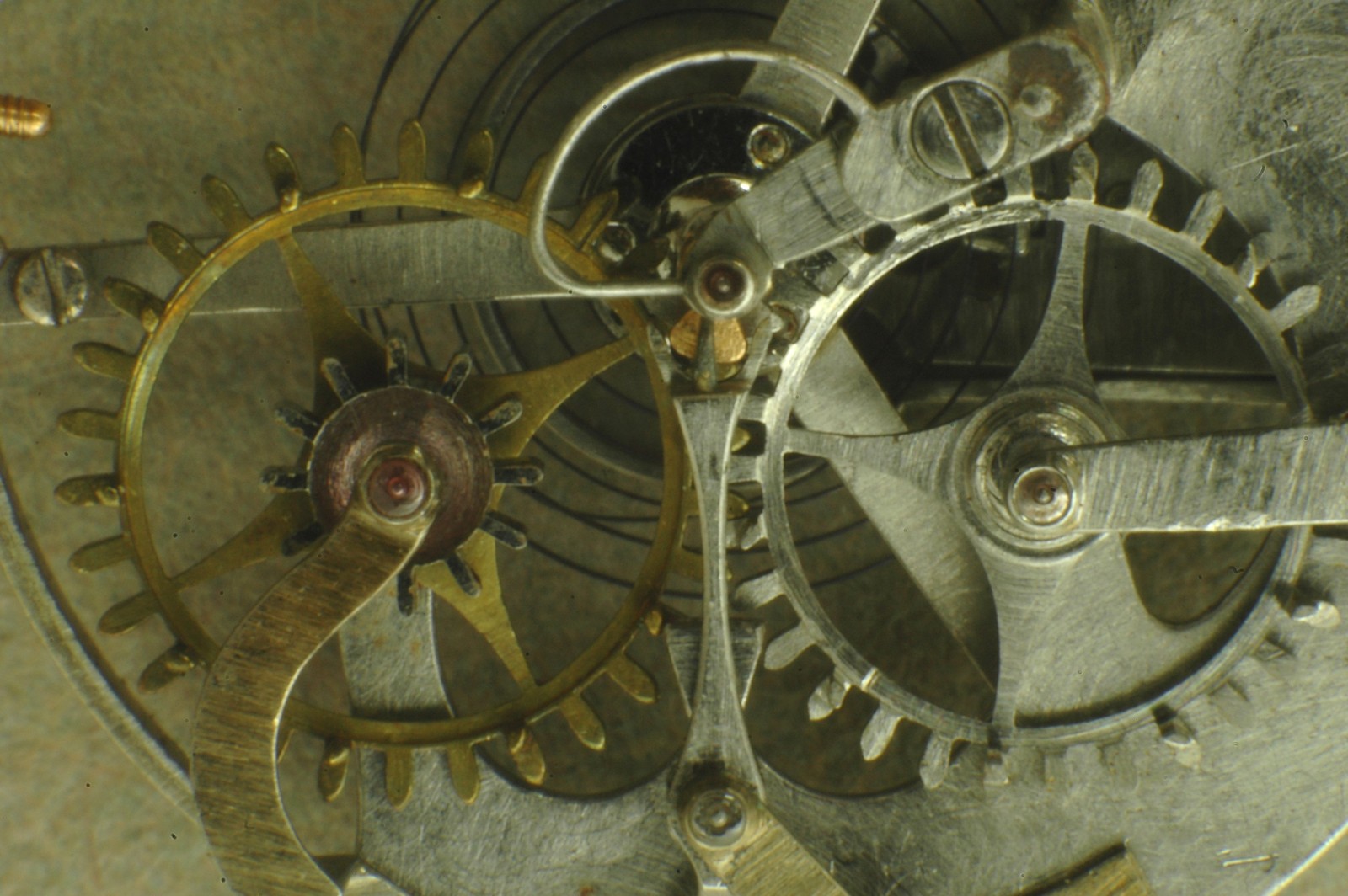
Figure 1. Back of the escapement platform of No. 1135. Photograph by Kjorford. Resized and recompressed as JPEG. The resized image is distributed under the same licence. Wikimedia Commons CC BY-SA 3.0

Removing the escapement and balance together#
The movement is gilt brass, with jewel bearings down to the centre wheel. The escape wheels, detent and balance sit on a separate removable platform so the escapement and its oscillator can be handled together. 1
The platform makes the complex parts easier to assemble separately and gives a way to adjust the depth of mesh between the train and escape wheel. Breguet later used a similar interchangeable arrangement in his twin-barrel marine chronometers. 1
The three-arm bimetallic compensation balance has gold and platinum screws and is paired with a blued-steel Breguet balance spring. The compensation limits changes in rate with temperature, and a pare-chute cushions shocks to the balance staff. The object description confirms these features but does not give a current daily error or long-term test results. 1
| Item | Documented configuration of No. 1135 |
|---|---|
| Display | Hours and minutes, with subsidiary seconds between 8 and 9 o’clock |
| Escapement | Two coupled escape wheels and a rocking detent |
| Regulator | Three-arm bimetallic compensation balance and Breguet balance spring |
| Escapement platform | Removable, carrying both escape wheels, the detent and balance |
| Striking | Quarter repeater with one hammer and gong |
| Case | 20-karat gold, case No. 1945, diameter 42 mm |
The specifications are from the 2014 catalogue. It gives no frequency, power reserve or measured rate, and figures for later watches cannot establish them for this one. 1
Sound, gold decoration and the display#
One hammer sounds the time#
A quarter repeater sounds the hours and fifteen-minute intervals on demand. The auction description gives a single hammer striking a gong and a pull-and-twist push-piece on the case band. Its resolution differs from a minute repeater, which can sound individual minutes. 1
The presence of a gong does not establish its tone, volume or decay time. Those properties also depend on its shape, attachment, interaction with the case and adjustment. No measurements of frequency or sound pressure for No. 1135 were confirmed for this article.
The original cover and the surviving case#
Pierre-Benjamin Tavernier made the case, dated 1802. The dial is visible today, but originally it was a hunter or savonnette with a front cover. According to the auction essay, the centre of the cover was later replaced with a crystal, making the display readable with the cover closed. The suggestion of a change around the 1830s is an estimate. 1
The back has concentric engine turning and a central “I” for the Duke. The pattern consists of rings made by engaging and withdrawing the tool at the surface, differing from ordinary barleycorn. The gold inner cover has related decoration and is held by two half-head screws. 1
The gold dial is also engine turned, with Roman hours on a smooth ring. Details include blued Breguet hands, off-centre subsidiary seconds and secret signatures on both sides of XII. The pendant and bow are at 3 o’clock, in line with the original hunter layout. 1
The inner cover refers to a “second detached escapement” by Breguet and to its invention in Year X of the French Republican calendar, from September 1801 to September 1802. This predates delivery in 1806. “Second” alone does not identify the watch as the second natural escapement made. The auction essay cites the lever escapement as a detached design Breguet had previously used. 1
Ownership and rediscovery#
It is unknown when the Duke parted with the watch. In December 1837, Madame de Montenoir of rue de Richelieu, Paris, took it to Breguet for cleaning and repair. The service entry leaves her relationship to the Duke and the transfer of ownership unconfirmed. 1
After a long gap in the record, a letter addressed to Lord Harris in Britain survives with a receipt stamp dated 29 August 1944. The 2014 lot came with a copy of that letter, extracts from the workshop books, copies of drawings and notes from Breguet’s notebook, and Breguet certificate No. 3824 dated 13 August 1984. The lot list documents the material that accompanied the watch. It does not establish direct inspection of every original document for this article. 1
Breguet acquired the watch at Christie’s in Geneva on 10 November 2014. The official results list lot 393, buyer “The Breguet Museum”, and CHF 605,000 including premium. Breguet’s own announcement reports CHF 500,000 and does not say whether it includes fees. As of the November 2026 check, the last confirmed location information is the announcement of its addition to the historical collection. No present permanent display location was confirmed. 1 2 5
Historical significance and open questions#
The auction research and buyer’s announcement identify No. 1135 as Breguet’s first watch made with a natural escapement. The years of revisions, high cost and removable platform show the difficulty of turning the experiment into a usable watch. 1 2
Daniels later drove the two escape wheels through separate trains, and Pratt also studied and made escapements with two independent wheels. The link with No. 1135 is the problem of reducing the impulse faces’ dependence on oil. The drive and locking mechanisms differ. 4
Some later Breguet watches combined the natural escapement with a tourbillon. The separate platform in No. 1135 lets the escapement and balance be removed together. It does not rotate as a tourbillon carriage. 1
Open questions include comparison of the delivery date with original records, when the cover was altered, the ownership sequence from 1837 into the twentieth century, recent conservation work and current measured performance. The surviving movement and records can be compared without filling those gaps by inference.
Chronology#
| Date | Event and scope of evidence |
|---|---|
| March 1802 | The Duke of the Infantado places the order. Exact day unconfirmed |
| 1802 | Tavernier makes gold case No. 1945 |
| March 1803 | Bernaudat delivers the first escapement |
| April 1804 | Escapement modified. Details include inference |
| September and December 1805 | Further changes to the escapement |
| January 1806 | Dispatch, sale and delivery to the Duke. The sources give the 12th, 13th and 16th |
| December 1837 | Madame de Montenoir brings the watch in for cleaning and repair |
| August 1944 | Letter to Lord Harris, with a receipt stamp dated the 29th |
| February 1983 | The 2014 consignor acquired the watch after its public appearance on the 4th, according to the auction material |
| August 1984 | Breguet certificate No. 3824 dated the 13th |
| March 2010 | Keith Orford’s study appears in Antiquarian Horology, as listed in its official index |
| November 2014 | Breguet acquires the watch at the Geneva auction on the 10th and announces it on the 12th |
| November 2026 | Public records checked. Permanent display and recent restoration are unconfirmed |
Manufacture and provenance are principally from 1, the 2014 acquisition from 2 5, comparison of delivery dates from 3 and the 2010 article from 6.
References#
- Christie’s, “Breguet No. 1135”, Important Watches, Geneva, 10 November 2014, lot 393. Object specifications, workshop records as reported, provenance and Lot Essay. Accessed 7 November 2026.
2. Swatch Group and Breguet, “Christie’s auctions: Breguet enriches its historical collection”, 12 November 2014. Buyer’s official announcement. Accessed 7 November 2026.
3. Christie’s, Important Watches, Geneva, 10 November 2014 — press release, 2014, pp. 4–5. Related to the auction catalogue and part of the same body of evidence. Accessed 7 November 2026.
4. Derek Pratt, “In Breguet’s Footsteps…”, Horological Journal, March 2009, pp. 106–109 with a Postscript. Principles and limitations, especially pp. 106–107, and the independent double-wheel escapement, p. 108. A general technical study rather than an object examination of No. 1135. Accessed 7 November 2026.
5. Christie’s, Important Watches — Geneva, 10 November 2014, Sale #1404, results, 2014, p. 1, lot 393. The result table identifies the buyer, price and inclusion of the premium. Accessed 7 November 2026.
6. Antiquarian Horological Society, List of articles published in Antiquarian Horology, Keith Orford, “A watch with Breguet’s échappement naturel”, vol. 32, no. 1, March 2010, starting on p. 52. The official index was checked. The original article and workshop manuscripts were not read for this account. Accessed 7 November 2026.