This article was translated from Japanese using AI. Read the Japanese original
Breguet No. 20–148 is a self-winding pocket watch purchased during the French Revolution by Antoine-César de Choiseul, Duke of Praslin. Its silver dial shows the state of wind and temperature side by side. When the watch is carried, a weight mounted at the edge of the movement swings and winds two mainsprings. The watch displays the date and day of the week and sounds the time when the pendant is pressed. The edge of the movement is signed “Breguet à Paris No. 148.” The L. A. Mayer Museum for Islamic Art in Jerusalem identifies it as WA 104-71. 1 2
The two watches numbered 148 and the Duke of Praslin#
The silver-dial watch numbered 148 appears as entry 6 in David Lionel Salomons’s 1921 catalogue, with certificate no. 2508. The catalogue records a sale in December 1792 for 4,000 francs. Sotheby’s advance announcement in 2020 also gave December 1792, but the individual lot entry cites a Breguet certificate dated 20 August 2020 and gives the sale date as 20 December 1791. The buyer and price agree. 1 2 3
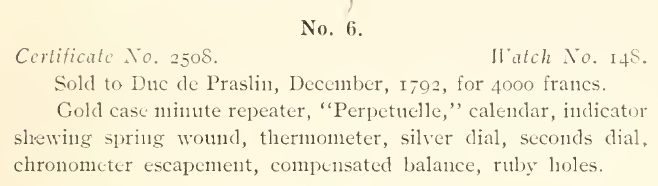
Figure 1. Entry 6 of the catalogue, describing the silver-dial no. 148. Author: David Lionel Salomons. Source: scan of the original on Wikimedia Commons, p. 32. Rights: Public domain. The entry was cropped and converted to JPEG.
Entry 91 in the supplement to the same catalogue also lists a watch numbered 148. That watch, with certificate no. 2348, has an enamel dial, independent central seconds with a stop mechanism, and a “P” at the centre of the case back. It belonged to Edward Blyth when the catalogue was published. Entry 91 likewise lists 20 December 1791, the Duke of Praslin and 4,000 francs, so the date of sale alone cannot identify which watch is which. The illustration and certificate number together allow the watch with the silver dial, calendar and thermometer to be traced. 1 2
The Duke of Praslin supported Breguet by purchasing watches and helping to finance the workshop. According to Sotheby’s 2025 entry for No. 1052, when Breguet’s partnership with his investor Xavier Gide ended in 1791, the duke provided money for the settlement and later helped Breguet re-establish his Paris business in 1795. Other pieces acquired by the same customer include Breguet No. 92 (article in Japanese), which has dials on both sides. 2 4
The weight winds and the balance keeps time#
Breguet called his self-winding pocket watches perpétuelles. As the case moves, for instance when the wearer walks, a weight pivoted at the edge of the movement swings back and forth in an arc. The weight in No. 20–148 uses gold and platinum and winds the mainsprings in two barrels. Thin buffer springs at both ends of its travel cushion the impact when the weight reaches them. Breguet’s official chronology says watches of this design acquired a reputation among royalty and nobility in the 1780s. 2 5
The barrels deliver their stored energy to the gear train, and the escapement advances the train at regular intervals while giving impulses to the oscillating balance. Sotheby’s records an Earnshaw-type spring-detent escapement and an Arnold-type temperature-compensated balance in this watch. The spring detent momentarily locks the escape wheel before releasing it in step with the balance. The compensating balance limits changes in rate with temperature. The thermometer on the dial displays the temperature itself. 1 2
The silver dial and striking mechanism#
A date scale surrounds the Roman-numeral chapter ring. The subdial at six o’clock combines the seconds and day-of-the-week indications. Nearer the centre are sector scales for the state of wind and temperature. According to Sotheby’s, the original enamel dial was replaced by the current engine-turned silver dial. The certificate cited in the 2020 catalogue states that the replacement displays the same indications as the original. The silver dial is also shown and described in the 1921 catalogue. 1 2
The gold case is 59 mm in diameter and its back is also engine-turned. The auction catalogue attributes the mark “AG” below a star to the casemaker Ami Gros and records case no. 2044. Pressing the pendant activates the minute repeater, which sounds the time on two gongs. A slide to the left of the pendant prevents it from being pressed. The catalogue explains that the compact striking mechanism left enough room on the dial side for the calendar and thermometer mechanisms. Salomons’s p. 123 shows the front of the dial beside a photograph of the movement with the dial removed. 1 2
From a British collection to Jerusalem#
According to the provenance in the 2020 Sotheby’s catalogue, the watch appeared at the auction of the Bentinck Hawkins collection in 1895, passed through Berkeley Sheffield’s hands and was sold by Louis Desoutter to Salomons in May 1920. A Breguet certificate dated 8 June 1906 bears Desoutter’s mark and an annotated collection number. The collection passed through Salomons’s daughter Vera Bryce Salomons to the L. A. Mayer Museum for Islamic Art in Jerusalem. The watch was scheduled for auction in London in October 2020, but the lot was withdrawn. 2 6
Chronology#
| Date | Event |
|---|---|
| 1780s | Breguet develops the weight-wound perpétuelle. 5 |
| 20 December 1791 or December 1792 | Date of the sale of No. 20–148 to the Duke of Praslin. The auction catalogue citing the 2020 certificate gives the former and Salomons’s 1921 catalogue gives the latter. 1 2 |
| 1895 | Listed as lot 493 at the auction of the Hawkins collection. 2 |
| June 1906 | Breguet issues the certificate later cited in the auction catalogue. 2 |
| May 1920 | Salomons acquires the watch from Desoutter. 2 |
| 1921 | Salomons’s catalogue includes entry 6 and an illustration. 1 |
| 1923 | According to Sotheby’s provenance, the watch appears at the exhibition marking the centenary of Breguet’s death at the Musée Galliera in Paris. 2 |
| October 2020 | Sotheby’s catalogue lists the watch under the Jerusalem museum’s inventory number WA 104-71. The lot is withdrawn. 2 3 |
References#
- David Lionel Salomons, Breguet (1747–1823), London, 1921, pp. 32, 123, 226. Accessed 21 November 2026.
- Sotheby’s, Important Watches, Lot 207, The Duc de Praslin No. 20–148, London, October 2020. Specifications, certificates, provenance and auction notice. Accessed 21 November 2026.
- Sotheby’s, Select Works from the L.A. Mayer Museum for Islamic Art’s Legendary Collection to be Offered at Sotheby’s London, September 2020, section on the Duke of Praslin’s perpétuelle. Accessed 21 November 2026.
- Sotheby’s, A Celebration of Breguet’s 250th Anniversary, No. 1052, 2025, section on the relationship between Breguet and the Duke of Praslin. Accessed 21 November 2026.
- Montres Breguet, Apparition des premières montres automatiques, official chronology, entry for 1780. Accessed 21 November 2026.
- The Museum for Islamic Art, Watches collection, collection provenance. Accessed 21 November 2026.