This article was translated from Japanese using AI. Read the Japanese original
Breguet No. 1150 is a mantel clock that keeps time with a steel tuning fork. Made in Paris in 1868, it is held by the Musée international d’horlogerie (MIH) in La Chaux-de-Fonds, Switzerland, under inventory number IV-337. Beneath the dial, two prongs extending inside a case glazed on four sides determine the clock’s rate. 1
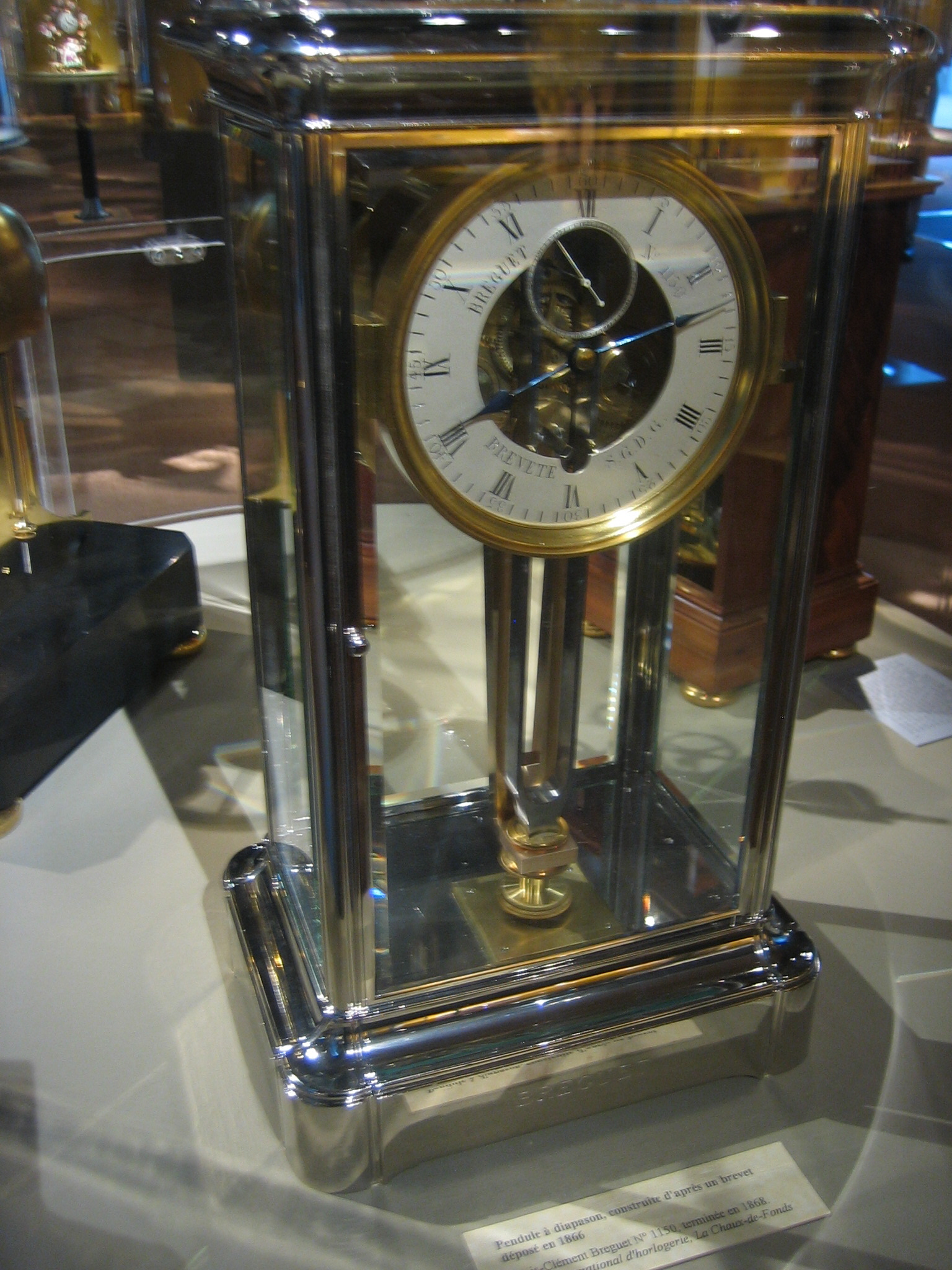
Breguet No. 1150 (1868, MIH collection, IV-337). Photograph by Horology. Source: Wikimedia Commons file description. Licence: CC BY-SA 3.0. Unmodified.

The regulating mechanism visible through the glass#
The nickel-plated brass case measures 46 × 26 × 19 cm. The ring dial has Roman hour numerals and Arabic numerals at five-minute intervals, with a small seconds hand at the top. The museum records the inscriptions “Breguet N°1150” and “Breveté SGDG” on the dial, “Breguet” on the case and “PK” at the base of the tuning fork. 1
Inside the clock are two barrels, a going train and an escapement. According to the museum, the regulating steel fork is 250 mm long and oscillates at 100 Hz, with one prong in contact with the escapement. The photograph shows the fork’s two prongs extending below the dial and joined at the bottom. 1
Sustaining and counting the oscillations#
If a tuning fork is struck once, its amplitude gradually diminishes. In this design, the gear train delivers repeated small impulses through the escapement to keep the tuning fork oscillating. The fork’s movement is fed back through the same escapement, determining the intervals at which the escape wheel advances. The train gears that motion down and transmits it to the hands, whose rotation indicates the time elapsed. 1 2
Georges Sire examined a mantel clock of this design at the 1867 Paris Universal Exposition. He wrote that its anchor escapement released one tooth of the escape wheel on each swing of the fork in either direction. At the same moment, the tooth pushed the anchor and gave the fork an impulse. The anchor locks and releases the escape wheel and provides the point of contact through which the train supplies energy to the fork. 3
Sire reported that the fork’s mounting on the exhibited clock could slide to adjust the depth of engagement with the escapement. Temperature affected that depth. In a trial with a fork making 512 single vibrations per second, considerable force was needed to overcome the inertia of the wheel as it repeatedly stopped and advanced. Escapement wear also increased. The ability of the train to follow the fork’s motion governed how fast the mechanism could run. 3
The clock’s 100 Hz and the single vibrations counted in experiments#
The 100 Hz specified by the MIH for No. 1150 means 100 complete cycles per second. In Alfred Niaudet-Breguet’s 1866 report, a “single vibration” means one swing in one direction. The roughly 100 single vibrations per second reported for his first prototype amount to about 50 Hz. The roughly 200 single vibrations per second in the next trial correspond to about 100 Hz. 1 2
Using Lissajous’s optical method, Niaudet compared the tuning fork connected to the clock with a second fork set vibrating by hand. After bringing the two into agreement, he reported that they stayed in agreement even when he doubled and tripled the weight driving the prototype. The experiment tested how much the frequency changed under different conditions of energy transfer from the escapement to the fork. 2
Presentation, manufacture and collection history#
The MIH identifies No. 1150’s mechanism as based on French patent no. 73414 in Louis-Clément Breguet’s name, filed in October 1866. At the Academy of Sciences meeting on 10 December that year, Niaudet reported on a prototype he had made and suggested its use for measuring short intervals and driving recording instruments at a steady speed. 1 2
The following year, the Paris Universal Exposition showed a mantel clock regulated by a tuning fork in class 64 of its machinery hall. According to the recollections of acoustical instrument maker Rudolph Koenig, a clock of the same design also appeared at the Vienna Universal Exposition of 1873. Koenig later used the mechanism in his own tuning-fork comparator. He determined a fork’s frequency by comparing the hand that counted its vibrations with a chronometer of known rate. 3 4
A later US patent for a mechanical tuning-fork resonator, US9134705B2, cites a photograph of No. 1150 as prior art and states that the MIH acquired this clock in 1967. The mechanism used to set a clock’s rate in the nineteenth century was thus cited in the development of a modern mechanical tuning-fork resonator. 5
Chronology#
| Date | Event |
|---|---|
| October 1866 | According to the MIH, Louis-Clément Breguet files French patent no. 73414. 1 |
| December 1866 | Niaudet-Breguet reports on his tuning-fork clock prototypes and experiments at a meeting of the Academy of Sciences. 2 |
| 1867 | A tuning-fork mantel clock is exhibited in the machinery hall of the Paris Universal Exposition. 3 |
| 1868 | No. 1150 is made in Paris. 1 |
| 1873 | A tuning-fork clock is also exhibited at the Vienna Universal Exposition, according to Koenig’s recollections. 4 |
| 1882 | Koenig describes a tuning-fork comparator based on the same principle in his book. 4 |
| 1967 | The MIH acquires No. 1150, according to the prior art section of the later US patent. 5 |
| 2015 | US patent US9134705B2 is issued, citing a photograph of No. 1150 as prior art. 5 |
| November 2026 | No. 1150 (IV-337) is verified in the MIH’s public collections catalogue. 1 |
Related articles#
- Alfred Niaudet-Breguet
- Louis-Clément Breguet (Japanese)
References#
- Musée international d’horlogerie, “Pendule à diapason”, 1868, inventory no. IV-337. Accessed 22 November 2026.
2. Alfred Niaudet-Breguet, “Application du diapason à l’horlogerie,” Comptes rendus hebdomadaires des séances de l’Académie des sciences, vol. 63, 10 December 1866, pp. 991–992. Original volume. Accessed 22 November 2026.
3. Georges Sire, L’horlogerie à l’Exposition universelle de 1867 à Paris, 1870 offprint, pp. 79–80. CNUM, 8K396. Accessed 22 November 2026.
4. Rudolph Koenig, Quelques expériences d’acoustique, 1882, pp. 173–175, fig. 47. Accessed 22 November 2026.
5. Tuning-fork resonator for mechanical clock movement, US9134705B2, 15 September 2015, prior art description and Non-Patent Citations. Accessed 22 November 2026.