This article was translated from Japanese using AI. Read the Japanese original
On 27 October 1789, when the Arnold clock in the transit room at Dunsink Observatory read 1 h 7 min 39.5 s, the Arnold in the study read 1 h 8 min 0.2 s. Henry Ussher, the observatory’s first astronomer, recorded the difference as 20.7 seconds. His comparison shows the two clocks ordered from London clockmaker John Arnold in use on the same day. 1
Both are weight-driven longcase pendulum clocks, intended for timing stars crossing the meridian. The surviving pair are Clocks A and B in Patrick A. Wayman’s 1972 report. They look alike, but A retains much of its eighteenth-century mechanism and B includes parts made in the twentieth century using A as a model. 1 2
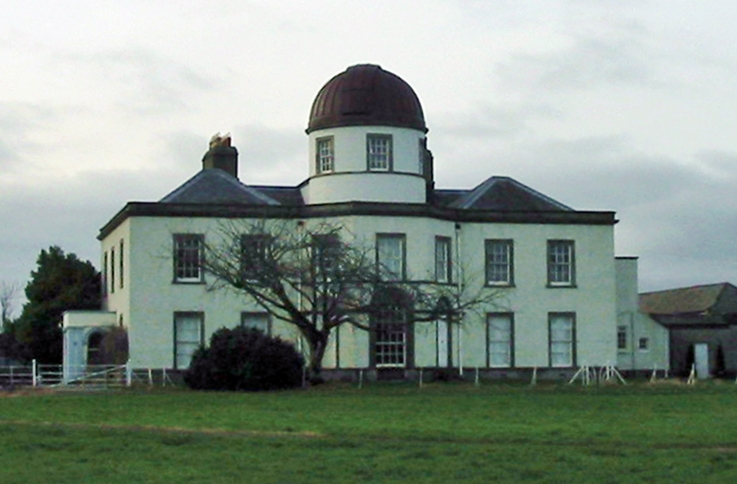
Figure 1. Main building of Dunsink Observatory, photographed on 22 December 2002 by David Malone (Dwmalone). Crop and brightness adjustment by Jaqian. No further changes for publication. Photograph and file history on Wikimedia Commons CC BY-SA 2.5

An order for a new observatory#
Trinity College Dublin opened Dunsink Observatory in 1785. According to Wayman, Ussher visited London in 1783, saw Greenwich Observatory and ordered instruments from Jesse Ramsden and two astronomical clocks from Arnold. In his description of the observatory presented to the Royal Irish Academy on 13 June 1785, he planned a pier with a base five feet square to give the clock stable support. The layout would let the transit instrument and vertical circle use the same clock. He lists the price of the clock as 80 guineas. 1 3
The words “& Son” are squeezed into the signature on Clock A’s dial. Wayman takes this as a clue that A was completed around 1787, when he dates the change to the name John Arnold & Son. Clock B’s signature was laid out to include “& Son” from the outset. The announcement, manufacture and installation are documented separately. The clocks first appear together in a firmly dated observation in October 1789 and both appear in an instrument inventory of 1790. The inventory also says one of the clocks was damaged in transit from London. 1 2
The two clocks’ displays and mechanisms#
| Item | Clock A | Clock B |
|---|---|---|
| Inventory identifier | DUN003 (1821) | DUN004 (1822) |
| Listed date of manufacture | 1787 | Late eighteenth century |
| Case height and maximum width | 1,906 mm and 450 mm | 1,915 mm and 455 mm |
| Time kept after twentieth-century restoration | Solar time | Sidereal time |
| Condition at restoration | Most of the mechanism survived | Missing parts were remade using A as a model |
Dating and dimensions are from Charles Mollan’s inventory of scientific instruments. The condition and operation of A and B come from Wayman’s restoration report. Both clocks have mahogany cases and silver-coloured dials with a large minute scale and a small seconds dial above. In A, an aperture shows the hour on a 24-hour ring. The minute hand turns around the main dial, the seconds hand sits above and the hour numeral is visible through the aperture. A’s square silvered dial measures 12 inches (about 305 mm) on each side. Its driving weight is 9.5 lb (about 4.3 kg) and the clock ran for about a month on a winding. 1 2
According to Allix’s examination, incorporated into Mollan’s inventory, six pillars separate A’s two plates and the train arbors run in brass holes or sapphire bearings depending on the arbor. Harrison maintaining power keeps driving the train during winding. If the clock stopped during each monthly winding, its time would have to be restored from another clock. The mechanism helps preserve the time used for observations. 2
Limiting changes in length with temperature#
Both temperature-compensated pendulums have five rods of steel and zinc. A has three steel and two zinc rods, and its pendulum bob has lead within a brass casing. As temperature rises, expansion of the steel tends to lower the bob and expansion of the zinc rods, arranged to act in the opposite direction, tends to raise it. The difference in thermal expansion reduces changes in the effective length from the suspension point to the bob. A has a rate-adjusting screw at the bottom of the pendulum. According to Wayman, one turn of the nut spans 28 divisions and each division changes the daily rate by about one second. 1 2
Limiting changes in period with amplitude#
Clock A’s deadbeat escapement has sapphire pallets. Wayman’s examination found that their cylindrical surfaces made nearly line contact with the escape-wheel teeth. The suspension spring was steel when examined, with adjustable cycloidal cheeks on either side. As the pendulum swings farther, the spring bends against the cheeks and its freely bending length decreases. The period of a pendulum swinging in a circular arc grows with amplitude, and the cheeks reduce its effective length to offset that change. 1
Wayman reports that observatory records from around 1832 give a semi-amplitude of about 1°40′ when the clock was well oiled, with variations of about ±2′ of arc. For a simple pendulum swinging in a circular arc, this variation corresponds to about ±0.2 seconds in daily rate. If poor lubrication lets the semi-amplitude fall to 1°15′, the calculated daily rate differs by about two seconds from the rate at 1°40′. Wayman considered the practical effect of the cheeks limited. They were difficult to position precisely and small variations in amplitude had little effect on the rate when the clock was running well. 1
Rate stability for astronomical observations#
To time a stellar transit, the observer reads the clock when a known star crosses the reference line in the telescope’s field. Even when weather interrupts observations for several days, an observer who knows how much time the clock gains or loses daily can estimate the change since the last observation. A sidereal day lasts about 23 h 56 min in mean solar time, so clocks set to sidereal time and clocks set to ordinary time based on the Sun divide the day differently. Ussher’s observing notebook refers to clocks by room, but Wayman could not establish how the original roles were assigned to the surviving A and B. 1 5 9
In records from May and June 1788 reproduced by Wayman, Ussher measured daily losses of 5.0–7.1 seconds for an Arnold clock. From July to August 1971, the restored A was compared with time signals. Daily rates calculated over three-day intervals ranged from a loss of 0.70 seconds to 0.00 seconds. The earlier records say “Arnold clock” and the later ones explicitly say “Clock A”, and the measurement intervals differ. Both show that observers using the clock as a reference recorded the difference between displayed times and how much that difference changed with time. 1
Repairs, replacements and return to Dunsink#
In the college history, director Robert S. Ball wrote that the board sent two clocks for repair to John Crosthwaite of Dublin in 1793 and was still asking for one back in 1816. Wayman reads the 1793 record as referring to one clock by Crosthwaite and one by Arnold, with one returned around 1809. Armagh Observatory also has a Crosthwaite mean-time clock that was used at Dunsink. A. G. Gunn, who studied its provenance, describes the early Crosthwaite clock as a substitute used while an Arnold clock was being repaired. 1 3 5 6
According to Wayman, in 1877 Dent No. 2032 took over as the sidereal reference and a clock by Booth of Dublin took over as the mean-time reference. Ball’s report that year describes the Booth clock controlling the harbour office clock by electric current. At mean noon Ball compared it with the astronomical clock, used the differences for that day and the previous day to estimate the next day’s difference, and adjusted small weights on a platform halfway down the Booth pendulum. In one experiment, adding 635 mg increased the rate by one second per day. 4
The retired Arnold clocks also carry traces of later adjustment. Attached to the inside of the door of the more original clock was a rate-adjustment note dated 15 September 1893, thought to be by assistant Arthur E. Lyster. 1 4
In the twentieth century both clocks were in the care of David S. Torrens, a professor of physiology at the college and a horological researcher. One stood in his study. The other was dismantled, and its case served as a workshop cupboard. After he died, Charles Allix directed the restoration, which Wayman dates to 1968–1969. Clock A served as the model for remaking B’s pendulum and scale, suspension supports and cheeks, the crutch linking escapement and pendulum, pallets and hands. Woodwork at the bottom of B’s case was also replaced. Both clocks returned to the observatory in working order in June 1971. Armagh Observatory’s public account also locates them at Dunsink. 1 7 8
Chronology#
| Date | Event |
|---|---|
| 1783 | Ussher visits London and meets Arnold. Wayman places the two orders after the visit. 1 |
| June 1785 | Ussher reports to the Royal Irish Academy on his plans for the observatory and the clocks. 1 |
| c. 1787 | Comparison of the signatures suggests the date of Clock A’s completion. 1 2 |
| May–June 1788 | Ussher records the rate of an Arnold clock. 1 |
| October 1789 | Comparison of the Arnold clocks in the transit room and study. 1 |
| 1790 | Both clocks appear in the instrument inventory. 1 |
| 1793 | The college sends two clocks to Crosthwaite for repair, one by Arnold and one by Crosthwaite according to Wayman. 1 3 |
| 1877 | The Dent and Booth clocks become the sidereal and mean-time references. 1 4 |
| September 1893 | Date on the rate-adjustment note inside the door of the more original clock. 1 |
| 1968–1969 | Allix directs restoration. Clock A serves as the model for B’s missing parts. 1 |
| June 1971 | Both clocks are reinstalled at Dunsink Observatory. 1 |
| November 2026 | Armagh Observatory’s public account was checked and locates both clocks at Dunsink. 8 |
References#
- P. A. Wayman, “Notes on the History of Dunsink Observatory III. The Arnold Clocks”, Irish Astronomical Journal, 10(8), December 1972, pp. 275–281 and Plate XIV. Scan at NASA ADS (accessed 2026-11-20).
2. Charles Mollan, Irish National Inventory of Historic Scientific Instruments, Dunsink Observatory, p. 63, DUN003 and DUN004. Scan from the Scientific Instrument Society (accessed 2026-11-20).
3. Robert S. Ball, “The Observatory, Dunsink”, The Book of Trinity College, Dublin, 1591–1891, 1892, pp. 131–145. Text at Project Gutenberg (accessed 2026-11-20).
4. Robert S. Ball, “Reports from the Observatory of Trinity College, Dublin. No. 1. On the Method of Regulating a Clock Intended to Show Correct Mean Time”, Proceedings of the Royal Irish Academy. Science, second series, vol. 3, pp. 66–68, presented 26 February 1877. Scan of the bound volume (PDF pp. 90–92) (accessed 2026-11-20).
5. A. G. Gunn, “Astronomical Clocks at Armagh Observatory”, Irish Astronomical Journal, 23(2), 1996, §§ 1 and 4. Scan at NASA ADS (accessed 2026-11-20).
6. Armagh Observatory and Planetarium, “Regulators”, Crossthwaite entry. Collection account (accessed 2026-11-20).
7. Linde Lunney and Deirdre Bryan, “Torrens, David Smyth”, Dictionary of Irish Biography, 2009. Entry (accessed 2026-11-20).
8. Armagh Observatory and Planetarium, “The Earnshaw Clocks”. Observatory account of its clocks (accessed 2026-11-20).
9. U.S. Naval Observatory, “Sidereal Time”, Sidereal Time section under Notes. Explanation of sidereal time (accessed 2026-11-20).