This article was translated from Japanese using AI. Read the Japanese original
The Cathedral of Santa Maria del Fiore in Florence has a 24-hour clock whose single hand moves anticlockwise and marks the end of the day at sunset. It is known as Paolo Uccello’s clock because he painted the dial in 1443. The cathedral authority identifies Angelo di Niccolò as the maker of the first mechanism and dates the surviving mechanism to 1761, by Giuseppe Borgiacchi. The painting, the movement and the time system each have a history of their own. 1 2 3
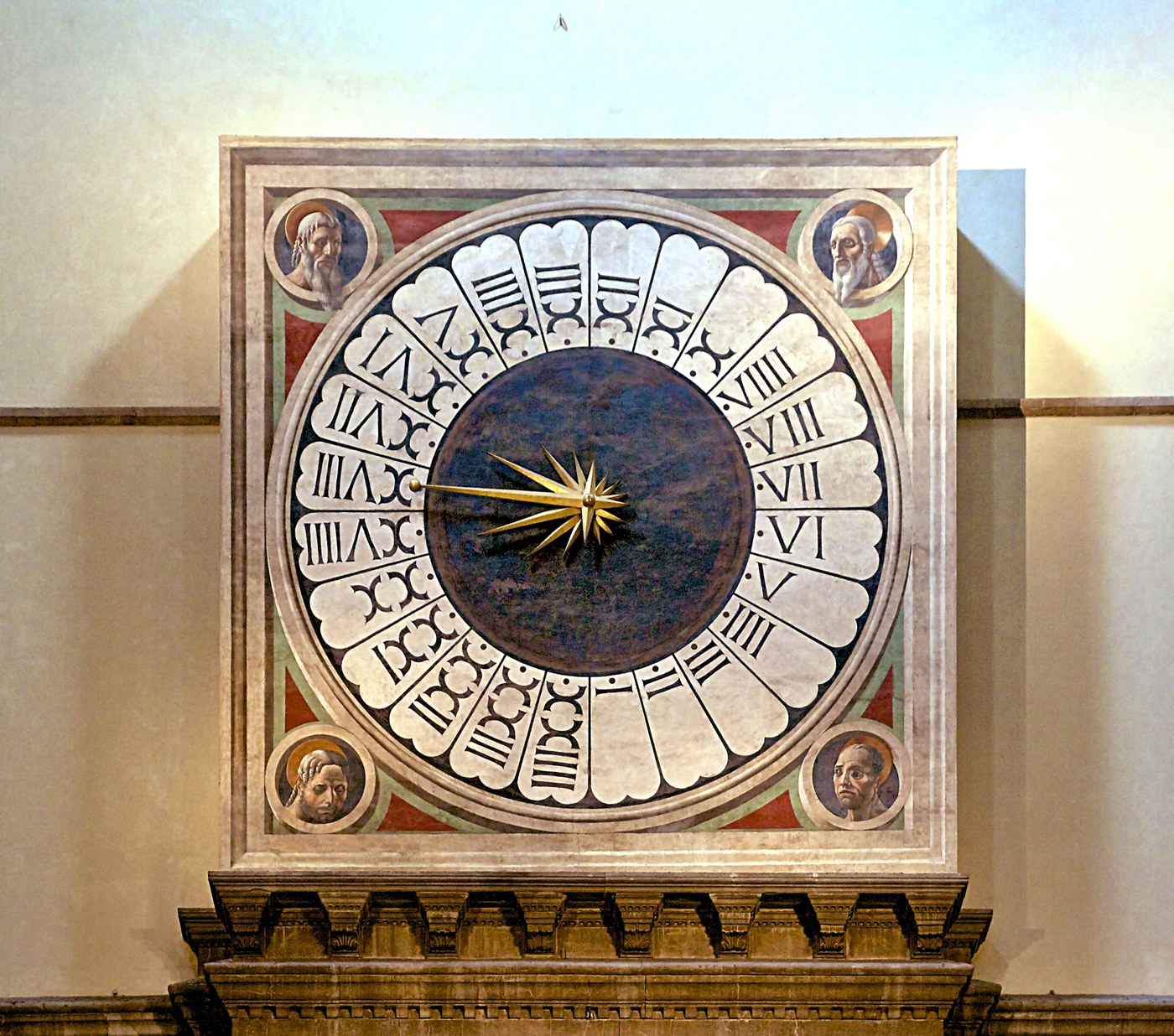
The full dial. XXIIII at the bottom marks the end of the day. Painting by Paolo Uccello (1443). Photograph by Jebulon, 4 June 2011. Source Wikimedia Commons file. Photograph under CC0 1.0. The painting is out of copyright, as Uccello died in 1475. Resized and recompressed as a JPEG only.

The wall painting and the mechanism#
The clock is high on the interior wall above the main entrance, visible when you turn back towards the doors. The movement is housed between that wall and the outer façade and drives the hand from behind the dial. The official entry lists plaster, pigment, bronze and gold, and records fresco painting, casting and gilding among the techniques. The present clock is the result of work on the wall painting and on the mechanism. 1 2
Uccello’s work can be dated from records as well as later biographies. Italy’s national cultural heritage catalogue cites payments identified by Giovanni Poggi, 40 lire on 22 February 1443 and 10 lire on 2 April. The catalogue reports the records without reproducing the original accounts. Some descriptions give 1433, while the cathedral authority and national catalogue agree on 1443, the date used here. 2 4
The composition frames a circular hour scale within a square and places a head in each corner. The scale is legible from the floor, and the heads are painted to suggest three-dimensional form. They have been read as Evangelists or prophets and lack the symbols ordinarily used to identify them. Their identities remain uncertain, as the question mark in the national catalogue indicates. 4 5
The published dimensions vary. The cathedral’s official object page gives a height and width of 670 cm. Its detailed catalogue likewise describes a square 6.70 m on each side, about 44.9 m² in all, with an hour circle 5.87 m across. The dimensions field in that same record also gives 470 cm. The overall size here follows the object page, as the measurement ranges represented by the figures have yet to be reconciled. 1 2
Reading the 24th hour at sunset#
An anticlockwise day#
The dial marks 24 hours in Roman numerals, and its hand makes one revolution a day. XII is at the top and XXIIII at the bottom, with the numbers increasing anticlockwise. This system is called ora italica. Hour 24 falls at sunset and the hours of the new day are counted from then. The XXIIII mark therefore corresponds to sunset in this system, while midnight is the boundary on modern civil clocks. 3 5
Suppose the hand is set for a day on which sunset occurs at 18:00 by a modern clock. One hour before sunset it would point to XXIII, and one hour afterwards to I. This example illustrates the dial’s reading without giving a sunset time for a specific date in Florence. The direction of rotation and the position of sunset on the dial are separate aspects of reading it. 5
Adjustment through the seasons#
Because sunset shifts with the season, the number shown at the same modern time changes through the year. The authority says the clock is adjusted year-round so the last hour falls at sunset. Its 2014 account says the keeper winds and sets it weekly. The timing of sunset is applied by the keeper. 3 5
Setting the time maintains that relationship with local sunset, in addition to correcting any change in rate. The mechanism moves the hand, while the keeper adjusts the indication to the local sunset. The 2014 account describes that adjustment on a weekly schedule. 3
How the eighteenth-century mechanism works#
Power and regulation#
According to the official accounts, the original movement was repaired repeatedly, replaced by a pendulum movement in 1688 and replaced again by the current mechanism in 1761. Details of the fifteenth-century movement are uncertain. The cathedral authority suggests that it was weight-driven. The surviving movement gives no basis for reconstructing the first escapement or its tooth counts. 3 6
A weight powers the surviving movement. Winding raises the weight and stores potential energy. As it descends, it turns the gears. The pendulum provides the period and an anchor escapement meters the train’s advance. Jack Forster, who visited the movement chamber in 2016, documented the stone weight, large winding crank, iron frame, pendulum and the fork, or crutch, that transmits its motion, and the shaft leading to the hand. His photographs show how the gears link the power supply and display and how the pendulum and escapement control the advance. 7
A small dial on the movement side lets the keeper check and set the position of the large hand on the other side of the wall. The public reads the main dial while winding and adjustment take place inside the wall. This small setting dial plays a role in maintaining the much larger clock. 7
Forster suggests that the escapement appears to be a deadbeat design, an identification based on his observations. The type has yet to be confirmed through a teardown report. The public sources consulted provide no reliable specification for pendulum length, tooth counts, weight mass or running accuracy. 7
Repairs and alterations to the same clock#
The della Volpaia family helped repair the original movement. The official account names Lorenzo and then his son Camillo, and reports a major rebuilding in 1546–1547. Later work included introducing a pendulum, replacing the movement, overpainting the dial and restoring the time system. Repairs allowed the clock to continue serving the same purpose in the cathedral as its parts changed. 3 6
Restoring the dial#
Different dates for conversion to twelve hours#
The cathedral’s detailed catalogue says Angiolo Gori repainted the dial in 1669 and converted it to a clockwise, twelve-hour display. It records further overpainting in 1761. The official 2014 account associates the twelve-hour conversion with the 1761 replacement of the movement. The cathedral authority’s accounts thus place the change at different stages. Both document changes to the appearance seen today. 2 3
The detailed catalogue dates the wall-painting restoration to 1963–1968. Examination beneath the overpainting found a green layer below the blue background. The same catalogue says the present star-shaped hand was reconstructed during this restoration using written sources and other works by Uccello. The hand belongs to that reconstruction. 1 2
The official account from 2019 dates restoration of the time system to the 1970s. Establishing how that relates to the years given for the painting would require comparing detailed work records. 6
Restoration of the mechanism in 2014#
Under the Opera di Santa Maria del Fiore, Andrea Palmieri and Ugo Pancani of the clock conservation research centre at Florence’s I.S.I.S. Leonardo da Vinci restored the mechanism in 2014. Officine Panerai provided financial support. The official 2019 account records completion in October 2014. The makers of the movement, the restorers and the sponsor had distinct roles. 6
The clock combines a Renaissance painted time display with a later mechanism and the keeper’s adjustments to sunset. Conservation of a work of art and maintenance of a functioning machine meet in the same object. The official catalogue listed it as a work inside the cathedral when checked on 6 November 2026. 1 2
Timeline#
| Date | Event and scope of the evidence |
|---|---|
| February and April 1443 | Payments to Uccello are reported in the national cultural heritage catalogue. The dial dates to 1443. 4 |
| 1443 | The official account attributes the original mechanism to Angelo di Niccolò. Its detailed construction remains uncertain. 3 |
| 1497 | The official 2019 account records repair and alterations. 6 |
| 1546–1547 | Major rebuilding by Camillo della Volpaia. 3 |
| 1669 | Gori repaints the dial. The detailed catalogue places the conversion to a clockwise, twelve-hour display here. 2 |
| 1688 | The movement is replaced by one with a pendulum. 3 |
| 1761 | Borgiacchi replaces the movement. Official accounts give different dates for the twelve-hour conversion. 2 3 |
| 1963–1968 | Wall-painting restoration. The detailed catalogue dates reconstruction of the star-shaped hand to this period. 2 |
| 1970s | The official 2019 account gives this period for the restoration of the original time system. 6 |
| 2014 | Palmieri and Pancani restore the mechanism with Panerai’s support. 6 |
| May 2016 | Forster’s account of his visit to the movement chamber appears. 7 |
| November 2026 | The official object page and catalogue entries are present. Operation and visitor access are separate questions. 1 2 |
Sources for the clock’s history#
The references to payments and early repairs follow the accounts of the cathedral authority and national cultural heritage catalogue. Brunelleschi’s possible involvement is among the interpretations discussed by the official catalogue. 2 6 7
References#
- Opera di Santa Maria del Fiore, Paolo Uccello, Monumental clock. Location, materials, techniques, dimensions and reconstruction of the hand. Accessed 6 November 2026.
2. Opera di Santa Maria del Fiore, Quadrante di orologio, detailed catalogue entry corresponding to national listing 0900289644, “Descrizione”, “Notizie storico critiche”, “Restauri” and other sections. Accessed 6 November 2026.
3. Opera di Santa Maria del Fiore, L’orologio del Duomo: un’opera d’arte che segna l’Ora Italica, displayed publication date 22 May 2014. The present page also mentions completion of the restoration in October that year. Accessed 6 November 2026.
4. Ministero della Cultura, teste di profeti (?) entro clipei / mostra d’orologio, catalogue no. 0900289644, compiled in 1989 and updated in 2006. Accessed 6 November 2026.
5. Opera di Santa Maria del Fiore, Paolo Uccello e il suo orologio… Controcorrente!, 16 October 2013. The time system and uncertainty over the figures’ identities. Accessed 6 November 2026.
6. Opera di Santa Maria del Fiore, Cosa rende speciale l’Orologio del Duomo di Firenze, 4 March 2019. Repair history, restoration of the original display and the 2014 restoration. Accessed 6 November 2026.
7. Jack Forster, Inside The Walls Of The Duomo: A Visit To The Great Clock Of Paolo Uccello In Florence, Restored By Officine Panerai, Hodinkee, 26 May 2016. Firsthand observations and photographs in the movement chamber. Its date of 1433 for the dial differs from the official catalogue, and the escapement subtype is the author’s inference. Accessed 6 November 2026.