This article was translated from Japanese using AI. Read the Japanese original
Carrying a reference time across the sea#
John Harrison’s H4 is a large portable timekeeper designed to keep the time of the port of departure during a voyage. It is held by the National Maritime Museum in Greenwich under object number ZAA0037. Work began in 1755, and the museum dates its completion to 1759. It was tested on the 1761 voyage to Jamaica and the 1764 voyage to Barbados. The Board of Longitude accepted that the results of the second voyage met the strictest accuracy condition in the Longitude Act of 1714. 1 2 3
If Earth is taken to rotate 360° in 24 hours of mean solar time, a time difference of one hour corresponds to 15° of longitude, and one second to 15 arcseconds. For example, when local mean solar time is noon, if a clock keeping the departure-port time reads 2 p.m., the local position is 30° west of the departure port. In practice, the time determined by observation and the clock reading are brought to the same reference, allowing for the clock’s rate—how much it gains or loses in a day. The strictest longitude error permitted by the 1714 Act, 0.5°, corresponds to a time difference of two minutes. 2 3 4
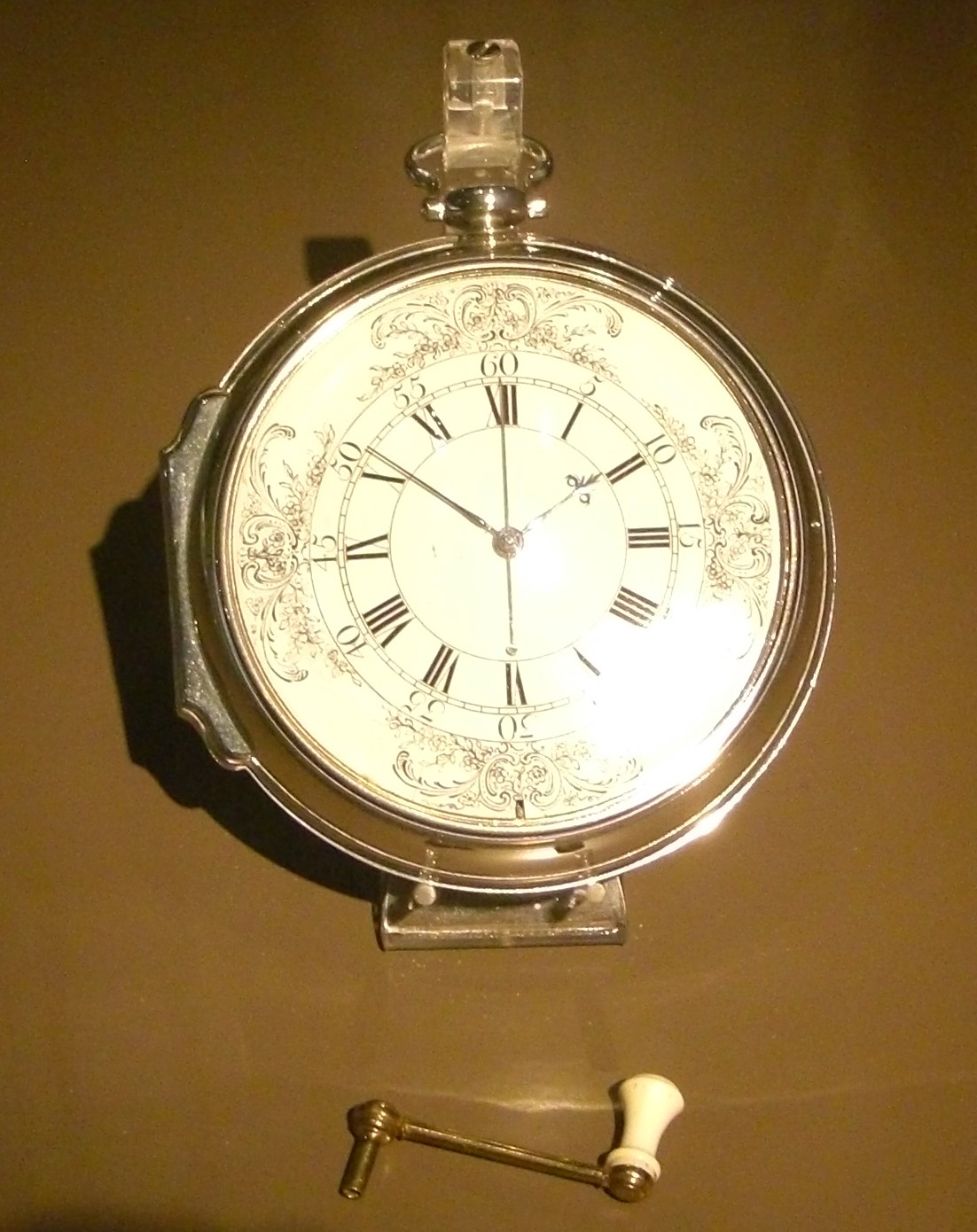
H4 and its winding key on display in Greenwich, August 2009. Photograph: Colonel Warden. Source: Harrison H4 chronometer.jpg (Wikimedia Commons). CC BY-SA 3.0, unaltered.

The appearance of a large pocket watch#
The Maritime Museum’s catalogue gives the dial diameter as 102 mm, overall dimensions as 165 × 124 × 28 mm, and weight as 1.45 kg. A white enamel dial decorated with floral patterns is housed in a double silver case. The hours use Roman numerals and the numerals on the outer scale are Arabic; seconds can also be read from a long central hand. Gould explained that the third wheel was internally toothed so that it turned the next wheel in the same direction, a device that made the central seconds hand move clockwise. 1 5
While working on the large marine timekeeper H3, Harrison also studied regulators for portable watches. In 1753 the London clockmaker John Jeffreys made a pocket watch to Harrison’s design. Its performance gave Harrison a clue for making a small marine timekeeper. H4’s mainplate bears the names of father and son and the date 1759. His son William handled the clock on both voyages and joined his father in the published account of its construction. The testimony recorded in the 1767 book says that Maberley made the three springs other than the balance spring. 1 2 5 6
Regulating the force inside the clock#
Daily winding and rewinding every 7.5 seconds#
The mainspring pulls a conical fusee by a chain. As the spring unwinds and its force falls, the chain acts at an increasing radius, reducing changes in the torque delivered to the train. While the clock is being wound with a key, a separate spring inside the fusee drives the train. This arrangement kept the clock running and preserved the reference time even during daily winding at sea. 5 6
Farther downstream in the train is a remontoire. A small spring delivers force just before the escape wheel; the upstream train rewinds it eight times a minute, or about every 7.5 seconds. A fly regulates the speed of rewinding. From the regulator’s perspective, the small spring’s brief releases and rewinding recur repeatedly, limiting the effects of changes in the power supply over a day and friction in the upstream wheels. The auxiliary spring inside the fusee keeps the clock running during winding; the downstream small spring supplies power in normal running. 5 6
Gould’s examination of the clock also records a brake that stopped the balance when only one turn of chain remained on the fusee. It stopped the balance about half an hour before the mainspring ran down, keeping the remontoire wound. Once the small spring had also unwound and the train stopped, restarting required releasing the remontoire’s stop. 5
Balance, diamonds and temperature compensation#
The steel balance beats five times a second, or makes 2.5 complete oscillations per second. The design aimed to obtain stable oscillations against a ship’s motion by making a large balance swing quickly through a wide arc. The escape-wheel teeth alternately push small diamond pallets near the balance staff. In this modified verge escapement, the shape of the surfaces where teeth and pallets meet also helped compensate for the tendency of the period to vary with amplitude. The 1767 testimony says that compensating pins touching the balance spring were added after the return from the Jamaica voyage. 2 6 7
As temperature changes, the balance spring’s elasticity changes, affecting the period of oscillation. In H4, a strip combining steel and brass bends with temperature, changing the effective length of the balance spring as it passes between two pins at the end of the strip. The printed testimony describes comparing the rate with a thermometer beside the clock in a cold place and near a fire, then adjusting it. Ruby pivot holes and diamond endstones support the pivots; small amounts of oil were used on the pallets and in the pivot holes. 5 6
What the voyages measured#
1761–62: Jamaica#
William took H4 to Jamaica aboard the Deptford. The often-quoted figure of about five seconds is the discrepancy found when longitude from the clock—using the rate determined before departure—was compared with observations on arrival on the outward voyage. The official trial ended in Jamaica, and William and H4 returned aboard a different ship, the Merlin. Gould gives an error of just under two minutes over the roughly five-month round trip. The commissioners debated the value then assigned to Jamaica’s longitude and the reliability of the rate measurements made before departure, and called for a further trial. 2 3 5
1764: Barbados#
For the second clock trial, William sailed aboard the Tartar in March and reached Barbados in May. The commissioners compared the longitude difference between Portsmouth and Barbados obtained from astronomical observations with the difference found by carrying H4. The astronomical calculation used records including equal-altitude observations of the Sun and eclipses of Jupiter’s satellites. The clock was a practical means of finding longitude; astronomical observations at the destination provided the standard for the trial. 2 3
The minutes of 19 January 1765 list the clock errors calculated by four assessors in units of time: John Campbell, 41.5 seconds; John Bevis, 33 and two-thirds seconds; George Witchell, 47.3 seconds; and James Short, 34.5 seconds. Their simple average is about 39.24 seconds, equivalent to about 9.8 arcminutes of longitude. On 9 February the Board accepted that the result lay well within the Act’s strictest limit, and required disclosure of the design and proof that another maker could produce a similar clock. 2 3 8
Trials at Greenwich#
From May 1766 to March 1767, H4 was compared under Maskelyne with the standard clock at the Royal Observatory, Greenwich. Its rate was recorded dial-up, tilted from horizontal, and vertical, among other positions; in winter the temperature sometimes fell below freezing. In his response, Harrison challenged how the watch’s rate was handled when it was handed over, the placement of the clock and thermometer, and the positional conditions. On the Barbados voyage, however, the clock had been carried in a box with a graduated arc so it could be returned to its intended position when the ship heeled under sail. 2 6 8 9
Publishing the principle and the surviving clock#
At the Board’s request, Harrison and his son dismantled the clock and answered questions from experts. The 1767 book contains that testimony, the construction account submitted by father and son, and engraved plates. The Board made disclosure and delivery of the clock, together with sums already paid, the terms for a total of £10,000; the remaining payment depended on demonstrating that a similar clock could determine longitude within half a degree. The copy K1, commissioned by the Board from Larcum Kendall, was completed in 1769 and used on James Cook’s second voyage. Father and son also made the next clock, H5, which bears a 1770 signature. K1 shows another clockmaker reproducing the design; H5 records the father and son continuing the work themselves. 6 10 11 12
In the twentieth century, Rupert T. Gould dismantled, cleaned, reassembled and tested Harrison’s four marine timekeepers. His working notes record a second cleaning of H4 in 1935. In his 1923 book Gould also noted arranging a replacement for a broken mainspring. The Maritime Museum catalogue separately registers the clock and winding key, as well as three fragments of the removed mainspring. The surviving clock’s condition thus preserves a history of long-term care after the trials. 1 5 13 14
The modern reconstruction begun by Derek Pratt was taken over by the Charles Frodsham workshop and completed in 2014. It drew on Anthony Randall’s dimensioned drawings and observations of the original. Making and adjusting the diamond pallets and remontoire shows, as did the copies around 1770, how a clockmaker turns component drawings into a working timekeeper. 7 15
Chronology#
| Period | H4 and related events |
|---|---|
| 1753 | John Jeffreys makes a pocket watch to Harrison’s design. 1 |
| 1755–1759 | H4 is made. The date on its plate is 1759. 1 5 |
| 1761–1762 | William goes to Jamaica aboard the Deptford for the trial and returns aboard the Merlin. 2 5 |
| March–May 1764 | He sails to Barbados aboard the Tartar for the trial comparing longitude differences. 2 3 |
| January–February 1765 | The Board receives four calculations and accepts the accuracy of the sea trial. 3 |
| August 1765 | Harrison and his son disclose the mechanism. A certificate dated 22 August confirms the dismantling demonstration and explanation. 6 9 |
| May 1766–March 1767 | Land trials at the Royal Observatory, Greenwich. The construction account and plates are published in 1767. 2 6 8 |
| 1769–1770 | Kendall’s K1 is completed in 1769. H5 bears the father and son’s 1770 date. 10 11 |
| 1935 | Gould records a second cleaning of H4. 13 |
| 2014 | The modern reconstruction begun by Pratt is completed. 15 |
| Checked November 2026 | The original is registered in the National Maritime Museum catalogue as ZAA0037. 1 |
John Harrison’s life (in Japanese) traces the evolution of his designs from H1 to H5; the 1767 book (in Japanese) introduces the relationship between the testimony and engraved plates. The article on Derek Pratt (in Japanese) describes the methods used in the modern reconstruction.
References#
All sources accessed 23 November 2026.
- Royal Museums Greenwich, H4, ZAA0037. Date, manufacturing background, dimensions and related objects. See also the case, ZAA0037.6.
- Royal Museums Greenwich, Longitude found: the story of Harrison’s timekeepers. Account of development, trials and reward.
- Commissioners of Longitude, minutes RGO 14/5, official transcription by Cambridge University Library. 17 August 1762, 18 September 1764, 19 January 1765 (p. 70), and 9 February. The transcription was checked against the archival original.
- Jim Bennett, James Short and John Harrison: personal genius and public knowledge, Science Museum Group Journal, 2014. Longitude trials, figures and social context.
- R. T. Gould, The Marine Chronometer: Its History and Development, 1923, pp. 50–60, 66–69. Examination, figs. 16–17 and sea trials.
- John Harrison and William Harrison, technical account, ed. Nevil Maskelyne, The Principles of Mr. Harrison’s Time-Keeper, 1767, preface pp. v–viii, testimony pp. ix–xvii, account of the principles and plates pp. 19–31.
- Tim Lake, The Microscopic Magic of H4, Harrison’s First Sea Watch, SJX Watches, 2019. Comparison of escapement forms, examination and reconstruction.
- Anthony Randall, Lucky Chance, Fraud or Deception? The Trials and Tribulations of Harrison’s H4, Horological Journal, May 2021, pp. 202–207. Board record in fig. 2 and trial results in figs. 3–4.
- John Harrison, Remarks on a Pamphlet Lately Published by the Rev. Mr. Maskelyne, 2nd ed., held by the Wellcome Library, 1767, pp. 2–3, 6–15. The inventor’s response on rate, temperature and position, and the certificate dated 22 August 1765 in the footnote on p. 6.
- Royal Museums Greenwich / University of Cambridge, K1, ZAA0038. Commissioning, completion and voyage use of the copy.
- Science Museum Group, Marine Timekeeper known as ‘H5’ by John Harrison and Son 1770. Signature and construction.
- Royal Museums Greenwich, Proposal by the Board of Longitude to pay John Harrison a sum of money for the development of his timekeepers, BGN/9, 1765. Proposal for disclosure of the principles and trials of a similar timekeeper.
- Royal Museums Greenwich, Rupert Thomas Gould Papers, GOU. Working notes, especially the catalogue record for GOU/5 in 1935.
- Royal Museums Greenwich, Three fragments of mainspring removed from H4, ZAA0037.2. Catalogue record for removed parts.
- Roger Stevenson, Derek Pratt’s Reconstruction of John Harrison’s H4, Part 1, Horological Journal, February 2015, republished. Transfer of the reconstruction and division of work. See also the Horological Society of New York film description for the completion date.