This article was translated from Japanese using AI. Read the Japanese original
An animated landscape#
The Jaquet-Droz Grotto, or La Grotte, was unveiled in 1774 and used machinery to animate a pastoral mountain landscape. A farmer rides a donkey to a mill, shepherds play music, animals make sounds and figures dance in a garden. A grotto was one feature of a stage bringing together rocky slopes, buildings and small characters. 1 2
It is known as the fourth automaton alongside the workshop’s Writer, Draughtsman and Musician. Those three are androids centred on one human figure each. In the Grotto, people, animals, plants and heavenly bodies move to create events across the landscape. The work is lost, and its appearance is known through show descriptions, engravings and records of production and sale. 1 2
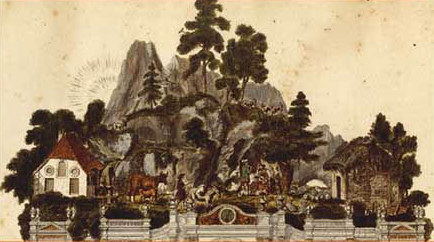
Figure. Coloured period engraving showing the Grotto landscape. Colourist unknown. Engraved by Balthasar Anton Dunker and completed by F. Lardy in 1776. Scan by Rosebud23, unchanged here. The engraving is in the public domain, with Dunker having died in 1807 and Lardy in 1812. Attribution and date follow the collection description, which differs from the Commons entry. Wikimedia Commons file Rights statement 2 6


Who made it and when?#
Father, son and workshop#
The work belongs to the workshop of Pierre Jaquet-Droz and his son Henri-Louis. Witness testimony dated 17 October 1774 names Jean-Frédéric Leschot, Henry Huguenin, Jean-Baptiste Grisez and Charles Humbert-Droz among the artisans working on the Draughtsman, Musician and Grotto. Some signatures reproduced in the text use longer names or different spellings. 3
The testimony legally recorded when workers transferred from father to son and the state of the objects then. Leschot put the transfer in early September 1772. At that point the Grotto had carved rocks, terraces and several goats but no mechanism. Father and son each intended to prepare a design, but by then neither had done so. The son later gave the artisans wheel trains for their work on moving the various figures. 3
The landscape was shaped first and the mechanisms followed. Henri-Louis directed work by several artisans. The testimony leaves their individual assignments for figures or sound mechanisms unconfirmed. Completion and public display in 1774 do not establish when every part was begun. 3
A work made for paying audiences#
A Paris show description dated 26 November 1774 announced that the four works were shown daily at the Hôtel de Lubert. It gives visiting hours from 11 a.m. to 2 p.m. and 5 to 8 p.m., admission at six or three livres, and a courtyard for carriages. The Grotto was part of a public show with paid admission. 1
Henri-Louis and Leschot’s spectacle mécanique used engineering to surprise audiences and attract commissions for luxury mechanisms. The Grotto’s history also shows how a watchmaking workshop advertised its skills. 2
Rocky slopes and formal gardens#
The engraving cut by Dunker and completed by Lardy in 1776 shows a rocky landscape on an architectural base with a garden at the front. The three androids are arranged around it as part of the composition presenting the whole show. They were separate from the Grotto. 2
The 1774 description puts formal flower beds against a building front in the foreground, with a Swiss mountain scene behind. There are cottages, a mill, a stream, a bridge, grazing herds and a rocky slope with a grotto. Architecture ties the symmetrical garden to the more varied countryside. 1
The contemporary description gives the footprint as quatre pieds & demi en quarré and the height as deux à trois pieds. One modern account gives an area of about 0.5 square metres and a height of about 0.8 metres. These figures interpret the historical units and phrasing. They do not give independently measured width or depth. 1 2
The recorded dimensions of 33.5 × 44.3 cm belong to the print. H 4425 at the Musée d’art et d’histoire, Neuchâtel, is also a number for the engraving. 2
What happened in a performance?#
The farmer, donkey and shepherds#
The 1774 description advertised the following sequence for the mountain scene. 1
- A farmer leaves his cottage riding a donkey. He crosses the landscape and a bridge over the stream, heading to the mill to collect flour.
- As he passes the livestock, a dog guarding the herd barks. The show description boasts that real dogs answered.
- A shepherd emerges from the grotto and raises a flute to his lips. A short prelude receives a faint echo.
- He approaches a sleeping shepherdess and plays a gentle melody. She wakes, sits up, looks at him and takes up her guitar to play with him.
- The farmer’s return interrupts them. The shepherd bows and withdraws into the grotto, and the shepherdess resumes her previous position. Now on foot, the farmer drives the donkey ahead of him, carrying sacks of flour back to the cottage.
The farmer rides the donkey on the way out and walks behind the laden animal on the way back. The change gives the outward and return journeys distinct actions. The description does not establish whether a figure was reconfigured or exchanged for a concealed second one. 1
Livestock, flowers, fountains and dancing#
Sheep and goats reportedly grazed and bleated, cows chewed the cud and a calf suckled. The forecourt had yews, statues, fountains and orange trees with buds that opened and gave way to fruit. Two fountains and a birdcage were set into the architecture. The birds moved and sang. 1
A clock stood above the central gate. At the entrance a woman played a tympanon and two women danced a minuet. The eighteenth-century dictionary describes the tympanon as a string instrument played with two beaters. The exact source of the sound is unknown, whether produced at the figure’s hands or by a separate mechanism inside the base. 1 7
The Sun was said to rise from behind the rocks, reach its highest point and set. The description claims that its passage matched the season. The latitude represented, method of changing seasons, period and error are unrecorded. The claim does not establish the performance of a precision astronomical clock. 1
Coordinating sound and motion#
The mechanism brought actions together in time. The shepherd emerged after the farmer left, the flute preceded the shepherdess waking, and the farmer’s return ended the duet. Reciprocating motion, changes of posture, music and animal calls were sequenced so that the audience could follow a story. 1
The workshop testimony mentions wheel trains and describes the rocks, terraces and goats already present in 1772 as carved. Descriptions of flute, guitar, tympanon, echo and animal calls show the range of sounds the show presented. 1 3
Touring, sale and disappearance#
A travelling mechanical show#
After public display in La Chaux-de-Fonds in 1774, the exhibition went to Paris and London. The 1776 engraving was based on a drawing made in Britain and preserves the appearance of the works. 2
Sandrine Girardier re-examined letters and show material for evidence of subsequent touring and sale. After London the exhibition travelled to Ghent, Paris and Lyon, and was shown in Geneva in 1785. Girardier dates the sale to the Gendre brothers, French merchants in Madrid, to 1788 and suggests the Writer may already have been sold. 4
The sale date and the destruction story#
In 1965 Diane Perrot drew on earlier research to report the sale of all four works to the brothers on 20 October 1787 for 41,000 French livres. Girardier uses 1788 because Leschot recalled the sale as having taken place eighteen years earlier in a letter dated 29 April 1806. The accounts differ in date and in the objects included. 4 5
In the same letter Leschot says he heard that the works had been left in poor condition somewhere in Spain and did not know where. The letter documents hearsay and the need to search for them. It does not report an execution or destruction witnessed by Leschot. 4
Perrot also describes a story in which the showman was arrested on suspicion of magic and the Grotto taken apart to examine its workings. The article cites no judicial record, and Girardier treats the story as a later hypothesis. The three surviving androids subsequently returned to Neuchâtel. Their return does not establish the Grotto’s whereabouts or fate. 4 5
Chronology#
| Date | Work and records |
|---|---|
| c. September 1772 | Later testimony recalls the transfer of workers from father to son. The Grotto had carved rocks, terraces and goats, but the mechanism was unfinished. 3 |
| 1774 | Shown in La Chaux-de-Fonds alongside the three androids. 2 |
| 17 October 1774 | Witness testimony on the state of the work and the artisans’ employment. The end of Leschot’s transcribed statement gives the 18th. 3 |
| 26 November 1774 | Paris show description records the sequence, opening hours and prices. 1 |
| 1775–1777 | The mechanical show is presented in London. 2 |
| 1776 | Dunker and Lardy’s engraving, after a drawing made in Britain. 2 |
| 1781 | The Grotto appears in Ghent show material. 4 |
| 1784 | Lyon show. 4 |
| 1785 | Final public showing by Jaquet-Droz and Leschot in Geneva. 4 |
| 1787–1788 | Accounts differ on the date and objects in the sale to the Gendre brothers. 4 5 |
| 29 April 1806 | Leschot writes about the sale and reports of poor conditions in Spain. 4 |
| 1965 | Perrot describes the work and theory of its disappearance in an English article. 5 |
| 2020 | Girardier’s workshop history revisits testimony, show material and correspondence. 3 4 |
| Checked in November 2026 | The work is described as lost. The engraving and written records remain the main evidence. 2 |
Significance#
The Grotto presented a small world of nature and society. Animals in the mountains, farm work, a musical duet, garden dancing and the movement of the Sun interacted on a small stage. Part of the effect was that the audience could read a story in the order of the actions. 1
The evidence does not allow a detailed reconstruction of the lost mechanism. It shows how watchmaking skills went into theatre and design. The engraving records appearance, the advertising the performance, the testimony the work of manufacture and the letters its circulation.
References#
- “Description de divers Ouvrages de Méchanique inventés & exécutés par M. H. L. Jacquet Droz”, dated 26 November 1774, L’année littéraire, vol. 7, pp. 264–270. Reprinted in Sandrine Girardier, L’entreprise Jaquet-Droz, 2020, appendix 2, pp. 547–549. The public show description was consulted, with promotional claims treated as such. Reprint PDF. Accessed 12 November 2026.
2. Sandrine Girardier, “Le quatrième automate des Jaquet-Droz”, Société d’histoire et d’archéologie du canton de Neuchâtel, Images du Patrimoine. Description of the 1776 engraving, Musée d’art et d’histoire, Neuchâtel, H 4425. Article. Accessed 12 November 2026.
3. “Audition de témoins”, 17 October 1774, AEN, Justice civile, La Chaux-de-Fonds, J. J. Brandt père, vol. 150, pp. 302–307. Girardier, L’entreprise Jaquet-Droz, Éditions Alphil–Presses universitaires suisses, 2020, appendix 1, pp. 543–545, and discussion pp. 120–123. The transcription was consulted. Reprint PDF. Accessed 12 November 2026.
4. Sandrine Girardier, L’entreprise Jaquet-Droz : Entre merveilles de spectacle, mécaniques luxueuses et machines utiles (1758–1811), 2020, pp. 117–123 and 132–144. The 1806 letter is discussed across pp. 142–144, source BGE Ms. Suppl. 964, p. 277. The book’s transcription was consulted. PDF. Accessed 12 November 2026.
5. Diane Perrot, “The Grotto: the long lost automata by Jaquet Droz”, The Music Box, vol. 2, no. 4, Christmas 1965, pp. 140–143 (PDF pp. 4–7). Account of an older sale record, the disappearance theory and the engraving. PDF. Accessed 12 November 2026.
6. Istituto centrale per la grafica, “Indice incisori stampe”, entries for Dunker Balthasar Anton (1746–1807) and Lardy François Guillaume (1749–1812). Used to check the engravers’ life dates. Index. Accessed 12 November 2026.
7. Académie française, Dictionnaire, 4th ed., 1762, “TYMPANON”, text at CNRTL. The definition describes metal strings struck with two wooden beaters. Dictionary entry. Accessed 12 November 2026.