Compteur de tierces#
This article was translated from Japanese using AI. Read the Japanese original
The Compteur de tierces is a pocket-watch-shaped elapsed-time instrument that Louis Moinet made for astronomical observation. Its centre hand indicates sixtieths of a second and a high-frequency oscillator mechanically divides short intervals. The modern Louis Moinet company calls it the world’s first chronograph and dates its completion to 1816. The auction dating and some recorded specifications differ. 1 2
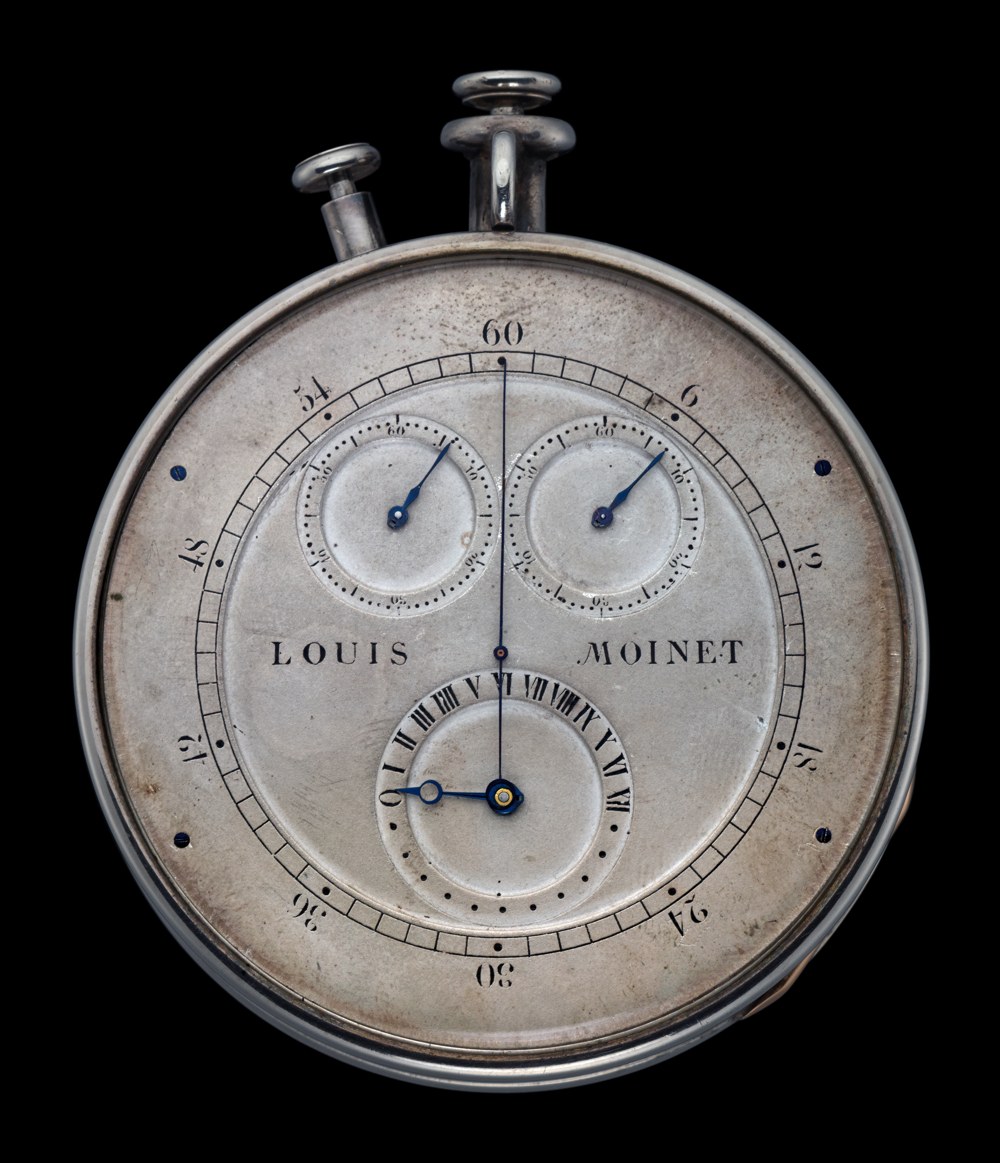
Figure 1. Louis Moinet’s “Compteur de Tierces”. By LouisMoinet. Source Wikimedia Commons. Licence CC BY-SA 3.0. Hohum’s crop on Commons was resized and recompressed as a JPEG. The displayed image carries the same licence.

Measuring short intervals while observing stars#
The problem in Moinet’s treatise#
In Part II of his horological treatise, pp. 430–431, §1531, Moinet describes the instrument as a counter marking sixtieths of a second. If an observer watched a star while counting a clock’s beats, the star could pass the next reference line in the telescope while the observer was checking the time. The lines were reticle wires in the field of view. 3
Moinet wanted a way to know in advance how long the star took to move precisely from one line to the next. Given the interval between crossings, a good observation at an adjacent line could help recover a missed crossing. The counter thus helped connect the reference lines in the telescope to observation times. 3
Moinet traces the idea to a small quadrant based on Borda’s work. He acquired an instrument intended for shipboard observation and adapted it to use on land with a graduated horizontal circle by Fortin, a level, a tripod and other additions. The telescope’s narrow field and close spacing of the wires created a need to measure short crossing times. 3
The inventor’s recollection explains why he needed such fine divisions of time, though it gives no day-by-day record of construction.
From a private instrument to a historical object#
In the same section, Moinet says that the counter he made for himself had gone unpublished at the time and remained unknown. A footnote on p. 431 says that age and other commitments prevented him from using it, and that he was willing to agree terms with someone who wanted to put it into series production. The footnote documents an offer to make the invention available to others. It gives no evidence that a series was produced. 3
Indications and construction of the surviving instrument#
Multiple time scales on one dial#
The slender centre hand and the peripheral scale in 60 divisions indicate short intervals. The specifications published in 2013 identify the centre hand as the sixtieth-of-a-second indication, the upper-left dial as a 60-minute register, the upper-right dial as a 60-second register and the lower dial as a 24-hour register. The pusher near 12 starts and stops the timer and the one near 11 returns the centre hand to zero. The specification leaves open whether all the register hands return to zero together. 4
A tierce here is 1/60 second. It continues the sexagesimal subdivision from hours into minutes and minutes into seconds by dividing the second into 60 parts. Moinet’s text identifies tierces with sixtieths of a second. 3
Silver case and fusee drive#
Christie’s records a four-body silver case, silver dial, blued steel hands, bayonet bezel, gilt-brass movement, chain fusee and cylinder escapement, with a case diameter of 64.7 mm. A fitted brown leather box accompanied it. 1
A fusee is a cone-shaped transmission component that compensates for the change in mainspring force as the spring unwinds. The chain acts at different radii depending on the force from the spring.
The 2013 specification lists full plates held by four pillars, a ruby and steel cylinder escapement, a bar-shaped oscillator with platinum adjusting weights, a flat balance spring with seven coils and 13 jewels in total. It gives dimensions of 57.7 mm in diameter and 9 mm in thickness, and a running time of more than 30 hours. The measurement points in the dimensions field are unspecified, leaving open whether its diameter is comparable with Christie’s 64.7 mm case diameter. 1 4
Christie’s lists 32 teeth on the escape wheel while the 2013 specification lists 30. The tooth count matters for reconstructing the train and its action, so both figures are retained here. No measurements from a teardown or records of replacement parts have been found to resolve the discrepancy. 1 4
What 30 Hz and 1/60 second mean#
The modern Louis Moinet company and the Federation of the Swiss Watch Industry FH give the frequency as 216,000 beats per hour, or 30 Hz. The hourly beat count measures half-oscillations of the balance, while the frequency in hertz counts complete oscillations. 2 5
The half-oscillations per second are 216,000 ÷ 3,600 = 60. The number of complete oscillations is half that, or 30. If the indication advances on every half-oscillation, its smallest step is 1/60 second. This is a conversion of published figures rather than a measurement of the surviving instrument’s frequency.
The fineness of the scale and how close a measurement comes to the true elapsed time are separate questions. Frequency error, position, temperature, the observer’s reaction and the reading of the hand and scale can all affect the result. On p. 430, Moinet distinguishes decimal figures written in records from the intervals his mechanism actually marks. The 1/60-second increment gives the display resolution. It does not establish an accuracy of ±1/60 second under all conditions. 3
Higher frequency raises questions of lubrication, wear and energy use. F.P. Journe’s account of chronograph history discusses the counter and points out these challenges. Its discussion is about technical issues, without reporting wear or long-term rate tests on this object. The published sources leave the amount of wear and friction at the ruby contacts unquantified. 6
Dating and the “first chronograph”#
The auction catalogue and the dating to 1816#
Christie’s 2012 catalogue lists the signature Louis Moinet, Paris, and dates manufacture to around 1820–1830. The modern Louis Moinet company gives 1815 for the start and 1816 for completion, based on marks on the dust cover. A 22 April 2013 FH article presents it as a previously unknown piece that calls for a reassessment of chronograph history. 1 2 5
Silver hallmarks provide evidence for dating a case or its inspection. Establishing the dates of all movement components requires further evidence.
Priority depends on the definition#
The counter shows elapsed time with a hand. Ink chronographs record a time mark on paper or a dial. F.P. Journe’s historical account treats Moinet’s counter, independent seconds hands, Rieussec’s ink recorder and later zero-reset mechanisms as separate stages of development. 6
Calling it the world’s first chronograph depends on including a surviving mechanical elapsed-time counter with start, stop and zero reset in the modern category. The claim concerns priority under that definition and leaves questions about other kinds of timers, direct lines of influence and the mechanisms of later chronographs separate.
Provenance and later recognition#
| Period | Documented event and source |
|---|---|
| 1815–1816 | Start and completion dates given by the modern Louis Moinet company from the marks and other evidence |
| First half of the nineteenth century | In his treatise, Moinet recalls using a private counter for astronomical observations |
| Publication of Part II of the treatise | §1531 describes the purpose, and a footnote expresses willingness to let others make it |
| 2012 | Appears at Christie’s, catalogued as a silver counter of around 1820–1830 |
| April 2013 | The FH presents its historical significance as an instrument completed in 1816 |
| 2016 and 2019 | Louis Moinet reports world-record recognition as the first chronograph and first high-frequency stopwatch respectively |
| April 2025 | Release of the modern “1816” wristwatch, a separate product drawing on the historical instrument |
The public sources consulted leave gaps in nineteenth-century ownership, restoration and component replacement history. They also do not establish the object’s current permanent display location.
The GPHG entry gives the modern “1816” as reference LM-150.20.60 with a titanium case of 40.6 mm, a beat rate of 28,800 per hour and a 48-hour power reserve. Its name and dial layout recall the historical piece. The modern calibre and its frequency differ from the original 30 Hz movement. 7
The significance of the Compteur de tierces lies in its use of a separate mechanical counter to solve a short-interval problem encountered in observation. Reading Moinet’s explanation alongside records of the object reveals a connection between scientific observation and clockmaking that the frequency figure alone cannot show.
References#
- Christie’s, Louis Moinet, Compteur de tierces, lot 5553708, 2012 auction catalogue, Details and Lot Essay. Accessed 9 November 2026.
2. Les Ateliers Louis Moinet, Inventor of the Chronograph. The modern company’s account of dating, frequency, operation and record recognition. Accessed 9 November 2026.
3. Louis Moinet, Nouveau traité général astronomique et civil d’horlogerie théorique et pratique, ETH-Bibliothek Zürich, Rar 17375:2, part II, pp. 430–431, §1531 and footnote. Original at e-rara, p. 430, p. 431. The publication date of 1841 in the catalogue does not date the composition of the complete set. The passage does not establish the year the instrument was made. Accessed 9 November 2026.
4. La Cote des Montres, Louis Moinet, inventeur du chronographe, 2013. Technical description based on the brand announcement. Accessed 9 November 2026.
5. Fédération de l’industrie horlogère suisse FH, Louis Moinet — The Chronograph’s Inventor, 22 April 2013. Includes material also published in the brand announcement. The original URL returned a 404 response, and the preserved web text was consulted. Accessed 9 November 2026.
6. F.P. Journe, Manuel d’utilisation — Chronographe Monopoussoir Rattrapante, pp. 4–5, “Le chronographe et ses débuts”. Its edition and page reference for Moinet differ from those of the copy in reference 3. Accessed 9 November 2026.
7. Fondation du Grand Prix d’Horlogerie de Genève, LOUIS MOINET, 1816, 2025 entry. Specifications and release date of the modern product. The historical description is the entrant’s. Accessed 9 November 2026.