This article was translated from Japanese using AI. Read the Japanese original
Johann Poestdorffer (also spelled Possdorffer) made this rock crystal watch in Dresden in the first half of the seventeenth century. It is a pendant timepiece that tells the hours by hands and a bell; its dial also displays the date, lunar age and phases of the moon. Through the rock crystal case, whose exterior is cut into eight facets, two arms can be seen, each ending in a winged angel’s head. These arms form part of a cross-beat escapement that regulates the watch. The Grünes Gewölbe (Green Vault) in Dresden holds it as object VI 7a. The 1978 exhibition catalogue records its overall length as 9.1 cm. 1 2
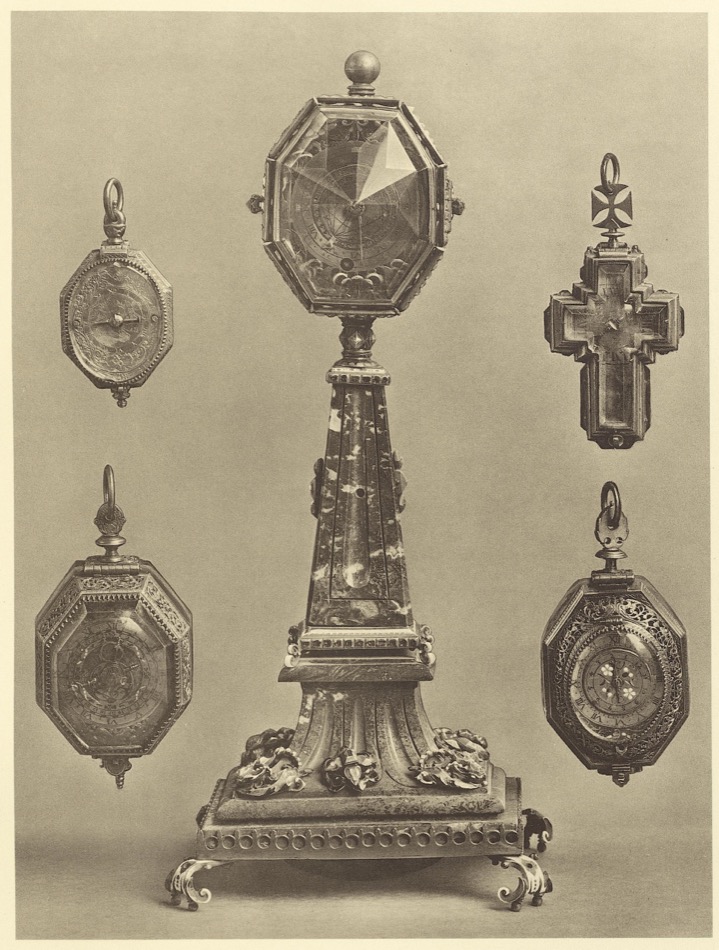
The Dresden-inscribed VI 7a is at lower left; the Prague-inscribed watch is at lower right. Jean Louis Sponsel, ed., Das Grüne Gewölbe, vol. 2, plate 28 (1928). The digitised source is held by Heidelberg University Library. Source: Wikimedia Commons file description. CC BY-SA 3.0 Germany. Reduced in size only.

The rock crystal case and dial#
Seen from the front, the watch has a hinged rock crystal cover over a dial of silver gilt and enamel. The outer ring marks the hours from 1 to 12; the inner ring shows the moon’s age, or the number of days since the new moon. A small aperture inside that ring gives the day of the month, while the central illustration shows the moon’s phase. The lunar age and phase convey the same cycle in numbers and images; the date aperture gives the day within the calendar month. 1
The bell sits in a space below the dial. The pierced frame supporting the dial and the floral openwork around the cover also let the bell’s sound pass through. The case was made from a single block of rock crystal: its exterior was cut into multiple facets, and its interior hollowed out to house the movement. Engraving and openwork on the movement’s gilt-brass back plate can be seen through the transparent side. The Dresden inscription on the back plate identifies the movement’s maker; the case is unsigned. 1 3
Keeping time with two arms#
An escapement momentarily arrests the train driven by the power source, then lets it advance in steps governed by the regulator. In the widely used seventeenth-century verge escapement, a crown-shaped escape wheel alternately engages two pallets fixed to one arbor, while a balance mounted on that arbor swings back and forth. In Bürgi’s cross-beat system, two arms on separate arbors work in alternation to advance the wheel train. 1 6
In Dresden VI 7a, the two arms cross beneath a pierced support on the back plate. The winged angel heads at their ends are gilt-brass weights that double as ornaments. Placing weights away from the pivots increases the arms’ inertia as they swing. The motion visible through the crystal is the regulator itself, marking the passage of time. Chandler and Vincent, who documented the watch, noted weights of the same form on Bürgi’s clocks in Dresden’s Mathematical-Physical Salon. 1
Before pendulum clocks became widespread, Bürgi made clocks with the cross-beat escapement to meet the need for fine time measurements in astronomical observation. VI 7a is a portable-scale example of a mechanism known from stationary clocks used for observing the heavens. Chandler and Vincent also documented clocks using the same system by Hans Buschmann and Hans Christoph Kreitzer of Augsburg. Those two clocks were mounted on stands, while VI 7a has a suspension ring and combines the mechanism with a bell for striking the hours in a portable form. In their 1980 paper, the researchers identified VI 7a as the only cross-beat portable watch they then knew of that was not built into a stand. 1 6
From Prague to Dresden#
In the 1928 collection catalogue, the same plate as VI 7a shows another pendant watch bearing an inscription indicating that Poestdorffer made it in Prague. The Liechtenstein family accounts cited by Vincent in a 1987 paper record payments by Karl I to Bürgi and Poestdorffer between 1620 and 1624. Vincent interpreted the overlap in the two craftsmen’s work at this court as an opportunity for escapement technology to pass from Prague to Dresden. 1 3 4
Poestdorffer also made portable watches with different mechanisms. The Metropolitan Museum of Art’s Dresden-made watch 17.190.1525 is dated by the museum to about 1630–1640 and measures 3.2 × 2.2 cm overall. It has a conventional verge escapement and an enamel dial showing the hours and half-hours. Its rock crystal cover is a later addition. The 1978 exhibition catalogue dates VI 7a to the early seventeenth century; Chandler and Vincent’s caption to figure 7 suggests the second quarter of that century. 1 2 5
Collection and research chronology#
| Date | Record |
|---|---|
| Shortly before 1590 | Chandler and Vincent’s proposed date for Bürgi’s invention of the cross-beat escapement. 1 |
| 1620–1624 | Payments from Karl I to Bürgi and Poestdorffer are recorded. 4 |
| First half of the seventeenth century | VI 7a is made in Dresden. The 1980 study of the watch estimates the second quarter of the century. 1 2 |
| 1928 | The Grünes Gewölbe catalogue includes VI 7a and mentions the inscription on its back plate and its wing-shaped regulating components. 3 |
| 1977 | The 1980 paper reports that Joachim Menzhausen described VI 7a’s mechanism as a cross-beat escapement. 1 |
| 1978–1979 | It appears as no. 315 in the catalogue for a touring US exhibition of Dresden’s collections. 2 7 |
| 1980 | Chandler and Vincent’s paper illustrates the front, dial and back plate and compares the watch with contemporary examples using the cross-beat escapement. 1 |
Related article: Jost Bürgi (Japanese).
References#
- Bruce Chandler and Clare Vincent, “A Rock Crystal Watch with a Cross-Beat Escapement,” Metropolitan Museum Journal 15 (1980), pp. 193–201 (copyright notice dated 1981), especially pp. 196–199, figs. 7–9, notes 12–16. Published article PDF (accessed 23 November 2026).
2. National Gallery of Art, The Metropolitan Museum of Art, and Fine Arts Museums of San Francisco, eds., The Splendor of Dresden: Five Centuries of Art Collecting, 1978, p. 166, no. 315. Exhibition catalogue PDF (accessed 23 November 2026).
3. Jean Louis Sponsel, Das Grüne Gewölbe, vol. 2, 1928, pp. 62–63, 206, plate 28. Description of the watch, description of plate 28 (Wikisource transcription, accessed 23 November 2026).
4. Clare Vincent, “Prince Karl I of Liechtenstein’s Pietre Dure Tabletop,” Metropolitan Museum Journal 22 (1987), p. 159, note 14. Published article PDF (accessed 23 November 2026).
5. The Metropolitan Museum of Art, “Watch,” Johann Possdorfer, object no. 17.190.1525 (collection database, accessed 23 November 2026).
6. J. H. Leopold and Clare Vincent, “Seventeenth-Century European Watches”, The Metropolitan Museum of Art (1 March 2009, accessed 23 November 2026).
7. The Metropolitan Museum of Art, “The Splendor of Dresden: Five Centuries of Art Collecting” (guide to the 1978 exhibition catalogue, accessed 23 November 2026).