This article was translated from Japanese using AI. Read the Japanese original
The Duality is a manually wound wristwatch introduced by Philippe Dufour in 1996. One barrel drives two escapements and balances, and differential gearing combines their rates in a single time display. The dial shows hours, minutes and subsidiary seconds, while the back reveals two independent regulating systems. The arrangement had a precedent in watchmaking school pocket watches of the 1930s and was adapted for a small wristwatch. 1 2
Production was long reported as nine watches. A further example delivered in 2014 was made public in 2024, and Dufour confirmed a total of ten in a 2026 interview. 3 4 5
From a watchmaking school pocket watch to a wristwatch#
The source of the idea#
Dufour recalls seeing a pocket watch with two balances made at the Vallée de Joux watchmaking school, in a catalogue of the Time Museum in Rockford, Illinois. The earlier work of the school he had attended inspired the wristwatch. He says he used AutoCAD for the design, tested it with existing parts and built a prototype differential to confirm that one barrel could drive both regulators. 3
One precedent is movement No. 220, a school watch from Le Sentier by Albert G. Piguet. Sotheby’s documented it in 2019 as a 1933 movement with 29 jewels, two lever escapements and Guillaume balances, one train and a differential. The catalogue says six movements of this kind were made between 1932 and 1934. The gold case on the example was added in the 1970s. 6
The school watches already used two balances and a differential. Dufour’s problem was to fit the idea into a wristwatch and have both escapement and balance assemblies work without one bringing the other to a stop. 1 2
Design and collaborators#
In a 1997 technical article, watchmaker Ron DeCorte records helping in Dufour’s workshop over the winter and accompanying him to the launch in Basel. Dufour’s own watch was developed with assistance at the prototype stage. DeCorte’s article includes an exploded view, a sectional drawing and an explanation based on the tooth counts. It records the mechanism from the perspective of someone involved in its development. 2
Dufour’s 1998 article dates the introduction at Basel to 1996 and gives the intended run at the time as 25. He also says he could only confirm that the computer design worked after assembling it and that an ordinary timing machine assumes a single regulating system. Assembly and adjustment were challenges alongside fitting two balances into the available space. 1
Two escapements and regulators, one display#
Splitting the drive and combining the rates#
The mainspring supplies power from one barrel. The layout is close to a conventional train as far as the third wheel. A differential at the fourth wheel divides drive between two branches, each with an escape wheel, lever and balance. Each time an oscillating balance unlocks its escapement, the corresponding train advances. The progress of the two branches governs the seconds-hand arbor through the differential, and with it the hour and minute display. 2
The regulating systems operate independently. Stopping one balance leaves the other running, since the design does not depend on their synchronizing by resonance. In an experiment Dufour described to Jack Forster in 2017, stopping one balance made the subsidiary seconds hand take about two minutes to turn once. The watch continued to run, but its indication no longer advanced at the correct rate. 2 7
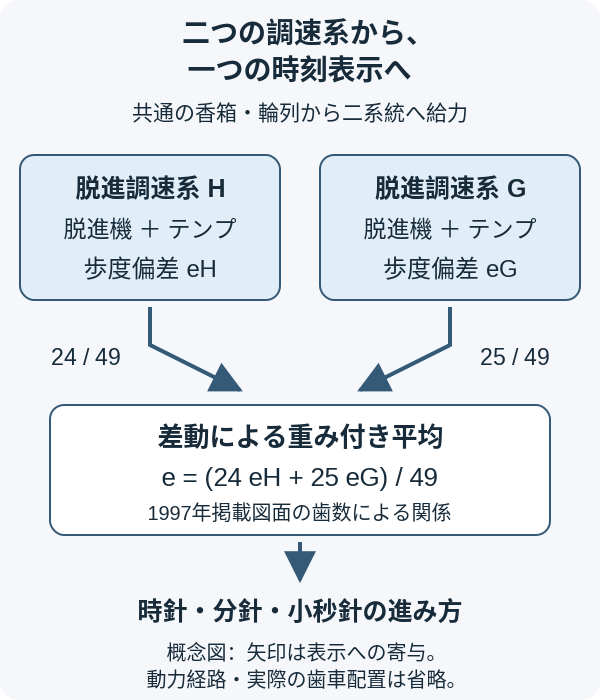
Figure 1. Conceptual diagram of how the rates combine. The arrows show contributions to the display rather than the power flow or actual gear layout. By My Horology Notebook, drawn for this article from the mechanical relationships in reference 2. CC BY 4.0. Unchanged. No existing technical drawing or exploded view has been reproduced.
How exact is the average?#
The watch is often described as displaying the average of the two rates. In the tooth counts DeCorte published in 1997, the two fourth wheels contribute about 0.4898 and 0.5102 respectively to the rate of the seconds-hand arbor. The values sum to one and differ slightly from 0.5 each. They are derived from the combination of 20 and 28 teeth. For the published mechanism, the result is a weighted average with nearly equal weights. 2
Let eH and eG be the deviations from nominal speed for the branches corresponding to lower fourth wheel H and upper fourth wheel G in the original article, and let e be the deviation of the display. The resulting relation is approximately as follows. 2
Use the same unit for all deviations, such as seconds per day. The equation recasts the tooth-count relationships of the mechanism published in 1997 as rate deviations. Friction and changes in amplitude are outside the calculation.
For example, if one gains six seconds per day and the other loses two, the equal-weights approximation gives a displayed gain of two seconds. If both gain six seconds, the display also gains six. These are numerical examples from the equation. They establish neither the Duality’s measured performance nor a fixed gain in accuracy from using two regulators.
The aim and limits of reducing positional error#
Dufour said in 2017 that he adjusted one regulator slightly fast and the other slightly slow. He placed their balance spring attachment points on opposite sides as a way of addressing errors in vertical positions. If the errors of the two branches behave differently, combining the rates can reduce variation in the displayed result. 7
Errors that affect both in the same direction can remain. Practical accuracy requires measurements by position, temperature, state of wind and on-wrist conditions. The sources consulted give neither a daily rate tolerance for all pieces nor independent long-term comparative results. 3 7
A small case and the workmanship visible inside#
Basic specifications#
The table gives specifications documented by the manufacturer and by catalogues for individual watches. The model is Duality, and several listings identify the movement as Cal. 10. 3 8 9
| Feature | Documented specification and scope |
|---|---|
| Winding and display | Manual winding. Central hour and minute hands, subsidiary seconds around seven-thirty |
| Movement | 30 mm diameter, 4 mm thick, 40 jewels |
| Regulators | Two lever escapements, two Glucydur balances and two balance springs with Breguet overcoils |
| Frequency | Each oscillator makes 18,000 half-oscillations per hour, or 2.5 Hz |
| Adjustment | DeCorte observed free-sprung balances with regulating screws |
| Power reserve | 40 hours according to the manufacturer |
| Case | Most sources give a diameter of 34 mm. Examples or specifications in 18-carat yellow, pink or white gold and in platinum |
| Crystal and back | Sapphire crystals on both sides according to the manufacturer |
Dimensions need to be read by source. Phillips’s 2017 listing for No. 00 gives 35.5 mm. Dufour’s 1998 article and the records for Nos. 03, 10 and 01 give 34 mm. The cause of the discrepancy and the conditions of measurement are unclear, and the figure for No. 00 cannot serve for the series as a whole. 1 4 8 9 10
Finishing reveals the shape of the movement#
The balances are visible from the back while the dial presents a simple time display. The standard silver-coloured dial has applied hour markers, dauphine hands and subsidiary seconds towards the lower left. That seconds position follows the arrangement of the train inside. The quiet dial and the complex movement are two faces of the same watch. 1
In 2015 the collector GaryG, who photographed the watch on several occasions, recorded sharp internal corners on the barrel bridge, mirror finishing on the escapement-side bridges and Geneva stripes that change with the angle of the light. The execution brings out the outlines of the bridges, the widths of the bevels and how the edges meet the faces. 11
The differential itself presented machining challenges. DeCorte describes keeping stacked coaxial parts round and concentric, press-fitting jewels and assembling the planetary gears. He counts 18 parts excluding screws. The 1998 article gives 21, and the sources do not provide a common basis for reconciling the counts. Miniaturisation also required keeping bearings and gears free to move at this scale. 1 2
The record of nine and the later discovery of a tenth#
What the numbers tell us about dates and production#
The official website still describes nine watches. Phillips’s 2024 Reloaded catalogue, lot 65, records No. 10 as an additional example delivered in 2014, almost ten years after it was ordered, and consigned by its original owner. It has an entirely matte platinum case, grey dial and pink gold-coloured hands and markers and comes with a certificate of origin. 3 4
A workshop visit published in June 2026 reports Dufour saying that he made ten. He accommodated customers’ preferences for numbers, according to the article, so a high number does not establish the total produced. The later catalogue entry and Dufour’s interview support a total of ten as of the date of this account, while the early sources give nine. 5
Nos. 03 and 01 have certificates dated in 1999. The 1996 date for the model is its announcement date. The sequence of serial numbers gives no reliable completion dates. 8 9
Differences documented for individual watches#
| Watch | Date in the record | Features in the published record |
|---|---|---|
| No. 00 | 1996 | Platinum. A 2017 Phillips listing documents the early example. 10 |
| No. 03 | 1999 | 18-carat white gold. Certificate of origin dated 10 September 1999. It came with an extra black lacquer dial and a set of hands when offered in 2024. 8 |
| No. 10 | Delivered in 2014 | Entirely matte platinum with a grey dial. The additional example was made public in 2024. 4 |
| No. 01 | Around 1999 | 18-carat white gold. Offered in 2025 with a 1999 certificate of origin, original press material and movement drawings. 9 |
The examples document dials, hands, cases and papers by watch. The extra dial accompanying No. 03, in particular, shows why a photograph alone cannot establish whether it shows a watch’s original delivery configuration or a separate example. 8
Auction results of the 2020s and what they document#
At Phillips New York on 8–9 June 2024, No. 03 sold for US$2,056,500. In Geneva on 8 November of that year, No. 10 sold for CHF 1,512,000. On 6–7 December 2025 in New York, No. 01 sold for US$3,085,000. All published prices include the buyer’s premium. 12 13 14 15
Even in the same series, serial numbers, cases, associated documents, whether an example was coming to auction for the first time, sale dates and currencies differ. These results cannot establish one market price or a fixed rate of increase. The catalogues also give historical evidence by making No. 10 and early examples with 1999 certificates public. 4 8 9
During the 2026 workshop visit, Dufour mentioned an idea for improving the differential. He said making it would take time and that he was unable to take on additional requests. This records an idea he discussed in an interview, with no launch of a new Duality documented. 5
The Duality brought mechanical ideas developed in school watches into a wristwatch. It linked the rates of two regulators to one display and fitted the mechanism into a small, carefully finished case. Comparative accuracy data are limited, but drawings, a collaborator’s record, Dufour’s demonstrations and surviving examples allow the mechanism to be traced in detail. 1 2 5 11
Timeline#
| Date | Event and evidence |
|---|---|
| 1932–1934 | Later collection catalogue records six movements with two escapements and a differential made at the Le Sentier school. No. 220 dates to 1933. 6 |
| 1996 | The Duality is introduced at Basel, as confirmed by the 1998 article. 1 |
| June 1997 | DeCorte publishes his development experience and the differential’s construction and gear calculation. 2 |
| March 1998 | Dufour’s article describes the intended run of 25, dimensions and manufacturing method. 1 |
| 1999 | Date of the certificates of origin for Nos. 03 and 01, documenting examples after the launch. 8 9 |
| 2014 | No. 10 delivered to its original owner, according to Phillips. 4 |
| 2017 | No. 00 appears at Phillips. An interview with Dufour describes the differential and his approach to adjustment. 7 10 |
| June 2024 | No. 03 sells in New York. 8 12 |
| November 2024 | No. 10 is made public and sold in Geneva, adding evidence to the earlier account of nine watches. 4 13 |
| December 2025 | No. 01 sells in New York with its original material and certificate. 9 14 |
| June 2026 | Dufour confirms ten watches during a workshop visit, which also shows a demonstration model of the differential and hand-coloured drawings. 5 |
Last checked 4 November 2026, Japan Standard Time.
References#
- Philippe Dufour, “The Duality: A Double Escapement Wristwatch”, Horological Times, March 1998, pp. 8–10. AWCI PDF. Accessed 4 November 2026.
2. Ron DeCorte, CMW, “Duality: A Double Escapement Wristwatch from Philippe Dufour”, Horological Times, June 1997, pp. 40–43, especially pp. 41–43 and figures 1–4. AWCI PDF. Accessed 4 November 2026.
3. Philippe Dufour, “Mes créations”, “Montre bracelet Duality”, undated. Official website. Dufour’s recollections and specifications. Accessed 4 November 2026.
4. Phillips, Reloaded: The Rebirth of Mechanical Watchmaking, 1980–1999, 8 November 2024, lot 65, Duality No. 10. Catalogue entry. Accessed 4 November 2026.
5. Mark Kauzlarich, “Dispatch: A Visit to Philippe Dufour’s Workshop, Thirteen Years Since Our Last”, Hodinkee, 3 June 2026. Workshop visit and interview. Accessed 4 November 2026.
6. Sotheby’s, Masterworks of Time: Adolphe Lange, The Golden Era of Glashütte, 2019, lot 100, Albert G. Piguet, Le Sentier, No. 220. Record of the school watch. Accessed 4 November 2026.
7. Jack Forster, “Just Because: How The Dufour Duality Actually Works, As Explained By Philippe Dufour”, Hodinkee, 15 November 2017. Technical interview with Dufour. Accessed 4 November 2026.
8. Phillips, The New York Watch Auction: X, 8–9 June 2024, lot 87, Duality No. 3. Watch and accessories. Accessed 4 November 2026.
9. Phillips, The New York Watch Auction: XIII, 6–7 December 2025, lot 94, Duality “No. 1”. Watch and certificate. Accessed 4 November 2026.
10. Phillips, Winning Icons, 26 October 2017, lot 47, Duality No. 00. Catalogue entry. Accessed 4 November 2026.
11. GaryG, “Behind The Lens: Philippe Dufour Duality”, Quill & Pad, 16 March 2015. Photographs and observations. Accessed 4 November 2026.
12. Phillips, The New York Watch Auction: X — Sale Results, 8–9 June 2024, lot 87. Results PDF. Explicitly includes the buyer’s premium. Accessed 4 November 2026.
13. Phillips, “Phillips Watches Surpasses US$200 Million in Annual Auction Sales for Four Consecutive Years”, late 2024, Duality No. 10 in the top results and buyer’s premium note. Official results announcement PDF. Accessed 4 November 2026.
14. Phillips, “The New York Watch Auction: XIII Achieves $43.5 Million”, 7 December 2025. Official sale announcement. Dates of sale and result for No. 01. Accessed 4 November 2026.
15. Phillips, The New York Watch Auction: XIII — Sale Results, December 2025, lot 94. Results PDF. Explicitly includes the buyer’s premium. Accessed 4 November 2026.