This article was translated from Japanese using AI. Read the Japanese original
Beside the gate of the old Royal Observatory in Greenwich, London, a large clock shows 24 hours around a single dial. Installed in 1852, the Shepherd Gate Clock is a secondary clock that received electrical signals from the observatory’s master clock and showed Greenwich Mean Time continuously to passers-by. It still displays the time outside the gate, with later replacements and alterations to the dial and control system. The Royal Museums Greenwich object number is ZAA0533. 1 2 3
The clock gave anyone outside the observatory access to time established by astronomical observation and sent by wire to multiple sites. Alongside the time balls and signals to railways, the gate clock was part of a network linking observation, correction, distribution and display. 2 4
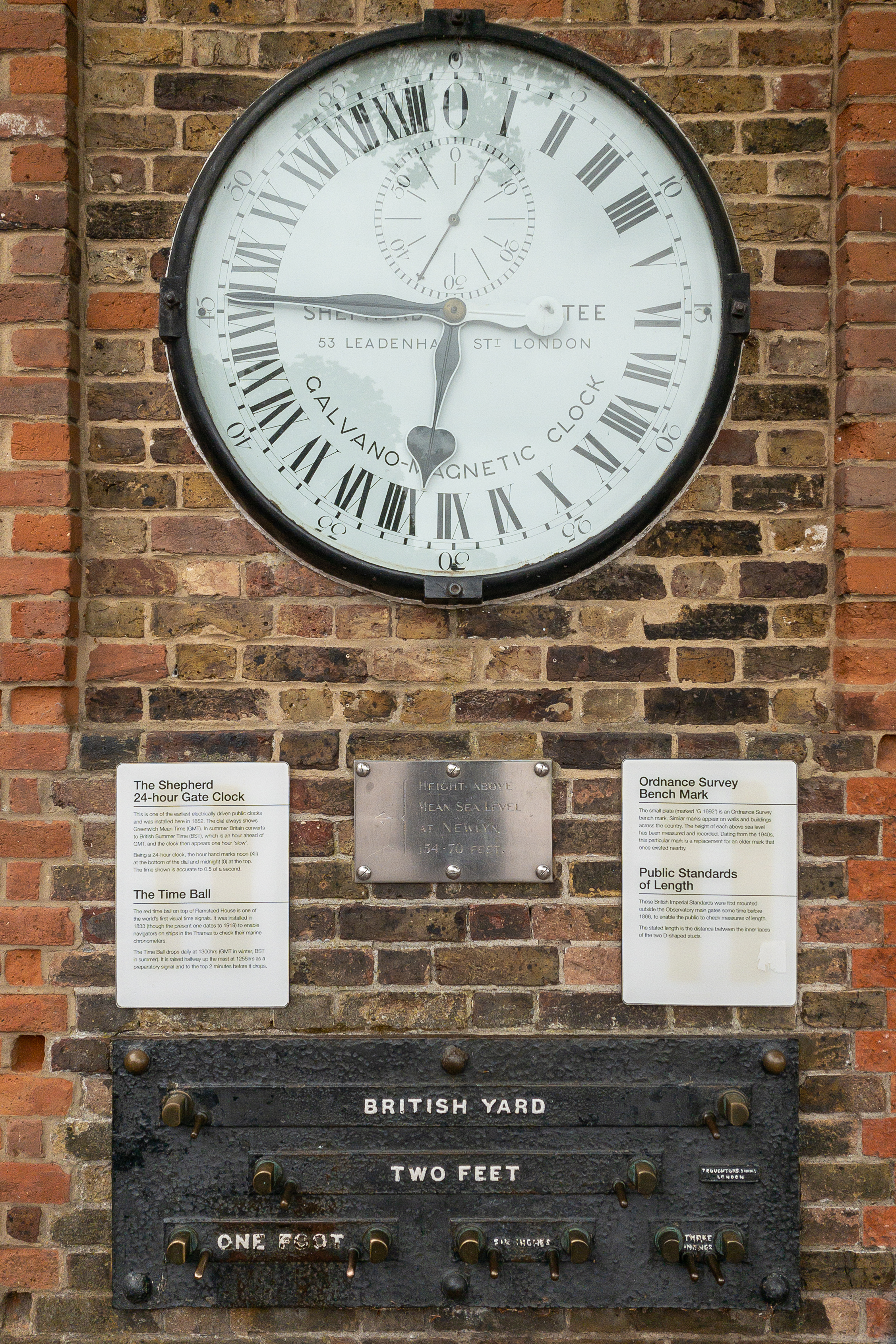
The gate clock and public standards of length. Photograph © Y.ssk / Wikimedia Commons / CC BY-SA 4.0. Reproduced as supplied, with the photographer’s original crop.

How the public dial came about#
On nineteenth-century railways, local time differences made timetables difficult to coordinate. Greenwich Mean Time increasingly served as a common reference, and telegraphy offered another way to convey accurate time over a distance alongside carrying timepieces in person. 3
At the Great Exhibition in London in 1851, clockmaker Charles Shepherd exhibited a system in which a master clock sent electrical signals to drive several secondary clocks. Astronomer Royal George Airy saw it and placed an order in December that year. In his 1852 annual report, Airy described a master clock whose error could be corrected from observations, and secondary clocks to display time around the observatory and outside its gate. The gate dial was intended for the public. 1 5
According to Graham Dolan’s research based on the astronomer’s journal, the frame was fitted to the wall on 20 May 1852 and the clock entered service on 13 August. It cost £75. In his 1853 report, Airy said the same master clock drove the gate clock, clocks inside the observatory and the clock at London Bridge station, as well as providing railway signals and dropping time balls. The gate clock was one of several devices connected to the same master clock. 1 5
Setting the time and sending it electrically#
From observation to the gate#
The pendulum-driven master clock was checked and adjusted using the observatory’s observations. Airy’s 1853 report describes checking its error against another clock, then using an auxiliary pendulum to advance or retard the master clock’s indication. In a later setup, star transits established the error of a sidereal clock, which was compared with the mean-time master clock to calculate corrections. 4 5
Pulses from the master clock travel through wires and operate the electromagnetic mechanism of the gate clock. The secondary clock advances its display in step with the signals it receives. Multiple dials can share the same time reference, with accuracy depending on the adjustment of the master clock, the wiring and the receiving mechanism. 2 4
In 1853 the receiving clock in the chronometer room also followed the master clock and was used to check marine chronometers. A time ball signalled a particular instant to users at a distance, while the gate dial continuously showed the time to people walking past. Both were outlets of the same distribution system. The 1853 report also describes a signal needle at the observatory that confirmed that the Strand time ball had operated. 5
The gate clock’s electromagnetic mechanism has also been altered. Records say the coils were rewound and the armature remagnetised in 1922. The number of electromagnets was reduced from eight to four at some point between the early twentieth century and the early 1930s. The exact year remains unknown. 1
Reading 24 hours and the change of time convention#
The hour hand makes one circuit of the dial in 24 hours, turning at half the speed of one on a 12-hour dial. On the present display midnight is at the top and noon at the bottom. As installed, the clock showed astronomical time, with the day beginning at noon. On 1 January 1885 it switched to civil time beginning at midnight. Reading old photographs by the present convention can therefore shift the interpretation by half a day. The clock displays Greenwich Mean Time throughout the year, including when civil clocks change for summer time. 1
Changes to the clock and its present form#
During installation in 1852, Alexander Bain objected to Shepherd’s name on the dial in a dispute about electric clock patents. The name was removed and restored in 1853. Airy discusses the episode in his autobiography. 1 6
The dial was repaired in 1881. The journal leaves the details of the repair unknown. In 1893 Dent No. 2012 replaced Shepherd’s master clock. Around 1910 the dial was repainted, changing the style of the numerals and scale. 1
An air raid on 15 October 1940 destroyed the gate and damaged the dial, while the mechanism escaped major damage. James Cooke and Son of Birmingham produced a replacement dial. A second one was made and fitted in 1947. When the wall was rebuilt later, the clock moved to the right of its original position. In 1981–1982 the dial, hands and mechanism were removed and the dial repainted to bring it closer to its earlier appearance. A new seconds hand was made in 1982. 1
The control system changed as well. According to Dolan, a Synchronome pendulum clock controlled it from 1960 to 1991, followed by a controller based on the UK’s MSF standard-time radio signal from 1991 onwards. Continued replacements and maintenance have kept the public display in service. 1
Timeline#
| Year | Event |
|---|---|
| 1851 | Shepherd exhibits an electric clock network at the Great Exhibition. Airy orders a system. |
| 1852 | The gate clock is installed and enters service on 13 August. |
| 1853 | Airy reports a system serving the gate, observatory and railway clocks, as well as time balls. |
| 1885 | The display switches from astronomical time beginning at noon to time beginning at midnight. |
| 1893 | Dent No. 2012 takes over as master clock. |
| 1940–1947 | An air raid damages the dial, and the clock stops until a replacement dial is fitted. |
| Around 1960 | The clock is moved to its present location when the gate is rebuilt. |
| 1981–1982 | The dial is repainted and a new seconds hand is made. |
| From 1991 | A controller based on the MSF signal is used. |
The timeline follows Dolan’s research checking individual events against journals and restoration records, and Airy’s annual reports. 1 5
References#
1. Graham Dolan, “The Shepherd Gate Clock,” The Royal Observatory Greenwich, undated. Installation dates, display, damage and repair, and changes in control. https://www.royalobservatorygreenwich.org/articles.php?article=1085 (accessed 4 November 2026).
2. Royal Museums Greenwich, “Our collections: A unique history of timekeeping,” undated. Relationship between the gate clock and the master clock. https://www.rmg.co.uk/collections/our-collections-unique-history-timekeeping (accessed 4 November 2026).
3. Royal Museums Greenwich, “History of Royal Observatory Greenwich,” undated. Railway time and the electrical clock network of 1852. https://www.rmg.co.uk/stories/space-astronomy/history-royal-observatory (accessed 4 November 2026).
4. Dániel Belteki, “Revealing observatory networks through object stories: Instrumental networks,” Science Museum Group Journal, 2023. Greenwich Time System, observation and correction, and diagrams. https://journal.sciencemuseum.ac.uk/article/revealing-observatory-networks-through-object-stories-instrumental-networks/ (accessed 4 November 2026).
5. George Biddell Airy, Reports of the Astronomer Royal, 5 June 1852 and 4 June 1853, excerpts. Plans for installation and accounts of operation. https://www.royalobservatorygreenwich.org/articles.php?article=1357 (accessed 4 November 2026).
6. George Biddell Airy, Autobiography of Sir George Biddell Airy, ed. Wilfrid Airy, 1896, section for 1852. Bain’s objection and the history of the inscription. https://www.gutenberg.org/cache/epub/10655/pg10655-images.html (accessed 4 November 2026).