This article was translated from Japanese using AI. Read the Japanese original
The Swansea Tompion is an unnumbered table clock attributed to Thomas Tompion and dated to about 1675–1680. It strikes the hour automatically and has a separate repeater that sounds the hours and quarters when a cord is pulled. A stepped cam and pins of different lengths select the number of blows, an arrangement that predates the widespread adoption of rack striking. The clock preserves one of the early approaches to telling time by sound on demand. 1
Name and date#
According to John Robey, the clock takes its name from its former owners, the Vivian family, who were involved in copper smelting near Swansea in Wales. Its maker worked in London. Robey’s account leaves the first customer and the circumstances of the Vivians’ acquisition unconfirmed. 2
The date is a scholarly estimate. Robey’s 2005 paper notes that R. W. Symonds dated the clock to around 1675, while Jeremy Evans placed it nearer 1680. There is no inscribed completion year that establishes 1675 or allows a claim of priority to be settled simply by comparison with the account of an invention in 1676 discussed below. 1
The Vivian Tompion No. 47, also from the Vivian family, is a separate clock. Dated to about 1684, it is described as a small pull-repeat clock with a numbered case and without automatic hour striking. The Swansea Tompion is unnumbered and combines ordinary hour striking with a separate repeater. The shared family name and exhibition venue do not identify a single object. 1 3
Ebony veneer and an alarm#
The National Trust catalogue describes it as an ebony-veneered table clock with a basket top, a quarter repeater and an alarm. The listed materials are ebony, wood, metal and brass. It combines an ebony exterior with metal striking mechanisms and offers a time display, pull repeating on demand and an alarm. 4
The entry leaves the dimensions of the case and dial and the alarm strike-count controls unspecified. It records ebony veneer, and gives no evidence of a solid ebony case or of the alarm using the same mechanism as the hour repeater. 4
Two ways of sounding the time in one clock#
Automatic hour striking and pull repeating serve different purposes even when they make similar sounds. The Swansea Tompion has a separate system for each. 1
| System | When it operates | How the strike count is set | What it sounds |
|---|---|---|---|
| Ordinary hour striking | On the hour | Count wheel | Hours |
| Pull repeat | When the cord is pulled | Snail, follower lever and pins of different lengths | Hours and quarters |
The count wheel stops the striking train at notches around its rim. The hammer strikes the bell while the train runs, and the distance to the next locking point determines the count. The clock keeps this arrangement for ordinary hour striking and separately selects the repeat count from the time shown. Robey’s photographs show a large bell for ordinary hour striking and separate bells for repeating hours and quarters. 1
A quarter is a fifteen-minute interval. The repeater sounds quarters, while a minute repeater also sounds individual minutes. The pull repeat operates on demand and the separate hour strike still sounds automatically. 1
Reading the strike count from stepped heights#
A snail with two sets of six steps#
A snail is a stepped cam. Turning it changes the position of a lever, converting the angle representing the time into a displacement that selects the number of blows. The hour repeater has a “double-six” snail with two sets of six steps. It strikes at most six blows, and each count corresponds to two hours six hours apart. 1
One blow, for example, represents one or seven o’clock, and six represent six or twelve. Smith’s 1675 account similarly assigns one blow to seven, two to eight and six to twelve. A listener needs more than the count to distinguish all twelve hours. Robey notes that this arrangement reduces the power required from the repeating train and limits the sideways travel of the lever. 1 6
The lowest step gives one blow and the highest six. The lever stays in contact with the profile of the snail all the time. Robey notes that the order of the steps is reversed compared with the usual later layout, so the operation differs from that of later rack-striking clocks. 1
Sideways movement selects pins of different lengths#
In the hour repeater, a connecting arm and several arbors turn the motion of the snail follower into sideways movement of the hammer tail. The rotating wheel has pins of different lengths. The position of the tail determines how many pins can reach it. Each pin that reaches it lifts the hammer, which then strikes the bell. The strike count is controlled by selecting which pins engage the tail. 1
In Robey’s drawing, the follower rotates in a plane parallel to the dial-side plate. A rocking arm with a pivot axis at 45° to the vertical and other parts transmit this motion at right angles to the plate. A connection with play at both ends joins parts that move in different directions. A wire connects the arbor of the sideways-moving tail to the hammer arbor, so the hammer itself need not shift sideways. 1
The quarters are counted by a similar combination of follower, linkage and arbors, with motion in the opposite direction to the hour system. Selecting only a few quarters requires less sideways travel. In the same limited space, two sets of six steps instead of twelve steps in succession also limit the amount of travel needed for the hours. 1
Comparison with a gathering rack#
In the later rack-and-snail system, the snail sets how far a toothed rack can move and a rotating gathering piece lifts it one tooth at a time. Each tooth gathered corresponds to one blow. The Swansea Tompion’s snail works through the pin arrangement, and the movement has no rack gathered one tooth at a time. 1 2
Robey considers Tompion’s Castlemaine, Tulip and Sussex clocks, dated to about 1680, as a separate group with early rack striking for the hours. Those clocks have a rack to be gathered and a fixed rack to hold it against returning during the process. Comparison shows different ways of counting strikes explored in the same period. 1
Signs of experimentation in the surviving clock#
Robey records that the repeater’s spring barrel sits between the plates. Later Tompion repeaters use a leaf spring. Parts of the pillars and some repeater arbors were filed for clearance, and the edges of the plates are less neatly finished than on later work. 1
Robey interprets these details as evidence of experimental work, with adjustments made during assembly. The clock also has safety devices to avoid damage, for example from reverse motion, making the actual movement more complex than a diagram of its working principle. 1 2
The available technical reports focus on the striking mechanisms and the disposition of their components. 1 3
Reading the evidence about invention#
An important account connecting Edward Barlow with 1676 appears in William Derham’s The Artificial Clock-maker of 1696. Chapter 9 describes the invention of a clock that sounds the time when operated by pulling a cord or a similar means. It does not describe a rack gathered tooth by tooth, so Barlow’s involvement in repeating clocks does not establish that he invented what is now called rack-and-snail striking. 1 5
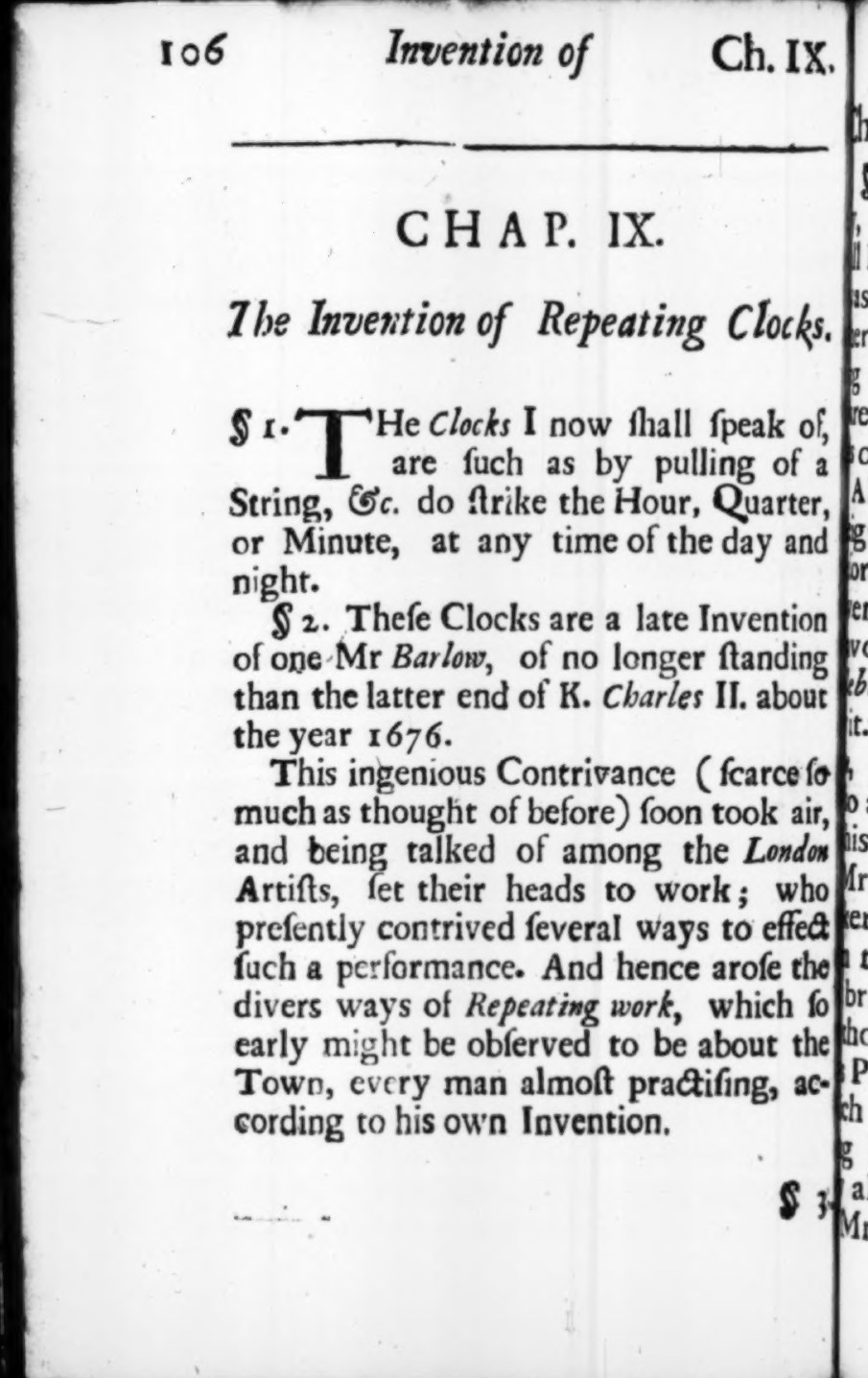
Figure 1. William Derham, The Artificial Clock-maker (1696), p. 106. The page describes pull repeating independently of the design of the Swansea clock. Author William Derham (died 1735). Source Wikimedia Commons file. Public domain, as marked in the file for countries with a term of life plus 100 years and for the United States. Public Domain Mark 1.0. Page extracted, margins cropped and converted to JPEG.
John Smith’s Horological Dialogues of 1675 describes a clock that strikes the hour with six blows or fewer. Its quarters are indicated by the number of bells sounded together. The clock described by Smith has not been identified as the Swansea Tompion. The similarity gives technical context, without establishing who made the clock Smith described or who commissioned the surviving clock. 1 6
Robert Hooke’s diary also records a discussion with Tompion about sounding the time, without specifying a unique arrangement of parts. The Swansea Tompion preserves a concrete early method of deriving a strike count from a stepped cam. 1 2
Provenance, display and the current record#
In 2005 Robey recorded the clock as on loan to the Manor House Museum in Bury St Edmunds. In February 2011 he wrote that it was on display at Lyme Park near Stockport. Each account documents its location at the time. 1 2
Its current collection record is National Trust No. NT 499791. The entry names it as the Swansea Tompion and records that Michael Hugh Vivian bequeathed it for display at Lyme Park on his death in June 2007. It was previously on loan with five other items. One of those items, LYM.H.047, was returned to its lender on 15 June 2017. The Swansea clock was the item bequeathed. 4
As checked in November 2026, the record places it in the Lyme collection in Cheshire. The available sources leave the gallery, public display dates and details such as the dates of restoration and a list of replaced parts unconfirmed. 3 4
Timeline#
| Date | The clock and related records |
|---|---|
| 1675 | Smith publishes Horological Dialogues, describing a clock indicating the hours in six blows or fewer. Its identity remains unconfirmed. 1 |
| About 1675–1680 | Estimated date of the Swansea Tompion. Symonds prefers about 1675 and Evans a date closer to 1680. 1 |
| About 1676 | Date later linked by Derham to Barlow’s invention of a repeater. This does not establish the date of the surviving clock. 1 |
| About 1680 | Early rack hour striking in Tompion’s Castlemaine, Tulip and Sussex group, distinct from the Swansea mechanism. 1 |
| 1696 | Derham publishes The Artificial Clock-maker, describing the invention of clocks that sound the time on demand. 1 |
| Date unconfirmed | Formerly in the Vivian family collection. The dates of acquisition and transfer have yet to be traced in a continuous record. 2 |
| 1951 | Symonds includes it in Thomas Tompion: His Life and Work, cited by Robey as earlier literature on the clock. 1 |
| March 2005 | Robey publishes photographs and working diagrams and reports the loan to the Manor House Museum. 1 |
| June 2007 | Bequeathed for display at Lyme Park on the death of Michael Hugh Vivian. 4 |
| February 2011 | Robey reports it on display at Lyme Park. 2 |
| November 2026 | Official record checked, Lyme collection, NT 499791. Display on a given date and detailed restoration history remain unconfirmed. 4 |
References#
- John A. Robey, “Who Invented Rack-and-Snail Striking? The Early Development of Repeating and Rack Striking”, Antiquarian Horology, March 2005, pp. 584–601. The distributed PDF has its own pagination, 1–18. The examination of the clock and figures 1–3 are on PDF pp. 2–3, and the history of the invention on pp. 5–8. Symonds and others are cited through this paper. Accessed 7 November 2026.
2. John Robey, “The Truth about Barlow”, Clocks, February 2011, pp. 29–33. Previous ownership, display, figures 4–6 and the account of the rackless mechanism are on pp. 31–33. Based on the same author’s study in reference 1, rather than a second independent examination. Accessed 7 November 2026.
3. Carter Marsh & Co., “The Vivian Tompion No.47, circa 1684”. Dealer’s account of No. 47’s case number, mechanism and provenance. Used to distinguish a separate object. Accessed 7 November 2026.
4. National Trust Collections, “Table clock, NT 499791”. Official object record identifying the Swansea Tompion, its materials, form, alarm, bequest and the return of a loaned item. The date field gives 1675 and the description gives circa 1675. Accessed 7 November 2026.
5. William Derham, “The Artificial Clock-maker”, London, James Knapton, 1696, chapter 9, pp. 106–108 (digital PDF pp. 120–122). Near-contemporary account of Barlow, repeaters and Tompion’s making of watches, with no identification of the Swansea clock. Accessed 7 November 2026.
6. J. S. [John Smith], “Horological Dialogues”, London, Jonathan Edwin, 1675, pp. 49–52 (digital PDF pp. 65–68). Distinguishes a clock that repeats the hours automatically from a different arrangement with up to six blows for the hour and the number of bells indicating the quarters. Accessed 7 November 2026.