This article was translated from Japanese using AI. Read the Japanese original
Three separate scales for hours, minutes and seconds occupy the face of a cylinder just under 17 centimetres across. A suspension fitting at the top encloses an iron ball. Opening the back reveals an escapement that drives a sprung balance through a pair of gears. Reinier Plomp, who examined the instrument, identified it as a longitude timekeeper made about 1675–1680 by the Paris clockmaker Isaac Thuret. The dial bears the inscription “Thuret A Paris”. 1
Keeping the time of the port of departure#
To find longitude, a navigator compares the local time observed aboard ship with the time at a reference point at that same instant. An hour’s difference in mean solar time corresponds to 15 degrees of longitude, so an error of one minute on the clock amounts to 15 minutes of arc. The clock carries the reference time, for example that of the port of departure. Observations of the sun supply local time. Instructions published by the Royal Society in 1669 on the basis of Huygens’s work specified how to determine a pendulum clock’s daily rate before sailing and correct for the difference between apparent and mean solar time. They also called for at least two clocks in case one stopped. 2
In the 1660s, while Huygens was improving the pendulum clock, Alexander Bruce devised ways to accommodate the movement of a ship. National Museums Scotland holds Bruce’s marine pendulum clock, made by Severijn Oosterwijck in 1662. Plomp saw in the ball suspension of Thuret’s timekeeper an idea Bruce had introduced in early sea clocks. Inside Thuret’s cylinder, a balance oscillating under the action of a spring sets the period. In a pendulum clock gravity provides the restoring force. 1 3
A cylindrical case and three scales#
Plomp gives the case diameter as 16.8 cm, its depth as 8.3 cm and the dial diameter as 16.0 cm. The thin copper case is covered with grey ray skin and reinforced inside with brass rings. The glazed front door and turned brass rear door both hinge on the left. Two lead plates on the left counterbalance the heavy barrel on the right. A brass tube above the case houses an iron ball with room to move. Plomp regarded this suspension as evidence that the clock was intended for use at sea. 1
Three silver rings are set into the gilt brass dial, with hours at the top, minutes at the lower right and seconds at the lower left. Engraved floral scrolls and masks occupy the spaces outside the scales, with acanthus leaves around the rim. The upper inscription reads “Thuret A Paris”. Inside, a small plate inscribed “THURET” is screwed to the cock supporting the balance staff. A regulator above it adjusts the period of the balance. 1
From the barrel to the balance#
A three-day train#
The wound mainspring supplies the power. The barrel teeth engage the pinion on the minute arbor, and an intermediate wheel transmits the motion to the seconds train, which is connected to the crown escape wheel. Thuret drove the train directly from the barrel, dispensing with the fusee or remontoire that could even out the force of the mainspring. Plomp records a running time of three days. 1
Thuret mounted the escapement that controls the train outside the two movement plates, on the outer face of the back plate. Plomp suggests that this position may have made the new mechanism easier to modify during trials. 1
A balance with a wide arc#
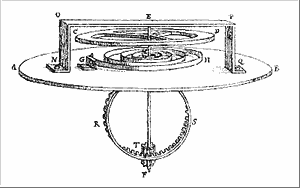
Figure 1. Christiaan Huygens (1629–1695) published this drawing of the regulating mechanism on 25 February 1675. Source: Wikimedia Commons. Public domain (rights information). The drawing was published in 1675, and its author died more than a century ago. Image reproduced without alteration.


In a verge escapement the teeth of the crown wheel act alternately on the pallets, restoring energy to the oscillator. In Huygens’s drawing the pallets and balance are on separate arbors. The large wheel RS on the pallet arbor rocks back and forth and drives the small pinion T on the balance staff. A small arc of the large wheel produces a larger one at the pinion, so the balance can swing through a wider angle than the pallets. The inner end of the spiral spring is fixed to the staff and its outer end to the plate. As the spring coils and uncoils, it returns the balance towards its rest position. This geared arrangement is known as a pirouette. 1 4
The balance in Thuret’s clock measures 4.9 cm in diameter. Plomp records a rotation of about 150 degrees before the next pallet releases and a complete oscillation of about one second. He interpreted the slow, wide swing as an attempt to reduce the frequency with which the escapement acted on the balance. The extra pair of gears also introduced friction at the mesh. Pocket watches soon came to use a balance mounted directly on the verge. 1
Working with Huygens#
According to Huygens’s notes, on 22 January 1675 Thuret heard his explanation and made a first model. The next day Thuret showed him another model of his own making. In a letter published that February, Huygens wrote that a small version of the regulator could serve in a pocket watch and a large one in determining longitude on land or at sea. On 10 September Thuret wrote to Huygens that he had learned the idea of the spiral spring from him and had followed his explanation in making the first model. On 21 November Huygens told Henry Oldenburg that he was sending a clock made by Thuret to England and intended to employ him again. Despite their dispute over credit for the invention, the two men were still in contact about making clocks that autumn. 4 5 6 11
Plomp considered whether Huygens had been involved in making this timekeeper. He cited the suspension, the regulator’s conformity with the published design and Huygens’s continuing interest in a large sprung balance as late as August 1679. He gave no direct record identifying who ordered the instrument and also considered the possibility that Thuret made it on his own initiative. The paper gives no measured rate for this particular clock at sea. 1 9
The 1999 paper includes photographs of the case, train and escapement. Another sprung-balance clock by Thuret is the religieuse table clock studied by Rory McEvoy in 2023. Its balance is visible through an opening in the front, and a French auction in 2009 provides a point of reference for its recent provenance. The cylindrical longitude timekeeper can be recognised by its suspension and the three separate scales on its dial. 1 8
Comparison with eighteenth-century marine timekeepers#
Keeping a clock running aboard ship and keeping the time of the port of departure accurately for weeks posed distinct mechanical problems. Size was one consideration. In July 1675 Huygens wrote that although his portable watch was more accurate than ordinary watches of the day, friction at the pivots and the mainspring force needed to prevent stoppages made it difficult to match a stationary clock, particularly one with a long pendulum. In later years he also recognised the effect of temperature on the rate of a watch fitted with a balance spring. 7 9
In the eighteenth century John Harrison’s H4 combined temperature compensation with a fusee and a remontoire to steady the force reaching the balance. Pierre Le Roy coupled temperature compensation with an escapement that left the balance free of the train for much of its swing. Plomp compared Le Roy’s pursuit of accuracy without a fusee or remontoire with Thuret’s approach. Thuret’s instrument shows both what could already be taken to sea in the seventeenth century and the problems of precision that remained for the eighteenth. 1 10
Chronology#
| Date | Event |
|---|---|
| 1662 | Oosterwijck makes Bruce’s marine pendulum clock. 3 |
| May 1669 | Huygens’s instructions for using pendulum clocks at sea appear in print. 2 |
| January 1675 | Huygens records the two models made by Thuret. 11 |
| February 1675 | The Journal des Sçavans publishes Huygens’s letter and drawing of the regulator. 4 |
| September and November 1675 | Thuret writes about making the model. Huygens tells Oldenburg he has arranged to send him a clock by Thuret. 5 6 |
| c. 1675–1680 | Estimated date of the longitude timekeeper, according to Plomp. 1 |
| August 1679 | Huygens proposes testing a sea clock with a large balance and a spiral spring. 1 9 |
| 1760s | Sea trials of H4 are followed by trials of Le Roy’s timekeepers in France. 1 10 |
| 1999 and 2008 | Plomp publishes his study of the surviving clock. It is later reprinted in the bulletin of the Friends of the Ole Rømer Museum. 1 |
Related articles#
References#
- Reinier Plomp, “A Longitude Timekeeper by Isaac Thuret with the Balance Spring Invented by Christiaan Huygens,” Annals of Science 56(4), 1999, pp. 379–394. Bibliographic record and abstract. Full text of the 2008 reprint, pp. 15–40, especially fig. 1 and sections 5–7. Accessed 24 November 2026.
2. Christiaan Huygens, “Instructions Concerning the Use of Pendulum-Watches, for finding the Longitude at Sea”, 1669. Oeuvres complètes, vol. 6, no. 1743, 1895, especially sections 1–6. Accessed 24 November 2026.
3. Tacye Phillipson, “Calculating longitude at sea: The clock that tried to solve the problem”, National Museums Scotland, object T.2018.215. Accessed 24 November 2026.
4. Christiaan Huygens, letter to J. Gallois, published in the Journal des Sçavans, 25 February 1675. Oeuvres complètes, vol. 7, no. 2014, 1897, pp. 424–425. Accessed 24 November 2026.
5. Isaac Thuret, letter to Christiaan Huygens, 10 September 1675. Oeuvres complètes, vol. 7, no. 2055, 1897, p. 499. Accessed 24 November 2026.
6. Christiaan Huygens, letter to Henry Oldenburg, 21 November 1675. Oeuvres complètes, vol. 7, no. 2078, 1897, pp. 542–543. Accessed 24 November 2026.
7. Christiaan Huygens, letter to Henry Oldenburg, 11 July 1675. Oeuvres complètes, vol. 7, no. 2040, 1897, pp. 477–478. Accessed 24 November 2026.
8. Rory McEvoy, “An early demonstration of the spiral balance spring by Isaac Thuret”, Antiquarian Horology 44(1), March 2023, pp. 43–55. Journal information. Accessed 24 November 2026.
9. J. A. Vollgraff, ed., “Application pratique aux horloges de différents mouvements vibratoires plus ou moins isochrones”, Oeuvres complètes, vol. 18, 1934, especially pp. 505–508. Editorial commentary on the effect of temperature in 1683. For the August 1679 proposal see Huygens’s draft memorandum on the Academy, vol. 8, no. 2185, 1899, p. 197. Accessed 24 November 2026.
10. Richard Dunn / Science Museum, “Movements and maps – the French quest for longitude”, 5 December 2024. Discussion of Le Roy’s trials and escapement. Accessed 24 November 2026.
11. Christiaan Huygens, notes on the idea and first models of the balance spring, 1675–1676. Oeuvres complètes, vol. 7, no. 2008, 1897, especially pp. 409–410. Accessed 24 November 2026.