The Great Clock of Westminster#
This article was translated from Japanese using AI. Read the Japanese original
In the Elizabeth Tower at the Houses of Parliament in London, one pendulum clock drives four enormous dials and sounds a melody every quarter of an hour and a bell on the hour. “Big Ben” originally named the Great Bell that strikes the hours. The tower and clock mechanism have their own names. To keep accurate time while driving large, wind-exposed hands and striking heavy bells, the clock uses separate trains for timekeeping and striking and a gravity escapement that shields the pendulum from changes in external load. 1 2
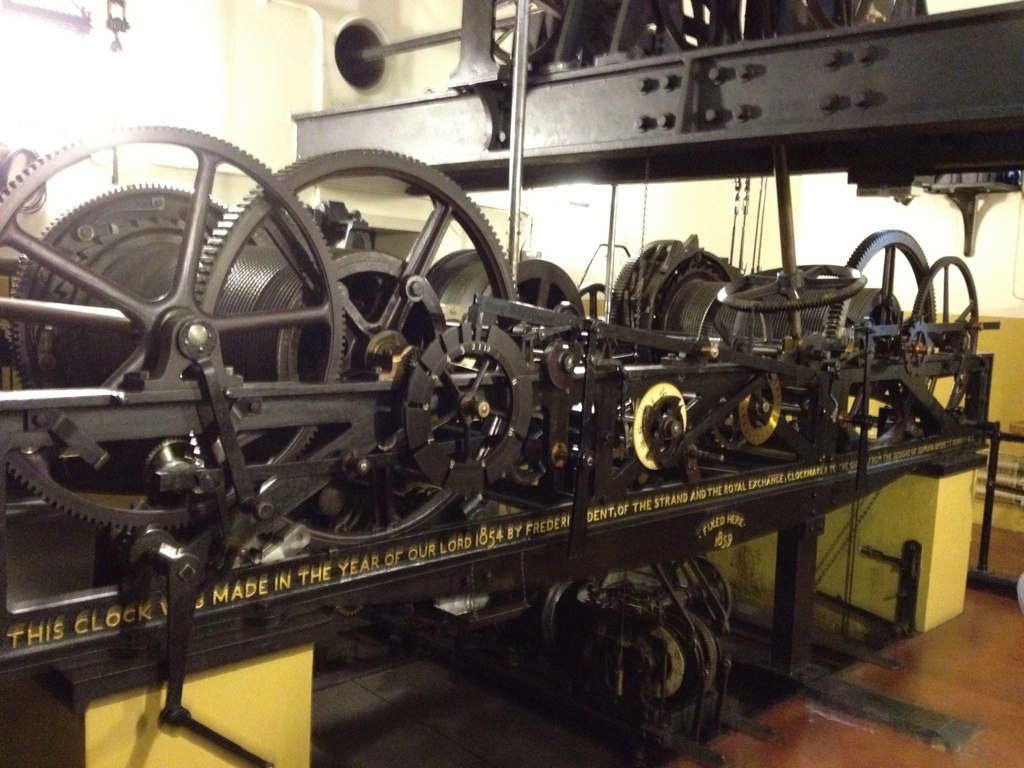
Figure. The Great Clock’s mechanism, photographed in 2012. Photograph by Paulobrad. Source Wikimedia Commons. Licence CC BY-SA 4.0. Reproduced unchanged.

From commission to operation#
After the fire of 1834 badly damaged the old Palace of Westminster, plans were drawn up for a new palace and clock tower. In 1846 a competition was held to select a clockmaker, with Astronomer Royal George Airy assessing entries. The requirement that the first stroke of each hour fall within one second of the correct time was demanding for a tower clock with large exterior hands. Historian Edward Gillin analyses the project as an example of both the collaboration and tensions between astronomers’ theoretical knowledge and clockmakers’ practical experience. 3 4 10
In 1852 clockmaker Edward John Dent took on the work based on Edmund Beckett Denison’s design. Dent died in 1853, and his stepson Frederick Dent took over the business and the commission. The mechanism was completed in 1854. It had to wait for the tower and was installed in April 1859. It began keeping time on 31 May. Its accuracy was checked using time signals telegraphed from the Royal Observatory, Greenwich. 4 5
The design changed during manufacture. In Denison’s later account, the initial drawings were altered to suit the interior of the tower. A spring remontoire, which stores and supplies train power through a small spring, was dropped after trials in which it moved the heavy hands every 30 seconds. A gravity escapement instead isolated the pendulum from changes in force or friction in the train. This is Denison’s own account, published in 1857. 6
One clock drives four dials and five bells#
The cast-iron frame is about 4.7 metres long and 1.4 metres wide, and the mechanism weighs about five tonnes. Each of the four dials is seven metres in diameter. Parliament’s specification lists copper-sheet minute hands 4.2 metres long and weighing 100 kg each including the counterweight. Each hour hand is 2.7 metres long and weighs 300 kg including its counterweight. 2
The going train drives the hands. The quarter-chiming train plays a melody every 15 minutes on four smaller bells, and the hour-striking train strikes the Great Bell. Falling weights supply power. Gears, shafts and wires extending to the belfry move the hands and hammers. The going train’s central shaft distributes motion in four directions. 1
Denison chose the Cambridge Quarters used at Great St Mary’s Church in Cambridge. The Great Bell first struck the hour on 11 July 1859, but a crack was found that year. The largest quarter bell struck the hours in its place. In 1863, at Airy’s suggestion, the Great Bell was turned 90 degrees and striking resumed with a lighter hammer. 3 5
The pendulum and gravity escapement#
The pendulum is about 4.4 metres long, weighs about 310 kg in all and takes two seconds for one swing. Parliament’s specification gives a bob weight of 203 kg and lists concentric steel and zinc tubes. Their different rates of expansion limit changes in the pendulum’s effective length with temperature. A contemporary engineering journal illustrates how the iron parts expand to lower the bob, while the zinc tube raises it. 2 7
An escapement releases the gears in small steps and makes up for lost energy. In Denison’s double three-legged gravity escapement, the train lifts a gravity arm, and the falling arm delivers an impulse to the pendulum. Variations in the load on the train, from wind on the hands for example, are less likely to affect the push directly. 2 7
Old pennies on the pendulum provide fine adjustment. According to Parliament, adding one penny makes the clock gain about 0.4 seconds per 24 hours. Changing the mass distribution slightly adjusts the pendulum’s effective length. 2
Failure and conservation#
The clock has undergone repair and alteration during its long service. On 5 August 1976 a failure in the quarter-chiming mechanism caused substantial damage. A parliamentary answer the next day said the clock was running again and that repairing the quarter-chiming mechanism would take time. The bells escaped damage. Parliament’s timeline records completion of mechanical repairs in time for an event in May 1977. 3 8
During the tower’s major conservation project, begun in 2017, the mechanism was dismantled and lowered from the tower so its gears and bearings could be examined and repaired. The automatic winding mechanism installed in 1912 was also rebuilt. The Great Bell returned to regular service in 2022, the year the conservation work was completed. 3 9
Timeline#
| Year | Event |
|---|---|
| 1834 | Fire destroys most of the old Palace of Westminster. |
| 1846 | Selection of the Great Clock’s maker begins, with Airy judging the entries. |
| 1852 | Dent takes the commission based on Denison’s design. |
| 1853–1854 | Frederick Dent takes over on Edward John Dent’s death and completes the mechanism. |
| 1858–1859 | The Great Bell is recast. The clock starts on 31 May 1859, and the Great Bell first strikes the hour on 11 July. |
| 1863 | The cracked Great Bell is turned and striking resumes with a lighter hammer. |
| 1912 | The automatic winding mechanism is installed. |
| 1976–1977 | The quarter-chiming mechanism fails and is repaired. |
| 2017–2022 | Major conservation of the tower and Great Clock. |
References#
1. UK Parliament, Big Ben Virtual Tour: Mechanism Room (accessed 30 October 2026).
2. UK Parliament, Great Clock facts (accessed 30 October 2026).
3. UK Parliament, A brief history of Big Ben and Elizabeth Tower (accessed 30 October 2026).
4. UK Parliament, Big Ben’s Great Clock celebrates its 160th Birthday, 2019 (accessed 30 October 2026).
5. UK Parliament, Constructing the most accurate clock in the world (accessed 30 October 2026).
6. Edmund Beckett Denison, Clocks and Locks: With a Full Account of the Great Clock at Westminster, second edition, 1857, p. 108 (PDF p. 126, accessed 30 October 2026).
7. The Engineer, The Westminster Clock, 31 October 1856, pp. 587–588 (accessed 30 October 2026).
8. UK Parliament, Hansard, Big Ben, 6 August 1976 (accessed 30 October 2026).
9. UK Parliament, Conserving a clocktower in the middle of a working Parliament (accessed 30 October 2026).
10. Edward J. Gillin, Mechanics and Mathematicians: George Biddell Airy and the social tensions in constructing time at Parliament, 1845–1860, pp. 1–2 and 6–9 (accessed 30 October 2026).