This article was translated from Japanese using AI. Read the Japanese original
Dunsink Observatory, north-west of Dublin, Ireland, began observing in 1785. It was founded as a teaching and research facility of Trinity College and now belongs to the Dublin Institute for Advanced Studies (DIAS). Its role in the history of timekeeping comes from using precision clocks to measure star positions and developing a way to send the time obtained from those observations into the city. London pendulum clocks, Dublin instrument makers, a harbour time ball and the law defining time all figure in the history of the observatory. 1 2 7
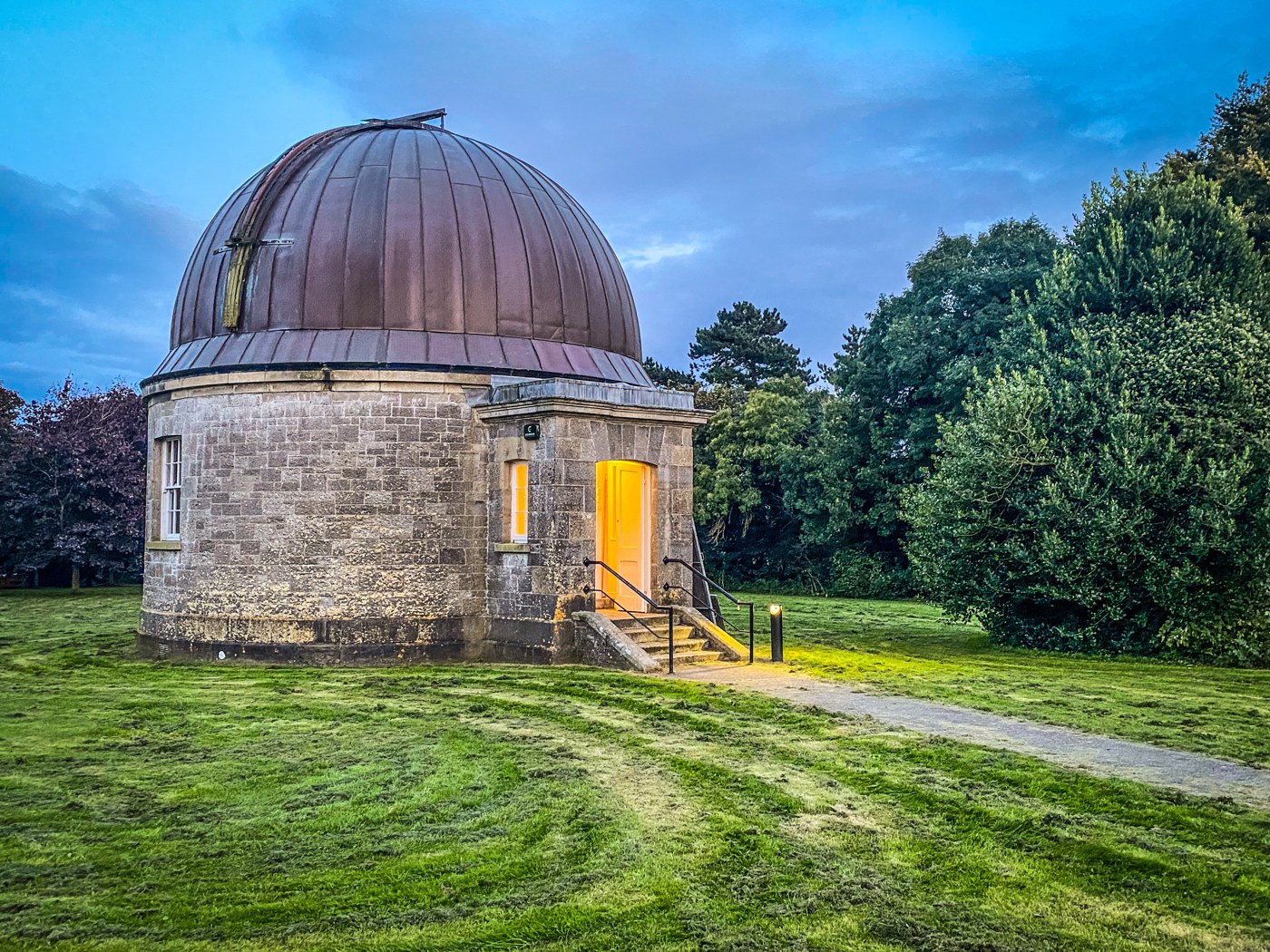
Figure 1. An observing dome at Dunsink Observatory, photographed in 2023 by Dieglop. Wikimedia Commons. CC BY-SA 4.0, which also applies to the image displayed here. Resized and recompressed as JPEG, without cropping or changing the colours.

Living and observing on the hill#
Dunsink is about 8 km north-west of central Dublin, near Castleknock. The site includes a main building that served as a residence, a separate telescope dome and the assistant’s house. The hill provided an open view for measuring celestial directions and an observing environment away from the city. Modern planning documents also treat the observatory as a scientific and cultural site whose surroundings need to be coordinated with urban development. 7 8
Footsteps, wind shaking the building and the way an instrument is supported all affect measurements. At Dunsink the instrument piers were isolated from the surrounding structure. Combining living quarters and observing rooms while keeping the instruments stable is a feature also examined in comparison with the later Armagh Observatory. 7
A bequest, a chair and an observatory#
The project began with a bequest from Francis Andrews, Provost of Trinity College. Robert S. Ball’s 1892 history, drawing on college records, describes the plans for £3,000 to build the observatory and £250 a year for upkeep, alongside a dispute over the inheritance. Trinity College had to make additional contributions and put institutional arrangements in place. 1
Henry Ussher was appointed the first Andrews Professor of Astronomy in 1783. Observations began in 1785. He presented a paper describing the observatory to the Royal Irish Academy on 13 June of that year. It appeared in the first volume of its proceedings, published in 1787. Elements in the original plans such as a long connecting wing were never built. 1 2
John Brinkley took over after Ussher died in 1790. A royal charter in 1792 gave the professor supported by the Andrews endowment the title Royal Astronomer of Ireland and set out appointment procedures, assistants, duties and periodic college visits. The foundation of the chair, start of observations and establishment of the title by charter came at distinct dates. 1 2
Procurement of early instruments involved lengthy dealings between the college and makers in London. Ussher ordered a great circle from Jesse Ramsden, which was reduced from the 10-foot diameter originally conceived and completed by Matthew Berge after Ramsden died. The 8-foot instrument installed in 1808 was intended to measure stellar altitudes and positions precisely. More than twenty years passed between completion of the building and completion of this major instrument, illustrating the difficulties of equipping an observatory away from the makers of such instruments. 1
What the precision clocks measured#
An observer could look through a telescope as a body crossed the north–south meridian and note the reading of the clock at transit. This linked the star’s position and the time. Alignment or mounting errors could still affect the result even if the clock was accurate. Conversely, the transit of a star with a known position revealed how far the clock was ahead of or behind the reference time. Dunsink’s clocks were part of that system of positional astronomy. 1 3
Sidereal time is reckoned from the direction of the stars. Mean solar time, the time used in everyday life, averages the apparent Sun’s irregular motion. The collection inventory records one Arnold clock for solar time and the other for sidereal time. A pair running on different scales shows how time for observation and mean time could be kept separately. 3
The two Arnold pendulum clocks#
The two clocks signed John Arnold & Son have tall mahogany cases, a prominent minute indication and separate seconds and hours. DUN003 is the solar-time clock and DUN004 the sidereal clock. Both have five-rod zinc-and-steel temperature-compensated pendulums to limit changes in effective length and rate as temperature varies. 3
The inventory reproduces Charles Allix’s examination of DUN003, describing a month’s running time, a deadbeat escapement, sapphire contact surfaces and bearings, and Harrison maintaining power during winding. The deadbeat escapement limits recoil while the wheel is locked. Maintaining power keeps the clock running each time it is wound. Precision depended on the escapement, mounting, friction, oiling, temperature and how the clock was wound day to day. 3
Ussher’s observation book for 27 October 1789, examined by Wayman, compares the two clocks, and the 1790 inventory also lists two Arnold clocks. Both therefore date back at least to 1789. The surviving clocks have undergone later alteration and restoration. The inventory records work in 1967–1969. In Wayman’s restoration account, A had survived relatively intact. On B, the pendulum, suspension supports, escapement parts and hands were among the pieces recreated using A as a model. 4 3
Crosthwaite and a long history of repairs#
Dublin clockmaker John Crosthwaite also helped supply and service the observatory’s instruments. Ball’s college history reports that two clocks were sent away for repair in 1793 and that their return was requested in 1800, 1804, 1806 and 1807. One was still under repair in 1815 and 1816. 1
Wayman identifies those two clocks as one by Crosthwaite and one by Arnold. At Armagh Observatory, a Crosthwaite mean-time clock is recorded as having been used at Dunsink and transferred in the 1790s. These records show how clockmakers, the college and observatories acquired, repaired and reused instruments across the region. 4 11
Clockwork to drive a telescope#
William Rowan Hamilton was professor from 1827 to 1865. During his tenure Dunsink was also a place for research in optics, mechanics and quaternions. Observations themselves were carried out by his assistant Charles Thomson and others. 1 2
Under Hamilton’s successor Franz Brünnow, a Cauchoix objective donated by James South was fitted to a Grubb equatorial mounting. Ball gives 17 February 1863 as the date of the gift, and Wayman also gives 1863. The Portal to the Heritage of Astronomy gives 1862, so the sources differ on the year. 14 The South Telescope came into use in 1868. It is a refractor with a clear aperture of 11.75 inches, about 30 cm. 1 2 3
To observe a star continuously, the telescope must follow its movement across the field as the Earth rotates. An equatorial mount has an axis aligned with the Earth’s axis. A mechanical drive turns the telescope about it. The South Telescope was driven by a weight descending inside the mounting pillar, with a centrifugal governor controlling the speed. Two balls move outwards as they rotate, changing friction and limiting the speed. A worm and sector gear moved the telescope, which could track over about two hours of travel. 3
The drive serves a different purpose from the pendulum clocks used for stellar transit observations. The drive described in the inventory has no pendulum control. It uses friction to maintain smooth movement, with enough drive to handle small changes in resistance. Displaying precise time and tracking a star image smoothly are separate design problems. 3
Brünnow used the telescope for studies including stellar annual parallax. In the 1870s the observatory acquired a new transit instrument from Pistor & Martins in Berlin. Ball dates the installation to 1872–1873. The inventory gives 1874–1936 as its period of use. 1 3
Sending observed time to the harbour#
After Robert S. Ball became director in 1874, the observatory added an electric chronograph. It left time signals and observation marks on a recording surface so the observer did not have to read a stopwatch. Wayman says that in 1877 a Dent clock, No. 2032, and a Booth clock replaced the Arnolds as the sidereal and mean-time references respectively. An inventory from the 1880s also records this pair and says the mean-time clock sent time electrically to both the Port and Docks Board and Trinity College. 4 5
The 1880s survey lists two recording cylinders and a controlling clock made by Grubb. The surviving DUN005 in Mollan’s inventory is dated around 1890 and has lost its cylinder and other parts. 1 3 5
Dunsink’s time service sent signals and received confirmation. Ball wrote that the observatory’s mean-time clock controlled the front and boardroom clocks of the Port and Docks Office by the Jones system. The front clock sent a report back to the observatory each minute. The harbour time ball dropped at 1 p.m. Greenwich time, and its fall was also reported back automatically. 1
Mariners could see a time ball fall from a distance and use the instant to set their clocks. Sending a signal along a wire to operate a clock or ball leaves open whether it was obeyed. The return signal confirmed the connection between the reference time obtained by observation and the indication made elsewhere. 1
Wayman describes a target of one second for the service and says stellar transits were observed in many weeks. 2
Dublin mean time and Greenwich time#
Dublin lies west of Greenwich and its local mean time is about 25 minutes 21 seconds behind. Measurements of longitude have been revised over time. David Malone’s account of historical figures and his own measurements distinguishes the point measured at the observatory and which historical longitude is used. 12
The Statutes (Definition of Time) Act of 2 August 1880 required Greenwich mean time in Great Britain and Dublin mean time in Ireland for times stated in laws, deeds and other legal instruments unless otherwise specified. 6
The Time (Ireland) Act 1916 specified that from 2 a.m. Dublin mean time on 1 October 1916, time for general purposes would be the same in Ireland as in Great Britain, during and outside summer time. This ended the use of Dublin mean time as a separate legal basis. The port’s time-ball drop could still have been given in Greenwich time earlier, as Ball’s account records. 1 10
Suspension, revival and preservation#
The time service continued after the chair fell vacant in 1921. F. J. O’Connor kept it going for about a year after Charles Martin died in 1936. The college suspended its observatory work in 1936, and the time service continued until around 1937. After a pause in research, the site passed into state ownership in 1947 and became a base for the DIAS School of Cosmic Physics. Research under Hermann Brück moved into solar spectroscopy and photoelectric photometry, giving new work to a facility previously used for positional astronomy and time distribution. 2 4 7
A fire in 1977 damaged the transit room and instruments. The inventory records intact instruments as well as fragments, restored instruments and parts reused on different mountings. The surviving observatory bears evidence of successive repairs and changes of use. 3 7
The site allows precision clocks, telescopes, architecture, books and records to be studied together and used in science education. Official event information for 2026 brings the historic observatory together with the work of present-day astronomers. Both research and public engagement are part of its role. 13
Preserving the observing environment#
On 12 September 2025, “The Historic Astronomical Observatories of Ireland” was submitted to the World Heritage Tentative List with Birr and Dunsink as its component sites. A cross-border proposal would also include Armagh. Placement on a tentative list is a step towards nomination and formal inscription. 7
As development approaches, preserving the buildings also means preserving darkness and lines of sight. DIAS’s 2022 submission concerning the development plan raises lighting, the view of the southern horizon, the historic meridian and land use around the observatory. 8
On 23 October 2026 Fingal County Council reported councillors’ approval of a Dunsink Urban Area Plan including a cultural district centred on the observatory. It said that measures constituting material amendments could require further public consultation and steps towards final adoption. How to accommodate both the science facility and urban growth remained an open question as of 24 October 2026. 9
Timeline#
| Date | Event |
|---|---|
| 1774 | Andrews dies. His bequest provides the basis for establishing the observatory. 1 |
| 1783 | Henry Ussher becomes the first Andrews Professor. 2 |
| 1785 | Observations begin at Dunsink. Ussher presents an account of the observatory on 13 June. 1 2 |
| 1787 | Ussher’s description appears in the transactions of the Royal Irish Academy. 1 |
| October 1789 | Ussher’s observing book records comparisons between two Arnold clocks. 4 |
| 1790 | Ussher dies. Brinkley succeeds him. 1 |
| 1792 | A royal charter establishes the title Royal Astronomer of Ireland and provisions for the observatory’s operation. 1 2 |
| From 1793 | College records document repairs and efforts to recover the clocks sent to Crosthwaite. 1 |
| 1808 | Installation of the great circle begun by Ramsden and completed by Berge. 1 |
| 1827 | Hamilton becomes professor. 1 2 |
| February 1863 | James South donates an objective to the college on the 17th, according to Ball. 1 |
| 1865 | Hamilton dies. Brünnow succeeds him. 1 2 |
| 1868 | The South Telescope with its Grubb mounting comes into operation. 2 3 |
| 1870s | A new transit instrument is installed. Ball becomes professor in 1874. 1 3 |
| August 1880 | The 1880 Act specifies Dublin mean time for times in legal documents in Ireland. 6 |
| 1892 | Ball moves to Cambridge. Rambaut succeeds him. 1 2 |
| October 1916 | The 1916 Act aligns time for general purposes in Ireland with that in Great Britain. 10 |
| 1921 | The chair becomes vacant, while the time service continues. 2 |
| 1936–1937 | College astronomy activity is suspended after Martin’s death. O’Connor continues the time service for about a year. 2 4 |
| 1947 | Revival under DIAS. Brück reorganises research. 2 7 |
| 1967–1969 | Allix works on the Arnold clocks. 3 4 |
| 1977 | Fire in the transit room. 7 |
| 1988 | The inventory records a restoration of the South Telescope. 3 |
| 2022 | DIAS submits planning comments seeking protections for lighting, views and land use. 8 |
| September 2025 | The historic observatories are submitted to the World Heritage Tentative List. 7 |
| October 2026 | The council announces approval of an urban plan with a cultural district and outlines remaining steps. 9 |
Looking at the observing site, timekeepers, recording equipment, signals sent to the harbour and the rules for using that time shows how precision timekeeping became a public service.
References#
- Robert S. Ball, “The Observatory, Dunsink”, The Book of Trinity College Dublin 1591–1891, 1892, chapter VI, pp. 131–145. The director at the time describes the observatory in the college history. Text. Accessed 24 October 2026.
2. P. A. Wayman, “The Andrews’ Professors of Astronomy and Dunsink Observatory, 1785–1985”, Irish Astronomical Journal 17, 1986, pp. 167–184 and plates. Lecture of 14 March 1985. Paper. Accessed 24 October 2026.
3. Charles Mollan, Irish National Inventory of Historic Scientific Instruments, 2020 release, Dunsink section, pp. 63–66, DUN002–005, DUN008, DUN010 and other entries. Inventory. Accessed 24 October 2026.
4. P. A. Wayman, “Notes on the History of Dunsink Observatory III. The Arnold Clocks”, Irish Astronomical Journal 10(8), 1972, pp. 275–281, plate XIV. Quotes the observing book and discusses the objects and their restoration. Paper. Accessed 24 October 2026.
5. G. H. Boehmer, “Report on Astronomical Observatories”, published in 1889 from a survey conducted in 1886, Dunsink section, pp. 420–421. Report. Accessed 24 October 2026.
6. Statutes (Definition of Time) Act 1880, 43 & 44 Vict. c. 9, section 1. Text. Accessed 24 October 2026.
7. National Monuments Service, UNESCO World Heritage Centre, “The Historic Astronomical Observatories of Ireland”, Tentative List no. 6901, submitted 12 September 2025. Entry. Accessed 24 October 2026.
8. MKO / Dublin Institute for Advanced Studies, Submission to the Draft Fingal Development Plan 2023–2029: Dunsink Observatory, 2022, especially pp. 6–9 and 12–17. Submission. Accessed 24 October 2026.
9. Fingal County Council, “Green light for up to 15,000 homes in Dunsink City Quarter as landmark plan approved by councillors”, 23 October 2026. Announcement. Accessed 24 October 2026.
10. Time (Ireland) Act 1916, 6 & 7 Geo. 5 c. 45, section 1 and schedule. Text. Accessed 24 October 2026.
11. Armagh Observatory and Planetarium, “Regulators”, section on the Crosthwaite clock. Collection description. Accessed 24 October 2026.
12. David W. Malone, “Dunsink and Timekeeping”, section on positions and historical longitudes. Text. Accessed 24 October 2026.
13. DIAS Dunsink Observatory / Dublin Festival of History, “Dublin Festival of History at DIAS Dunsink Observatory”, event on 1 October 2026. Event information. Accessed 24 October 2026.
14. UNESCO Portal to the Heritage of Astronomy, “Dunsink Observatory, Dublin, Ireland”, section on the South Telescope. Text. Accessed 24 October 2026.