This article was translated from Japanese using AI. Read the Japanese original
In Florence’s historic centre, you can walk from a working watch shop to a cathedral clock and a museum of scientific instruments. Panerai on Piazza San Giovanni shows the connection between the shop and the workshop. The cathedral displays a clock that counts the day from sunset. At Museo Galileo, you can compare ways of reading time from the sky and measuring it with mechanisms. Each stop has its own admission arrangements and its own things to see, so allow time accordingly. 126
Opening hours and admission information were checked on 23 October 2026. Times below are local. Consult the official listings before visiting for changes on particular dates and available booking slots.
Three places to visit#
| Place | What to see | Admission and timing |
|---|---|---|
| Panerai Florence boutique | A working shop connecting watch sales and watchmaking | Open daily 11:00–19:00. Appointments are available. 1 |
| Cathedral of Santa Maria del Fiore | Uccello’s 24-hour dial | Tourist admission Monday to Saturday 10:15–15:45. Closed to tourists on Sundays and religious holidays. The cathedral itself is free and requires no reservation. 34 |
| Museo Galileo | Sundials, instruments for telling time by the stars, astronomical clocks and models of mechanical clocks | Usually 9:30–18:00, Tuesday 9:30–13:00. Standard admission €14. Reservations are optional for ordinary individual visits. 59 |
The cathedral clock is visible inside the cathedral at ground level. Free cathedral entry is separate from paid passes that include the dome, bell tower or archaeological remains below ground. Museo Galileo uses its own admission ticket. 45
Piazza San Giovanni and the Panerai boutique#
Panerai’s address is Piazza San Giovanni 14R. Its Italian and English boutique listings say this square has been its base since 1926 and that the business, then called “Orologeria Svizzera”, also assembled and repaired watches. 1
The current shop lists a watchmaker’s bench on the ground floor and a lounge upstairs. The spaces for sales and for watchmaking serve different purposes. If your main reason for visiting is to see historic watches or records, ask the boutique first what can be seen and on what terms. You can use “Book an Appointment” on the official site or call +39 055 215 795. 1
Set aside around 20–30 minutes in the itinerary to see the exterior and step inside if staff are available. This is a suggested stop rather than an official visit duration. For a scheduled consultation or discussion about repairs, allow the time agreed with the boutique.
Panerai’s “Immersion” exhibition at Museo Marino Marini ran from 10 to 19 September 2026. It was a temporary exhibition that had ended by October. 1
The cathedral’s counterclockwise day above the entrance#
Inside the cathedral, look back above the main entrance to see the large dial painted by Paolo Uccello in 1443. The dial is marked with 24 hours and the hand travels counterclockwise. The 24-hour mark at the bottom represents sunset, the boundary between days. The dial reads differently from a modern wristwatch with 12 at the top and six at the bottom. Look at the sequence of the numbers, the star-shaped hand and the faces in the four corners to see how this time display also forms part of the painted interior. 2
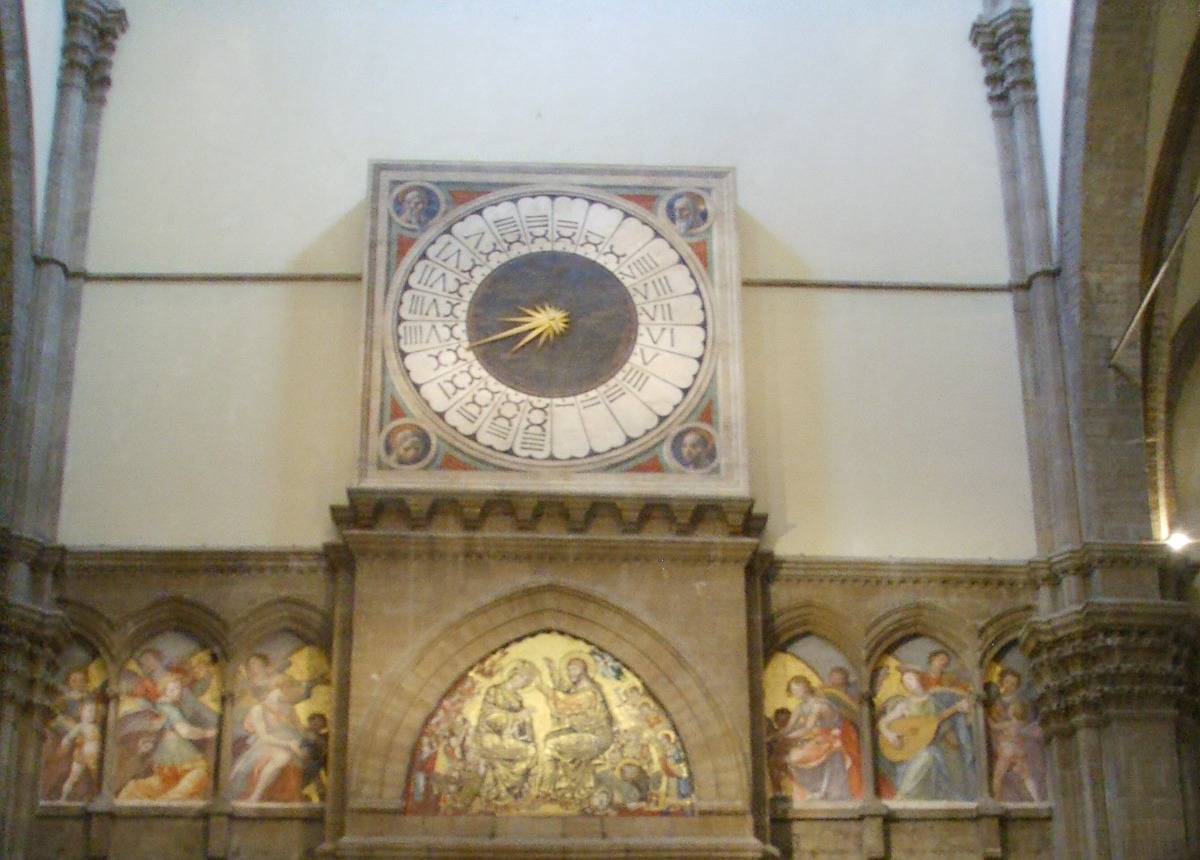
Figure. Uccello’s dial viewed from inside the cathedral. Photograph by I, Sailko (2007). Source Santa maria del fiore, orologio di paolo uccello.JPG — Wikimedia Commons. Licence CC BY 2.5 Generic. Cropped at the top of the original photograph without colour changes.

The mechanism that drives the hand is behind the wall. The current movement is from the eighteenth century. The ordinary visit inside the cathedral gives a view of the dial. 2
Around 20–30 minutes inside is one option, plus time to queue. Leave enough time before the next stop for the admission wait. Visitors must cover their shoulders and legs above the knee. Beach flip-flops are prohibited. The cathedral gives priority to worship. 4
Museo Galileo, from observing the sky to watching mechanisms move#
At Museo Galileo, Piazza dei Giudici 1, start at Room II, “Astronomy and Time”, to find the timekeeping displays. A sundial reads time from the Sun’s position as indicated by a shadow. A nocturnal reads time at night from the position of stars. The instruments show different reference points and scales used to tell time before precision mechanical timekeepers. 6
A nocturnal dated 1554, for example, uses the stars on one face and has a sundial with a folding gnomon on the back. One instrument contains methods for day and night. Looking at the pointer and graduations, and imagining how it would be held, helps explain how it was used. 7
Astronomical clock inv. 3370 in the same room is dated to around 1575 and attributed to Caspar Rauber. The pavilion-like case has different indications on its faces, showing the calendar and lengths of day and night as well as the time. The armillary sphere on top is operated by hand. 8
The interactive area includes enlarged models of a pendulum clock and an escapement. The escapement meters the advance of the train in step with the regulator. The models let you see the repeated locking and release that moves the hands at regular intervals, an action that can be hard to observe in a small finished watch. 10
Another section presents old turret clocks and a working model of Lorenzo della Volpaia’s planetary clock. The original is lost, and the model is a reconstruction based on drawings by his son Benvenuto. The displays offer a chance to see historical instruments alongside models made to explain them. Follow the instructions on site for operating models or running mechanisms. 11
Admission and facilities#
The museum gives an average visit of one to two hours. On Tuesdays it normally closes at 13:00, so schedule the visit in the morning. It lists a special opening until 18:00 on Tuesday, 8 December 2026. It typically closes on 1 January and 25 December, and ticket office sales end 30 minutes before closing. 59
Groups of 15 or more must book, as must people taking guided tours or workshops. Individual visitors can buy a ticket for a chosen day through the official online ticket office. Standard admission is €14, ages six to 18 pay €7 and children under six enter free. The museum lists a €1 fee per ticket for online or phone bookings and does not take part in free admission on the first Sunday of the month. 59
Visitors using a wheelchair or similar equipment should use the entrance at Lungarno Anna Maria Luisa de’ Medici 2 and call staff for help on the intercom. The museum has a lift, wheelchair lifting equipment and accessible toilets on each floor. Tactile visits using models and other materials require a booking and have separate arrangements from ordinary visits. 12
Photography is permitted without flash, tripod or selfie stick. Visitor photos and videos are for private, non-commercial use. Publication or distribution online has separate permission requirements. A Japanese mini-guide PDF is available from the official visitor services page. 13
Walking from the station and adjusting the route by day#
From Santa Maria Novella railway station, walk to Piazza San Giovanni and the cathedral, then follow Via dei Calzaiuoli to Piazza della Signoria and on to Piazza dei Giudici by the Arno. Panerai and the cathedral are around the same square. Visiting them together and seeing the streets on the way to the museum avoids going back and forth.
From the airport, take tram T2 into the centre. Operator GEST describes the connection between Peretola Aeroporto and San Marco–Università. Current route information from Autolinee Toscane lists stops including Alamanni–Stazione SMN. GEST gives about 20 minutes between the airport and the centre, plus time waiting for a tram and walking after you get off. Check the direction and stopping points for each leg on the day of travel. 1415
On Monday or Wednesday through Saturday, one option is the cathedral from 10:15, Panerai from 11:00, then lunch and a walk before spending one to two hours at the museum in the afternoon. Set aside about half a day and allow for the walk from the station, queues and breaks.
On Tuesday, visit the museum first from 9:30 and finish before 13:00, then continue to the cathedral and boutique. On Sundays and religious holidays, plan around the boutique and museum because the cathedral is closed for tourist visits. Choose the dial, instruments or current watch shop you most want to see and fit the stops around that priority. 135
References#
- Panerai, “Panerai Boutique Firenze”, current boutique listings in Italian and English. Address, hours, watchmaker’s bench, lounge, location from 1926 and dates of the temporary “Immersion” exhibition. Italian listing, English listing. Accessed 23 October 2026.
2. Opera di Santa Maria del Fiore, “Paolo Uccello, Monumental clock”. Dial, movement, location and time system. Object description. Accessed 23 October 2026.
3. Opera di Santa Maria del Fiore, “Informazioni”, opening information displayed on 23 October 2026. Visitor information. Accessed 23 October 2026.
4. Opera di Santa Maria del Fiore, “FAQ”. Free cathedral admission without a reservation, dress requirements, and the distinction between tourist entry and paid passes. FAQ. Accessed 23 October 2026.
5. Museo Galileo, “Opening Times & Fees”. Regular and special hours, charges and group conditions. Information. Accessed 23 October 2026.
6. Museo Galileo, “Room II: Astronomy and Time”, online exhibition description. Room guide. Accessed 23 October 2026.
7. Museo Galileo, “Collections”, entry for the nocturnal. Collection guide. Accessed 23 October 2026.
8. Museo Galileo, “Astronomical clock”, inv. 3370. Object record. Accessed 23 October 2026.
9. Museo Galileo, “FAQ”. Average visit length, individual and group bookings, booking fees and free admission policy. FAQ. Accessed 23 October 2026.
10. Museo Galileo, “Time and Space”, interactive section. Exhibition guide. Accessed 23 October 2026.
11. Museo Galileo, “Ancient mechanical clocks”. Turret clocks and planetary-clock model. Exhibition guide. Accessed 23 October 2026.
12. Museo Galileo, “Accessibility”. Dedicated entrance, lifts and tactile visits. Accessibility information. Accessed 23 October 2026.
13. Museo Galileo, “Information & Services”. Photography rules and Japanese guide. Visitor services. Accessed 23 October 2026.
14. GEST, “Aeroporto”. Airport line information. Airport tram guide. Accessed 23 October 2026.
15. Autolinee Toscane, “Servizio Tramvia Firenze - Linea T2”. Current directions and stops. Route information. Accessed 23 October 2026.