This article was translated from Japanese using AI. Read the Japanese original
Greenwich became a centre for checking clocks and distributing time over a distance. Observations at the Royal Observatory, trials of naval chronometers, signals to ships on the Thames and telegraph distribution to the railway and city depended on different instruments and people. 1 4 6
The town by the river and the observatory on the hill#
Greenwich lies on the Thames in London. The royal and naval buildings along the river and the observatory on high ground in the park behind them are part of the same landscape. The Maritime Greenwich World Heritage Site encompasses the observatory, the Old Royal Naval College, the Queen’s House, the park and historic buildings in the town. This article covers timekeeping around that riverside district and the observatory. The modern Royal Borough of Greenwich extends farther, taking in Woolwich to the east and Eltham to the south-east. 2 16
The problem of finding longitude at sea prompted the order to build an observatory in 1675. The former Greenwich Castle site in the Royal Park offered Crown land and existing foundations. Its elevation was suitable for observation, and London’s scientific community was still within reach. John Flamsteed moved in in 1676. The building served as both his residence and a place to conduct a sustained programme of observations. 1
Down by the river, Greenwich Hospital redeveloped the former royal palace site and cared for injured and sick naval personnel. The hospital also owned property in town and redeveloped the town centre in the 1830s. Navigation science on the hill and welfare and education for sailors by the river were distinct activities supported by the Crown and Navy. The hospital buildings subsequently housed the Royal Naval College from 1873 to 1998. Today they serve higher education, music and dance teaching, and public access to the heritage site. 16
Comparing clocks with stars#
An astronomical clock has to be checked against the sky. An observer records the moment a star crosses the local meridian and compares the time with the star’s known position to establish the clock’s error. The clock also carries time between observations. Determining time requires repeated comparisons between the astronomical reference and the continuously running mechanism. 3
An early example is the pair of clocks Thomas Tompion made in 1676 on Jonas Moore’s commission. The movements were set behind the walls of the Octagon Room and had pendulums about 13 feet long. Flamsteed used them to compare intervals between stellar transits. Royal Museums Greenwich explains that their long running time also reduced interruptions for winding and servicing. 7
The clocks involved more than the observers alone. Royal Society records show that one was donated to the Society in 1736 and returned to the observatory in 1835. The object moved among makers, donors, observers and a learned society, showing the connections that supported precision timekeeping. 8
The eighteenth century: Carrying time to sea and finding it from the sky#
To determine longitude at sea, a navigator compares local time found from observations of the Sun or other bodies with the time at a reference place at the same instant. A rotation of 360 degrees in 24 hours makes a difference of one hour equivalent to 15 degrees of longitude and four minutes to one degree. A marine timekeeper carried the reference place’s time aboard ship and kept it there. In his 1767 reply to Maskelyne, John Harrison distinguished a clock always showing the right time from one with a known constant rate. A navigator could correct for a predictable gain or loss and still use the clock to find longitude. 17
The lunar-distance method offered another way. A navigator measured the angle from the Moon to a bright star or another suitable body and used tables to find the time at the reference meridian when that separation would occur. The observed angle needed correction for parallax and atmospheric refraction. The first Nautical Almanac, for 1767 and bearing an imprint dated 1766, supplied the celestial positions needed for this method. Its instructions give lunar distances every three hours of Greenwich apparent time and discuss corrections for parallax and refraction. The U.S. Naval Observatory also identifies lunar distances as a principal purpose of the early almanac. 18 19 27
IMCCE’s account of the history of ephemerides shows that Maskelyne used Mayer’s solar and lunar tables, that Dunthorne and others divided the work of computation and checking, and that the project had connections to French plans for a navigational almanac by Lacaille and others. Tables based on the Greenwich meridian connected theories developed elsewhere with calculators, publishers and observers at sea. 19
The timekeeper method was also tested at Greenwich. Harrison’s H4 underwent comparative trials at the Royal Observatory in 1766–1767. In his reply Harrison questioned how the reference clocks were managed and who witnessed the trials, where the watch and thermometer were placed and how well testing the watch in a vertical position represented its use at sea. The dispute shows that evaluation involved the reference, the conditions and the arrangements for witnesses as well as the figures. 17 20
Related articles include John Harrison, Nevil Maskelyne and the nautical almanac.
Receiving naval chronometers and testing their rates#
The 1821 scheme and the first trials in 1822#
The London Gazette of 26 June 1821 printed an Admiralty notice dated the day before. It announced a depot at Greenwich’s Royal Observatory to increase the supply of naval chronometers and encourage improvements in manufacture. Makers could deposit instruments there for trial and selection for purchase or sale to private buyers. 4
In a lecture to watchmakers in 1866, observatory employee William Ellis dates the first competitive trials to 1822, following the previous year’s announcement. He says that prize trials were suspended in 1836 after thirteen rounds. The government subsequently bought the best chronometers. 5
Stability of rate over time#
Rate is how much a clock gains or loses over a given period. In the 1866 procedure Ellis describes, chronometers received in January were exposed to winter cold, a heating apparatus and room temperature. They were turned to different orientations to check magnetic effects, heated again and compared until about July. The assessment used the range between the highest and lowest weekly rates and the differences between successive weeks. The latter received double weight. 5
The object was to find how much the gain or loss changed under different conditions, such as temperature. For a timekeeper carrying reference time at sea, a predictable rate could be accounted for. If it changed with conditions, corrections became harder. The trials produced a sequence of comparable observations of each instrument. 5
Three ways to distribute time#
A time ball visible from ships#
The time ball installed on Flamsteed House in 1833 gave ships on the Thames and people in town a visible signal. The current instructions say it is raised halfway at 12:55, to the top at 12:58 and dropped at 13:00. Observers watch for the instant the ball moves. 9
It is now operated at 13:00 GMT in winter and 13:00 BST in summer, with operation suspended in high winds. An accurate clock has to be paired with a signal that can be seen and an observer in a position to see it. 9
Delivering time with a portable chronometer#
The museum holds a copy of a newspaper photograph of Maria Belville from 1892, a record of how Greenwich time reached London clockmakers. Its account dates the regular service started by her husband John Henry, using a pocket chronometer, to 1836. Maria took over after his death and later passed it to their daughter Ruth. Visiting customers regularly connected the observatory reference with clocks in town. 10
The service shows one way a workshop far from the observatory could obtain its time. The portable chronometer was checked against the reference, carried to the customer and compared with the customer’s own clock. 10
Driving subsidiary clocks electrically#
In Shepherd’s system, introduced in 1852, a master clock sent regular electrical impulses to operate connected subsidiary clocks. On the gate clock’s 24-hour dial, the XII for noon is at the bottom. The public display let people compare their clocks from outside the observatory. 11
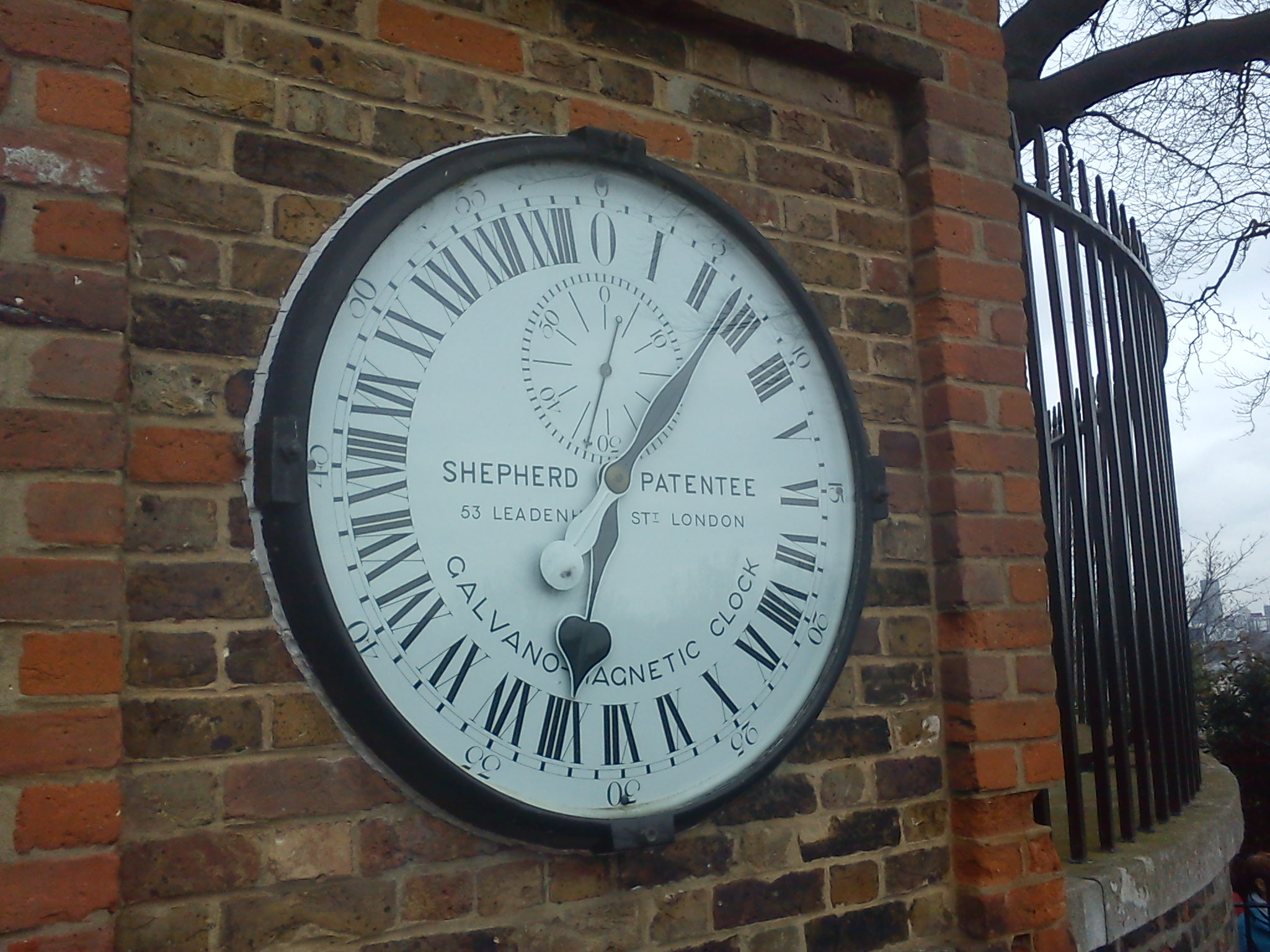
Figure 1. The Shepherd Gate Clock at the Royal Observatory, Greenwich, photographed in 2015. Its 24-hour dial shows noon at the bottom. Photograph by Ulke0004. Wikimedia Commons. CC BY-SA 4.0. Unmodified.

The sympathetic dial ZAA0532, formerly on the observatory’s chronometer comparison table, was part of the same system. The catalogue describes an electrical signal each second operating an electromagnet, advancing a ratchet by one tooth and driving the seconds hand and train. Known as a sympathetic chronometer, it depended on signals from the master clock for its indications. 6
A transcription of the observatory’s 1853 annual report describes daily correction of the Normal Clock by comparison with the observing clock and its connections to the chronometer room, gate, other clocks on site and the railway. Astronomical observation, correction of the reference clock, distribution and comparison with users’ clocks were distinct stages in keeping time accurate. 12
Broadcasting, quartz clocks and moving the observatory#
In the twentieth century, time signals reached radio listeners as well as ships, railways and clockmakers. On 5 February 1924 the BBC first broadcast Greenwich’s six pips. The modified Dent astronomical clock No. 2016 sent electrical signals over a telephone line and the BBC turned them into sound. Listeners could set their clocks by ear at home, in addition to going out to compare them with a public clock. 21 22
Shortt free-pendulum clock No. 3 was introduced that November. The master pendulum was housed in a vessel at reduced pressure and freed as far as possible from driving displays and sending signals. An electrically linked slave clock handled those functions. The maker’s mark identifies the Synchronome company in Clerkenwell Road, London. Greenwich tested and used the clock. 23 24
A quartz clock made under the National Physical Laboratory’s supervision was installed in 1939. War interrupted the project. Air raids interfered with night observations, so by the end of 1940 the time service had moved to Abinger. A separate system was set up in Edinburgh, and the two stations were linked during the war. Quartz clocks made by the Post Office Research Station arrived in 1943, shifting timekeeping and comparison from pendulums to quartz. 24
London’s smoke and light and vibrations from traffic degraded observing conditions. The observatory’s departments moved to Herstmonceux from 1948 onwards. The Greenwich site became part of the National Maritime Museum in 1953, and Flamsteed House opened to the public in 1960. 1
The international meridian agreement and time today#
In 1884 the International Meridian Conference proposed Greenwich’s meridian to national governments as the common origin for longitude. Resolution II of the Final Act specifies the meridian through the centre of the observatory’s transit instrument. Twenty-two voted in favour, one against and two abstained. Japan voted in favour. 13
Resolution IV proposed a universal day for purposes where it was convenient and provided for using local or other standard times where appropriate. Resolution V defined the universal day as a mean solar day beginning at mean midnight on the initial meridian. The resolutions did not bring all clocks into one system on that date. 13
The historical meridian and the reference used by satellite navigation are distinct. The museum places the modern international reference meridian about 102.5 m east of the historical line at the observatory. 14
Time is now generated by another system. The UK’s National Physical Laboratory (NPL) maintains UTC(NPL) with atomic clocks and a primary caesium frequency standard and contributes to international Coordinated Universal Time, UTC. 15
Preserving the places and instruments of timekeeping#
The buildings and instruments on site help tell the history of timekeeping. Observing stars on the hill, comparing clocks, reading the dial at the gate and sending a ball signal to the river were different kinds of work in the same area. The collection records for Tompion’s movement and the sympathetic dial describe their histories, and the gate clock is still on its public site. 6 7 11
As of October 2026 the First Light project was restoring historic buildings and improving the exhibits, routes through the site and accessibility. The museum had announced a long closure of the whole site from 2 November that year. 25 26
Greenwich became a symbol of world time through observation, calculation, trials, maintenance, signals and the comparisons made by users. Even after the research moved elsewhere, the surviving instruments and landscape make it possible to follow that chain.
Timeline#
| Date | Event in Greenwich timekeeping |
|---|---|
| 1675 | Construction of the Royal Observatory is ordered. 1 |
| 1676 | Flamsteed moves in. Tompion’s clocks support observations. 1 7 |
| 1736 | One of Flamsteed’s clocks is donated to the Royal Society. 8 |
| 1766–1767 | H4 undergoes comparative testing at the observatory. The first nautical almanac, for 1767, is published. 17 18 20 |
| June 1821 | The Admiralty announces a chronometer depot at Greenwich. 4 |
| 1822 | The first competitive trials begin, according to Ellis. 5 |
| 1833 | The time ball begins operation. 9 |
| 1835 | The Royal Society’s Tompion clock returns to the observatory. 8 |
| 1836 | Competitive trials are suspended. The Belville time service begins. 5 10 |
| 1852 | Shepherd’s electric clock system is introduced. 6 11 |
| 1866 | Ellis explains the chronometer trial procedure to watchmakers. 5 |
| October 1884 | The final resolutions of the International Meridian Conference include a proposal to adopt the Greenwich meridian. 13 |
| 1924 | The BBC starts broadcasting the six pips. Shortt No. 3 is introduced in November. 21 24 |
| 1939 | A quartz clock made under NPL supervision is introduced. 24 |
| Late 1940 | The time service moves to Abinger. 24 |
| From 1948 | Observatory departments move to Herstmonceux. 1 |
| 1953 and 1960 | The site becomes part of the museum. Flamsteed House later opens to the public. 1 |
| 1997 | The riverside town’s buildings and park are inscribed as a World Heritage Site. 2 |
| 2026 | First Light conservation and exhibition renewal are underway. 25 |
References#
- Royal Museums Greenwich, History of Royal Observatory Greenwich, “Why is there an Observatory in Greenwich?” Accessed 23 October 2026.
2. UNESCO World Heritage Centre, Maritime Greenwich, Outstanding Universal Value and Integrity. Accessed 23 October 2026.
3. Royal Museums Greenwich, Portable transit telescope, AST0986. The individual object is distinguished from the use of instruments of this type to find time. Accessed 23 October 2026.
4. Admiralty Office, 25 June 1821, The London Gazette no. 17719, p. 1351, published 26 June 1821. Accessed 23 October 2026.
5. William Ellis, Lecture on the treatment of chronometers at the Royal Observatory, Greenwich, delivered 1 March 1866, The Horological Journal VII, 1 April 1866, pp. 85–92. Modern transcription consulted. Accessed 23 October 2026.
6. Royal Museums Greenwich, Sympathetic chronometer, ZAA0532, around 1852. Accessed 23 October 2026.
7. Royal Museums Greenwich, A history of the Royal Observatory in six objects, “Year-going clock movement”, ZAA0885. Accessed 23 October 2026.
8. Ellen Embleton, Flamsteed observed, Royal Society, 13 May 2019. Discusses the 1736 record and a 1922 letter. Accessed 23 October 2026.
9. Royal Museums Greenwich, The Greenwich Time Ball and one time for all. Accessed 23 October 2026.
10. Royal Museums Greenwich, Greenwich Mean Time…Mrs Belleville, PAI8786, collection description of the 1892 image. Accessed 23 October 2026.
11. Royal Museums Greenwich, The Shepherd Gate Clock. Accessed 23 October 2026.
12. George Biddell Airy, Reports of the Astronomer Royal, extracts 1836–1868, 1853 report, section V, modern transcription. Accessed 23 October 2026.
13. International Meridian Conference, Protocols of the Proceedings, Gibson Bros., 1884, Final Act, pp. 199–202. Project Gutenberg transcription. Accessed 23 October 2026.
14. Royal Museums Greenwich, What is the Prime Meridian, and why is it in Greenwich?, “Is the Greenwich Meridian still the Prime Meridian?” Accessed 23 October 2026.
15. National Physical Laboratory, Time scales, “Maintaining the national time scale”. Accessed 23 October 2026.
16. Maritime Greenwich World Heritage Site, Our history. Extent of the site, “Astronomy and naval welfare” and “Education, science and heritage”. Accessed 23 October 2026.
17. John Harrison, Remarks on a pamphlet lately published by the Rev. Mr. Maskelyne, 2nd ed., London, W. Sandby, 1767, pp. 2–15. Project Gutenberg transcription. Accessed 23 October 2026.
18. U.S. Naval Observatory, History of The Nautical Almanac, opening and chronology for 1766. Accessed 23 October 2026.
19. Guy Boistel / IMCCE, Le Nautical Almanac and Astronomical Ephemeris (1767–1920), section 1 and “Maskelyne et ses calculateurs”. Historical study in French. Accessed 23 October 2026.
20. Royal Observatory Greenwich history site, Rates of chronometers and watches on trial at the Observatory, 1766–1915. Opening and catalogue description of RGO4/311 consulted. Accessed 23 October 2026.
21. Emily Akkermans / Royal Museums Greenwich, The BBC pips: the Royal Observatory and the Greenwich Time Service, “The first broadcast” and Dent 2016. Accessed 23 October 2026.
22. BBC, The BBC Story: 1920s key dates, 5 February 1924. Accessed 23 October 2026.
23. Royal Museums Greenwich, Shortt Free Pendulum System, No. 3, ZAA0539, mechanism and maker’s mark. Accessed 23 October 2026.
24. Harold Spencer Jones, The Royal Greenwich Observatory, lecture of 27 January 1949, Proceedings of the Royal Society A 198 (1949), pp. 141–169, especially pp. 146–149. BGS scan of the original. Accessed 23 October 2026.
25. Royal Museums Greenwich, First Light: Transforming the Royal Observatory, “A place protected for generations to come”. Announcement as of October 2026. Accessed 23 October 2026.
26. Royal Museums Greenwich, Royal Observatory closures, closure announcement as of 23 October 2026. Accessed 23 October 2026.
27. Commissioners of Longitude / Nevil Maskelyne, The Nautical Almanac and Astronomical Ephemeris, for the year 1767, London, W. Richardson and S. Clark, 1766. Title page, preface and pp. 141–142 and 163–165, CUDL canvases 7, 11, 155–156 and 177–179. Consulted in the original page images. Accessed 23 October 2026.