This article was translated from Japanese using AI. Read the Japanese original
La Chaux-de-Fonds, in the Jura mountains of the Swiss canton of Neuchâtel, grew as makers, assemblers and dealers in watches and components came together in a city of homes, workshops and factories. At about 1,000 metres above sea level, the valley town took up watchmaking alongside farming and metalworking. As industry changed, so did its buildings and streets. The watchmaking town planning of La Chaux-de-Fonds and neighbouring Le Locle was inscribed on the World Heritage List in 2009. 1 2
Its history includes merchants coordinating dispersed workshops, makers seeking to produce affordable watches, immigrants, vocational schools, and workers and municipalities confronting downturns. The products and the city together show how the industry operated across many businesses and trades.
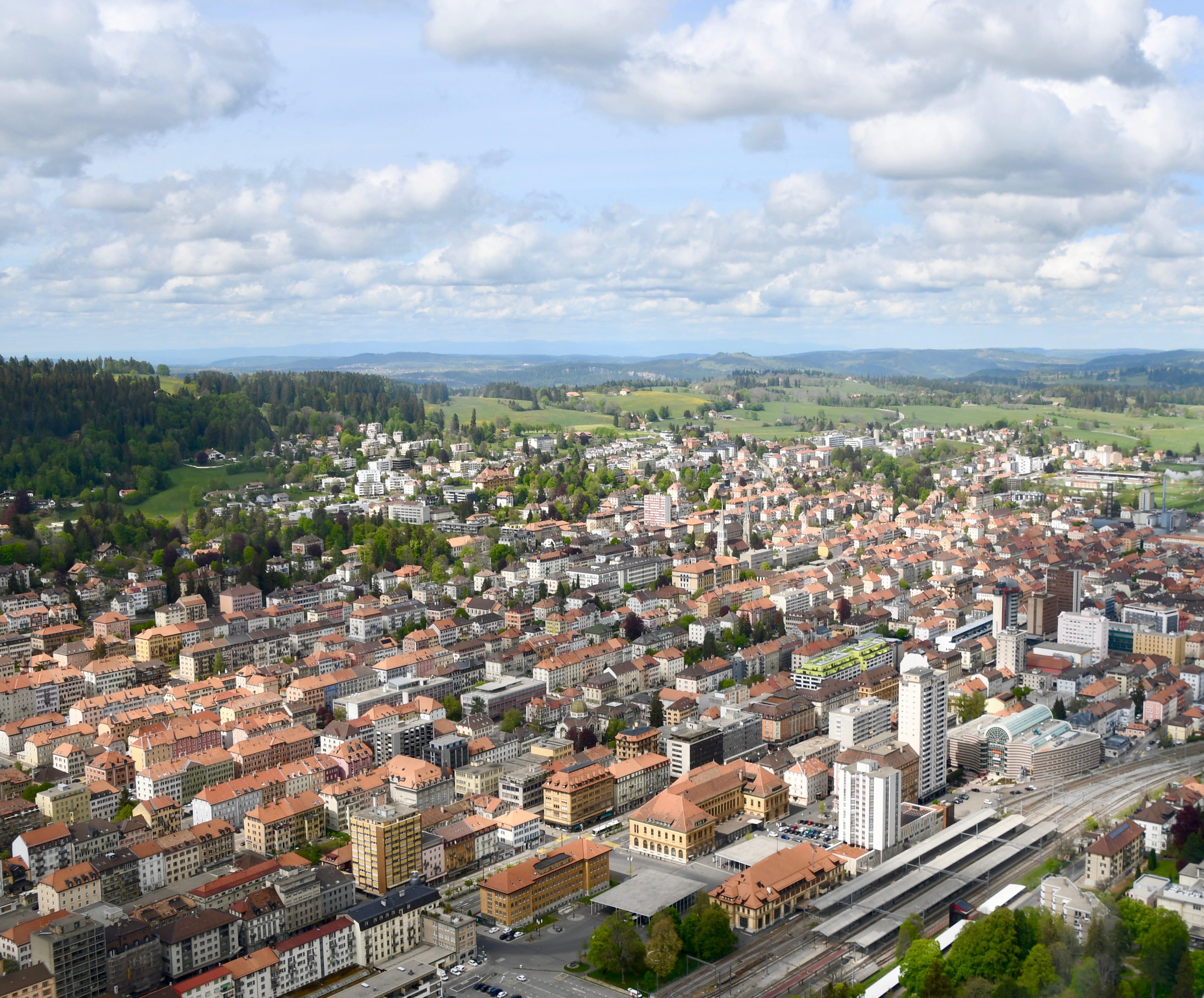
Figure. La Chaux-de-Fonds in 2020. Photograph by Jérémy Toma, from the Wikimedia Commons file record. CC BY-SA 4.0. Unchanged.

From rural settlement to a town of specialised trades#
The city dates its first community to about 1350. It became a centre of local administration in 1656. Lace making and watch and clock manufacture developed in the eighteenth century alongside farming and smithing. The Historical Dictionary of Switzerland counts 68 makers of pendulum clocks, eight cabinetmakers and four bronze founders in the locality around 1750. These clocks required wooden cases and metal ornamentation in addition to their mechanisms. 2 3
The story that Daniel JeanRichard repaired an English watch and brought watchmaking to the Jura mountains is a well-known origin tradition. Published in 1766, it has been retold in various forms as local people have passed down accounts of how the industry began. 4
In the eighteenth century Pierre Jaquet-Droz and his collaborators produced automata as well as clocks and musical devices. The Writer, the Draughtsman and the Musician use cams and other mechanisms to control their movements. The Writer can write combinations of up to 40 characters, the Draughtsman draws pictures and the Musician plays an organ. The Musée d’art et d’histoire in Neuchâtel now holds the three figures. 5 23
Établissage and the specialist trades#
Under the établissage system, several specialists made parts or carried out particular operations. The établisseur coordinated their work and finished and sold the product. Gearing, escapements, dials, cases, decoration and adjustment required different skills. An industrial survey of the town in 1867 counted 54 occupations related to watchmaking. 3 6
Parts travelled between family workshops and craftspeople outside the city, connecting small workshops to a wider trading network and requiring coordination of schedules and quality. In the second half of the nineteenth century, US standardisation of components, machine manufacture and series production of inexpensive watches placed Swiss producers under strong competitive pressure. The Historical Dictionary of Switzerland records a fall in Swiss watch exports to the United States from 18.3 million francs in 1872 to 3.5–4 million in 1877–1878. Factory consolidation overlapped with the established division of labour as production gradually changed. 6 7
Fire, streets and transport#
A fire in 1794 burned the centre of the village. Reconstruction and nineteenth-century population growth led to urban planning that took into account climate, terrain, sanitation and the needs of industry. Engineer Charles-Henri Junod’s plan of streets meeting at right angles was implemented from 1841. 2 3
Streets accommodated homes with well-lit workrooms, buildings that brought dispersed jobs together, employers’ and workers’ housing, and later factories. Natural light helped those working with tiny parts, while the terrain and sanitation also shaped the city. The city’s guide identifies farm workshops, buildings with rows of windows and factories as buildings from different periods that reflect changes in production. 1 7
The railway also changed the conditions for trade. The first section linking Le Locle and La Chaux-de-Fonds opened in 1857, and the line reached Neuchâtel in 1860. Some records date the ceremony to 1 July and the start of service to 2 July, while the city dates the opening to 2 July. The year is used here because the accounts describe the dates differently. Improving transport for watch merchants and products in the mountains was one reason for building the railway. 8 9 20
Society and immigration#
The watch trade drew craftspeople and merchants from different backgrounds. According to the Swiss Federation of Jewish Communities, merchants from Alsace settled from the 1830s, trading in watches and components and later taking part in manufacture. The community was founded in 1833, and the city council granted freedom of settlement in 1857. 10
Economic success and coexistence were accompanied by discrimination. Antisemitic riots broke out during the watch industry downturn of 1861, and some residents left. A synagogue opened in 1863 and a new one was built in 1896. The local historical society records the community’s participation in cultural, political and civic associations as well as economic life. 10 11
After the republican revolution of 1848 in Neuchâtel, industrialisation and population growth created a need for public services and education. The watchmaking school opened in 1865 to teach skills and theory. Its teachers collected timepieces as teaching material, laying the basis for the later Musée international d’horlogerie. 3 12
Watch decoration also had links to art education. In the father’s diary published by the city library, Charles-Édouard Jeanneret, later known as Le Corbusier, is recorded entering the art school in 1902 and studying engraving and drawing. The city says pupils learning to engrave watch cases used Art Nouveau patterns. From 1905, under their teacher L’Eplattenier, they developed the Style sapin, or fir-tree style, drawing on local nature. Education connected decoration on small watches to the city’s architectural culture. 21 22
An affordable watch from Roskopf#
Georges-Frédéric Roskopf’s “Proletarian Watch” shows how the same manufacturing network served other markets alongside luxury watchmaking. According to the Musée international d’horlogerie, the watch made in the city in 1867 showed only hours and minutes, went without precious metals or decoration and sold for 20 francs. It cost less than a high-end watch but was still out of reach for many workers. 13
Roskopf kept the movement to 57 parts, omitted one wheel from the train and used a pin-pallet escapement. On early versions, the user set the time by moving the minute hand directly. The train transmits the spring’s power, and the escapement lets it advance in steps in time with the balance’s oscillations. Simplicity in the design reduced the parts and assembly operations required. 13
A contemporary publication covering the horology class at the 1867 Paris Universal Exhibition lists Roskopf among the bronze medallists. Early watches were made by établissage. Parts came from dispersed workshops, with final assembly and sale at the office. The museum describes the separate factories built by successor firms Wille Frères and Charles-Léon Schmid in 1891 as a step towards centralised production. 13 14
Roskopf’s US patent 75,463 of 1868 describes mounting the escapement on a separate, replaceable plate and adjusting its position with screws and related fittings. 15
Different companies and technologies#
The industry’s buildings still reflect the change from dispersed workshops to factories. According to the city’s architectural guide, the enterprise Achille Ditisheim founded in 1881 began in small premises and built a large factory on Rue du Parc in 1904. It became Movado. Vulcain grew from the business Maurice Ditisheim started in the city in 1858 and introduced the Cricket alarm wristwatch in 1947. 7
Precision mechanisms and decoration also covered a wide range. Girard-Perregaux explains that the three gold bridges in its La Esmeralda pocket watch, which won gold at the Paris Universal Exhibition of 1889, supported the mechanism and were central to its appearance. Gold cases made in the city in the late nineteenth century drew on the decorative trades and served wealthy international customers. Roskopf’s simplified watch illustrates another price range and use served by the same city. 13 16
Research into materials that reduced the effects of temperature shows the reach of the Jura’s horological technology beyond one town. Charles-Édouard Guillaume, from Le Locle, studied alloys including Invar, with low thermal expansion, and Elinvar, with elasticity that changes little with temperature. Invar reduces dimensional changes in components such as pendulums. Elinvar reduces temperature-dependent changes in the elasticity of a balance spring. Guillaume’s Nobel lecture notes that the spring still needs to be paired with a suitable balance. 17
Crisis and reorganisation#
The city’s dependence on demand for watches made it vulnerable to downturns. In response to the crisis of the early 1930s, La Chaux-de-Fonds and Le Locle established ORIN in 1934 to seek out new industries. It attracted manufacture of products such as radio equipment, opening up work beyond watchmaking. 3
After growth following the Second World War, changes in watchmaking had a profound effect on the population and employment in the 1970s. According to the Historical Dictionary of Switzerland, in 1975 alone the city lost more than 1,000 residents and more than 2,000 jobs, mainly in watchmaking. Quartz technology and international competition changed how watches were made and sold. 2 3 6
The city’s account of its economy describes watch businesses and specialist skills as an economic foundation to this day. The connections among component manufacture, assembly, decoration and restoration offer a way to understand the earlier division of labour. 18
School, museum and World Heritage#
The watchmaking school’s teaching collection provided a basis for the city to sign the founding document for a horological museum on 24 March 1902. Ferdinand Berthoud’s marine chronometer No. 12 of 1774 entered the collection that year and exemplifies the precision timekeeping needed for navigation. The museum kept collecting and acquired a Jaquet-Droz musical clock depicting the fable of the fox and the stork in the 1920s. Its new building was completed in 1974. 12
The World Heritage inscription covers the watchmaking urban landscape of La Chaux-de-Fonds and Le Locle. UNESCO recognised the combination of dwellings, workshops, employers’ homes and later factories. Industrialisation left different phases of production visible together in the same city and along older streets. 1
In 2020 the “Craftsmanship of mechanical watchmaking and art mechanics” shared by France and Switzerland was inscribed on UNESCO’s Representative List of the Intangible Cultural Heritage of Humanity. This distinct designation covers knowledge and skills across occupations in design, manufacture and restoration. Buildings and the transmission of skills preserve different aspects of the same horological culture. 19
Timeline#
- Around 1350. The first community forms, according to the city. 2
- 1656. It becomes a centre of local administration. Horology and lace making develop in the eighteenth century. 3
- 1794. Fire burns the village centre. 2
- 1841. Junod’s grid plan comes into effect. 2
- 1848. Republican revolution in Neuchâtel. 3
- 1857. The railway section to Le Locle opens. 8
- 1865. The watchmaking school opens. 12
- 1867. Roskopf’s affordable watch goes on sale and wins a bronze medal in the horology class at the Paris Universal Exhibition. 13 14
- 1891. The two successor companies making Roskopf watches build their own factories. 13
- 1902. The founding document for the horological museum is signed. 12
- 1934. ORIN is established to attract new industry. 3
- 1974. The new Musée international d’horlogerie building is completed. 3
- 1975. Large losses of population and employment. 3
- 2009. Watchmaking town planning is inscribed on the World Heritage List with Le Locle. 1
- 2020. The craftsmanship of mechanical watchmaking and art mechanics in Switzerland and France is inscribed on UNESCO’s Representative List of intangible heritage. 19
References#
UNESCO World Heritage Centre, La Chaux-de-Fonds / Le Locle, urbanisme horloger
Jean-Marc Barrelet, « Chaux-de-Fonds, La », Dictionnaire historique de la Suisse
Éditions Antipodes, L’invention de l’horloger: De l’histoire au mythe de Daniel JeanRichard
Musée d’art et d’histoire de Neuchâtel, The Jaquet-Droz automata
Estelle Fallet and Béatrice Veyrassat, « Horlogerie », Dictionnaire historique de la Suisse
Ville de La Chaux-de-Fonds, La Chaux-de-Fonds et Le Locle à pied, 2012
Ville de La Chaux-de-Fonds, « Un train pour se relier », Le Tourbillon, 2026
Fédération suisse des communautés israélites, La Chaux-de-Fonds
Musée international d’horlogerie, Dossier de presse: exposition Roskopf, pp. 4–8
UNESCO, Decision 15.COM 8.b.8, Craftsmanship of mechanical watchmaking and art mechanics
Bibliothèque de la Ville de La Chaux-de-Fonds, Le Corbusier vu à travers le Journal du père
Musée d’art et d’histoire de Neuchâtel, Mouvements, exhibition, room 5