This article was translated from Japanese using AI. Read the Japanese original
The lakeside city of Neuchâtel supported watchmaking in the Jura mountains through astronomical observation, electrical communication, precision testing, research and education. It developed its own role in connection with La Chaux-de-Fonds and Le Locle in the same canton. Here, the history of watchmaking can be traced through institutions that measured precise time, sent it over long distances and certified how watches performed. 1 2
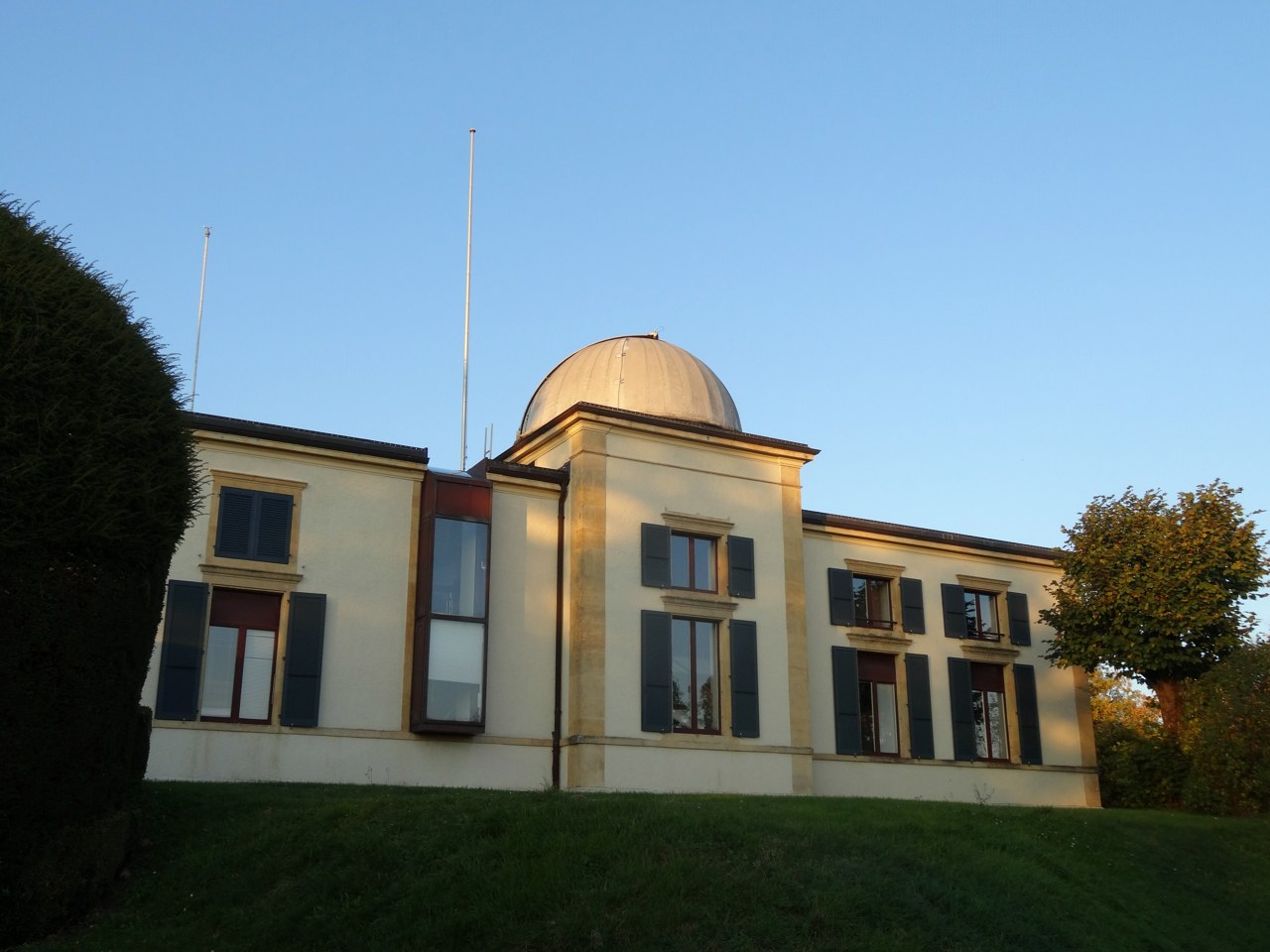
Figure 1. La Méridienne at Neuchâtel Observatory. The early building housed a meridian instrument. Photograph by Sinenomine2, 2013. Source Wikimedia Commons. Licence CC BY-SA 3.0. Resized to 1,280 pixels wide and recompressed as a JPEG. The displayed image carries the same licence.

The lakeside capital and the mountain watchmaking centres#
Neuchâtel, Neuenburg in German, is the cantonal capital on the shore of Lake Neuchâtel in western Switzerland. Railway lines along the foot of the Jura connect with routes into the mountains. In 2021 it merged with Corcelles-Cormondrèche, Peseux and Valangin. The focus here is the historic lakeside city. 1
The settlement around the castle and church dates back to the Middle Ages. In the nineteenth century it became a city of administration, education and industry. Businesses listed in the Historical Dictionary of Switzerland include Suchard’s chocolate enterprise, which came to Serrières in 1826, Hipp’s telegraph and electrical apparatus factory, and later companies working with ébauches and precious metals. 1
The cantonal capital brought together shared facilities needed by watchmakers and firms in the mountains. Public institutions supplied time and testing that would otherwise have required expensive instruments and expertise in individual workshops. The city’s history records that connection between watchmaking, government and science. 2
The observatory and the needs of watchmaking#
From a public clock to a scientific standard#
Auguste Bachelin’s L’Horlogerie neuchâteloise of 1888 describes a public regulator in the town hall and a small meridian instrument in its attic before the cantonal observatory existed. A meridian instrument is a telescope used to observe when a celestial body crosses the north–south reference plane. Comparing the time kept by the regulator with celestial observations reveals its gain or loss. As higher-grade watches developed, more stable observations and scientific oversight were needed. 3
The cantonal observatory was founded in 1858 with Adolphe Hirsch as its first director. After the buildings were prepared and the instruments installed, transmission of time by telegraph began on 25 June 1860. 3 4
The observatory was placed on the Mail hill to avoid the smoke and dust of the town. The site was chosen for its observing conditions. Testing precision depended both on the quality of the clocks and on the environment in which they were measured. 5
Determining, keeping and transmitting time#
The observatory determined time from celestial observations, kept it with a regulator while checking the difference between observations and the clock, and sent it as electrical signals to distant users. An error at any point made the time received at the workshops less reliable. 2 3
In Bachelin’s contemporary account, an electric clock set against observations emitted a signal at 1 p.m. It reached Bern, La Chaux-de-Fonds, Le Locle and other places. Users compared it with the local public regulator and determined a correction. Master clocks further distributed the time to secondary clocks in streets and workshops. Communications shared the same standard between city and mountains, alongside transport that carried goods. 3
Hipp’s electrical apparatus business illustrates that connection. The Historical Dictionary of Switzerland dates Hipp’s founding of a factory for telegraph and electrical apparatus in Neuchâtel to 1860. The cantonal historical society’s material puts the establishment of the factory there in 1873. The date given here for the company’s founding follows the dictionary. Electric clocks became part of urban infrastructure connecting the observatory, public clocks and subscribing workshops. 1 3 5
A city that certified performance#
Distributing the correct time and assessing submitted timepieces were separate tasks. Neuchâtel Observatory observed instruments submitted by manufacturers over a given period and recorded their rates in relation to position and temperature. In Bachelin’s account, the certificates differed for marine and portable instruments and according to test duration and number of positions. 3
The testing made it possible to compare makers’ adjustments by measurement and connected products’ reputations to assessment by a scientific institution. Historical research at the University of Neuchâtel describes the observatory as an institution that helped shape an economy of quality. Competition in precision encouraged skill and mattered for trust in the marketplace. 2
Sources describe the beginning of the competitions at different levels of detail. The university’s research summary mentions competitions from 1860, and Bachelin says the canton created prizes for outstanding timepieces in 1865. The system of testing and rewards took shape in the 1860s. 2 3
Education, collaborative research and electronic watches#
The city established a watchmaking school in 1871. It became a school of mechanical and electrical engineering in 1936 and joined a regional vocational education organisation in 1978. The university was established in 1909. The school’s evolution shows how the city’s base of watchmaking skills extended to machinery and electricity. 1
During the twentieth century, collaborative research gained importance alongside development by individual firms. The Swiss watch research laboratory LSRH was established in 1939 through an agreement with the university, and the Centre électronique horloger (CEH) followed in 1962. The Beta series developed by CEH resulted from research on how to fit a quartz oscillator and electronic circuitry into a wristwatch. 6 10
Quartz watch development involved the oscillator’s performance, the circuitry’s operation on a small battery, the transmission of signals to the display and fitting the whole design within wristwatch dimensions. CSEM’s history of low-power integrated circuits and miniaturisation shows how watch research fed into wider microtechnology. 6
In 1984 CEH, LSRH and FSRM formed CSEM. In 2007 the cantonal observatory’s activities were reorganised and passed to the university and CSEM. The ability to work with precise time and frequency has continued as part of the city’s technical base through these organisational changes. 6 7
Moving heritage objects and the memory of science#
Automata at the Musée d’art et d’histoire#
The Musée d’art et d’histoire de Neuchâtel (MahN) holds the Jaquet-Droz automata known as the Writer, the Draughtsman and the Musician. They were made in La Chaux-de-Fonds between 1768 and 1774 by Pierre Jaquet-Droz, his son Henri-Louis and Jean-Frédéric Leschot. Their present location shows how works made in one city of the canton came to be kept in another. 8
The collection entry for the Draughtsman credits Henri-Louis with making it in 1772–1774 with Leschot’s help. Three interchangeable sets of cams control the hand so that it draws on paper. A cam’s profile directs another part as it turns, encoding a sequence of motions in a mechanical shape. Reproducing human gestures applies knowledge of precision mechanisms to a task other than telling time. 9
The museum’s exhibition page dates the gift to the city to 1 May 1909. When the page was checked on 13 November 2026, it said the Writer was out of operation for repairs and remained on display. 8
Preserving the observatory buildings#
At the former observatory, observing instruments and buildings have become heritage objects in the science of measuring time. The Pavillon Hirsch records the expansion of the facilities in the early twentieth century. The EspaceTemps association opened an exhibition space inside it in May 2022 to document that history. The heritage here includes the equipment for observing, comparing and communicating time. 11
A cantonal decree of 2007 gave the university’s time and frequency laboratory responsibility for activities including teaching and basic research and transferred other applied research and development to CSEM. The observatory’s history survives in the buildings and the activities carried on by the research institutions. 7
Timeline#
| Year or period | Development related to the city’s horological culture |
|---|---|
| Middle Ages | The town forms around the castle and church. |
| 1768–1774 | The three automata later held by the city museum are made in La Chaux-de-Fonds. |
| 1858 | The cantonal observatory is founded. Hirsch becomes its first director. |
| 25 June 1860 | Time transmission by telegraph begins. |
| 1860s | Systems for testing timepieces and awarding prizes develop. |
| 1871 | The city establishes a watchmaking school. |
| 1 May 1909 | The automata are donated to the city. |
| 1909 | The university is established. |
| 1936 | The watchmaking school becomes a mechanical and electrical school. |
| 1939 | LSRH is established. |
| 1962 and 1967 | CEH is founded and Beta quartz wristwatch prototypes are made. |
| 1984 | Three research institutions form CSEM. |
| 2007 | Activities of the cantonal observatory pass to the university and CSEM. |
| 2021 | The merger with three neighbouring municipalities expands the city. |
| May 2022 | EspaceTemps opens an exhibition space in the Pavillon Hirsch. |
| November 2026 | The museum displays the automata, while observatory preservation and technical research carry on the city’s horological culture. |
The timeline draws on the references below. Alongside workshops making finished watches, Neuchâtel had institutions that tested performance, distributed a common time and conducted and passed on research. 1 3 6 8 11
Main sources#
The city’s history follows the Historical Dictionary of Switzerland. Bachelin’s contemporary account describes nineteenth-century facilities and practices. The research institutions’ own histories document how their roles changed. 1 3 6
References#
All sources checked on 13 November 2026.
- Jean-Pierre Jelmini and Michel Egloff, “Neuchâtel (commune)”, Historical Dictionary of Switzerland, revised 8 September 2021. Identification, urban history, economy and education.
2. Université de Neuchâtel, Institut d’histoire, “L’Observatoire cantonal de Neuchâtel (1858-1948)”. Description of the 2018–2022 research project on precision culture, certification of quality and time distribution.
3. Auguste Bachelin, L’Horlogerie neuchâteloise, 1888, Bibliothèque numérique romande digital edition, chapter 25, “Observatoire cantonal”, original pp. 179 onwards. Observations, transmission of signals and test categories.
4. Musée EspaceTemps, “L’Observatoire”. Purpose of the facilities and timeline from 1858 to 2007.
5. Société d’histoire et d’archéologie du canton de Neuchâtel, “Un observatoire pour l’industrie horlogère”. The Mail site and the nineteenth-century industrial and communications setting.
6. CSEM, “Geschichte und Spin-offs”. Institutional history and technology transfer in 1939, 1962, 1967 and 1984, as reported by the institution.
7. République et Canton de Neuchâtel, “Décret sur l’intégration d’activités issues de l’Observatoire cantonal au CSEM”, 25 April 2007, version as of 28 May 2013, arts. 1–2. Transfer of activities to the university and CSEM.
8. MahN, “The Jaquet-Droz automata”. Place of manufacture, makers, 1909 donation, display and operating status.
9. MahN collection record, “Automate ‘Le Dessinateur’”, object AA 3, 1772–1774. Maker and interchangeable cams.
10. ETA SA, “50 Jahre ETA Quarztechnologie”. Official history distinguishing the 1967 Beta 1 and 2 prototypes and the industrial Beta 21 of 1970.
11. Musée EspaceTemps, “Le contexte”. Scientific heritage preservation and opening of the exhibition space in May 2022.