This article was translated from Japanese using AI. Read the Japanese original
Pulkovo Observatory (Пулковская обсерватория) opened in 1839 on a hill south of St Petersburg. It measured the positions of stars precisely, providing references for mapping and navigation. Astronomical observations also established the errors of its clocks, and it distributed time by telegraph and radio. The clocks were working instruments that linked observations of the sky to telegraphy and navigation. 1 2
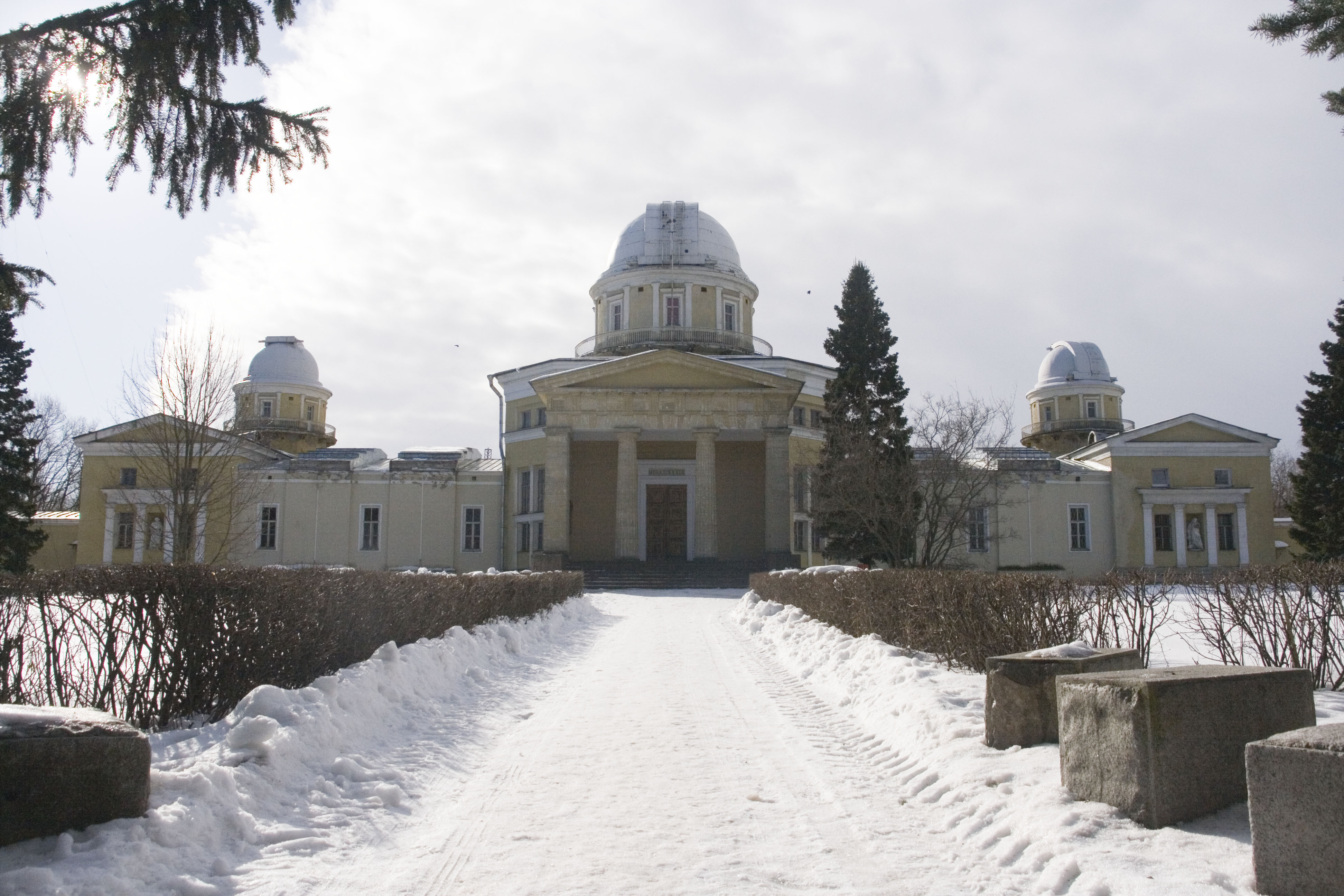
Figure. The observatory’s main building, rebuilt after the war, photographed in 2012. By Utopiya87. Source Wikimedia Commons. Licence CC BY-SA 3.0. Reproduced unchanged.

A national observatory on a hill#
The observatory stands on the Pulkovo Heights, about 19 km south of the city centre and around 75 m above sea level. Alexander Bryullov designed the main building under the direction of Friedrich Georg Wilhelm Struve, the first director. The new facility replaced an older observatory in St Petersburg. Its aims included observations for navigation and geodesy and the advancement of astronomy itself. It opened on 19 August 1839 in the Gregorian calendar, or 7 August according to the Julian calendar then used in Russia. 1 3
The Pulkovo meridian passes through the centre of the main building and was used as the reference for longitude on maps of the Russian Empire. Choosing a reference meridian is a convention distinct from measuring local time. Comparing the times at two places at the same instant gives their difference in longitude through the Earth’s rotation. Catalogues of star positions provided an observational reference and helped with navigation and mapmaking. 1 4
From the stars to clocks and from clocks to users#
The observatory’s time service determined clock errors from stellar observations, kept time between observations and communicated it to users. With a transit instrument aligned on the meridian, an observer watched selected stars cross a reference line in the field of view. The difference between the transit time predicted from a star’s position and the clock reading provided a correction to the clock. 2
The observatory’s history records early use of the large Struve–Ertel transit instrument, with Kessels pendulum clocks keeping time, followed later by Shortt free-pendulum clocks. The free-pendulum system limits interference from the drive with the pendulum that keeps time. The astronomical heritage inventory lists Dent, Riefler and Shortt astronomical pendulum clocks, a 1949 quartz clock and molecular frequency standards from 1962–1967. The inventory documents the holdings. Which instruments served as master clocks at any given time requires separate evidence. 2 1
Struve’s 1844 report on determining longitudes describes transferring the correction of a Hauth observing clock to a Kessels reference pendulum clock. The two clocks were compared in the morning and evening, at intervals of around 12 hours, by observing coincidences with a mean solar time chronometer. It is an example of transferring corrections through several timekeepers. 6
In 1863 a Muston clock in the observatory’s clock room sent time by wire to the St Petersburg central telegraph office. Its receiving clock was used to check clocks at other telegraph facilities. Time was subsequently distributed to sites including the public library and the Peter and Paul Fortress. At sea, ships had to carry chronometers to know the time at their reference meridian. Wireless signals changed how that time could reach them. 2 5
Wireless time signals and corrections#
In 1914 the difference in longitude between Pulkovo and Paris was measured by radio. Observers receiving the same signal at both sites could use it as a common instant and compare their clock readings. A signal’s actual transmission could differ from its scheduled time. From 1925 the Time Commission’s bulletin published retrospective estimates, based on observations, of the actual transmission times of domestic and foreign signals. Values from different time services could diverge because of systematic errors or differences between the clocks that kept time. In 1928 work began on calculating a combined estimate. 5
Sources differ on when scheduled broadcasts began. A 1972 historical paper published online by the metrology institute says the once-daily broadcast began on 1 December 1920 through the Novaya Gollandiya station in Petrograd, and that the Detskoye Selo station came into operation in 1923. The observatory’s own history dates broadcasts through Detskoye Selo to 1 January 1920. 2 5
Wartime destruction and reconstruction#
The observatory was destroyed in the Second World War, then rebuilt and reopened in 1954. According to the astronomical heritage record, the old main building was lost, but the large transit instrument and large vertical circle from the observatory’s opening were preserved. Before the war, Nikolai Pavlov introduced photoelectric recording of star transits to improve observational accuracy. The time service changed as its clocks, observing instruments and transmission equipment developed together. 1 2 4
A 2014 account by the Russian Academy of Sciences describes the observatory as a research institute active in astrometry, solar physics and radio astronomy, among other fields. It was inscribed in 1990 as part of the World Heritage site for the historic centre of St Petersburg and related monuments. Observations of time and latitude also helped researchers study the Earth’s rotation. Pulkovo’s horological history centres on the use of precision clocks in a network of observation and communication. 2 4
Timeline#
- 1839 — Pulkovo Observatory opens. Struve is its first director. 1 3
- 1840s–1920s — The Pulkovo meridian serves as the reference for longitude on maps of the empire. 4
- 1863 — Wired time transmission begins from the observatory clock to the central telegraph office. 2 5
- 1914 — Wireless signals are used to measure the difference in longitude between Pulkovo and Paris. 5
- 1920s — Scheduled wireless broadcasts and the work of the Time Commission begin. The commission’s bulletin publishes corrections from 1925. 5
- 1941–1945 — The observatory is destroyed during the war. 4
- 1954 — The observatory reopens after the war. 4
- 1990 — It becomes part of the World Heritage site “Historic Centre of Saint Petersburg and Related Groups of Monuments.” 4
References#
1. UNESCO and IAU, Central Astronomical Observatory at Pulkovo, Astronomical Heritage Portal, accessed 30 October 2026.
2. Пулковская обсерватория, История обсерватории, especially the section on time and latitude work, accessed 30 October 2026.
3. Steven J. Dick, Pulkovo Observatory and the National Observatory Movement: An Historical Overview, 1990, pp. 29–38, especially pp. 32–33, accessed 30 October 2026.
4. Российская академия наук, К 175-летию со дня открытия Пулковской обсерватории, 19 August 2014, accessed 30 October 2026.
5. D. Yu. Belotserkovsky and G. N. Paliy, Государственная служба времени и частоты СССР, published online by VNIIFTRI, section covering 1863–1928, accessed 30 October 2026.
6. F. G. W. Struve, Expédition chronométrique, 1844, p. 64, digitised ETH-Bibliothek copy, accessed 30 October 2026.